Live chat trends and insights from 50,000 consumers and 1000+ businesses
For instant support, customers opt for live chat but they're rarely satisfied. Live chat statistics show that most customer chat experiences end with frustration.
Businesses prefer speed, meaning quick connection times and even quicker responses. But here's the disconnect: consumers care more about getting their issue resolved, even if it takes a bit longer.
Businesses that prioritize customer satisfaction over live chat statistics like speed metrics will see huge benefits. Consumers are more likely to remain loyal, engage in positive word of mouth, and spend up to $500 extra per month with businesses that provide effortless live chat experiences.
95%
of customers value thorough, high-quality support more than speed.
52%
of consumers are more likely to remain loyal to a company that offers live chat support.
87%
of live chat interactions receive a positive CSAT rating.
Live chat earns a 73% satisfaction score, higher than 61% for email and 44% for phone. In fact, 73% of customers feel more comfortable with live chat than phone support.livechat
20%
of consumers have told friends or colleagues about a poor live chat experience.
29%
of consumers have told friends or colleagues about a positive live chat experience.
Consumers are more likely to tell their friends and colleagues about positive live chat experiences than negative ones. But still, a fifth of consumers have spread negative word of mouth based on a bad experience.
Looking at live chat statistics, it's clear that live chat, when done right, contributes to positive word of mouth, wins new customers and helps businesses grow. In fact, 40% of businesses plan to invest in live chat for customer support
of businesses say offering live chat has had a positive effect on sales, revenue, and customer loyalty. Businesses enjoy 10% higher average order value with live chat.
of consumers are more likely to buy from a company if they offer live chat support. In fact, online shoppers using live chat are 513% more likely to buy.
Customers value personal and instant means of interaction
Whether it’s by phone or live chat support, consumers want to speak to a real person. They aren’t happy to wait for a delayed reply. Consumers prefer live chat support
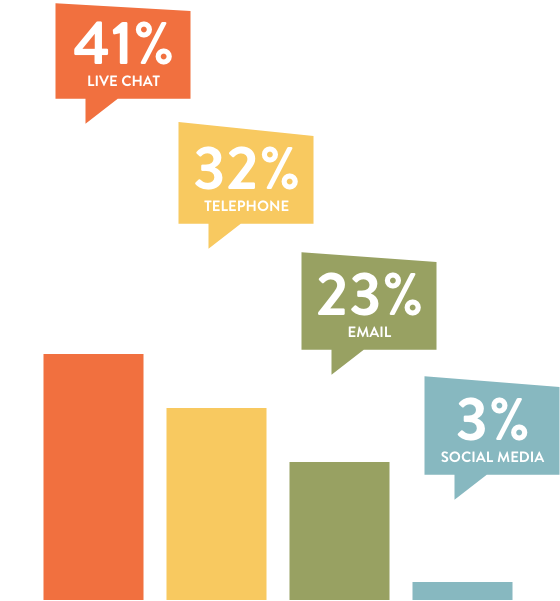
Despite the rise in popularity of businesses offering support through social media, live chat still reigns as consumers’ preferred support channel.
Live chat, in theory, offers them immediate help with minimal effort required.
Younger consumers particularly love live chat for the familiar user experience. It’s intuitive — like talking to friends via messaging apps.
Older consumers prefer traditional, offline channels like phone support over more modern methods.
Businesses may be overstaffing telephone support.
There’s an opportunity for businesses to improve customer satisfaction and reduce costs by routing more resources towards live chat and email support.
Typical frustrations include:
Support not being online despite live chat displaying as available
Being disconnected during a live chat
Effort required to start a live chat, particularly where there are pre-chat forms
38% of customers are most frustrated by poor user experience on live chat.
43% of businesses know their user experience is not good enough.
29% of consumers find scripted, impersonal responses the most frustrating.
38% of businesses say their users find their scripted responses most frustrating.
Support teams aren’t making customers feel like individuals. Canned responses, despite being predetermined, should still feel personal and human. Unfortunately, most businesses are not using them correctly.
Almost a fifth of customers rate long wait times as the most frustrating part of a live chat — they don’t want to be in a queue.
24% of consumers say long wait times are their biggest frustration.
19% of businesses say their customers are most frustrated by long wait times.
9% of consumers say having to repeat themselves is the most frustrating part of a live chat experience.
16% of businesses say their customers are most annoyed by having to repeat themselves.
Consumers want to be recognized. They want to know that a business sees them as an individual, not a ticket number. They don’t want to have to repeat themselves endlessly. But businesses are finding it difficult to ensure a consistent, unified approach to customer service that also feels personalized and proactive.
95% say they would prefer slower support if it meant the quality of help was higher.
Traditional wisdom assumes that consumers want instant support, but this isn’t necessarily true. 19 out of 20 consumers would rather receive slower-paced and personalized expert support over fast, low-quality support.
Live chat has a bad reputation. Consumers don’t expect high quality, speedy support. Their expectations for live chat are low, and yet, they still prefer it over phone, email, and social media support.
When starting a live chat conversation, 40% of consumers are not confident they’ll get the support they need in a reasonable amount of time.
This means businesses are making customers unhappy, losing revenue, spiking churn and adding extra strain on other channels for the support team.
Ask for customer satisfaction ratings and listen to their feedback.
Train your team to give canned replies a personal feeling by adapting templated content where necessary.
Modern live chat support needs to be as easy and effortless as messaging a friend.
Enable agents to meet customer expectations with personal, timely, and quality support.
Use the customer data you have available to deliver better customer service.
Provide friction-free customer service through live chat. Customers will be more likely to buy from you, and more likely to repurchase too.
We surveyed over 1000 US consumers, weighted according to US Census data. Our questions focused on live chat customer service, the overall experience consumers have with companies they do business with, and their current expectations.
We conducted a third-party online survey of 100 small/medium business owners and managers who use live chat on their website to talk with customers. Our questions focused on business priorities, their customers’ expectations, and how live chat performs for them.