Is AI replacing customer service jobs or just reshaping them? Explore how AI, hybrid models, and tools like Kayako are transforming support without eliminating the human touch.
It’s late evening. Your internet cuts out mid-meeting. You fire up a chatbot — and within 60 seconds, the issue is resolved. Feels like the future, right? Then one day, your bill is wrong, your account is locked, and you’re furious. The bot spins in circles. You get a human — and suddenly, everything makes sense.
That contrast? That’s the whole AI-in-customer-service debate in two scenarios.
There’s genuine anxiety around AI replacing customer service — from agents worried about their jobs to executives trying to figure out where to invest. And fair enough: the pace of change is real. But the answer isn’t a simple yes or no.
This guide cuts through the noise. We’ll cover AI’s real strengths and hard limits, the rise of hybrid support models, what’s actually happening with AI replacing customer service jobs, and the ethics your leadership team can’t afford to ignore. By the end, you’ll know exactly how to position AI as a growth engine — not an existential threat.
|
How AI Is Currently Used in Customer Service
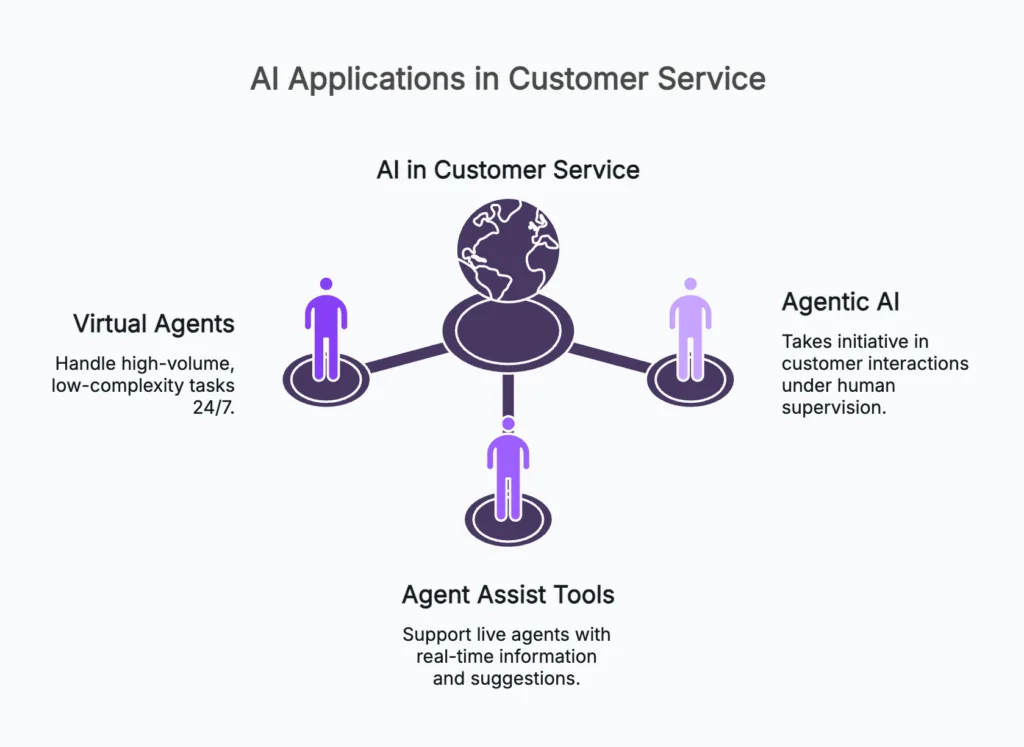
Forget science fiction. AI in customer service is already operational at scale — and it spans far more than a chatbot answering FAQs. Today’s AI footprint covers three distinct tiers of support:
1. Virtual Agents
Virtual agents handle the high-volume, low-complexity end of the queue: password resets, order tracking, account lookups, basic troubleshooting. Powered by natural language processing (NLP), they run 24/7 with zero fatigue. HSBC, for instance, uses AI to scan thousands of card transactions per second — approving or flagging suspicious activity in real time. That’s not just fast; that’s operationally transformative. Explore more examples of AI in customer service across industries.
2. Agent Assist Tools
While the agent is live with a customer, AI listens in real time — surfacing relevant knowledge base articles, suggesting responses, summarising the conversation, and automating CRM updates. The result? Agents look smarter, work faster, and stress less. Think of it as having your best senior agent whispering in your ear — for every interaction, every time.
3. Agentic AI
This is the frontier. Agentic AI doesn’t just respond — it takes initiative. Updating accounts, handling multi-step workflows, proactively reaching out. Still under human supervision, but increasingly autonomous. This is where the AI replacing customer service jobs debate gets loudest — and most misunderstood.
The stats are hard to ignore: 84% of businesses already deploy or plan to deploy chatbots, cutting wait times and boosting first-contact resolution by up to 20%. Customers love the availability. Finance teams love the cost savings. So why doesn’t AI just… take over? Because it has limits. Big ones.
How AI Is Reshaping Customer Service Right Now
Enough theory.
Let’s look at what’s actually happening on the ground — the companies that have gone all-in on AI, what they’ve gained, and in some cases, what they’ve had to walk back. These are the case studies worth knowing before you build your own strategy.
Klarna: The Boldest Bet — and the Most Instructive Pivot
In February 2024, Swedish fintech Klarna made headlines worldwide. Partnering with OpenAI, the company’s AI assistant handled 2.3 million customer service conversations in its first month alone — across 23 markets, in over 35 languages. According to Klarna’s own press release, the AI was doing the equivalent work of 700 full-time agents, matched human CSAT scores, and drove a 25% reduction in repeat inquiries. Resolution time dropped from 11 minutes to under 2 minutes. Projected profit improvement: $40 million in 2024. (Source: Klarna / OpenAI press release, February 2024)
Then came the pivot. By mid-2025, Klarna was actively recruiting human agents again — citing customer dissatisfaction with the all-AI approach. CEO Siemiatkowski told Bloomberg: “I just think it’s so critical that you are clear to your customer that there will always be a human if you want.” (Source: CX Dive, May 2025)
The AI still handles two-thirds of all chats — response times have improved 82% since launch and repeat issues are down 25%. But Klarna’s story is now the defining case study in why full replacement isn’t the goal. By late 2025, Klarna’s AI supports the equivalent of 800 full-time employees’ worth of work — with skilled humans still handling complex, emotional cases. (Source: CX Today, May 2025)
Bank of America: The Gold Standard for Hybrid AI
Launched in 2018, Bank of America’s Erica has now surpassed 3 billion client interactions, averaging 58 million interactions per month across nearly 50 million users. According to Bank of America’s official press release (August 2025), 98% of clients find what they need via Erica — and daily interactions save the equivalent of 11,000 staffers’ daily work.
BofA deliberately chose deterministic AI over generative AI for Erica — because in financial services, “we can’t afford to be 90% right.” (Source: CX Dive, August 2025). When Erica can’t help, it routes seamlessly to a human — no re-authentication, full context transferred. The result: customers are more satisfied with BofA’s mobile app than any other national bank, per J.D. Power.
Internally, Erica for Employees has reduced IT service desk calls by over 50%. In 2024, Merrill clients grew Erica usage by 13% year-over-year, logging a record 11.5 million interactions. (Source: Bank of America Newsroom, April & August 2025)
Vodafone: Deflecting 70% of Queries at Telecom Scale
Vodafone’s AI chatbot TOBi handles approximately 70% of all customer service queries — freeing human agents for complex issues, billing disputes, and escalations. And in May 2025, Vodafone and ServiceNow launched a five-year AI partnership to further transform global customer service — explicitly focused on eliminating repetitive tasks so agents can concentrate on SME clients and higher-complexity support. (Source: Cloud Wars, May 2025; JoinHGS, 2024)
H&M: AI That Sells, Not Just Serves
Most AI deployments in customer service are defensive — reducing cost, handling volume. H&M took a more aggressive angle: making AI a revenue driver. The global fashion retailer’s AI chatbot goes beyond order tracking and returns — it asks customers about style preferences and makes personalised product recommendations, connected directly to the live product catalogue. A support interaction becomes a sales conversation. This is the evolution most brands haven’t caught up to: moving from cost centre to revenue enabler. (Source: eesel AI, 2025)
The broader picture — by the numbers:
- 84% of businesses have deployed or plan to deploy AI chatbots — RingCentral 2025 AI Trends Report
- 75% of customer inquiries can now be resolved by AI tools without human intervention — Master of Code: AI in Customer Service Statistics, 2025
- Conversational AI reduces cost per contact by 23.5% and boosts annual revenue by 4% on average — IBM Institute for Business Value
- 80% of customer service organisations will use generative AI to improve agent productivity by end of 2025 — Gartner, August 2023
- 95% of enterprise AI pilots fail to deliver measurable business impact, despite $30–40B invested — MIT NANDA: The GenAI Divide, State of AI in Business 2025
The pattern across every successful deployment is the same: AI handles volume, speed, and routine; humans handle emotion, complexity, and judgment. The companies treating this as a binary choice — full replacement or nothing — are the ones that end up walking it back.
Where AI Shines — and Where It Stumbles
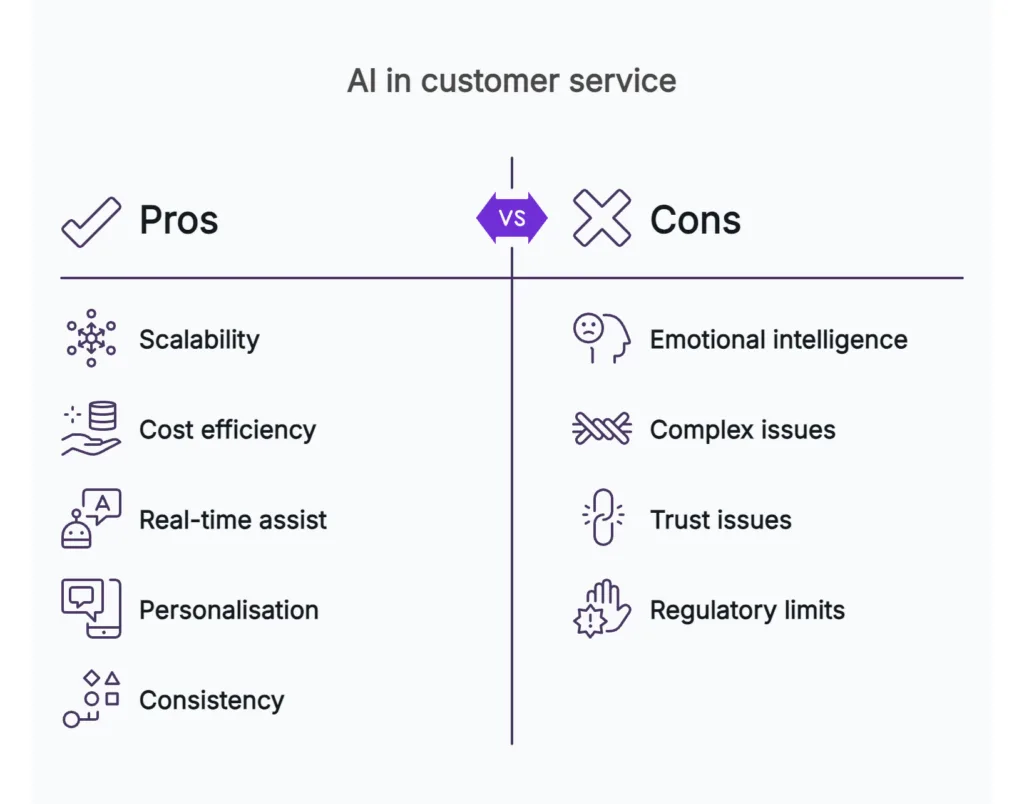
AI is genuinely exceptional at a specific set of tasks. Outside those tasks, it can actually damage your customer relationships. Here’s the honest scorecard:
Where AI Wins
- Scalability: Handles thousands of simultaneous interactions across web, mobile, and messaging — no break, no burnout.
- Cost efficiency: Automating repetitive interactions slashes cost-per-contact significantly, freeing human capacity for higher-value work.
- Real-time agent assist: Live suggestions and knowledge retrieval reduce average handle time and help junior agents perform like veterans.
- Personalisation at scale: AI sifts through customer history to deliver hyper-relevant responses and flag issues before customers even report them.
- Consistency: AI doesn’t have off days. Policy compliance and response quality stay stable across every interaction.
Where AI Falls Short
- Emotional intelligence: Frustrated customers don’t want a technically correct answer — they want to feel heard. AI can’t replicate genuine empathy.
- Complex, layered issues: Anything that requires judgement across multiple variables, context, or nuance tends to trip AI up — triggering escalations and customer frustration.
- Trust and transparency: Customers who feel deceived by undisclosed AI — or who don’t understand how their data is used — erode brand trust fast.
- Regulatory limits: Frameworks like the EU AI Act explicitly require human oversight in high-stakes decisions, limiting where full AI autonomy is even legal.
Bottom line: AI is a precision instrument, not a blunt replacement. Used right, it amplifies your team. Used wrong, it alienates your customers. This is exactly why hybrid support models have emerged as the dominant strategy — and why the question of is AI replacing customer service misses the real story.
|
Hybrid Support Models: The “Both/And” Revolution
Forget “Humans vs. AI.” The companies winning at customer experience right now are playing a completely different game. They’ve built hybrid support models — where AI handles volume, speed, and routine, and humans handle emotion, complexity, and judgment.
In practice, this looks like:
- Tiered query handling: AI owns the simple, high-frequency interactions solo. When escalation triggers — frustration detected, complexity threshold hit — it hands off to a human with full conversation context. No customer repeats themselves. No dropped context.
- Agent augmentation: Agents work alongside AI that surfaces answers, flags sentiment, and suggests next actions in real time. Agents feel supported. Customers get faster, sharper responses.
- Proactive AI: Rather than waiting for issues to surface, AI identifies risk signals — late deliveries, billing anomalies, usage drops — and triggers proactive outreach before frustration builds.
- Multilingual scale: AI handles language barriers efficiently and consistently; humans ensure nuance and quality for high-value or sensitive conversations.
Why does hybrid win? Because it:
- Cuts operational costs without sacrificing quality or empathy
- Reduces agent burnout by eliminating the tedious, repetitive work
- Handles demand surges without emergency hiring
- Creates a continuous feedback loop where human input improves AI accuracy over time
This isn’t theoretical.
It’s how modern AI customer service software operates today — and it’s the infrastructure behind every support team that’s successfully scaled without scaling headcount.
The Jobs Question: What’s Actually Happening to Customer Service Roles?
Here’s the part everyone’s nervous to say out loud: yes, some roles are changing. Entry-level, high-volume, repetitive work — the kind that used to fill large tier-1 support teams — is being automated. That’s real. AI replacing customer service jobs statistics show that automation is already compressing headcount in certain queue types, particularly after-hours and multilingual support.
But the fuller picture is more interesting:
What’s Going Away
- Repetitive tier-1 interactions: password resets, order status, FAQ responses
- Manual ticket classification and routing
- Data entry and CRM updates during/after calls
What’s Emerging
- AI supervisors and trainers: Someone has to oversee, correct, and continuously improve the AI models.
- CX strategists: Senior agents are evolving into experience designers — analysing AI outputs, identifying failure points, and engineering better customer journeys.
- Complex case specialists: The interactions AI can’t handle — emotionally charged, legally sensitive, multi-system — need highly skilled human agents who’ve been freed from the routine grind.
- Data and quality roles: AI generates enormous amounts of interaction data. Someone has to interpret it, act on it, and feed insights back into product and strategy.
The organisations navigating this well aren’t asking “how do we replace agents with AI?” They’re asking “how do we redeploy our best people to the work that actually requires them?” That reframe matters. Learn more about the future of AI in customer service and what smart operators are doing now.
|
Ethics, Trust, and Risk: The Guardrails You Can’t Skip
Customer service is intimate. It’s where people show up frustrated, confused, or vulnerable — with personal data, billing issues, health questions. That makes responsible AI deployment not just a legal obligation but a brand imperative.
The Non-Negotiables
- Transparency: Customers must know when they’re talking to AI. Non-disclosure isn’t just unethical — in many jurisdictions, it’s illegal. The EU AI Act is explicit on this.
- Data privacy: AI ingests sensitive customer data. GDPR and similar frameworks aren’t optional extras — violations destroy trust and invite serious legal exposure.
- Bias and fairness: AI trained on skewed historical data can systematically underserve certain customer groups. Regular audits aren’t optional; they’re operational hygiene.
- Human oversight: For consequential decisions — account closures, escalations, sensitive case handling — a human must be in the loop. Full AI autonomy in these areas isn’t just risky; under EU AI Act provisions, it’s restricted.
- Inclusivity: Diverse customers bring diverse needs. AI that doesn’t account for language variation, accessibility requirements, or cultural nuance will consistently fail segments of your base.
Trust is earned through consistency, transparency, and recovery. One viral AI failure — a bot giving wrong medical advice, mishandling a billing dispute, or appearing deceptive — can undo years of brand equity. The risk isn’t just operational. It’s reputational. For deeper context, explore AI hallucinations and customer experience risk — a critical read for any team deploying AI in production.
The Economics: What the Numbers Actually Say
Let’s talk ROI — because ultimately, every AI deployment decision is a financial one. And the economics are compelling, when you do it right.
- Cost per interaction: Human-handled contacts average €4–6 each. AI-automated interactions cost a fraction of that. For high-volume operations, the savings compound fast.
- Non-linear scaling: AI lets you absorb demand spikes — seasonal surges, product launches, crises — without proportional headcount increases. That’s a structural cost advantage.
- Labour optimisation: Hybrid models let businesses segment smartly: AI for standard users, human agents for premium or complex customers. You’re optimising value delivery, not just cutting costs.
- Upfront investment reality: Software, training, change management, and integration all cost real money. The payback horizon matters — and rushing implementation to hit a cost target is one of the most common AI deployment mistakes.
The hidden ROI of customer support automation goes beyond ticket deflection — it includes agent retention, CSAT uplift, and the revenue impact of resolving issues faster. For a full breakdown of where support cost reduction pays off most, see our guide on how to reduce customer service costs.
|
How Kayako Solves the AI-Human Balance Problem
Most help desk software gives you AI or humans. Kayako gives you both — working together, intelligently. It’s built for the reality that the AI debate has already settled: the future is hybrid, and the future is now.
Here’s what that looks like in practice:
AI Automation That Actually Works
Kayako’s AI handles incoming ticket classification, routing, and initial responses automatically — deflecting the repetitive volume before it ever reaches your agents. For teams drowning in tier-1 queries, this is immediate, measurable relief. Explore how automated customer support works without cutting corners on quality.
SingleView™ — Context That Changes Everything
When AI does escalate to a human agent, Kayako’s SingleView™ ensures the agent has full customer context — every previous interaction, ticket history, product usage, and sentiment signals — in one unified view. No more asking the customer to repeat themselves. No more agents flying blind. Every agent performs like your best agent.
AI-Suggested Responses
Kayako’s AI-suggested responses surface relevant answers and KB articles in real time as agents type — reducing average handle time, improving consistency, and accelerating onboarding for new team members. The agent always has final approval. AI assists; humans decide.
Proactive Engagement Engine
Kayako doesn’t just react — it anticipates. The platform identifies risk signals in customer behaviour and triggers proactive outreach before frustration becomes a ticket. This is the shift from reactive to proactive support that reduces churn and builds loyalty.
Analytics That Drive Strategy
Help Center Analytics and interaction data surface emerging trends, content gaps, and performance patterns across your entire support operation. Your leadership team gets the strategic insights needed to continuously improve — not just anecdotal feedback from individual tickets. See how measuring AI’s impact on customer success drives smarter decisions.
Built for the Hybrid Model
Kayako’s architecture is designed around the hybrid reality: AI for scale, humans for impact. The 90-Day AI Agent Pilot programme lets teams deploy AI against one support queue at a time — with clear KPIs, professional services support, and a measured path to full deployment. Scale your customer support without scaling headcount.
Whether you’re asking “is AI replacing customer service?” or “how do I use AI without losing what makes my support team great?” — Kayako is built to answer both. Explore why Kayako is the best helpdesk solution for AI-first support teams.
|
The Future: What Smart Operators Are Building Now
The question isn’t whether AI will reshape customer service. It already has. The question is whether your organisation is building the infrastructure to benefit from that shift — or scrambling to catch up after your competitors already have.
Tomorrow’s CX leaders are:
- Using AI analytics to continuously optimise both agent and customer experience
- Expanding self-service with seamless escalation paths for complex issues
- Investing in team upskilling — AI fluency and emotional intelligence, together
- Tying AI deployment firmly to brand values and customer-centric metrics
- Prioritising data governance for privacy, security, and regulatory compliance
- Communicating AI’s role transparently to maintain and build customer trust
The companies building this infrastructure now are creating a durable competitive advantage. The ones still debating the premise are falling behind. Keep up with the latest customer service trends shaping what effective AI-human support looks like in 2025 and beyond.
Conclusion: Not Replacement — Reinvention
So: will AI replace human customer service agents? The honest answer is: some roles, partially, already. But that’s not the story that matters.
The story that matters is that AI is creating a better version of customer service — one where routine queries are resolved instantly, agents focus on work that actually requires human judgement, and customers get faster, more personalised support across every channel.
The risk isn’t AI replacing your team. The risk is deploying AI badly — without the right guardrails, without the right tools, without the right strategy. That’s what erodes trust, alienates customers, and actually does damage the team.
Done right — with the right best helpdesk software, clear hybrid model design, and genuine investment in both AI and people — this is the most significant CX opportunity your organisation will see this decade.
|