
Explore what customer enablement is, why it matters, and how to build strategies that empower customers with the right tools, resources, and support for success.
You must have come across numerous social media posts on how brands have evolved with the times and changed the very definition of customer experience.
On how customer stores are rechristened as “Customer Experience Center”, and how customer empowerment is not just optional, but a particular cog that guarantees a loyal user base.

The modern relation between a brand and a customer isn’t just limited to conversion; it now extends to empowering users with tools and education, which makes them feel more like stakeholders, contributing actively towards a brand’s success.
With 91% business buyers saying that customer experience is as necessary as their product or services, customer enablement ensures that this notion comes to fruition.
This is achieved not only by focusing on solving a problem, but also by proactively helping users achieve their desired outcomes.
In the course of this blog, we are going to cover some essential pointers that will put the spotlight on the definition, the importance of the concept, some real-world examples with tools that can help you realize a loyal user base, but most importantly, help you understand how customer enablement is the next natural step to customer experience.
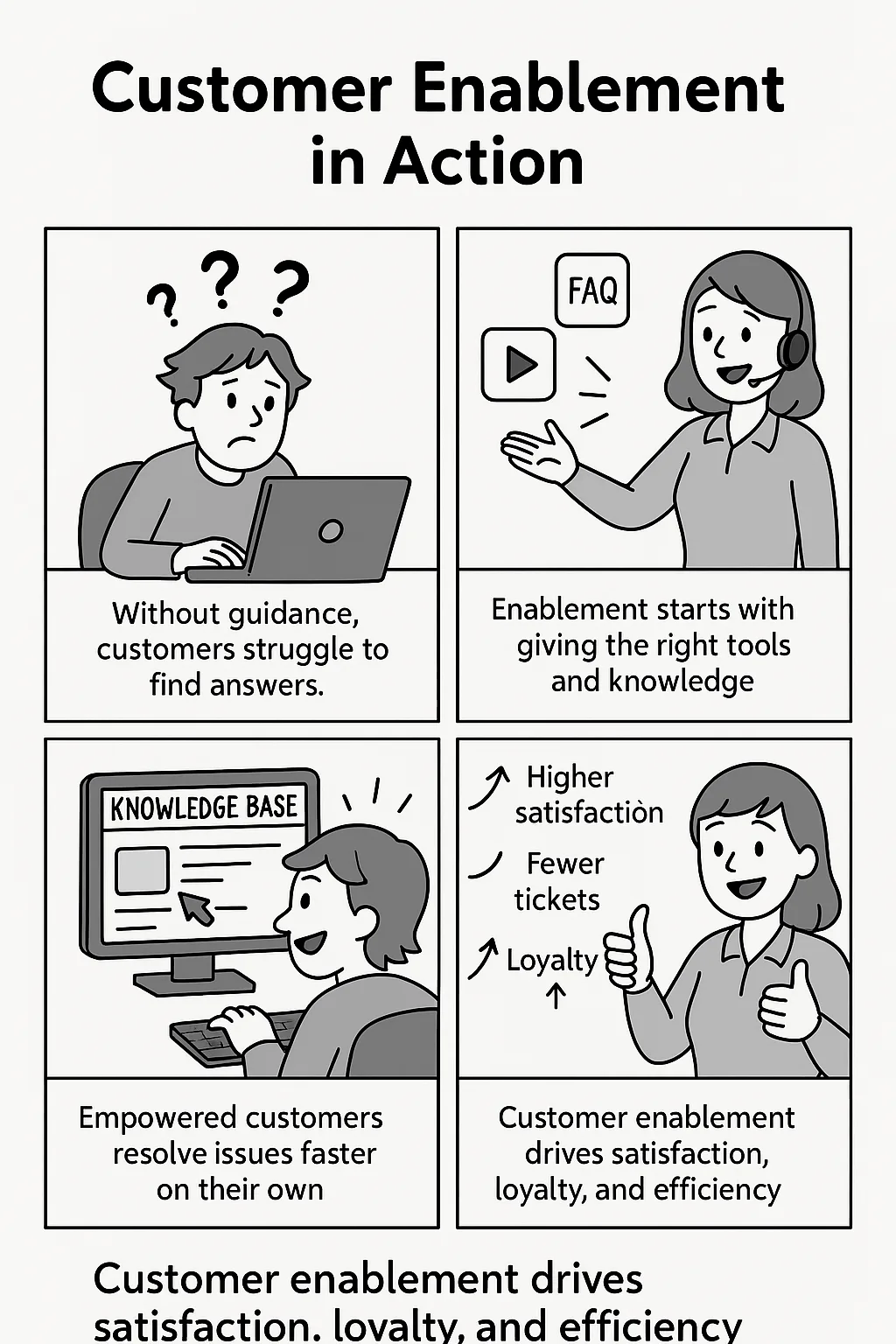
What is Customer Enablement?
While it is easy to get confused with customer experience, customer enablement is an entirely distinct concept.
It is defined as equipping customers with the required tools, knowledge base, resources, and other support that helps them make the most out of products and services.
As we mentioned earlier, it differs slightly from the customer support experience, as it focuses on improving overall outcomes when using a product.
In support services, the methodology is usually much more reactive compared to here, where the company plans resources to help users proactively.
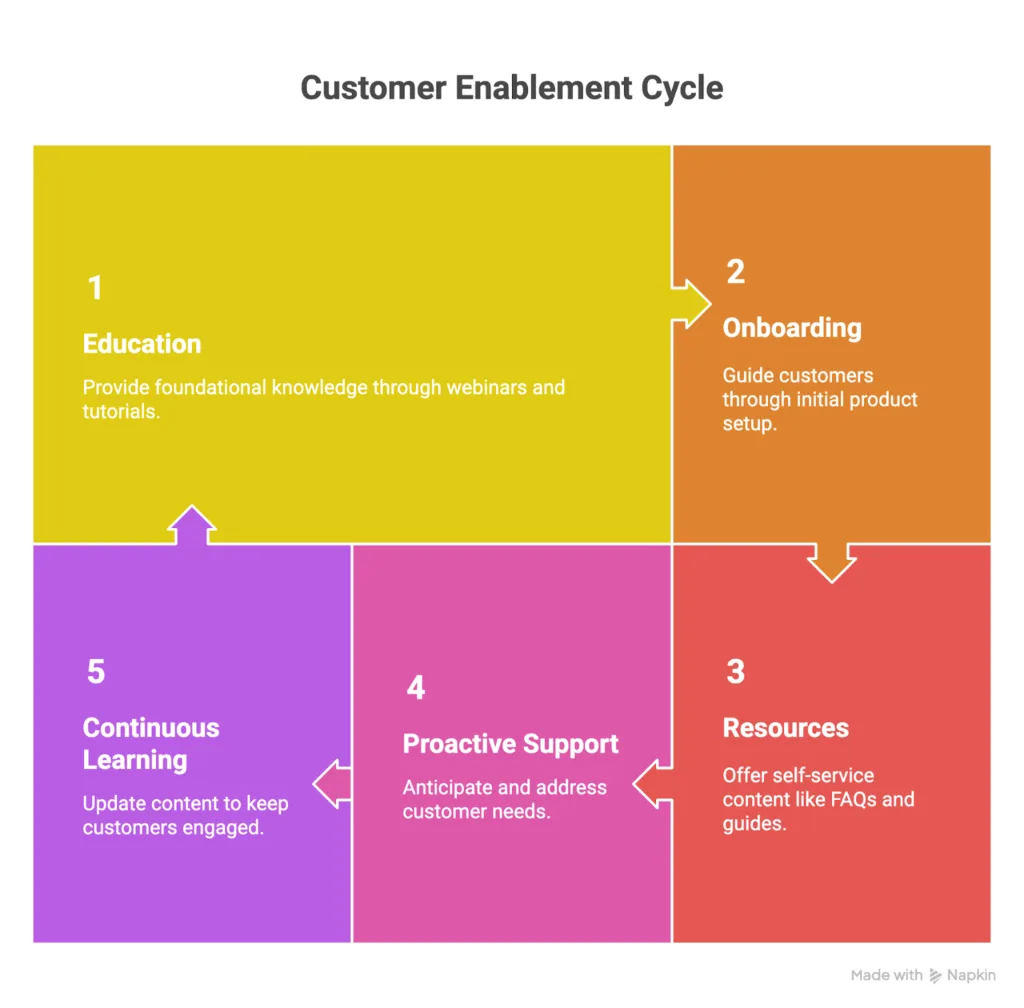
Some of the key components that are included in customer enablement are.
- Education: The step deals with providing customers with knowledge in the form of webinars, workshops, and tutorials. It serves as a foundational step in establishing a clear understanding of how to use your services/ products.
- Onboarding: The subsequent step where you introduce your product through guided setups, demos, or walkthrough videos. The objective of this step is to reduce initial hesitancy towards a product and get more time-to-value.
- Resources: The following strategy for learning is to provide self-service content like FAQs, knowledge bases, documentation, and video guides. Customers can bookmark these resources with confidence, knowing they will always find the answers they need.
- Proactive Support: This facet can help your brand set itself apart from competitors. Knowing what your users want (helpful tips, information about updates, social feed, public form, etc.) actively showcases to customers that you care about them. All this contributes immensely to improving trust and retention.
- Continuous Learning: Ensure to keep adding new material for users to read, and try out options for themselves. It helps keep customers engaged and more active with your brand while upskilling them simultaneously.
Why Customer Enablement Matters in 2025?
61% of users want to solve their product issues on their own.
The statistic above is enough to prompt companies to reevaluate the very definition of providing the ultimate customer experience, which goes beyond just speaking with a representative.
Customers with time have evolved, and with technology acting as a catalyst, the modern customers are hyper-aware about their rights and needs, and expect the same level of transparency from their brands as well.
It’s a non-negotiable pact that customers reward you for.
Here’s another stat to concur it.
94% of users remain loyal to a brand that is transparent, with 73% even willing to pay more for companies that associate themselves with this virtue.
And if you’re wondering how employing a customer enablement benefits your company, here’s a small checklist.
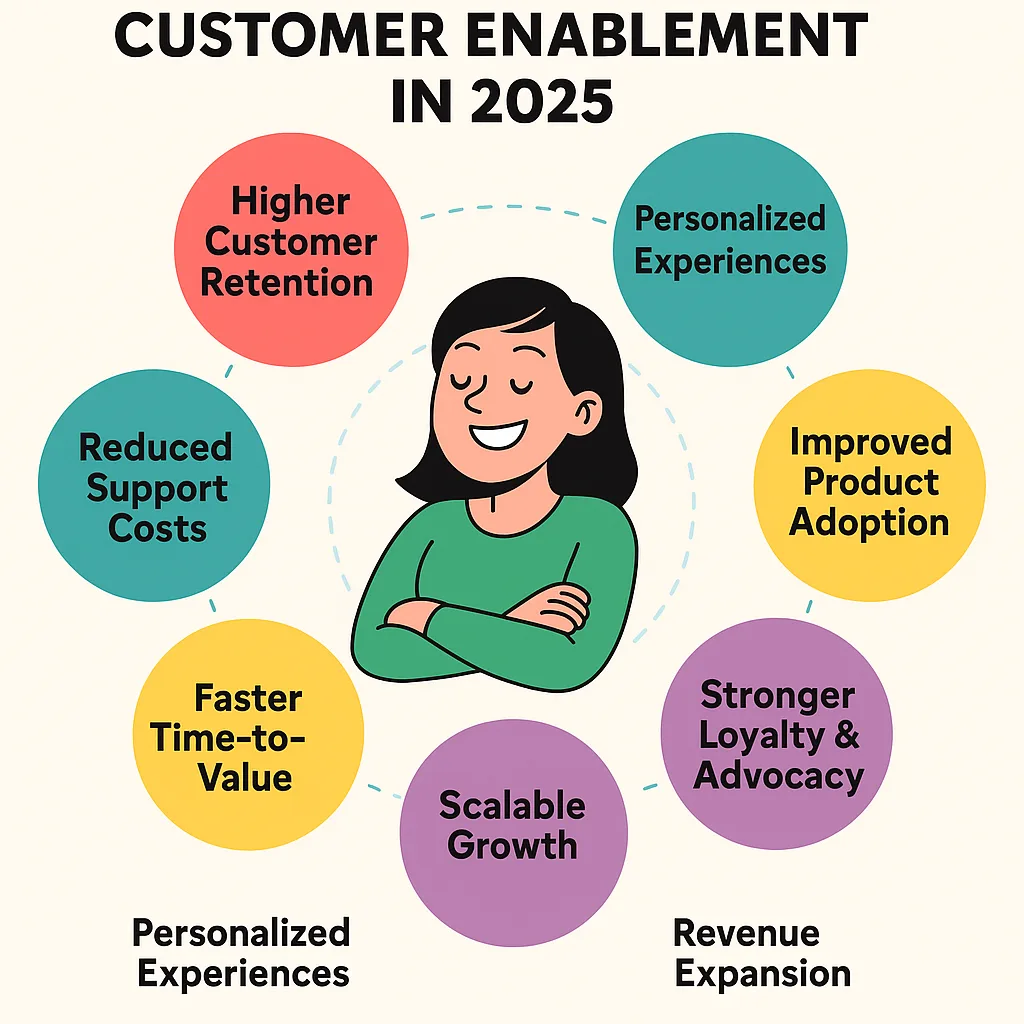
- Higher retention & loyalty: A user’s bond to the company is sacred, so much so that if a company provides what its marketing promises, it ends with a higher retention rate and brand loyalists.
It also contributes to revenue as it becomes 60%-70% easier to upsell to your existing user base compared to the new ones. - Reduced support tickets and operational costs: And, it’s not just brand imagery that gets worked upon; your agents get to work on complex issues as customer enablement material takes care of the generic queries.
- Faster adoption and time-to-value: Your consumers get faster onboarding with a product, allowing them to make the most of the product or service from the get-go.
- Stronger brand advocacy: As hinted in the first point, once a brand delivers on what it promises, the users become its most prominent advocates.
With word-of-mouth marketing influencing almost 32% of the new user base, it is safe to say that investment in customer enablement secures a positive revenue timeline.
Key Pillars of a Strong Customer Enablement Strategy
A framework for an all-season customer enablement process involves being an active listener to your customers’ feedback and anticipating what can make their lives easier.
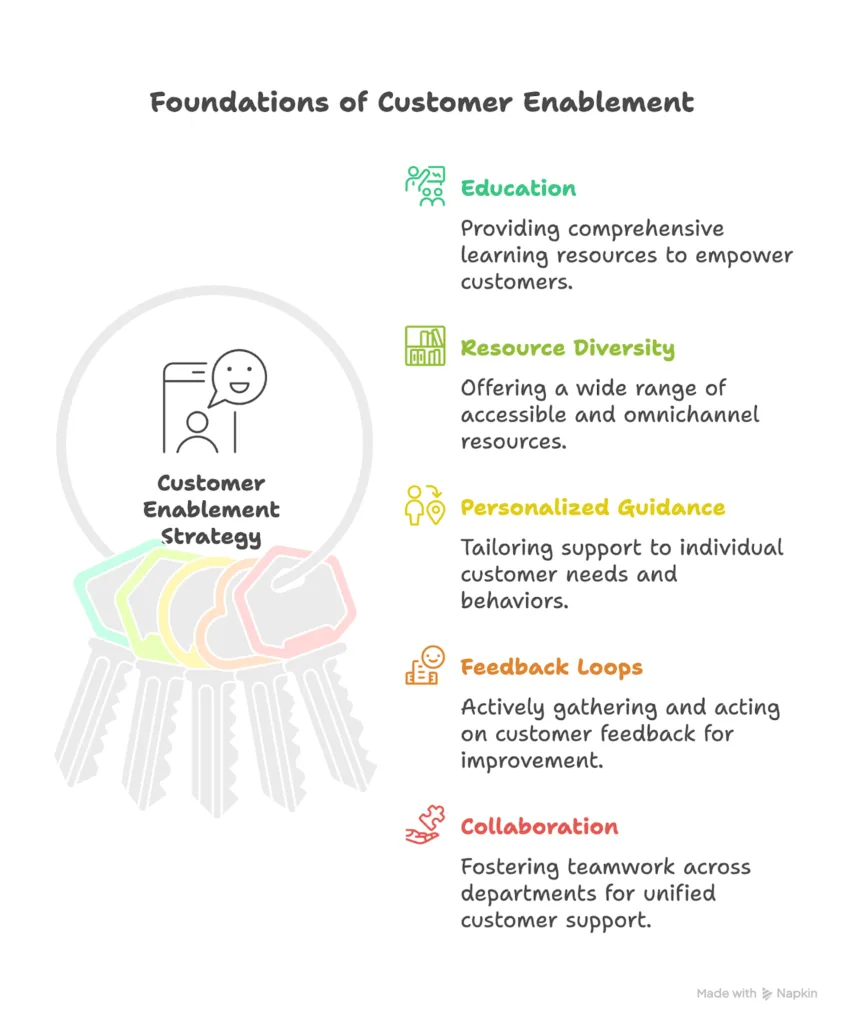
We list out the critical pillars that embody the perfect representation of customer service enablement workings.
- Education: Imparting information about your product is one thing, but to create an ecosystem where learning becomes the primary objective is what satisfies the customers. This is covered in the form of use cases, hacks to get the best out of a product, and more.
One of the most loved forms of education nowadays is community webinars, where experts engage in live chat sessions/customer forums responding to users’ queries.
- Diversify Resources: Your resources should be in many forms and channels, covering a knowledge base, FAQs, video libraries, and community forums.
Also, ensure that all your content is omnichannel-ready, easily accessible from mobile devices, desktops, iPads, and other devices.
- Personalized Guidance: Based on the customer’s journey and product usage behaviour, you can help them with regular information about relevant tips, reminders, and how-tos based on product usage behavior.
- Feedback Loops: Brands listening to customer feedback and acting on it is an essential trait, with 79% of consumers expecting the same. Through surveys, check-ins, and in some cases, beta testing, companies can improve their enablement materials and overall experience.
- Collaboration: Customer enablement, just like any other function, requires cross-functional collaboration.
From sales to marketing, making clients know about new information, to CX agents telling users about the updated knowledge base, the end success is a culmination of collective effort.
What are the best practices for customer enablement strategies?
To ensure that your process is thorough and on point with your customers’ needs, here’s what you should keep in mind:
- Map the Customer Journey: When you are aware of the entire user journey, from onboarding, adoption, and user review, you are in a much more solid position to deliver enablement resources that contain exactly what the users are looking for.
- Build Multi-Format Learning: Your repository should combine docs, videos, webinars, and microlearning modules, as you never know which form of education is most preferred by your target group.
- Empower Support Teams: It’s always a good idea to ensure that your customer service team is more than just its title. Your agents should be empowered to delve deeply into a product’s workings, enabling them to effectively assist users with their queries and various problem statements.
- Automate With Human Touch: While a chatbot can handle generic information requests, a human’s empathy can unlock much more rewarding responses, which helps keep a customer engaged.
- Measure What Matters: Find out whether the effort that you are making is yielding the desired result. Keep track of new user rates, feature usage, repository session usage, NPS, and retention metrics to help you gain a complete understanding of your investment.
- Involve a Customer Enablement Specialist: While it’s exciting to try and test your way to success, the reality is that your competitors are catching up with you big time. So, it’s wise to utilize the expertise of a specialist who can align what’s working for you and what isn’t seamlessly.

Which tools and platforms can help with customer enablement?
For your brand to be recognized as a prominent player that empowers its customers, the tools employed make a world of difference.
- Knowledge Base & Self-Service
We have already highlighted how important it is for a business to have a knowledge base for its users.
With platforms like Zendesk, Helpjuice, and Intercom Articles, businesses can build rich self-service portals, FAQs, and help centers that aid customer service teams in reducing ticket volumes while empowering customers to find answers 24/7.
All this contributes to improving satisfaction by putting information at their fingertips.
- Learning Platforms
For an extra layer of learning, consider platforms like Skilljar, Docebo, and LearnUpon, which can help brands create structured onboarding programs, product training modules, and, in some cases, certification courses for a more technically inclined user base.
All these efforts are considered ideal for scaling customer success enablement efforts, ensuring customers understand how to get maximum value from your product or service, while also building a closer bond with your brand.
- In-Product Guidance
Customers appreciate it when a tool comes built-in with walkthrough capabilities. Effort like these assures them that the brand cares about them.
Tools like WalkMe, Pendo, and Appcues enable the provision of contextual, real-time product walkthroughs and tips directly within the platform.
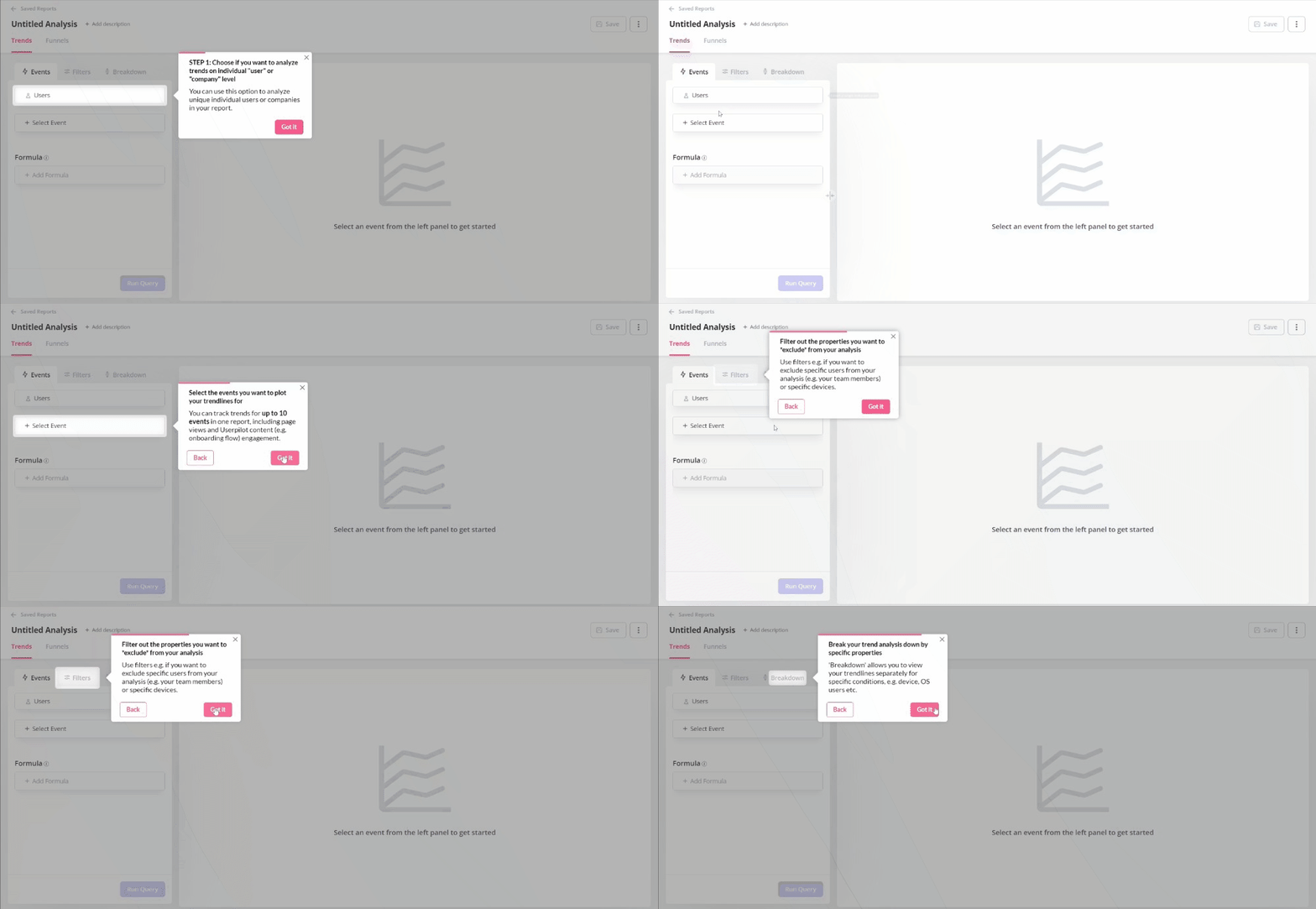
One of the best examples of this is when a customer is in the midst of setting up a new phone or software on their desktop, and an installation assistant pops up.
Such a “just-in-time” learning approach enhances the usage of new products with fewer hiccups and reduces the time-to-value for customers.
- CRM & Personalization
Finally, it comes to the customer service leg of enablement.
When you have platforms like Salesforce and HubSpot, integrating customer data to deliver personalized experiences helps achieve higher user satisfaction metrics.
This is achieved through tailored communication, tracking engagement, and proactively offering support based on their current session and historical behavior.
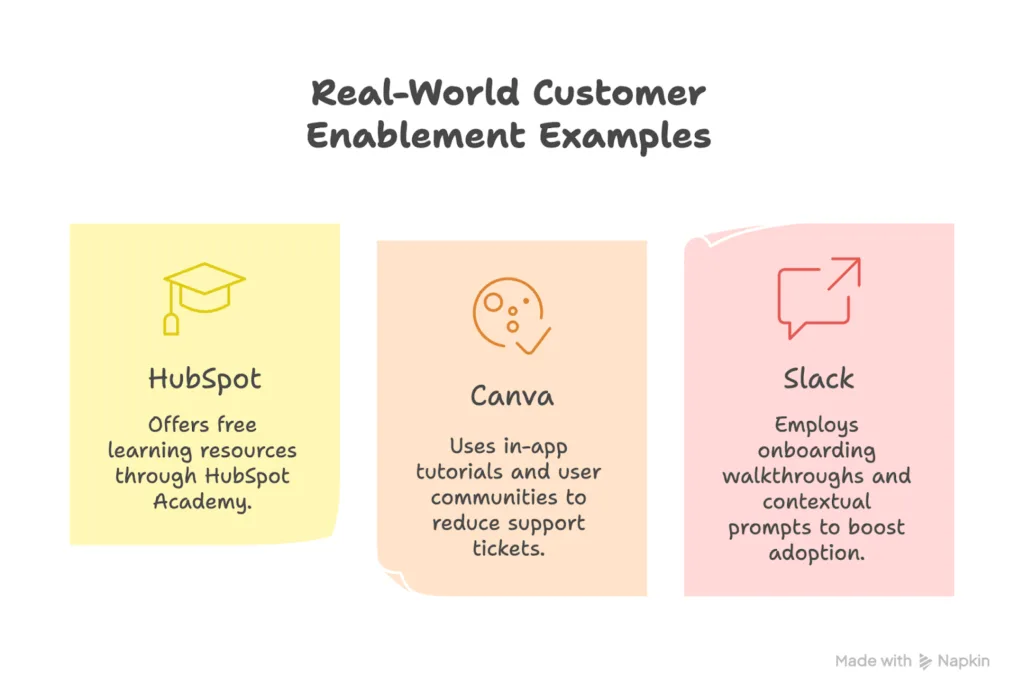
How to measure the impact of Customer Enablement?
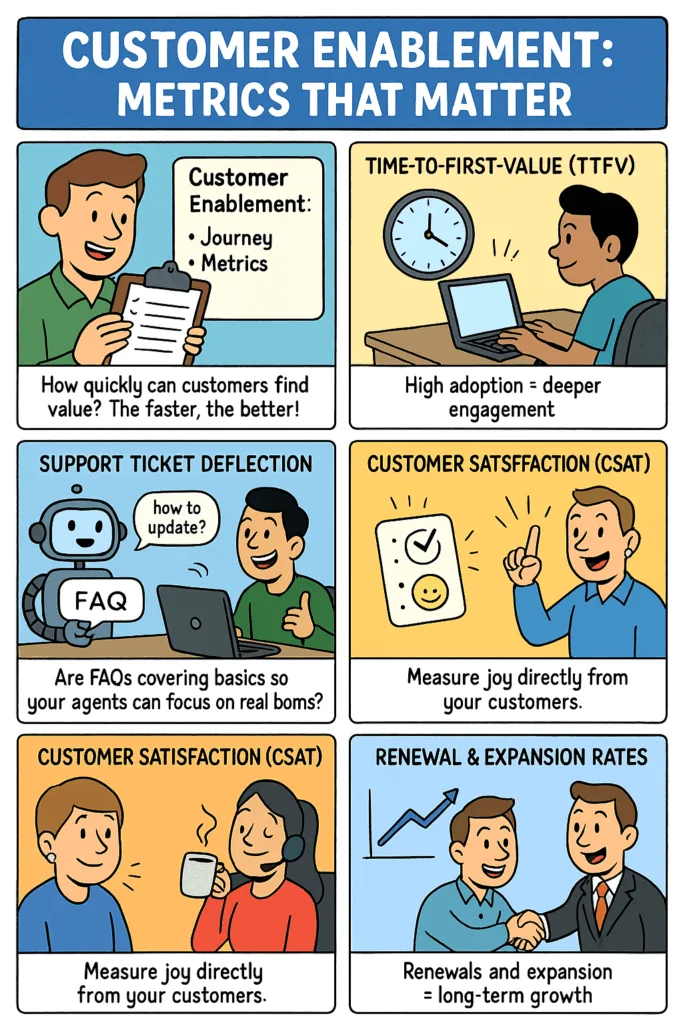
Just like any other faction, there are a few metrics that determine the success or improvement factors of a process. For customer enablement, these are the ones that you need to keep a close check on:
- Time-to-first-value (TTFV): It simply stands for how quickly your customers can get their work done on your product from the point of purchase. The shorter the TFFV, the stronger your enablement content is.
- Feature adoption rates: The metrics cover how well users have explored the features of the software. A higher adoption rate indicates greater engagement with the software.
- Support ticket deflection: Are the general queries easily getting covered with your self-help options? If the answer is no and your agents are already overwhelmed with basic queries, some revamping is in order.
- Customer satisfaction (CSAT): Find out from the consumers themselves if they are enjoying everything that you are providing them, from services to enablement material. Run surveys and conduct one-on-one sessions, if possible.
- Net Promoter Score (NPS): NPS points to how often customers recommend your product.
- Renewal and expansion rates: Much of the company’s revenues depend on upselling to customers or through renewals or AMC of their services. If your ticket size promises multiple renewals, it’s safe to say your business is doing well.
Consider customer enablement as a superhero power that does wonders for one’s own brand. When you uplift your users with knowledge, they reward you by being the most prominent advocate for your services.
Not only will it improve your standing in the market, but it will also mark you as a company that treats its consumer base as stakeholders who deserve every bit of transparency.
From a business perspective, your company will notice a significant increase in revenue and will see itself scaling up with its customers.
However, the most important thing to remember is that the customer enablement strategy is not just a one-off process; it’s a continuous cycle that benefits everyone.
Ensure that you continuously update your resources and reach out to readers with any updates. Be upfront about launches or new reading material so that your customers can engage with your brand like a family.
Chat, email, knowledge base, automations—together.
Rest assured that your business will certainly scale new heights from the moment your customers are enabled with relevant knowledge.
FAQs
1. What is customer enablement, and why is it important?
As a strategic process that involves equipping customers with the necessary tools, resources, knowledge, and support when using a product or service, customer enablement’s primary purpose is to foster a closer bond between the customer and the product’s functionality.
The most notable customer enablement materials include self-service content, training programs, and personalized guidance, all designed to help users realize value faster.
All this enhances customer satisfaction scores, fosters trust, and strengthens long-term relationships while reducing load on agents, improving ROI, and customer retention.
2. How does customer enablement differ from customer success enablement?
While customer enablement focuses on strengthening a user’s knowledge of a product, service, or usage, customer success enablement is more focused on empowering agents’ strategies, training, and insights to proactively assist customers with their queries.
3. What are the best practices for customer service enablement?
Here are some of the best practices for customer service enablement:
- Building a comprehensive knowledge base and self-service portal.
- Guided onboarding and interactive product tours.
- Making resources available on multichannel support options (chat, email, phone, in-product).
- Continuously updating content based on customer feedback.
- Upskill agents proactively