Your best hire just signed the offer.
What happens next decides whether they stay or leave within 90 days.
The employee onboarding process is often treated as an administrative formality: send the paperwork, get the details, issue the ID card, set up the laptop, done.
But that approach is expensive.
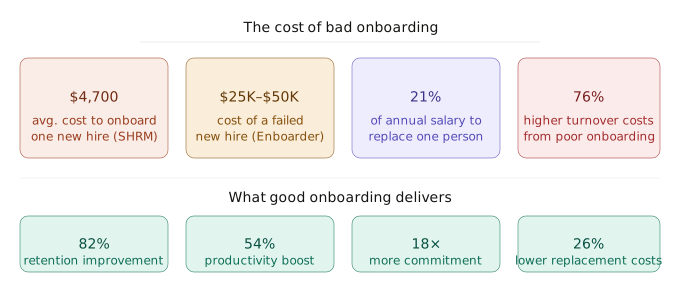
According to SHRM, the average cost to onboard a new hire is $4,700, and replacing one who leaves within a year costs 21% of their annual salary. Poor onboarding doubles the likelihood of early departure.
This guide covers what employee onboarding is, why it matters, the key steps, a checklist, best practices, and the tools that make it work. Looking for the customer side of the equation? See our guide on the customer onboarding process — the principles overlap more than you’d think.
What Is the Employee Onboarding Process?
Employee onboarding is the structured process of integrating new hires into an organization — covering everything from paperwork and system access to role clarity, cultural immersion, and team relationships. It starts before the first day (preboarding) and, when done well, continues for the employee’s first 90 days to 12 months.
It’s important not to confuse orientation with onboarding. Orientation is a single-day event. Onboarding is a full integration strategy. 43% of companies complete onboarding in a single day, which, according to research from FirstHR, is one of the most common mistakes organizations make.
A proper new employee onboarding process drives 69% higher 3-year retention (SHRM), boosts new hire productivity by 54% (Workplace Insights), and makes employees 18x more committed to their employer. Companies with structured onboarding also reduce replacement costs by 26% (Workplace Economics).
Why Is Employee Onboarding Important?
The numbers are blunt: only 12% of employees say their company does onboarding well. That’s from a study reviewed by Devlin Peck. The 88% who report a poor experience? Many of them don’t stick around.
Here are some more numbers that just get your attention:
1) Poor onboarding leads to 76% higher turnover costs in the first year (LinkedIn Talent Solutions, 2025).
2) Companies using AI for onboarding saw a 50% improvement in time-to-productivity (Gartner, 2025).
3) Diverse hires with inclusive onboarding are 70% more likely to feel welcomed (HR Dive, 2025).
4) And a failed new hire costs HR directors an estimated $25,000 to $50,000 (Enboarder, 2025).
Bad onboarding is expensive. Good onboarding is a competitive advantage.
Key Steps in the Employee Onboarding Process
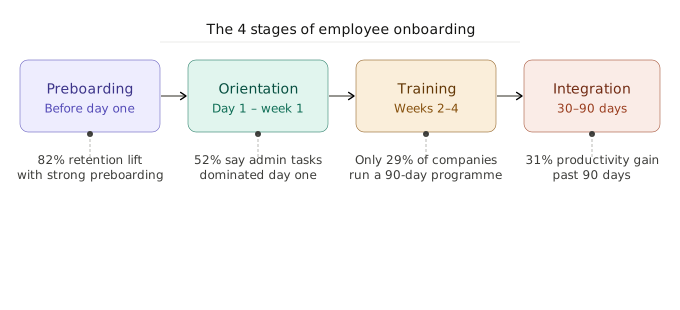
A well-structured new employee onboarding process runs across four stages:
Stage 1: Preboarding (Before Day One)
Handle paperwork, IT setup, and welcome communications before the first day.
A strong preboarding process can improve new hire retention by 82% (hibob, 2025). Send credentials, share the first-week schedule, and assign a buddy before they walk in the door.
Stage 2: Orientation (Day One to Week One)
Day one should feel like a welcome, not a paperwork pile-up. Cover workspace setup, team introductions, and company culture. 52% of employees say administrative tasks dominated their onboarding (TalentLMS & BambooHR, 2025). So be sure to distribute that load across preboarding instead.
Stage 3: Role-Specific Training (Weeks 2–4)
Now the real work starts. Role-specific employee onboarding training, one-on-ones with the manager, and goal-setting for the first 30-60-90 days. Only 29% of companies run a structured 90-day program (BambooHR, 2025). If you do, you’re already ahead of the majority in keeping the best talent for yourself.
Stage 4: Full Integration (30–90 Days)
Performance milestones, feedback loops, and cultural belonging checks. Organizations that extend onboarding past 90 days see new hire productivity accelerate by 31%, yet only 11% of employers run programmes longer than three months. When integration is complete, make sure your employee offboarding best practices are just as structured — the full lifecycle matters.
New Employee Onboarding Checklist
Here’s a practical new employee onboarding checklist to adapt for your team:
Before Day One
- Send a welcome email and offer confirmation
- Complete digital paperwork (contracts, tax forms, direct deposit)
- Set up workstation, email, Slack, and HRIS credentials
- Share the first-week schedule and assign a buddy
Day One to Week One
- Welcome meeting, workspace tour, team introductions
- Benefits enrolment and access to internal tools
- Company values, culture, and HR policy briefing
First 30–90 Days
- Weekly one-on-ones with the manager
- Employee onboarding training sessions and knowledge base access
- 30, 60, and 90-day milestone reviews
- New hire feedback survey at 90 days
Employee Onboarding Best Practices
What separates companies with great onboarding from those with forgettable ones? These employee onboarding best practices come up consistently in the data:
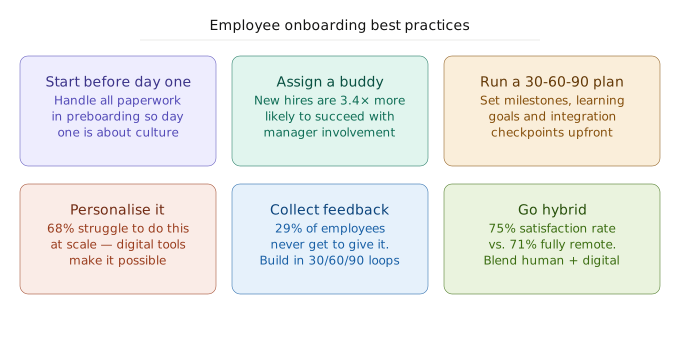
- Start before day one. Use preboarding to handle paperwork so day one can focus entirely on culture and connection.
- Assign a buddy. New hires are 3.4x more likely to rate onboarding as successful when their manager is actively involved. A peer buddy extends that support system.
- Run a 30-60-90 day plan. Set clear milestones, learning outcomes, and team integration checkpoints from the start.
- Personalize the experience. A sales hire and an engineer need very different journeys. Make sure that you are covering the nuances of each domain instead of generalizing it.
- Collect feedback. 29% of employees never get to provide onboarding feedback (TalentLMS & BambooHR, 2025). Build in touchpoints at 30, 60, and 90 days.
- Go hybrid. 75% satisfaction for hybrid onboarding vs. 71% for fully remote (TalentLMS & BambooHR, 2025). Blend the warmth of in-person with the efficiency of digital.
How to Automate Your Employee Onboarding Process
Employee onboarding automation removes the administrative drag that buries HR teams. Companies save around $18,000 annually through AI onboarding (iTacit), and HR saves an average of 4.5 hours a week on routine questions. The same principles behind helpdesk automation apply here: eliminate the repetitive, protect the human.
Here’s what automated employee onboarding software handles:
- Document collection and e-signatures: no more chasing paperwork across email threads.
- Automated account provisioning: Texans Credit Union cut system access setup from 15–20 minutes to under one minute using RPA.
- Compliance training assignment: Triggered automatically based on role, location, and seniority.
- AI chatbots for 24/7 new hire support: policy questions, benefit enrolment, IT setup – all basics answered instantly.
Hitachi cut onboarding duration by four days and reduced HR time per hire from 20 hours to just 12 using AI assistance. For a broader view of how AI in customer service is reshaping support workflows, the parallels are direct. Employee onboarding automation doesn’t remove the human element, it just frees your team to bring more of it.
Top Employee Onboarding Software in 2025
Choosing the right employee onboarding platform depends on your team size, complexity, and budget. Here are five consistently top-rated employee onboarding solutions based on G2 reviews and user testimonials:
1. BambooHR
Best for: Small to mid-sized businesses. BambooHR’s self-service portal lets new hires complete paperwork and access training before day one. G2 users rate ease of use at 94%, and one KIPP Nashville HR Director reports that “96% of our new hires say this is the best onboarding process they’ve ever been through.”
2. Keka HR
Best for: Growing businesses (50–500 employees) in India and APAC.
Keka delivers modular employee onboarding automation covering digital onboarding, payroll, and attendance in one interface, with implementation typically live in 2–4 weeks.
3. Jira + Confluence (Atlassian)
Best for: Tech and engineering teams. Jira tracks every onboarding task; Confluence houses the knowledge base. With Digital employee onboarding embedded in tools the team already lives in, there’s no separate system to manage.
4. Trakstar
Best for: Performance-aligned onboarding. Trakstar connects new hire orientation directly to goal-setting and performance management, giving employees clarity on expectations from the first week.
5. Continu
Best for: L&D-focused teams. Continu blends onboarding with continuous learning, so employee onboarding training doesn’t stop at week one. Tracks completion and adapts learning paths per role.
What Employees Say: Real Experiences with Great Onboarding
According to a 2025 TalentLMS and BambooHR survey, 75% of employees who experienced hybrid onboarding reported being satisfied — the highest of any format, and the group most likely to say onboarding accelerated their performance.
G2 reviews echo this. BambooHR users describe feeling “welcomed, not overwhelmed,” crediting structured checklists and automated workflows. Keka users highlight how digital onboarding removed manual friction, with one reviewer saying that it helped them feel “like part of the team before they’d even started.”
The flip side: 74% of employees say their onboarding was not successful (Yomly, 2026), and only 31% find it engaging. The gap between what companies think they’re delivering and what employees experience is wide and expensive.

So, there you have it. A new hire comes seeking not only a new workplace but also a setup where he/she feels welcome. It’s a place where they end up spending roughly one-third of their day, and the onboarding process is a big part of it. You do it well, there’s a whole lot of goodness coming your way through employee reviews on the workplace feedback platform and LinkedIn posts. If there is a lack of it, well, let’s just say, the same platforms will have sentiments that won’t exactly boost a company’s credentials.
Stay ahead of the curve and keep this checklist handy if you are looking to revamp your onboarding setup.
Frequently Asked Questions
What is the average cost of new employee onboarding?
$4,700 per hire on average (SHRM). SMBs typically spend $600–$1,800; enterprises $3,000+. When you factor in time, tools, and lost productivity, full onboarding costs can reach $7,500 to $28,000 per hire (Yomly, 2026).
What is the purpose of onboarding a new employee?
To integrate new hires so they feel welcomed, informed, and ready to contribute, covering role clarity, cultural integration, system access, team relationships, and performance expectations.
What is involved in onboarding an employee?
Four stages: preboarding (before day one), orientation (day one to week one), role-specific training (weeks 2–4), and full integration (30–90 days).
What are some of the best employee onboarding tools?
BambooHR (SMBs), Keka HR (APAC payroll-integrated), Jira + Confluence (tech teams), Trakstar (performance-aligned), Continu (L&D-focused). For new hire support, Kayako reduces IT and HR burden from day one.