

Frictionless Customer Experience: The Complete Guide to Removing Friction (and Keeping Customers)
You know that feeling when a website forces you to create an account before you can even see the checkout? Or when you explain your whole problem to one agent, get transferred, and have to explain everything again from scratch?
That’s friction. And your customers hate it.
Here’s the uncomfortable truth: 74% of consumers say they will switch brands if they find the buying process too difficult. Not because your product is bad. Because the experience of getting help felt like work.
In 2025, the brands winning on loyalty aren’t always the ones with the best products. They’re the ones delivering a frictionless customer experience — where every step feels effortless, every agent already knows the context, and getting help never feels like a battle.
This guide breaks down exactly what frictionless CX means, why it’s a business-critical priority in 2025, seven real-world frictionless customer experience examples you can actually learn from, and a practical roadmap to build it for your own online business.
|
What Is Frictionless Customer Experience? (Definition + Meaning)
Let’s start with the frictionless customer experience definition.
|
“A frictionless customer experience is one where a customer can move through every stage of their journey — discovery, purchase, onboarding, support, and renewal — without hitting unnecessary barriers, delays, or confusion.” — CX Industry Definition |
In simpler terms? It’s when getting help doesn’t feel like work.
The frictionless customer experience meaning goes deeper than just fast response times. In a genuinely frictionless CX, five things are always true:
Speed: Customers get answers without waiting — not “someone will get back to you within 48 hours.”
Convenience: Support is available on their preferred channel, not just yours.
Context: Agents already know who the customer is, their history, and what’s happened before. No repeating.
Consistency: The experience feels seamless whether they contact you by email, live chat, or mobile app.
Ease: Resolving an issue never requires more effort from the customer than the issue itself.
A PwC Consumer Intelligence Series study found that nearly 80% of American consumers rank speed, convenience, helpful employees, friendly service, and easy payment as their top expectations. Frictionless delivery happens when companies consistently hit all five — not just one or two.
It’s also worth noting what frictionless doesn’t mean. It doesn’t mean removing every step from the customer journey. Sometimes friction is intentional — like a security verification before accessing account details. Frictionless means removing unnecessary friction. The friction that adds zero value and only adds frustration.
The Real Cost of Customer Friction
Let’s not sugarcoat this. Friction costs real, measurable money — and the numbers are brutal.
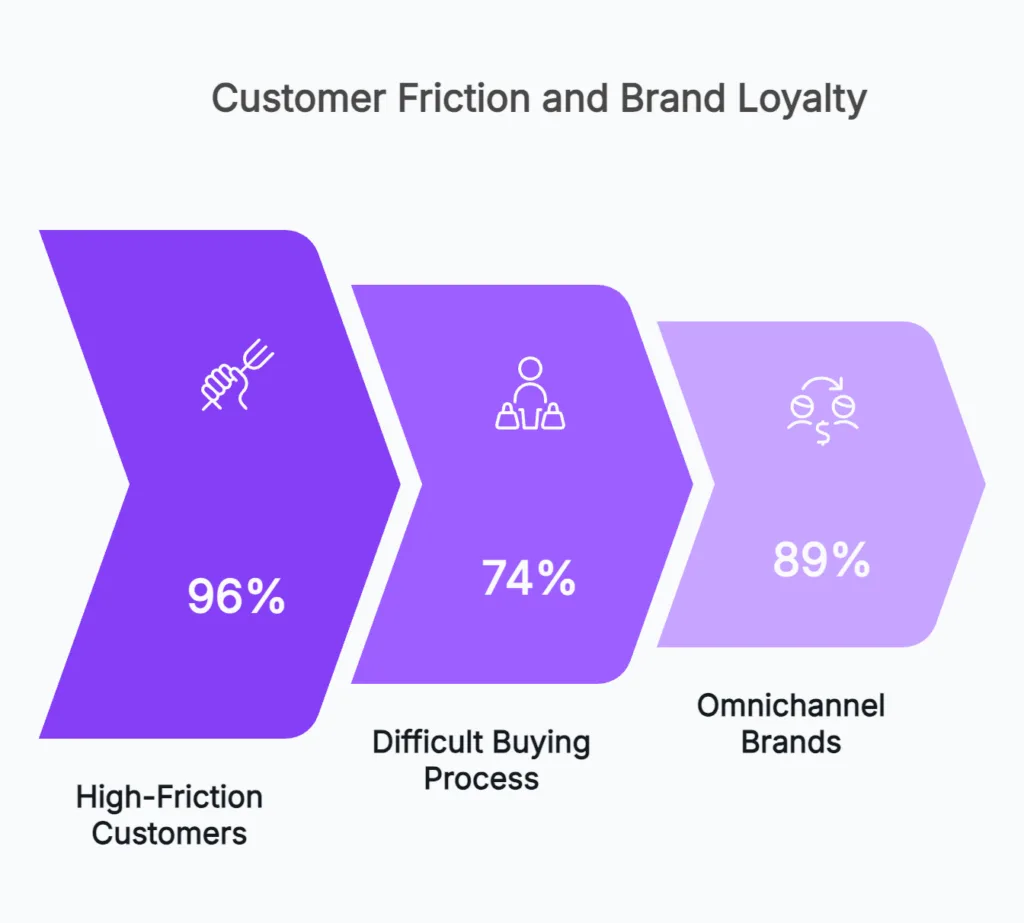
- 96% of customers who experience high-effort, high-friction interactions with a brand become disloyal — they buy less, complain more, and leave. (Gartner)
- 74% of consumers say they are likely to switch brands if they find the purchasing process too difficult. (Customer Experience Statistics, 2025)
- Companies with strong omnichannel strategies retain 89% of customers — compared to just 33% for those without. (Aberdeen Group)
- Brands delivering frictionless CX can charge up to a 16% price premium on products and services. (PwC)
- Companies that invest in CX improvement can expect a potential ROI of up to 7.5x their initial investment. (Forrester Research)
The flip side is equally compelling. When brand experience and customer experience are improved together, firms can achieve up to 3.5x revenue growth and drive higher retention — according to Forrester’s 2024 research.
The math is straightforward: friction is expensive. Frictionless customer experience is a revenue driver. And in 2025, it’s no longer a differentiator — it’s the baseline expectation.
What Your Customers Actually Want (Spoiler: Not Another Ticket Number)
Here’s what’s interesting. Customers aren’t asking for the moon. They’re asking for the basics — delivered consistently.
|
“88% of customers expect faster response times than they did just a year ago. 74% now expect customer service to be available 24/7.” — Customer Experience Statistics Report, 2025 |
The gap between what customers expect and what most businesses deliver? That gap is friction.
And it’s not just about response speed. A damning stat from the self-service world: 53% of businesses think their self-service options are satisfactory to customers. Only 15% of customers agree.
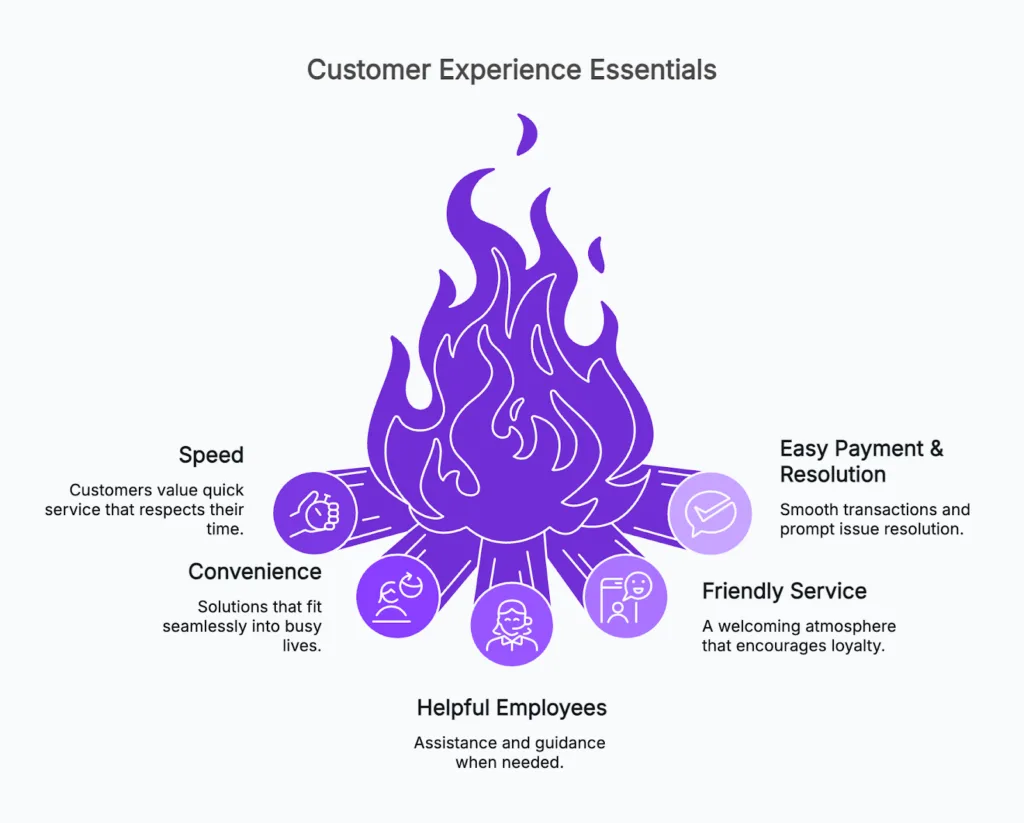
The challenge isn’t just speed. It’s delivering all five pillars — consistently, across every channel — without your team drowning in scattered conversations, siloed data, and repeated context. That’s what a unified customer experience infrastructure is designed to solve.
7 Frictionless Customer Experience Examples Worth Stealing From
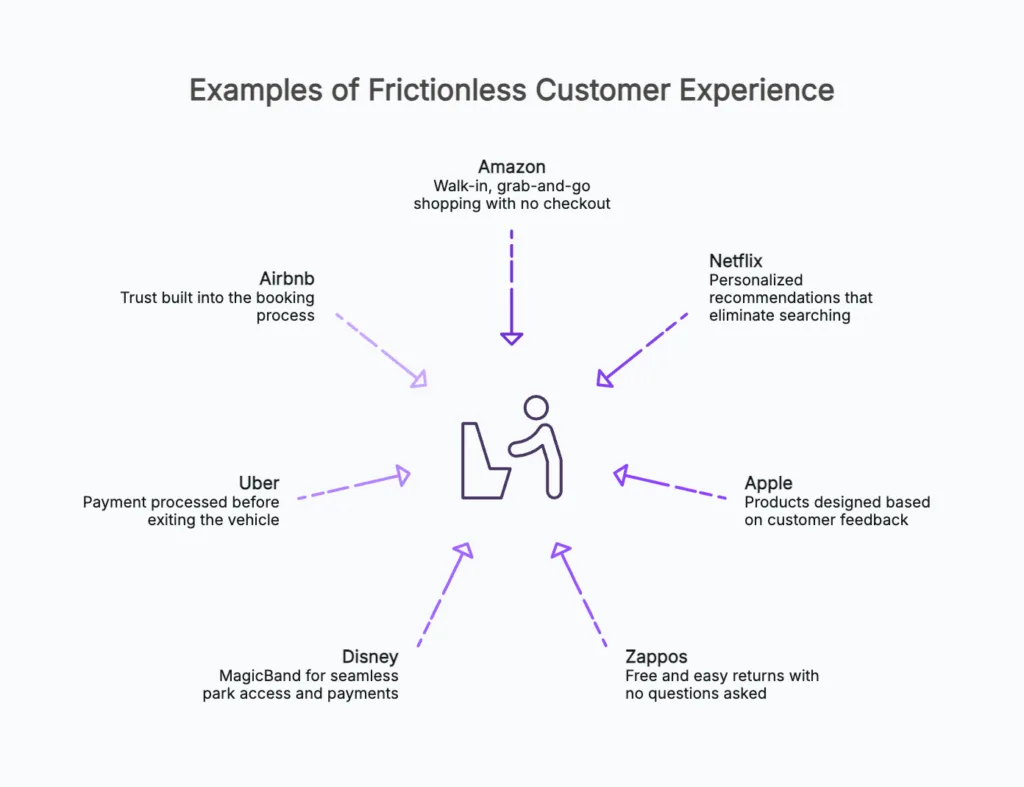
The best way to understand frictionless CX is to see it live. These brands haven’t just talked about removing friction — they’ve engineered it out of every step they control.
1. Amazon Go — Zero-Friction Checkout
Amazon Go stores let customers walk in, pick up what they want, and walk straight out. No queue. No cashier. No friction. Computer vision and AI track items in real time and charge the account automatically on exit.
A Piplsay survey found 57% of consumers said they’d love to see an Amazon Go-style store near them. The takeaway: when you remove the most painful step in a process entirely, people don’t just appreciate it — they tell others.
2. Netflix — Frictionless Personalization
Netflix doesn’t make you search for what to watch. It watches you — every click, pause, and rewatch feeds an algorithm that surfaces the right content before you even know you want it.
For your business: personalization reduces the effort customers need to find value. The less they have to search, the more they stay.
3. Apple — Feedback-Loop Product Design
Apple doesn’t just build great products. It builds products shaped by what customers actually say. Their tight feedback loops — through support interactions, reviews, and iterative product cycles — mean customers feel genuinely heard. And when customers feel heard, they feel less friction.
4. Zappos — Frictionless Returns
Zappos turned the most anxiety-inducing part of online shopping (returns) into a competitive advantage. Free returns. No questions. No forms. No hoops. What was once a major friction point became a reason to buy again — and tell friends.
5. Disney — One Wristband, Zero Friction
Disney’s MagicBand removes the friction of wallets, tickets, hotel keys, and check-in lines at their theme parks. One wristband connects every touchpoint in the park experience. Disney understands that friction isn’t just digital — it’s anywhere a customer has to work to enjoy what they paid for.
6. Uber — The Invisible Payment
Before Uber, the end of a taxi ride involved hunting for cash, waiting for card machines, and mental arithmetic on tips. Uber eliminated that moment entirely. Payment is automatic, receipts arrive instantly, and the whole interaction ends before you’ve shut the car door. One less thing to think about. That’s frictionless.
7. Airbnb — Engineering Trust
Booking a stranger’s home could be terrifying. Airbnb designed every element of their platform — verified reviews, ID checks, secure messaging, protected payments — to remove the friction of trust. When the experience feels safe before it feels convenient, customers commit.
|
“Frictionless doesn’t mean removing all steps. It means removing all unnecessary steps.” — CX Design Principle |
Where Does Friction Actually Live in Your Customer Journey?
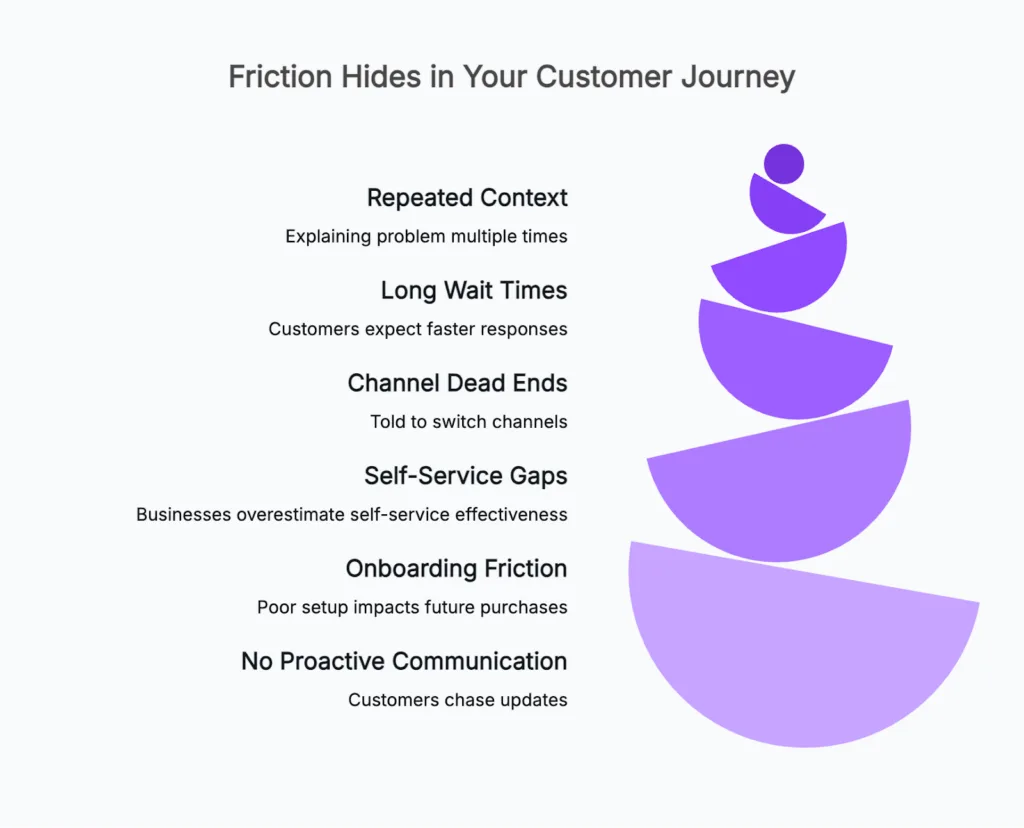
You can’t remove friction you can’t see. Here are the most common places customers hit walls — and what it looks like when they do.
🔴 Repeated context: A customer explains their problem to agent one. Gets transferred. Explains it again to agent two. Gets transferred again. This is the single most-cited complaint in customer service communities online — and it’s entirely preventable.
🔴 Long wait times: 88% of customers expect faster responses than a year ago. Long queues signal one thing: “your time doesn’t matter.”
🔴 Channel-switching dead ends: A customer starts on live chat, gets told to email support, emails support, and gets told to call. Omnichannel isn’t a buzzword — it’s what customers expect. 90% of customers expect consistent experiences across channels.
🔴 Self-service that doesn’t work: Most knowledge bases are outdated, disorganised, and impossible to navigate. Customers want to help themselves first — but only if your self-service knowledge base actually has what they’re looking for.
🔴 Onboarding friction: IBM found that a poorly designed onboarding process leads to fewer future purchases and significantly more negative word of mouth. The first experience shapes every experience that follows — especially for SaaS.
🔴 No proactive communication: Customers don’t want to chase updates. Being told what’s happening before they need to ask is one of the most underused tools in frictionless CX.
How to Build a Frictionless Customer Experience for Your Online Business
Building a frictionless customer experience for online businesses doesn’t require an overnight overhaul. It requires intentional decisions at every friction point — and the right tools to support them.
Step 1: Map Your Customer Journey End-to-End
You can’t remove friction without first finding it. Map every touchpoint from a customer’s first interaction to post-purchase support and renewal. Mark every place where customers slow down, drop off, or contact support. Those are your friction points.
Step 2: Unify Your Customer Data
Fragmented data creates fragmented experiences. When your support team can see the full history of a customer — across every channel, every previous ticket, every past conversation — they can skip the “can you explain your issue again?” moment entirely.
This is where a unified customer experience platform becomes non-negotiable. Context shouldn’t live in agents’ heads — it should live in the platform.
Step 3: Build Self-Service That Actually Works
Customers want to solve things themselves. 81% prefer to resolve issues on their own before reaching out to support. But your self-service knowledge base has to actually be useful — well-organised, up-to-date, easy to search, and built around how customers describe problems, not how your internal teams do. For inspiration, explore some help center examples that get it right.
Step 4: Go Genuinely Omnichannel
Customers switch channels constantly. Your support experience shouldn’t break when they do. Whether someone starts on live chat and moves to email, or contacts you via mobile and follows up on the web — the context should travel with them seamlessly.
Step 5: Use AI to Remove Friction Systemically
According to McKinsey, AI adoption has reached 72% globally — and the brands using it well are removing friction at scale. AI in customer service means intelligent ticket routing, instant AI-assisted responses for tier-1 queries, real-time sentiment detection that flags frustrated customers, and AI chatbots that handle volume without making customers feel dismissed. The benefits of AI in customer service go far beyond speed — they fundamentally change what’s possible.
Step 6: Track Customer Effort Score (CES)
Your customer support metrics tell you how hard customers are working to get help. Customer Effort Score (CES) is the friction detector — it tells you precisely where customers are over-exerting. Pair it with CSAT and NPS to get the full picture. Companies that regularly monitor and act on CX metrics are 25% more likely to retain customers and 20% more likely to see revenue growth. (Forrester)
|
“Companies with top-quartile customer experience strategies outperform their competition by nearly 80% in revenue growth.” — McKinsey & Company |
How Kayako Helps You Deliver Frictionless CX at Scale
Here’s the honest truth: most friction in customer support isn’t caused by bad agents. It’s caused by bad tools. When your team is switching between five tabs to pull up customer history, manually copying context from one channel to another, and working from an inbox not built for support — friction is baked in before the conversation even starts.
Kayako’s customer support software is built around a single idea: every customer conversation should feel effortless — for both the customer and the agent. Here’s how it removes friction at every layer:
SingleView Customer Timeline: Every previous interaction, across every channel, in one chronological view. Agents never have to ask customers to repeat themselves.
Omnichannel Inbox: Email, live chat, social media, and mobile — managed from one platform. Customers can switch channels. Your team won’t miss a beat.
AI-Powered Routing and Responses: Route tickets intelligently, surface relevant knowledge base articles, and suggest responses — so agents spend time solving, not searching.
Proactive Notifications: Reach out to customers before they reach out to you. Reduce inbound volume by getting ahead of issues before they become complaints.
Omnichannel AI Support: Kayako’s omnichannel AI customer support brings the power of AI to every channel without fragmenting the customer experience.
Whether you’re a startup scaling support or an enterprise managing thousands of daily conversations, Kayako removes the operational friction that holds your team back — and the customer experience friction that drives your customers away.
|
Conclusion: Friction Is Costing You More Than You Think
Frictionless customer experience isn’t a nice-to-have anymore. In 2025, it’s the baseline expectation — and the gap between businesses that deliver it and those that don’t is widening fast.
The brands winning on loyalty — Amazon, Netflix, Zappos, Airbnb — aren’t doing anything magical. They’ve just engineered friction out of every touchpoint they control. And the businesses losing customers? They haven’t. Not yet.
The good news: friction is fixable. Start by mapping where it lives. Unify your customer data. Build self-service that works. Embrace omnichannel. Use AI where it removes barriers, not where it creates new ones. And measure customer effort score religiously.
Most importantly, choose tools that remove friction for your team — because when agents have the full context they need, the customer perception shifts from “this was painful” to “that was effortless.”
|
“The best customer service is the kind that makes help feel easier than the problem itself.” — CX Design Principle |
|