What Is Customer Effort Score (CES)? Meaning, How to calculate and Improve
For over a decade, businesses spent enormous resources trying to exceed customer expectations, delight customers, and create “wow moments.” In 2010, three researchers from the Corporate Executive Board upended that entire strategy with a single finding published in Harvard Business Review: delighting customers does not build loyalty — reducing their effort does.
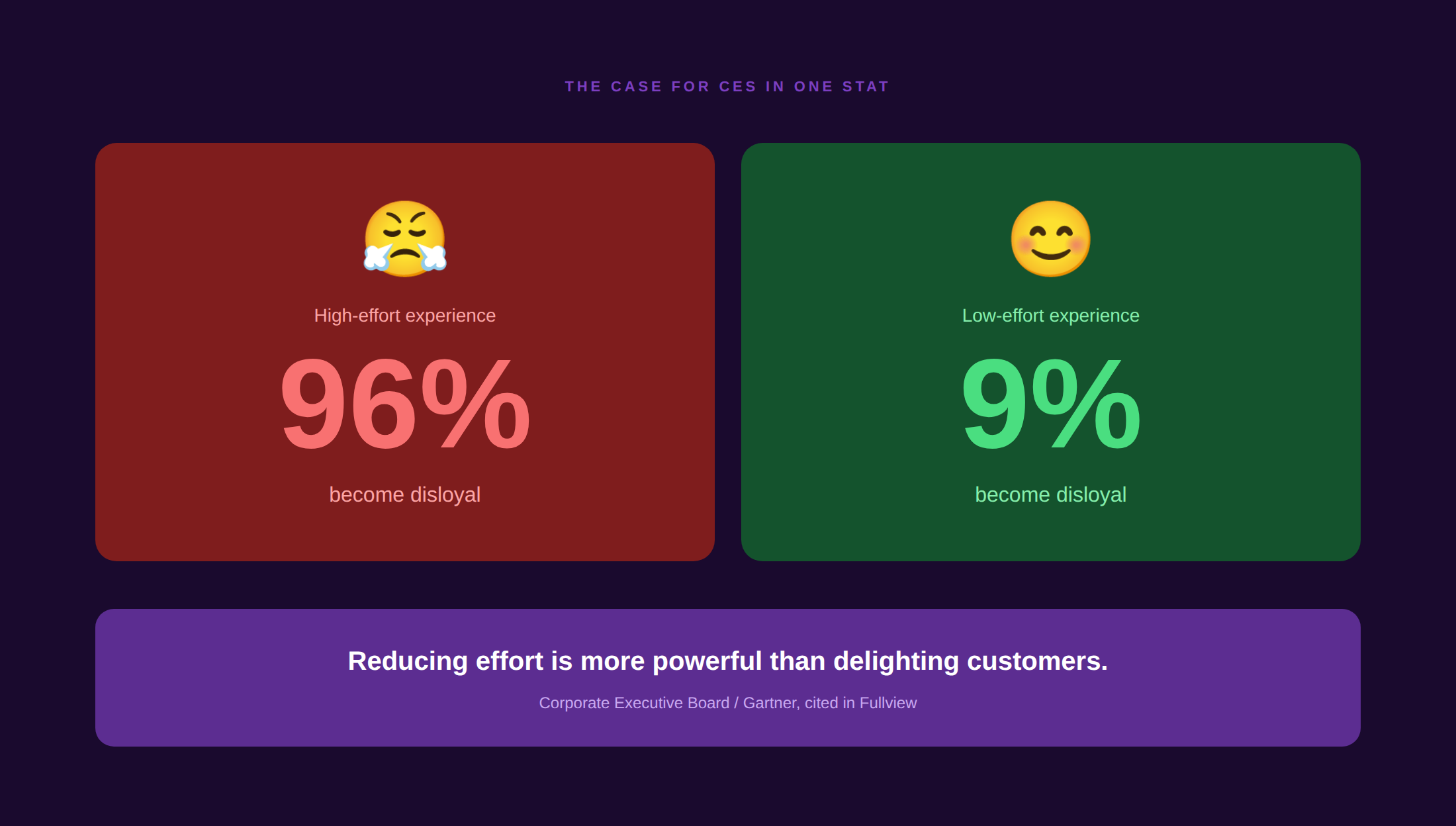
The paper, “Stop Trying to Delight Your Customers,” analyzed more than 75,000 customer interactions and found that customers who rated an interaction as low effort were exponentially more likely to repurchase, increase spending, and recommend the business to others. 96% of customers with a high-effort interaction become more disloyal, compared to just 9% with low-effort experiences (Fullview). That asymmetry is the foundation of the Customer Effort Score and why it has become the loyalty metric that rivals NPS in enterprise CX programs in 2026.
What Is Customer Effort Score (CES)?
Customer Effort Score (CES) is a customer experience metric that measures how easy or difficult it was for a customer to complete a specific interaction with a business — resolving a support issue, making a purchase, navigating a self-service portal, or completing onboarding. The lower the effort required, the more likely the customer is to stay, repurchase, and recommend.
CES was introduced in 2010 by Matthew Dixon, Karen Freeman, and Nicholas Toman (then at the Corporate Executive Board, now part of Gartner) in the HBR article cited above. Their research produced a metric focused on a single question: was this interaction easy? The insight that made CES distinctive was not the scale; it was the finding that customers do not reward companies for going above and beyond; they penalize them for making them work hard.
CES is 1.8 times more predictive of customer loyalty than CSAT and 2 times more predictive than NPS for service interactions (Ringly.io). That predictive advantage is the reason CES has moved from a niche metric to a primary KPI in customer success and support operations.
In 2026, CES matters more than ever because customer expectations of effort have compressed. 60% of customers abandon a brand after frustrating resolution experiences (Ratenow, citing Gartner). The threshold for “acceptable effort” has dropped sharply as AI, self-service, and instant-resolution tools have set a new baseline for what customers experience across their digital lives.
The CES Formula and How to Calculate It
The average score formula
CES = Sum of all CES responses / Total number of responses
This gives you the average effort score across all respondents. On a 1-to-7 scale, a higher number means customers found the interaction easier (7 = strongly agree that the company made it easy). On an inverted scale where 1 = very easy and 7 = very difficult, lower is better. Always specify which orientation your scale uses before reporting.
Worked example — average score method
100 customers respond to a post-ticket CES survey on a 1-to-7 scale.
Sum of all responses: 520
CES = 520 / 100 = 5.2
Interpretation: An average of 5.2 on a 1-to-7 agree/disagree scale means most customers
found the interaction easy. Scores of 5 or above are generally considered good.
The percentage of low-effort respondents variant
CES (%) = (Number of respondents scoring 5, 6, or 7) / Total respondents x 100
This variant expresses CES as the percentage of customers who rated the interaction as low-effort (5, 6, or 7 on the 1-to-7 scale). It is easier to communicate with non-technical stakeholders and maps more intuitively to improvement targets: “We want 80% of customers to rate support interactions as easy.”
Worked example — percentage method
100 respondents. 72 scored 5, 6, or 7.
CES (%) = 72 / 100 x 100 = 72%
Interpretation: 72% of customers found the interaction low-effort.
A target of 70%+ is a reasonable benchmark for most support contexts.
Use Kayako’s CSAT calculator alongside CES to pair satisfaction and effort data.
For a paired satisfaction and effort view, use Kayako’s CSAT calculator alongside CES. High CSAT with high effort often indicates customers are satisfied with the outcome but frustrated by the process; it’s a combination that predicts future churn better than CSAT alone.
What Is a Good Customer Effort Score? Benchmarks by Industry
Benchmarks vary by scale and industry. The most widely cited guidance uses the 1-to-7 agree/disagree scale.
The general thresholds on a 1-to-7 scale
- 5 to 6: Good. Customers generally found the interaction easy. This is the target range for most support and service operations.
- 6 to 7: Excellent. Low friction across the board.
- Below 4: Urgent attention required. High-effort experiences are a material churn risk.
- 7 (perfect score): Some CX researchers flag this as a potential signal that customers are over-relying on your support team for issues that could be self-served. A score of 5 to 6 often reflects the healthiest balance (Merren CX).
Industry-level benchmarks
| Industry | Typical CES range (1-7) | Key friction driver |
| Financial services | 5.0 to 5.5 | Complex forms, compliance friction |
| SaaS and technology | 5.2 to 5.8 | Onboarding complexity, product navigation |
| Retail and e-commerce | 5.5 to 6.0 | Returns process, order tracking |
| Healthcare | 4.8 to 5.4 | Scheduling friction, insurance navigation |
| Telecom | 4.5 to 5.2 | Billing complexity, transfer chains |
| Customer support (cross-industry) | 5.0 to 5.5 (70%+ low-effort) | Channel switching, repeat contact |
(Sources: Merren CX 2026, Sobot CES Benchmark, Fullview CES Benchmark, Gartner CES Research)
Note that CES benchmarks also vary by geography: customers in Asia-Pacific tend to give higher scores than European customers for equivalent experiences. If you operate across multiple markets, use internal cohort benchmarks rather than a single global threshold.
Kayako connects CES data to individual ticket records so coaching is based on real interactions, not aggregate averages. See How It Works
How to Write a CES Survey That Produces Reliable Data
The CES 2.0 question
The standard CES survey question, developed in the second iteration of the CEB research (CES 2.0), is:
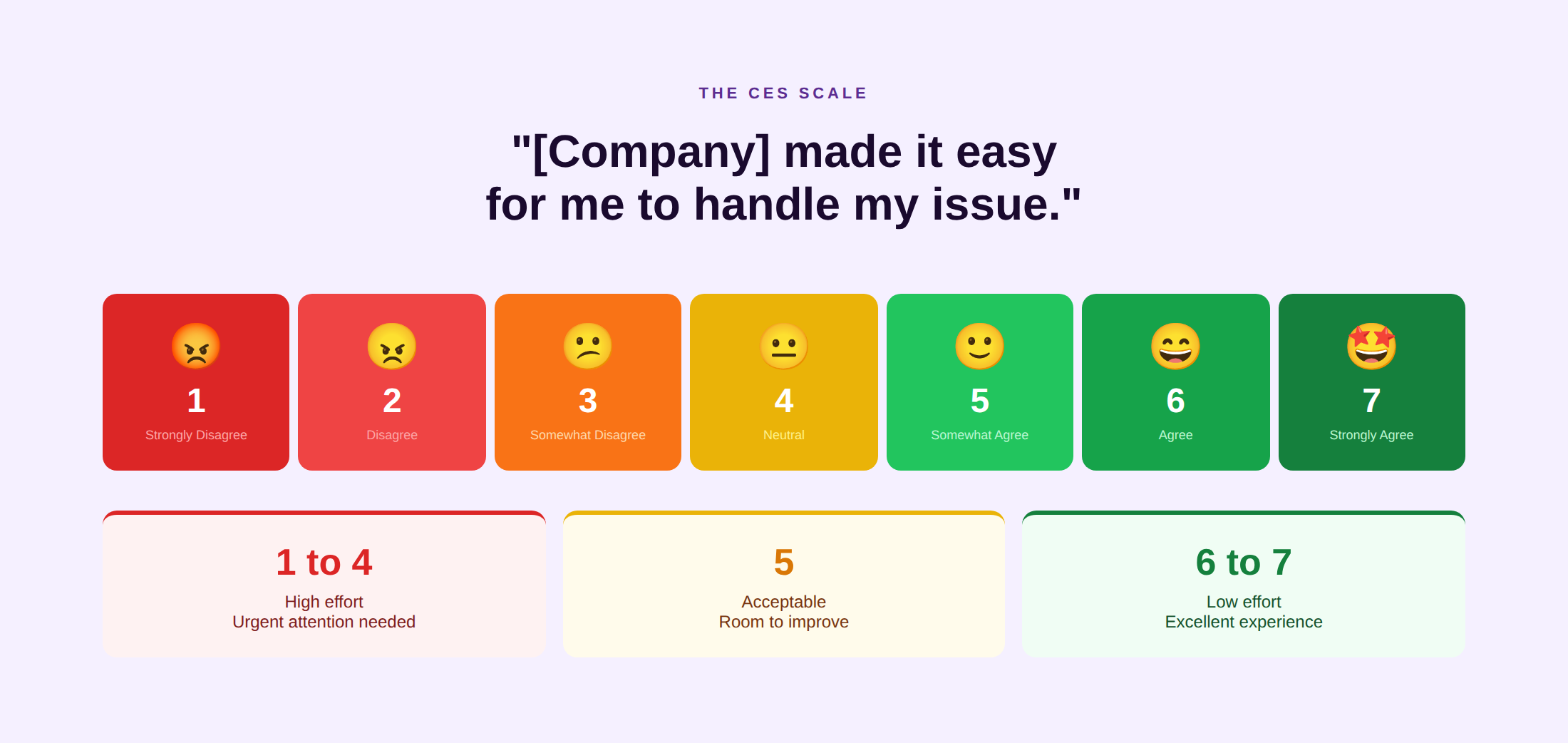
“[Company name] made it easy for me to handle my issue.”
Customers respond on a scale from 1 (Strongly Disagree) to 7 (Strongly Agree). This framing puts the responsibility on the company rather than the customer, as it is the company’s job to make things easy, not the customer’s job to figure things out. That distinction matters: the original CES 1.0 question (“How much effort did you personally have to put forth to handle your request?”) produced more variable responses because customers rated their own competence rather than the company’s design.
Alternative wordings
- “How easy was it to get the help you needed today?” — Works well when the specific task varies across customers. Clean, natural language; good for post-chat contexts.
- “On a scale of 1-7, how much effort did you personally have to put forth?” — Inverts the framing (lower = better). Use carefully and label the scale explicitly to avoid reporting confusion.
- “How easy was it to complete your [purchase/return/request] today?” — Transactional framing suited to e-commerce and self-service portal contexts.
Scale choice: 1-to-7 vs. 1-to-5
The 1-to-7 scale is the research standard and enables benchmarking against published CES data. A 1-to-5 scale produces compressed distributions that make it harder to detect meaningful differences between good and excellent experiences. On a 5-point scale, a score of 3.5 or above is generally good; 4.0 or above is excellent. Use the 1-to-7 scale wherever possible to preserve comparability with industry benchmarks.
When to send
CES must be sent immediately after the interaction it is measuring. A post-ticket CES survey sent three days after the ticket closes is no longer measuring the ticket; it is measuring the customer’s general sentiment. The rule: send within minutes for digital channels, within hours for phone. Satisfaction memory decays faster for low-intensity interactions (routine support) than for high-intensity ones (complex complaints), so the timing window for routine tickets is tighter than for major account issues.
How to Collect CES Data: Channels and Triggers
Post-ticket and post-chat surveys
The most common CES touchpoint. A one-question survey triggers automatically when a support ticket closes or a chat session ends. The CES response can be linked directly to the ticket, the agent, the issue category, and the channel, enabling both diagnostic reporting and agent-level coaching. Most helpdesk platforms support this as a native feature.
Post-call IVR surveys
An automated voice prompt at the end of a phone call asks the customer to rate the ease of the interaction by pressing a keypad number. Post-call CES captures the channel most likely to involve channel switching and repeat contact, making it particularly valuable for identifying where phone volume is being generated by failures in other channels.
Transactional email surveys
Sent within minutes or hours of a specific transaction. A one-question embed in the email body (clickable ratings, no redirect required) produces the highest response rates for post-purchase and post-onboarding CES measurement. Requiring a click-through to a survey form reduces completion rates significantly.
In-app micro-surveys
Triggered at specific in-product moments: after completing onboarding, after using a feature for the first time, or after submitting a support request through an in-app channel. In-app CES captures the product effort dimension that post-support surveys miss: customers can have an easy support interaction but find the product itself difficult to use, and only in-app CES reveals that gap.
How CES timing differs from NPS and CSAT
NPS is a relationship metric sent on a scheduled cadence (quarterly or annually), not tied to a specific interaction. CSAT is sent after a specific interaction but measures overall satisfaction, making timing slightly more flexible. CES must be tied to a specific action and sent immediately after it, because it is measuring the effort required by that action, not the customer’s general feeling about the brand. Sending CES at the wrong moment produces noise rather than a signal.
CES vs. NPS vs. CSAT: When Each One Matters
| CES | NPS | CSAT | |
| What it measures | Ease of completing a specific task | Likelihood to recommend the brand | Satisfaction with a specific interaction |
| Predicts best | Repeat purchase, service loyalty | Brand advocacy, long-term growth | Immediate satisfaction signal |
| Best timing | Immediately post-interaction | Quarterly or annual relationship pulse | Immediately post-interaction |
| Scale | 1-7 (agree/disagree) | 0-10 | 1-5 or 1-10 |
| Primary use case | Post-support, post-onboarding, post-purchase | Brand health, investor reporting | Agent coaching, immediate satisfaction |
| Limitation | No brand or emotional dimension | No interaction-level detail | No loyalty or friction signal |
The decision rule: use CES when you need to know whether a specific task was easy. Use CSAT when you need to know whether a specific interaction was satisfying. Use NPS when you need to understand overall brand loyalty and referral intent. The Effortless Experience research argues that for service interactions specifically, CES is the most reliable predictor of repeat business, because loyalty in a service context is built by removing friction, not by exceeding expectations.
CES in Customer Service: How Support Teams Use It
Post-ticket CES for operational intelligence
When CES is linked to individual tickets, it reveals which issue types, channels, and resolution paths generate high-effort experiences and which do not. A category of tickets consistently scoring below 4 signals a process failure: unclear knowledge base content, policy that requires too many steps, or a channel that cannot handle the query type efficiently. This level of diagnostic precision is not available from aggregate CSAT data.
Agent-level CES for coaching
CES tied to individual tickets allows coaching that is specific rather than generic. An agent whose CES scores are 1 to 2 points below the team median on escalation interactions has a diagnosable gap: likely in context-setting, expectation management, or escalation framing. An agent who consistently scores above the median has a transferable practice worth studying. CES turns the coaching conversation from “your scores are low” into “here is the interaction type where effort is highest, and here is what your highest-scoring peer does differently.”
CES as a churn warning signal
Accounts with persistently high-effort support interactions are at elevated churn risk. 74% of customers find it frustrating to have to repeat their story to different agents, and 85% of CX leaders report customers will drop brands over unresolved issues even on first contact (Zendesk CX Trends 2026). Tracking CES at the account level, not just the interaction level, identifies customers accumulating friction before they make a cancellation decision. See how customer churn rate connects to high-effort experience patterns at the account level.
Effortless Experience principles in queue design
Matthew Dixon’s The Effortless Experience identifies five sources of high customer effort: channel switching, repeat contacts, generic service, unnecessary warnings, and difficult escalations. Each of these is a queue design problem, not an agent skill problem. Reducing channel switching means building escalation paths that carry context. Reducing repeat contacts means improving first contact resolution. Reducing generic service means giving agents full customer history before the first message. These are infrastructure changes, not training changes.
The Benefits of Measuring Customer Effort Score
- Predicts repeat purchase more reliably than satisfaction scores. 94% of customers with low-effort experiences report they will repurchase, compared to 4% of those with high-effort experiences (Fullview). No other single metric produces that predictive gap.
- Surfaces friction faster than CSAT. CSAT captures how customers feel about the outcome. CES captures how customers felt about the process. A customer can be satisfied with a resolution and still have found the process exhausting — and that exhaustion predicts future churn in a way that satisfaction does not.
- Guides self-service investment. High CES scores on self-service interactions confirm that your knowledge base is working. Low CES on self-service signals that customers are finding the portal but not finding answers, or finding answers that do not resolve their issue. CES directs content investment toward the gaps that generate actual high-effort contacts.
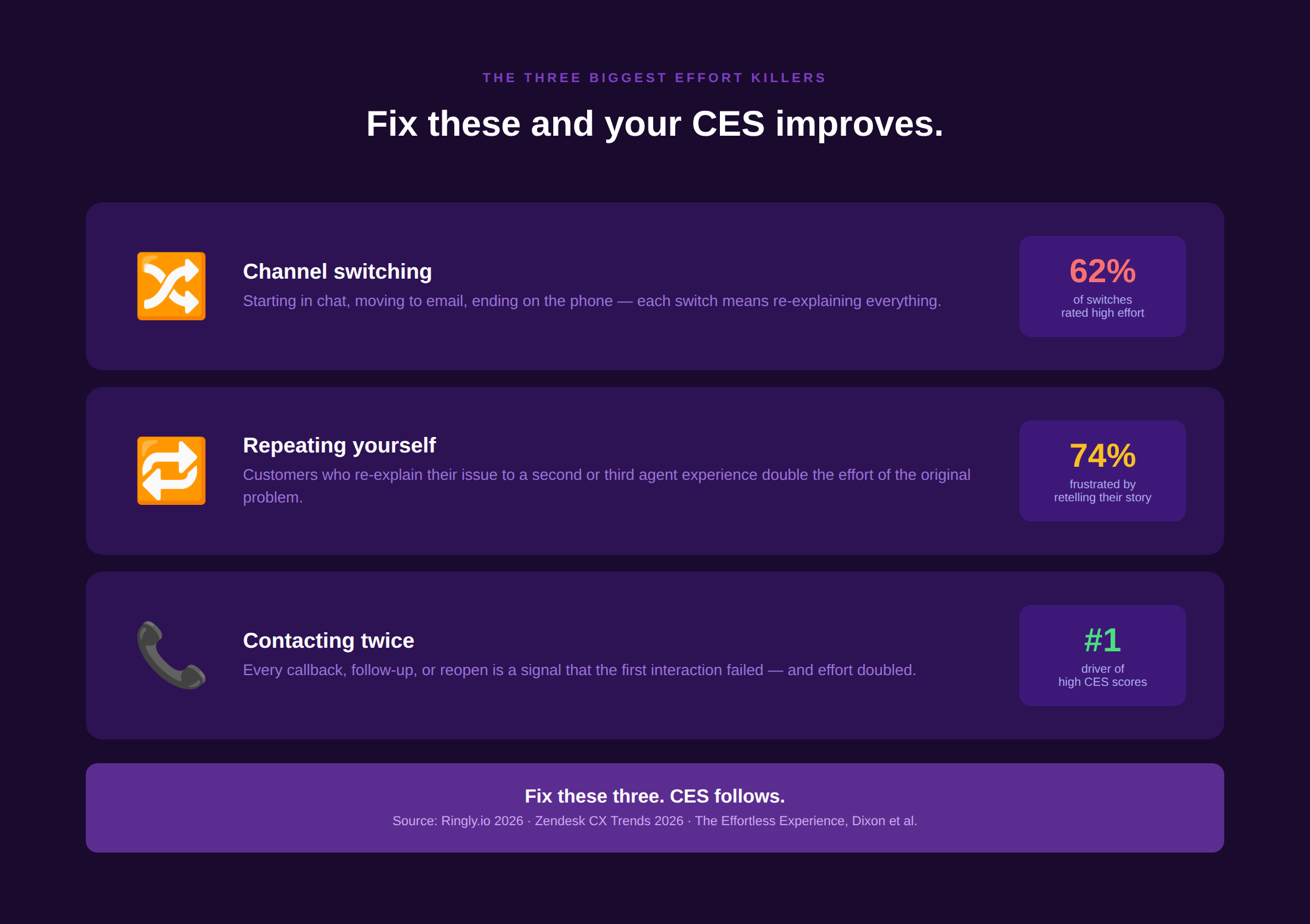
- Identifies channel-mix problems. 62% of channel switches are rated as high-effort by customers. If your CES data shows that phone interactions are consistently lower-scoring than chat interactions for the same issue type, customers are switching to phone because chat is failing, and CES is the only metric that makes that connection visible.
- Enables proactive churn prevention. Account-level CES tracking turns customer effort from a retrospective measurement into a forward-looking risk signal. Accounts accumulating high-effort interactions across multiple tickets are at churn risk, and CS teams armed with that data can intervene before the cancellation conversation starts.
The Challenges and Limitations of Customer Effort Score
CES only measures the interaction, not the brand
A customer can have an effortless support interaction and still switch to a competitor because of product limitations, pricing, or a better alternative. CES does not capture brand equity, emotional loyalty, or the cumulative weight of a long-term relationship. It is a transactional metric, and it should be used as one. Treating CES as a complete picture of customer health misses the brand and relationship dimensions that NPS and qualitative research capture.
Question wording sensitivity
Small changes in question wording produce meaningfully different CES distributions. “How easy was your experience?” and “The company made it easy to handle my issue” measure slightly different constructs and produce different score ranges. This makes benchmarking against published industry data unreliable unless you are using the exact same question format. Standardize your question and never change it mid-program.
Doesn’t capture the emotional dimension
Some of the most memorable customer service experiences are ones that were effortful but handled by an agent who showed genuine care and empathy. A 90-minute call that resolved a complex issue may score low on CES (high effort) but generate a five-star review because the agent was outstanding. CES misses that emotional quality. This is why CSAT and CES are most useful together rather than as substitutes: CES tells you about the process, CSAT tells you about the feeling.
Survey fatigue when stacked with NPS and CSAT
Companies that send CES, CSAT, and NPS after the same interaction create survey fatigue that reduces response quality across all three. The rule: choose the right metric for each touchpoint and send only one survey per interaction. Post-ticket: CES or CSAT (not both). Periodic relationship: NPS. Do not stack them.
How to Improve Your Customer Effort Score
Improve first contact resolution
Repeat contact is the primary driver of high CES scores. A customer who contacts support twice for the same issue has experienced maximum effort: they explained their problem, waited, got a partial resolution, and had to start over. First contact resolution improvement, through better knowledge base access, smarter routing, and agents who have full account context before they respond, removes the most common source of high-effort experiences directly.
Eliminate channel switching
Channel switching is responsible for 62% of high-effort ratings. A customer who starts in chat, gets transferred to email, and then has to call back has experienced three interactions instead of one. Each switch requires them to re-explain their situation. The fix is not discouraging channel switching; it is ensuring that context follows the customer across every channel switch. An omnichannel customer service infrastructure that maintains a unified conversation thread across channels is the structural solution.
Invest in the quality of the knowledge base
Customers who try to self-serve and fail end up contacting support. It’s a higher-effort path than resolving the issue in the first place. A knowledge base that is accurate, searchable, and structured for scanning (answer first, context second) deflects contacts before they become tickets and improves CES on self-service interactions simultaneously. Knowledge base best practices that keep content current and findable are a direct CES improvement investment.
Give agents full customer context before they respond
The moment an agent asks a customer to repeat information the company already has, effort increases. Kayako’s SingleView technology surfaces full account history, previous ticket context, and interaction notes before the agent types a word. Kayako’s Trilogy customer reduced average ticket age from 18 hours to under 5 hours and CSAT from 76% to 90% after deploying this unified context model. These are outcomes that directly reduce the effort customers experience in every subsequent interaction.
Build proactive service into the customer journey
The lowest-effort interaction is the one that never needs to happen because the customer was informed before they needed to ask. Proactive notifications about shipping delays, billing anomalies, known product issues, and upcoming renewals reduce inbound contact volume and the associated effort. Proactive customer service that anticipates common needs converts high-effort reactive contacts into low-effort or zero-effort experiences.
Best CES Software and Tools in 2026
1. Qualtrics
Best for: Enterprise CES programs with advanced segmentation, driver analysis, and integration with operational data. The most capable platform for connecting CES scores to specific touchpoints, agent records, and product usage data.
2. Medallia
Best for: Large-scale CX programs in financial services, retail, and hospitality where CES is one of several real-time signals. Strong at surfacing CES trends across multiple locations or channels simultaneously.
3. Delighted
Best for: Fast deployment and clean dashboards. Purpose-built CES templates with email, in-app, and link distribution. One of the fastest platforms to get CES data flowing from a live customer base.
4. Hotjar
Best for: Product and UX teams wanting to connect CES with session recordings and heatmaps. Reveals which UI elements generate high-effort experiences before customers have to contact support.
5. Survicate
Best for: Multi-channel CES with strong integrations to Intercom, HubSpot, and Slack. Solid balance of features and price for mid-market teams running CES alongside CSAT and NPS.
6. SurveyMonkey (Momentive)
Best for: Teams wanting CES integrated into a broader survey infrastructure. Good for organizations already using SurveyMonkey for other research who want CES without adding a new vendor.
7. Refiner
Best for: SaaS companies needing in-product CES micro-surveys tied to specific user actions. Strong targeting logic that triggers CES only for the right user segment at the right product moment.
8. Userpilot
Best for: Product-led growth teams wanting CES connected to feature adoption data. Reveals whether specific product features are generating high-effort experiences before users churn.
9. Typeform
Best for: Teams prioritizing survey completion rates on mobile. Conversational format outperforms traditional survey layouts on small screens — important when CES surveys are triggered mid-session on a mobile device.
10. Zendesk CES
Best for: Teams running Zendesk for support. Native post-ticket CES is built into the Zendesk workflow, with agent-level reporting and ticket-level CES correlation without additional tooling.
Kayako’s helpdesk surfaces full customer context for every agent, reducing the repeat explanations that drive high CES scores. Book a Demo
Real-World CES Improvements: Case Studies
Bell Canada: cutting repeat contacts by 51%
Bell Canada, the largest communications company in Canada, created a dedicated customer experience team focused specifically on reducing effort in service interactions. By identifying the root causes of repeat contacts — issues that required customers to call back because the first interaction did not fully resolve the problem — they reduced technical support requests by 51% and improved their NPS score by 57% (AnswerConnect, citing Bell Canada program data). The mechanism was the same one The Effortless Experience identifies as the primary CES driver: eliminating repeat contact eliminates the most common source of high effort.
Kayako customer: Contently
CES improvement through faster, contextual support
Before: High ticket volume, slow resolution, agents lacking account context.
After Kayako: 68% autonomous resolution rate, 91-second first response time, $1.8M in avoided costs.
The CES implication: A 91-second first response with full context eliminates the re-explanation
loop that is the primary driver of high customer effort scores in support.
Customers who get the right answer immediately, without repeating themselves, score 5 to 7
on CES surveys. Customers who wait, repeat, and transfer score 1 to 3.
A customer, rightly so, feels all empowered in the equation towards a company because they are the entity that brings the business. They have the power of options, with brands providing services at a more competitive price. So, be it a conglomerate, a small to medium enterprise, or a start-up, customers always like to have more bang for their buck. It’s a principle that works seamlessly in customer experience, too. If they end up getting what they want in a small window of time, they’ll praise your services, and if not, they’ll end up taking their business somewhere else. In short, a company must ensure that all its customers’ actions are for the constructive development of the company, and not the other way around.
FAQs
What is Customer Effort Score (CES)?
Customer Effort Score (CES) is a customer experience metric that measures how easy or difficult it was for a customer to complete a specific interaction, like resolving a support issue, making a purchase, or navigating a self-service portal. It was introduced in 2010 by the Corporate Executive Board (now Gartner) in the Harvard Business Review article “Stop Trying to Delight Your Customers.” CES predicts service loyalty more reliably than satisfaction scores because it focuses on reducing friction rather than maximizing delight.
What is the CES formula?
There are two common variants. Average score: CES = Sum of all responses / Total number of responses, expressed as a number on the scale used (typically 1-to-7). Percentage variant: CES (%) = Respondents scoring 5, 6, or 7 / Total respondents x 100. The percentage variant is easier to communicate and set targets around. Both are valid; choose one and report consistently. Always specify whether a higher or lower score indicates an easier experience.
What is the standard CES survey question?
The CES 2.0 standard question is: “[Company name] made it easy for me to handle my issue.” Customers respond on a 1-to-7 scale from Strongly Disagree (1) to Strongly Agree (7). This framing places responsibility on the company rather than the customer and is the version recommended for benchmarking against published CES research. Alternative framings include “How easy was it to get the help you needed today?” for post-chat contexts.
What is a good Customer Effort Score?
On a 1-to-7 scale, a score of 5 or above is generally good; 6 or above is excellent. Expressed as a percentage of low-effort respondents, 70% or above is a reasonable benchmark for most support contexts. Industry benchmarks vary: retail and e-commerce typically score 5.5 to 6.0; telecom and healthcare typically score 4.5 to 5.4. Always benchmark against your own historical trend and your specific industry rather than a universal target.
Is CES better than NPS?
Neither is universally better — they measure different things. CES is 1.8 times more predictive of loyalty than CSAT and 2 times more predictive than NPS for service interactions specifically (Ringly.io). But NPS captures brand advocacy and relationship health that CES cannot measure. The most complete approach: use CES after service interactions to reduce friction, CSAT to monitor satisfaction, and NPS for periodic relationship health checks.
How do I lower customer effort?
The five highest-leverage interventions: (1) improve first contact resolution as repeat contact is the primary driver of high effort; (2) eliminate channel switching by ensuring context follows customers across every channel with omnichannel support; (3) invest in knowledge base quality so customers can resolve issues without contacting support; (4) give agents full account context before they respond so customers never have to repeat themselves; (5) build proactive notifications for predictable issues before customers need to ask.