

Deliver seamless customer service across voice, chat, SMS, email, and social with an omnichannel contact center. Learn what it is, key features, implementation steps, and real examples.
A customer’s flight gets canceled. She checks the app, gets a text with rebooking options, asks about luggage on WhatsApp, then calls for help.
When the agent picks up, he already sees everything—her flight details, the WhatsApp thread, her loyalty status. The problem gets solved fast.
She feels seen, not shuffled.
That’s omnichannel in action.
When conversations jump between devices, channels, and time zones, customers expect continuity. Businesses need efficiency, insight, and scale. The question isn’t whether to support multiple channels—it’s how to orchestrate them into one coherent journey.
Here’s what this guide covers:
- What an omnichannel contact center is and how it’s different from multichannel
- Benefits for customers, agents, and the business
- Key features that make omnichannel work—unified desktops, AI, routing, analytics
- Step-by-step implementation guidance
- Best practices for daily operations
- FAQs, no-code builders, and AI-powered analytics
By the end, you’ll know what to build, when to deploy it, and why omnichannel is now a strategic must-have.
What Is an Omnichannel Contact Center?
Customers don’t think in channels. They think in needs and outcomes. Where and how they contact you—voice at lunch, chat on the commute, social messaging at night—shouldn’t force them to repeat themselves or start over.
An omnichannel contact center makes that seamless continuity possible.
An omnichannel contact center integrates all customer interaction channels into a single unified platform. Voice calls, emails, SMS, web chat, social media, WhatsApp, Apple Messages for Business, Google Business Messaging—all in one place.
Agents see every past and current interaction. Customers can switch channels mid-conversation without restarting.
This is different from multichannel, where businesses offer multiple contact options but treat each channel as a silo. A customer emails, then calls. The agent on the phone has no visibility into the email. That fragmentation wastes time and frustrates everyone.
Why Omnichannel Matters
Customers use multiple devices and platforms—smartphones, laptops, social apps, messaging, voice, in-person. They average nearly six different touchpoints during purchase decisions. Half use more than four regularly.
They expect you to recognize their journey and preferences. They want to switch channels without friction.
Omnichannel contact centers deliver by:
- Providing context-aware interactions where agents access full communication history
- Offering consistent brand messaging and service quality across all touchpoints
- Allowing frictionless channel switching—like deflecting an IVR call to WhatsApp
- Combining self-service automation with easy escalation to live agents
Core Components
A true omnichannel contact center includes:
- Self-Service Automation
AI-driven customer support, virtual assistants and natural language processing bots let customers find answers 24/7. High accuracy, low maintenance.
- Live Agent On-Ramping
Every automated interaction needs a smooth escalation path to a human when things get complex.
- Unified Digital Channels
One agent desktop manages all conversation types—social media, chat, SMS, email. Less toggling, more efficiency.
- Inbound and Outbound Voice Integration
Voice remains critical. Agents manage phone calls in the same interface and get AI tools for real-time sentiment analysis and transcription.
Real Example: Acme Airlines
Acme Airlines’ customers get proactive notifications across channels—flight confirmations, WhatsApp rescheduling options, automated loyalty miles updates.
When things get complicated (car rental questions, for example), customers escalate to agents within the same conversation thread. Agents see everything—prior interactions, voice calls, chat history.
Problems Omnichannel Solves
Channel Visibility and Agent Efficiency
Agents struggle when they juggle multiple apps without a consolidated view. Omnichannel platforms like Kayako provide unified dashboards and real-time metrics. Faster resolutions, less burnout.
Handling Volume Spikes
During peak periods, omnichannel centers flex agents across channels. Agents handle concurrent social media inquiries while voice call volumes spike. The system balances workloads intelligently.
Data Consolidation and Insight
Centralized data enables richer analytics—customer satisfaction predictions, trend analysis, performance tracking. Unlike fragmented systems, omnichannel platforms aggregate information into actionable insights.
Omnichannel’s promise is simple: meet customers where they are, whenever they connect, and carry their story with them. Now let’s look at the tangible benefits.
Benefits of an Omnichannel Contact Center
Benefits show up in the moments that matter—when customers need help, when agents are under pressure, when leaders make fast decisions. Omnichannel reduces friction, increases productivity, and delivers better business outcomes.
Related read: Benefits of ai in customer service
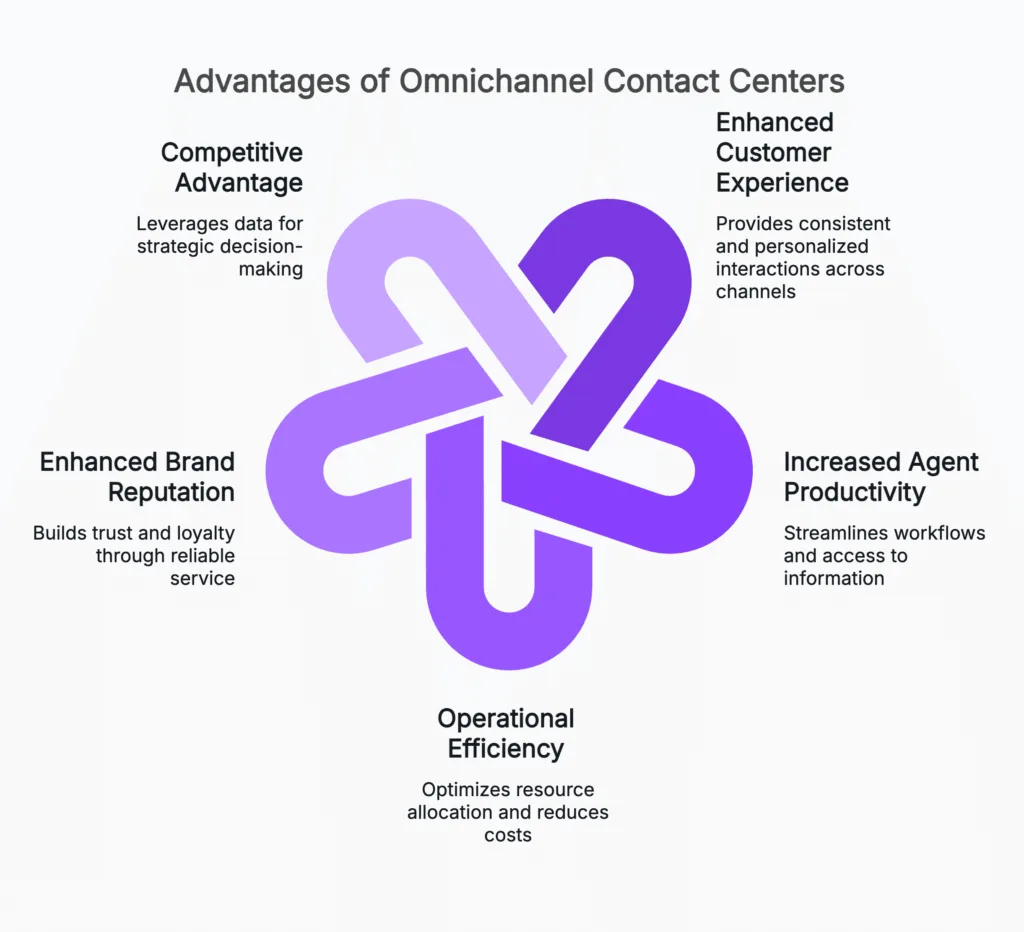
Enhanced Customer Experience
Omnichannel centers elevate customer experience by offering:
- 24/7 accessibility on preferred channels for convenience and flexibility
- Faster resolutions thanks to comprehensive customer context and AI assistance
- Personalized interactions that incorporate channel preferences, language, and service approach across discovery, adoption, engagement, and retention
- Consistent, proactive engagement like push notifications for order status, service alerts, and loyalty rewards
Multi-channel customers spend up to four times more than single-channel customers. Omnichannel capabilities help you capture and nurture this high-value group.
Increased Agent Productivity
Agents in omnichannel environments get:
- Single unified desktop to manage all channels, eliminating time wasted toggling between apps increases agent productivity
- AI tools like Kayako that provide real-time suggestions, sentiment analysis, and relevant knowledge articles
- Intelligent routing that automatically directs customers to the best-fit agents based on skills, availability, and channel preferences
- Workload flexibility that lets agents multi-task across lower-effort channels like social media or chat when call volumes spike
Operational Efficiency and Cost Reduction
Omnichannel centers streamline operations through:
- Integrated data and reporting tools that give immediate insight into call volumes, channel performance, and customer sentiment without waiting for IT reports
- Deflection strategies like IVR deflection to WhatsApp or chatbots that efficiently handle high contact volumes and reduce agent workload
- Scalable cloud-native architecture that enables rapid scale-up or scale-down, especially during seasonal spikes or crisis events
eMite’s CX Intelligence with Amazon Connect consolidates data across systems. An Australian home repair company used it to reduce call center costs by $200,000 during a peak crisis period.
Enhanced Brand Reputation and Customer Loyalty
Positive omnichannel interactions build trust and loyalty:
- Honoring channel and contact preferences makes customers feel respected and valued
- Quick, personalized resolutions minimize complaint escalations and churn
- Consistent messaging across touchpoints protects and strengthens brand identity
- Proactive communication (like flight rescheduling offers via WhatsApp) builds goodwill and reduces uncertainty
Competitive Advantage Through Data-Driven Decisions
Consolidated customer journey data lets businesses:
- Analyze buying patterns and popular channels to adapt strategies
- Leverage predictive analytics for customer satisfaction
- Optimize agent scheduling and resource allocation with granular metrics
- Implement cross-sell, upsell, and loyalty campaigns based on robust insights
The benefits stack across the organization—happier customers, empowered agents, leaner operations, smarter decisions. To turn those benefits into reality, you need the right features. Let’s look at what makes omnichannel actually work.
|
Key Features of an Omnichannel Contact Center
Features matter when they make work smoother for agents and paths shorter for customers. The right toolkit brings every conversation into one place, augments human judgment with AI, and lets your team design journeys without heavy engineering.
Unified Agent Desktop with Conversation History
Agents get a single cohesive desktop that displays:
- All channel conversations in thread format, preserving context regardless of channel switching
- Related customer data (booking references, account details) integrated through APIs
- Interaction histories including past calls, chats, and emails for personalized responses
Acme Airlines’ interface lets agents see flight confirmations, loyalty miles, WhatsApp rescheduling conversations, and car rental questions on one screen. Service stays streamlined.
AI-Powered Assistance and Analytics
Modern omnichannel centers embed AI features like:
- Real-time transcription and sentiment analysis that tracks customer mood and flags potential escalations
- Agent assistance bots that suggest responses, fetch knowledge articles, or automate routine tasks
- Customer satisfaction prediction (AI CSAT) without post-call surveys
- Custom Moments and triggers that capture and analyze specific keywords across interactions to inform coaching and strategy
Related Read: Customer support metrics to keep a watch on
No Code / Low Code Workflow Orchestration
Tools like Cisco Webex Contact Center’s Voice Flow Builder and Webex Connect’s Flow Builder let you create and optimize customer journeys and IVR scripts without developers. You can:
- Create automated deflections from IVR to chat or WhatsApp
- Build task bots that handle outbound engagement or slot-filling conversations
- Integrate external systems via HTTP requests for personalized, dynamic workflows
Omnichannel Routing and Queue Management
Route customers to the right resource with:
- Universal queuing where incoming requests from voice and all digital channels feed into a single, prioritized queue
- Skills-based and preference-based routing for tailored customer-agent matching
- Supervisor tools like whisper, barge, and takeover across channels to improve first-contact resolution
Integrated Communication Channels
An omnichannel center supports:
- Voice calls with advanced Interactive Voice Response (IVR)
- Chat and SMS, including business-messaging platforms like WhatsApp, Apple Messages, and Google Business Messaging
- Social media monitoring and direct replies (agents manage Twitter DMs, for example)
- Email management with features like BCC and email account switching in the desktop UI
Comprehensive Reporting and KPI Tracking
Unified dashboards provide:
- Real-time visibility into all contact volumes across channels
- Agent performance metrics, sentiment trends, and customer satisfaction levels
- Data export and API capabilities for advanced business intelligence and integrations
With unified interfaces, intelligent automation, and robust analytics, your contact center evolves from a queue-handling machine into a proactive service engine. Now let’s translate these capabilities into an implementation plan.
How to Implement an Omnichannel Contact Center Strategy
Implementation is where vision meets reality. To avoid costly mistakes and ensure smooth adoption, anchor your plan in customer needs, tie it to business outcomes, choose the right partners, and build iteratively with clear success metrics.
Assess Customer Needs and Channel Preferences
Start by understanding your customers:
- Which channels do they use most? Voice? WhatsApp? Social media?
- When and how do they prefer to engage—self-service at night, chat during workdays?
- What journey pain points do they encounter?
Use surveys, interaction analytics, and direct feedback to gather this data.
Define Clear Business Objectives
Establish what you want to achieve:
- Reduce average handle time?
- Increase customer satisfaction or Net Promoter Scores?
- Enhance agent productivity?
- Scale quickly during peak demand?
Align these goals with omnichannel platform capabilities to prioritize your deployment.
Choose the Right Technology and Partners
Select an omnichannel platform that meets your needs:
- Look for unified agent desktops that support voice plus digital channels
- Ensure AI features for agent assist and analytics
- Confirm integration capabilities with existing CRM, order management, or business systems
- Evaluate cloud-based options for scalability and agility
Develop and Test Automated Workflows
Use no-code visual flow builders to design IVR deflection paths, self-service bots, and omni-routing logic.
Train Agents and Supervisors Extensively
Training should focus on:
- Using the unified desktop effectively
- Leveraging AI recommendations tactically
- Handling cross-channel conversations and escalations
- Utilizing supervisor tools like whisper and takeover across channels
Change management should accompany technical deployment. Address agent concerns and build confidence in new workflows.
Monitor Performance and Iterate Continuously
Implement real-time dashboards and KPIs to track volumes, response times, customer sentiment, and satisfaction.
Leveraging eMite’s integration with Amazon Connect, clients gain immediate insights into peak stress points and can adapt staffing or workflows dynamically.
Establish a routine for reviewing analytics, gathering agent feedback, and refining processes for continual optimization.
A thoughtful rollout minimizes disruption and maximizes early wins. Once the foundation is in place, disciplined operations keep performance high.
Best Practices for Operating an Omnichannel Contact Center
Operating excellence is the daily habit that turns a good system into a great experience. These best practices help you maintain momentum, protect agent well-being, and consistently deliver outcomes that matter.
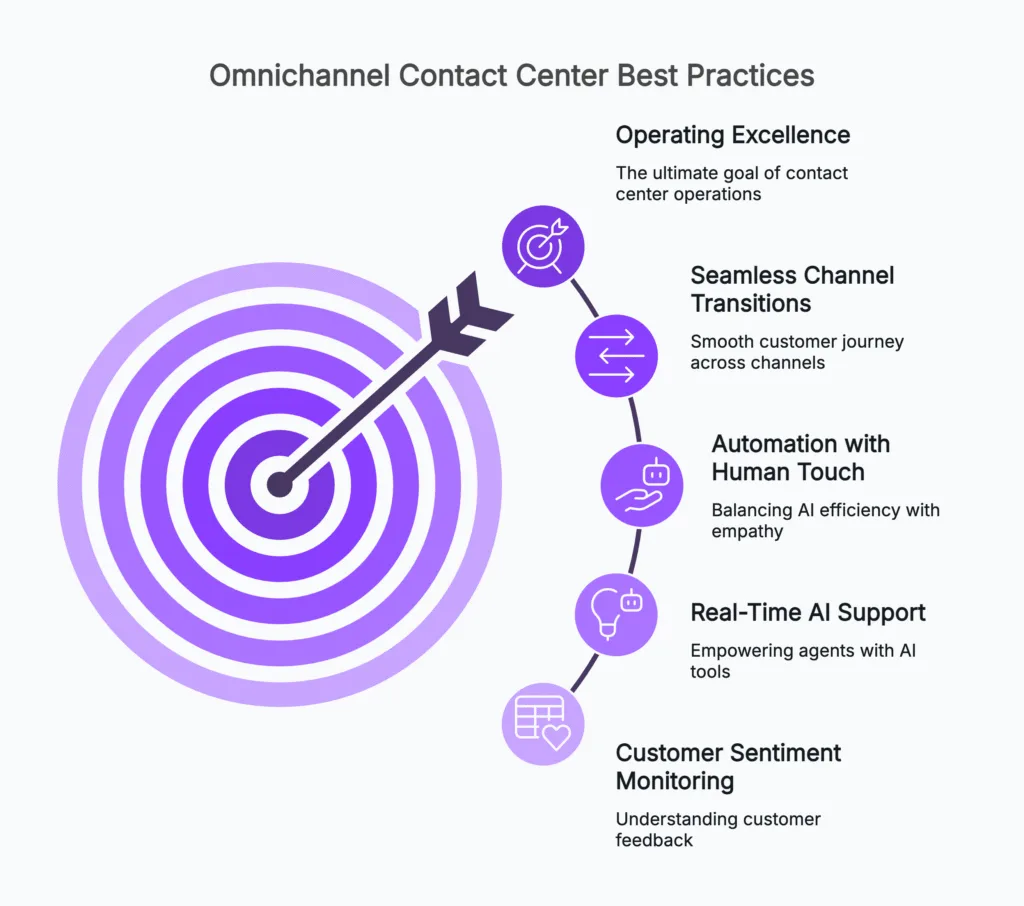
Prioritize Seamless Channel Transitions
Customers should switch freely between voice, chat, social media, and email without repeating information.
- Use platforms with true conversation stitching capabilities
- Agents should have full visibility of channel histories and prior issue resolutions
Balance Automation with the Human Touch
Leverage AI-driven self-service to handle routine inquiries and deflect calls during peak times.
- Make sure customers can easily escalate to a human agent
- Use task bots to guide customers but avoid over-automation that causes frustration
Equip Agents with Real-Time AI Support
Tools like Kayako provide:
- Next-best-action suggestions
- Transcriptions and sentiment scores
- Knowledge base search integration
These empower agents to provide faster, more empathetic service.
Monitor and Act on Customer Sentiment and Feedback
Use AI CSAT scores and custom moment triggers to identify issues early.
- Train supervisors to intervene proactively via whisper or call takeover
- Analyze sentiment trends by channel and issue type to improve workflows
Maintain Unified Reporting and Insights
Consolidate data on a single dashboard to reduce blind spots.
- Track KPIs across all channels
- Use data to optimize agent schedules, campaign timings, and contact handling strategies
Keep Agents Motivated and Supported
- Foster a collaborative culture among agents
- Use coaching based on real data from AI insights
- Recognize achievements based on omnichannel performance metrics
Implement Regular Process Reviews
- Reassess workflows and channel usage regularly
- Incorporate emerging channels like Apple Messages for Business
- Update bots with evolving customer language patterns
Best-in-class operations are never set-and-forget. They’re a rhythm of measuring, learning, and improving.
|
Frequently Asked Questions About Omnichannel Contact Centers
As teams shift from multichannel to omnichannel, a few key questions come up repeatedly. Here are concise answers to align stakeholders and accelerate decisions.
Q1: How is an omnichannel center different from multichannel?
Multichannel supports several channels but treats them independently, like separate islands. Omnichannel integrates all channels into a unified customer journey with seamless transition and shared context.
Q2: Can small businesses benefit from omnichannel centers?
Absolutely. With cloud-based solutions and low-code builders, even small to midsize businesses can implement and scale omnichannel service affordably.
Q3: How does AI improve omnichannel contact centers?
AI supports faster problem-solving by providing agent assist tools, predicting customer satisfaction, automating routine requests via bots, and analyzing trends for operational improvement.
Q4: What channels should be prioritized?
Start with your customers’ most-used channels—commonly voice, email, and chat. Then add social and messaging channels like WhatsApp as demand grows.
Q5: How to measure omnichannel success?
Track key metrics like Customer Satisfaction (CSAT), Net Promoter Score (NPS), first contact resolution, average handle time, and cross-channel engagement rates.
Q6: How to handle data privacy and compliance in omnichannel centers?
Ensure your platform supports secure, encrypted communication and complies with regulations like GDPR. This includes honoring customer contact preferences and data deletion requests.
With clarity on common questions, your team can move forward with confidence. Here are two focused insights to help you accelerate and sharpen operational control.
Leveraging No-Code Visual Flow Builders for Agile Contact Center Operations
When speed to change is the difference between delight and delay, no-code and low-code tools become your secret weapon. They help non-technical teams build and iterate on journeys without long release cycles.
A standout innovation in omnichannel centers is no-code and low-code workflow orchestration, highlighted in Cisco Webex’s Contact Center platform.
These visual builders let non-technical staff design, modify, or optimize IVR menus, chatbots, and cross-channel journeys rapidly.
Using Webex Connect’s Flow Builder, you can create a journey where a customer waiting on an IVR automatically gets offered a WhatsApp deflection, complete with context handoff.
Integration nodes allow real-time data fetching from business APIs to personalize conversations—like retrieving booking references or order status.
This agility reduces reliance on costly developer cycles and allows faster experimentation and customer-centric innovation.
The result? An operation that adapts in days, not months—meeting customers where they are, when they need you, and how they prefer to talk.
The Role of AI-Powered Analytics for Operational Excellence
Visibility drives agility. With unified, real-time intelligence, leaders can anticipate rather than react—optimizing staffing, refining journeys, and managing crises with confidence.
Platforms like eMite integrated with Amazon Connect provide groundbreaking CX intelligence:
- Real-time dashboards visualize KPIs across channels and integration points like CRM or ticketing systems
- Predictive analytics anticipate surges and resource needs
- Enable proactive management of staffing and strategy, reducing costs and improving customer experience
An Australian company in home repair used these tools to rapidly improve efficiency during natural disasters. Real-time omnichannel insight made the difference.
With these insights, leadership gains the “when and where” to act decisively—shaping better outcomes before issues turn into escalations.
Embracing the Future with Omnichannel Contact Centers
The shift to omnichannel contact centers represents a fundamental customer experience evolution. Gone are the days when separate channels and fragmented data dictated slow, impersonal service.
Today’s omnichannel centers integrate voice, digital messaging, AI, automation, and analytics into a cohesive solution that delights customers and empowers agents.
By understanding what omnichannel contact centers are, appreciating their benefits, knowing the key features, and adopting best practices for implementation and operation, you can build a resilient, scalable, customer-centric support operation.
Innovative technologies like AI agent assist, no-code flow builders, and unified analytics accelerate success even faster.
In a world where customers demand speed, context, and choice, the omnichannel contact center isn’t just an option. It’s the foundation of exceptional experiences and competitive advantage.
|