AI Sentiment Analysis: How It Works, Examples & Tools (2026)
Customer feedback is exploding across reviews, chats, emails and social. AI sentiment analysis is how modern teams read all of it — and turn raw emotion into decisions that improve the customer experience.
AI sentiment analysis is the use of natural language processing (NLP) and machine learning to automatically detect, measure and classify the emotional tone of text or speech as positive, negative or neutral — and, increasingly, to identify specific emotions like joy, anger or frustration. Also known as opinion mining or emotion AI, it converts large volumes of unstructured feedback into structured, actionable data.
Roughly 80% of business data is unstructured: the tweets, chat logs, call transcripts and reviews that traditional analytics can’t handle. AI sentiment analysis reads not just the words, but the meaning, context and tone behind them. It can catch sarcasm, detect intent, and process millions of interactions in seconds — something no manual review process can match.
This guide covers what AI sentiment analysis is, how it works, the main types, real worked examples, the best tools available in 2026, how it improves customer experience, and the honest limits you should plan around.
See customer tone in every conversation. Try Kayako today →
What is AI sentiment analysis?
At its core, AI sentiment analysis is a branch of NLP and machine learning dedicated to identifying subjective information in language. Instead of asking customers how they feel through a survey, it infers how they feel from what they already write and say.
It does this by reading three layers at once:
- Semantics — the literal meaning of words and phrases.
- Context — negation, intensifiers and sarcasm that flip or amplify meaning (“not bad at all” is positive).
- Paralinguistics — in voice data, cues like pitch, pace and tone.

The output is a sentiment label, often with a confidence or polarity score, that can be aggregated across thousands of conversations to reveal exactly how people feel about your brand, product or support.
Why is AI Sentiment Analysis Important?
Think feedback is just noise? Think again. Buried in those rants and raves is your next growth opportunity or PR disaster. Sentiment analysis separates signal from static.
Many organizations underestimate the value locked within unstructured customer feedback. Yet, understanding sentiment is pivotal for numerous reasons:
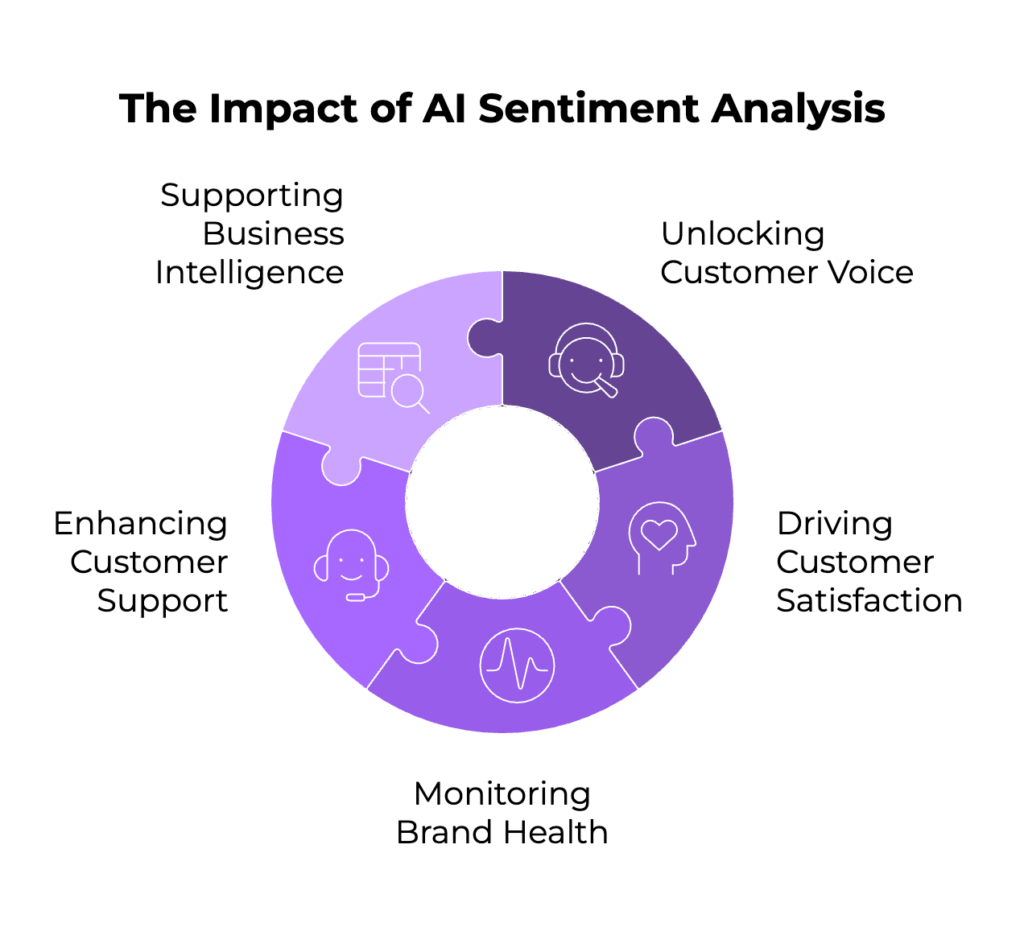
Unlocking the Voice of the Customer
AI Sentiment Analysis reveals genuine customer emotions and perceptions from interactions that traditional quantitative data cannot capture. Unlike surveys, which yield polarized or limited responses, sentiment scoring analyzes every interaction, providing a continuous and broad dataset for meaningful insights.
Driving Customer Satisfaction and Loyalty
Research shows that companies using real-time sentiment analysis are 2.4 times more likely to exceed customer satisfaction targets.
AI-powered sentiment scoring identifies issues driving dissatisfaction and detects opportunities where companies excel, enabling targeted improvements and personalized engagements.
Monitoring Brand Health and Market Perception
By analyzing social media chatter, product reviews, and public discussions, organizations can get a 360-degree view of brand perception in real-time. Sudden spikes in mentions around an event can be broken down by sentiment to distinguish whether public reaction is favorable or adverse, allowing marketing teams to tailor messaging or crisis response.
Enhancing Customer Support and Agent Performance
Sentiment analysis helps score agent performance objectively by detecting emotions during interactions and can provide real-time coaching guidance to agents to improve conversations dynamically—thereby improving customer experience and employee training.
Businesses leveraging advanced sentiment analysis tools report a 25% increase in customer retention by improving conversation quality.
Supporting Business Intelligence and Market Research
Going beyond quantitative metrics, sentiment provides qualitative insights into customer preferences, pain points, and attitudes toward products or services, informing product development and strategic planning with deep consumer-centric knowledge.
In fact, Retail and healthcare are among the largest end-users of AI sentiment analysis tools for this reason.
The importance of sentiment analysis is such that businesses equipped with this technology enjoy competitive advantages in understanding nuanced customer behaviors, optimizing processes, and proactively managing customer relationships.
Understanding its importance is one thing. But how does it actually work under the hood?
How AI sentiment analysis works
It can feel like magic, but the way AI sentiment analysis works is a defined pipeline. Most systems move through five stages:
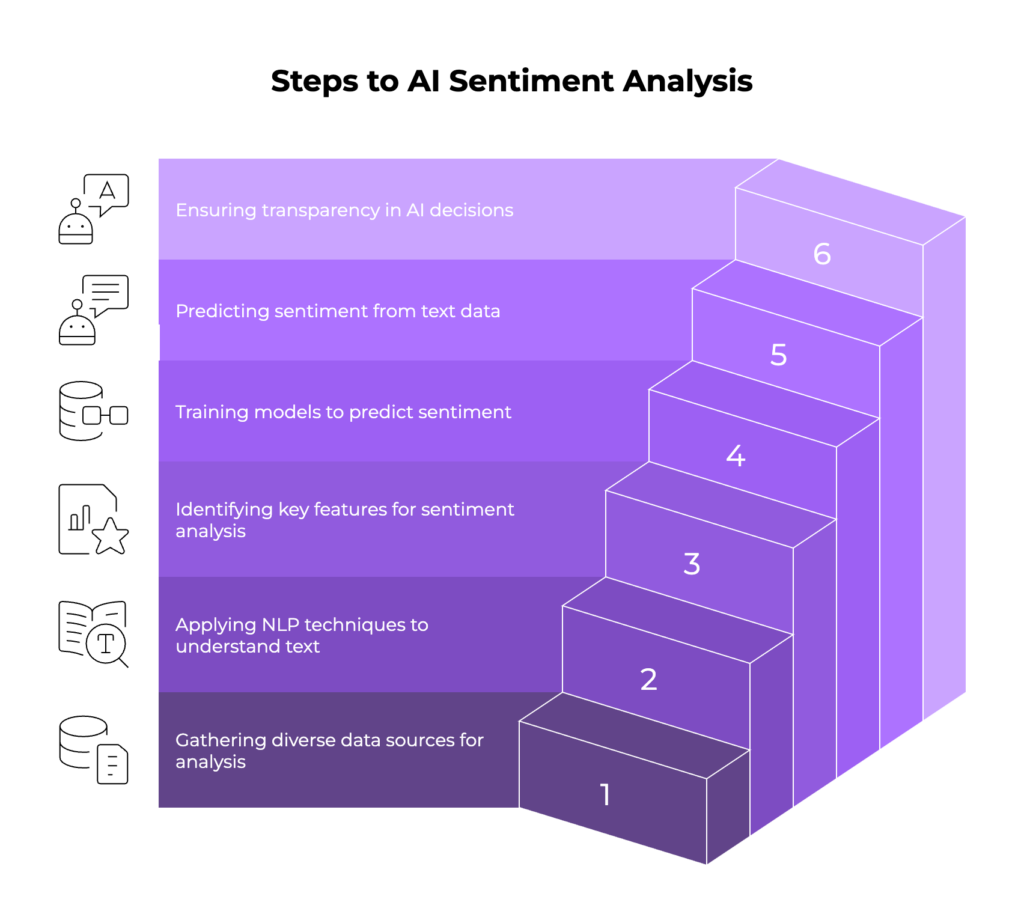
1. Data collection
Text and voice are gathered from reviews, social posts, support tickets, chat logs, emails and call recordings. This raw data is large and noisy, so it needs cleaning before analysis.
2. Natural language processing
NLP techniques tokenise text, tag parts of speech, and identify entities and syntax. This is where the model starts to grasp negation, sarcasm and intensity rather than just spotting keywords. Transformer models such as BERT, RoBERTa and the GPT family are now the standard engines for this step.
3. Feature extraction
The system pulls out signals that correlate with sentiment: keywords, emoji, punctuation, degree words (“very,” “slightly”), n-grams, and — for speech — phonetic features like pitch.
4. Model classification
Early systems relied on lexicon-based methods (sentiment dictionaries) or classic classifiers like Naive Bayes and SVM, both of which needed heavy manual tuning. Modern systems use deep learning — RNNs, LSTMs and CNNs, and especially transformers — which capture context and word relationships far more accurately.
5. Sentiment prediction and explainability
The model outputs a classification: binary (positive/negative), fine-grained (very positive to very negative), or multi-label emotions. Mature systems add explainable AI (XAI) techniques such as attention mapping or SHAP so teams can see which words drove a score — critical in regulated fields like healthcare and finance.
Types of sentiment analysis
“Sentiment” is not one thing. The main types each answer a different question:
- Fine-grained (polarity) analysis — scores sentiment on a scale from very positive to very negative, instead of a simple like/dislike.
- Emotion detection — identifies specific feelings such as joy, anger, sadness or fear, often using emoji and slang to sharpen accuracy.
- Aspect-based sentiment analysis (ABSA) — ties sentiment to a specific feature: “battery life,” “checkout speed,” “agent friendliness.” This is where the most actionable insight lives.
- Intent analysis — reads the motive behind the text: buying intent, a complaint, a query or appreciation — ideal for routing in support and sales.
- Multimodal analysis — combines text, voice tone and facial expression for a fuller read, used in call centres and video feedback.
AI sentiment analysis examples
The fastest way to understand the technology is to watch it score real customer language. Here are four examples that show where it shines — and where context matters most:
| Customer text | Sentiment (score) | Why it’s tricky |
| “Honestly, the new dashboard is incredible. It saved my team hours this week.” | Positive (+0.92) | Strong positive adjectives and a concrete benefit. Easy for any model to score. |
| “The product is fine, I guess. It does what it says.” | Neutral / weak (+0.10) | Faint praise. Lexicon tools may over-score “fine”; context-aware models read the hesitation. |
| “Great. Another outage. Exactly what I needed today.” | Negative (−0.70) | Sarcasm. Surface words look positive; only intent-aware models catch the real sentiment. |
| “Support took three days to reply, but they fixed it perfectly.” | Mixed (aspect-based) | Speed = negative, resolution = positive. Aspect-based analysis separates the two. |
The last two rows are the important ones. A keyword-counting tool would mislabel the sarcastic outage message as positive, and would miss that the support example contains two opposite sentiments about two different things. Context-aware, aspect-based models are what separate a useful system from a vanity metric.
Key Types of AI Sentiment Analysis

Not all sentiment is created equal. From detecting raw emotions to analyzing product-specific gripes, AI sentiment analysis comes in many forms each with a unique job.
Within the umbrella of AI Sentiment Analysis, several distinct but interrelated subtypes exist, each unlocking different insights:
Fine-Grained Sentiment Analysis
Also called polarity detection, this method assigns sentiment values along a continuum such as very positive, positive, neutral, negative, very negative. This granularity aids nuanced understanding beyond simple like/dislike.
Emotion Detection
Emotion detection identifies specific feelings such as joy, anger, sadness, fear, surprise, etc. This is valuable in gauging customer emotional states, detecting frustration or enthusiasm in support calls, and influencing real-time responses.
Techniques here use NLP-based semantic cues or classification algorithms trained on annotated emotional datasets, often incorporating emoticons and slang to improve detection accuracy.
Aspect-Based Sentiment Analysis (ABSA)
ABSA zooms in on particular product or service attributes within text, assessing sentiment specific to these aspects—for example, battery life of a phone, customer service response, or food quality. This granular perspective enables businesses to pinpoint exact strengths and weaknesses in their offerings.
Intent Analysis
Often coupled with sentiment analysis, intent detection digs into the underlying motives behind text, such as buying intent, complaint, query, or appreciation. Understanding intent helps tailor automated workflows in customer service or marketing, such as routing inquiries or offering targeted promotions.
Multimodal Sentiment Analysis
Integrating multiple data modalities—text, voice tone, facial expressions, gestures—this approach goes beyond words to deeply interpret customer emotions, beneficial for call centers and video-based feedback.
How AI sentiment analysis improves customer experience
For customer support and CX teams, sentiment analysis is not a reporting feature — it is an early-warning system. Applied to support conversations, it can:
- Surface at-risk customers in real time — flag frustration in a live chat or ticket so an agent or manager can step in before the relationship is lost.
- Prioritise the queue by emotion, not just age — route the angriest or highest-stakes conversations to your best agents first.
- Coach agents objectively — score tone across every interaction instead of a handful of manually reviewed calls, and give live prompts during conversations.
- Close the loop on VOC — trigger follow-up after negative interactions and feed recurring complaints back to product and ops.
Because support tickets are where dissatisfaction shows up first and most honestly, a helpdesk is one of the highest-value places to run sentiment analysis. Platforms like Kayako apply it directly to email, chat and ticket streams, so emotion is visible inside the same workflow your team already uses — no separate analytics tool required.
Chatbot sentiment analysis
The same technology powers smarter automation. Chatbots use NLP-based sentiment and intent detection to understand how a customer feels mid-conversation — not just what they asked. When a bot detects rising frustration, it can change its tone, escalate to a human, or skip the script entirely. That single capability is what separates a chatbot customers tolerate from one they trust.
Spot frustration before it becomes churn. Book a Kayako demo →
Common Use Cases and Applications of AI Sentiment Analysis
From defusing angry customers to informing product design, sentiment insights power decisions across industries. Here’s where the technology gets real.
The transformative potential of AI Sentiment Analysis spans across multiple industries and use cases:
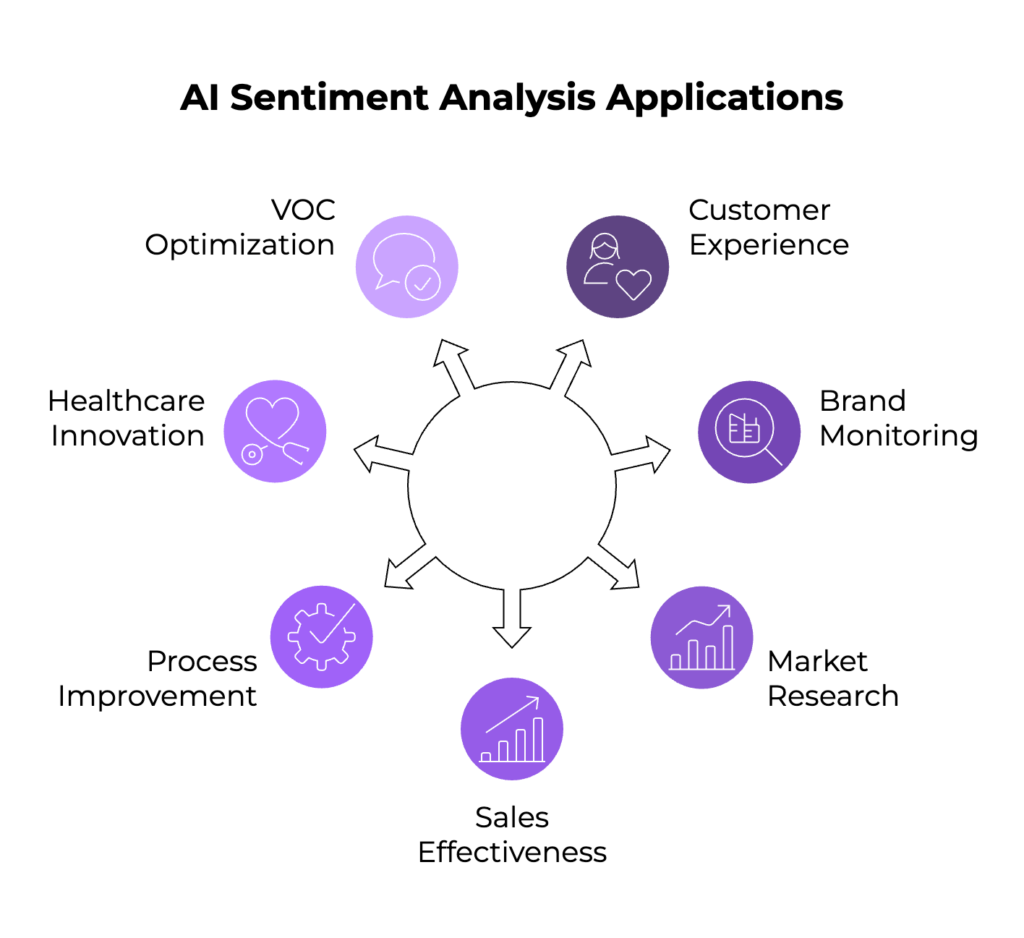
Customer Experience and Support
By scanning all customer interactions, sentiment models identify clients exhibiting dissatisfaction or frustration, allowing proactive outreach. Real-time sentiment scoring during calls provides agents with cues and coaching prompts to handle conversations more effectively.
Brand Monitoring and Reputation Management
Sentiment analysis continuously monitors social media mentions, reviews, and news coverage to detect shifts in public opinion and emerging issues, helping PR teams quickly respond and manage crises.
Market Research and Product Development
Companies analyze consumer opinions on features, quality, pricing, and support to guide product enhancements and strategic positioning based on authentic voice-of-the-customer insights.
Sales Effectiveness
Sentiment around sales processes, pitch quality, and objections can be analyzed to refine sales strategies and training programs, boosting conversion rates.
Process Improvement
Identifying sentiment trends related to operational inefficiencies reveals root causes behind negative experiences, enabling targeted process reengineering.
Healthcare and Social Innovation
Sentiment models are applied in medical patient forums for monitoring public health sentiment or in community programs to assess engagement and impact, as demonstrated through comparative AI-human analysis of community transcripts (Crave program study).
Voice of the Customer (VOC) and Survey Optimization
Sentiment from unstructured feedback supplements traditional survey methods, enabling adaptive surveys deployed post-negative interactions, increasing response rates and closing feedback loops more efficiently.
Best AI sentiment analysis tools in 2026
The right tool depends on what you are analysing and who is doing the work. Social teams, developers, enterprise CX leaders and support managers all need different things. Here is how the main categories compare:
| Tool / platform | Best for | Category |
| Kayako | Customer support & helpdesk — real-time emotion detection across tickets, email and live chat | Support / CX platform |
| SentiSum, Chattermill | Tagging and analysing support tickets and VOC feedback | CX analytics |
| Sprout Social, Brandwatch | Social media listening and brand reputation monitoring | Social listening |
| Google Cloud Natural Language, AWS Comprehend, Azure AI Language | Building custom, developer-led analysis pipelines | Cloud NLP API |
| IBM Watson NLU | Enterprise NLP with emotion and keyword extraction | Enterprise NLP |
| Hugging Face Transformers (BERT, RoBERTa) | Training and self-hosting your own models | Open source |
| ChatGPT, Claude (LLMs) | Flexible, prompt-based ad-hoc analysis without a fixed pipeline | Generative AI |
| NICE, Qualtrics, Medallia | Contact-centre analytics and experience management | Enterprise CX |
How to choose: match the tool to the data. If you mostly analyse social mentions, a social-listening platform fits. If your team lives in support tickets and live chat, a customer-support platform with built-in sentiment keeps the insight where you act on it. If you need full control and have engineering resource, open-source models or a cloud NLP API give you the most flexibility — at the cost of building and maintaining the pipeline yourself.
Free and online options
If you just want to test the concept, several free and browser-based sentiment analysis tools let you paste text or upload a file and see scores instantly, with no setup. They are perfect for a quick proof of value. For production use — high volume, real-time alerts, integration with your support stack — you will quickly outgrow a free demo and want a dedicated platform.
Can you use ChatGPT for sentiment analysis?
Yes. Large language models like ChatGPT and Claude are surprisingly capable general-purpose sentiment analysers. With a clear prompt, they can classify polarity, detect specific emotions, and even explain their reasoning — often without any training data. For one-off analysis, exploration, or processing a few thousand comments, an LLM is fast and flexible.
The trade-offs matter, though. LLMs can be inconsistent across runs, are harder to audit than purpose-built classifiers, raise data-privacy questions when you paste customer data into a public tool, and get expensive at scale. For ad-hoc analysis, reach for an LLM. For continuous, high-volume, real-time monitoring inside your support workflow, a dedicated sentiment system is more reliable and easier to govern.
How accurate is AI sentiment analysis (and where it struggles)
Accuracy varies widely by approach. Simple keyword- or lexicon-based models are often only 50–80% accurate — unreliable on their own. Modern transformer-based models perform substantially better, but no system is perfect, because human language is genuinely hard. The recurring challenges:
- Sarcasm and irony — “great, another outage” still trips up many models.
- Context and culture — idioms, slang and cultural nuance don’t transfer across domains or languages.
- Domain gaps — a model trained on general text underperforms on your industry’s vocabulary without fine-tuning.
- Black-box opacity — deep models can be hard to explain, which matters for compliance.
- Data bias — subjective training labels can propagate into predictions.
The practical answer is a hybrid approach: let AI handle scale and consistency, and keep humans in the loop for ambiguous, sensitive or high-stakes cases. That combination beats either one alone.
Where AI sentiment analysis is heading
The market is growing fast, and the technology is moving beyond simple polarity scoring toward:
- Emotionally intelligent LLMs — models prompted to recognise subtle emotional cues and respond with more empathy.
- Explainable, trustworthy AI — interpretable models that balance accuracy with transparency for regulated use.
- Multimodal analysis — combining text, voice prosody and facial expression for a fuller emotional read.
- Predictive sentiment — not just interpreting past feedback, but forecasting churn risk and behaviour so teams can intervene early.
Best Practices and Tips for Implementing AI Sentiment Analysis

Buying the tech is easy. Using it well? That’s the difference between real insight and dashboard noise. Here’s how to do it right.
Successful deployment hinges on thoughtful strategy:
- Define Clear Objectives: Know what you want to measure (customer satisfaction, product feedback, intent detection).
- Use Diverse Data Sources: Combine reviews, social media, voice interactions, and surveys for comprehensive views.
- Invest in Quality Training Data: Annotate data carefully, accounting for domain-specific language and cultural nuances.
- Incorporate Explainability: Use XAI techniques to understand model decisions and build user trust.
- Continuously Monitor Model Performance: Regularly assess AI against human benchmarks, especially for complex language constructs.
- Leverage Aspect-Based and Intent Analysis: For more actionable insights and targeted responses.
- Enable Real-Time Insights: Integrate sentiment scoring into live customer interactions for proactive engagement.
- Blend AI with Human Oversight: Use hybrid approaches to check AI misclassifications, especially for ambiguous or sensitive content.
- Adapt Surveys Based on Sentiment: Deploy targeted outreach following negative sentiment interactions to close feedback loops.
- Plan for Multilingual and Multimodal Scalability: Include provisions for voice, video, and international markets.
You’ve got the tech and the tactics; so what’s next? Let’s peek into the future of AI sentiment analysis.
Frequently asked questions about AI sentiment analysis
What is AI sentiment analysis?
AI sentiment analysis is the use of NLP and machine learning to automatically classify the emotional tone of text or speech as positive, negative or neutral, and to detect specific emotions. It turns unstructured feedback — reviews, chats, calls — into structured data businesses can act on.
Can I use ChatGPT for sentiment analysis?
Yes. ChatGPT and other LLMs can classify sentiment and emotion from a prompt, with no training data, and can explain their reasoning. They are great for ad-hoc analysis but less consistent and harder to govern than dedicated tools for continuous, high-volume monitoring.
Which AI is best for sentiment analysis?
There is no single best AI — it depends on your use case. Social teams favour social-listening platforms; developers use cloud NLP APIs or open-source transformer models; support and CX teams get the most value from a helpdesk with built-in sentiment analysis, where insight sits inside the workflow.
How accurate is AI sentiment analysis?
Basic keyword-based tools are often 50–80% accurate, while modern transformer models perform considerably better. Accuracy drops on sarcasm, idioms and domain-specific language, which is why a human-in-the-loop hybrid approach is recommended for sensitive cases.
The bottom line
AI sentiment analysis has moved from a nice-to-have to a core capability for customer-centric teams. It reveals the emotional truth inside your unstructured data — the signal traditional metrics miss — and lets you act on it at a scale humans never could. The teams that win aren’t the ones with the most feedback; they’re the ones who understand it fastest.
For support and CX leaders, the highest-leverage place to start is where customer emotion is rawest and most actionable: your support conversations.
Ready to turn customer emotion into faster resolutions and higher CSAT? Talk to a Kayako expert →