
Discover how white space analysis helps identify untapped market opportunities, close competitive gaps, and drive strategic growth. Learn its benefits, frameworks, and practical use cases
It’s a bright Sunday afternoon, and you have just had a lovely breakfast. You put your feet up and open the much-anticipated headlines in your newspapers.
And suddenly, you read about your favorite conglomerate, which you saw touching great heights in your adolescence, struggling to find an audience today.
All this makes you wonder, “How did it all come to this”?

It could very well be the case that your go-to company failed to adapt to the changing times, and the upcoming changes led by the digital landscape.
Or it could be that their product just didn’t see proper evolution, the way it was supposed to stay competitive.
Or, a new entrant in the market just did the same thing better.
It could be any reason.
But not all is doom, as there’s still a way to regain lost ground. To better understand the dynamics of the market and the consumer base, and to learn what can be done better.
It’s called White Space Analysis.
By definition, a white space analysis template is a strategic process used to identify market gaps based on technology and customer preferences.
The process is approached when the market has reached its saturation point, and companies are on the lookout for that one Eureka moment that makes them the crowd favorite again.
Especially for the ones who just want to read about their preferred company doing well in a Sunday newspaper headline.
In this article, we will explore the key aspects of white space analysis, including its definition, necessity, methodology, and the benefits it offers.
Because changing with the times is necessary, as said beautifully by Mr. Peter Drucker.
“The greatest danger during turbulent times is acting with outdated logic.”

What is White Space Analysis?
No matter how many companies cater to a singular objective, there’s always a grey area that remains unserved.
This can be either a customer’s need that has remained unfulfilled in the market or a use of technology that hasn’t been fully explored.
White space analysis examines the areas where a company can make its efforts count and address use cases that often go unaddressed.
Why White Space Analysis Matters?
From enhancing offerings to better understand their own market, white space analysis remains one of the most effective ways to unearth what’s working and what’s not.
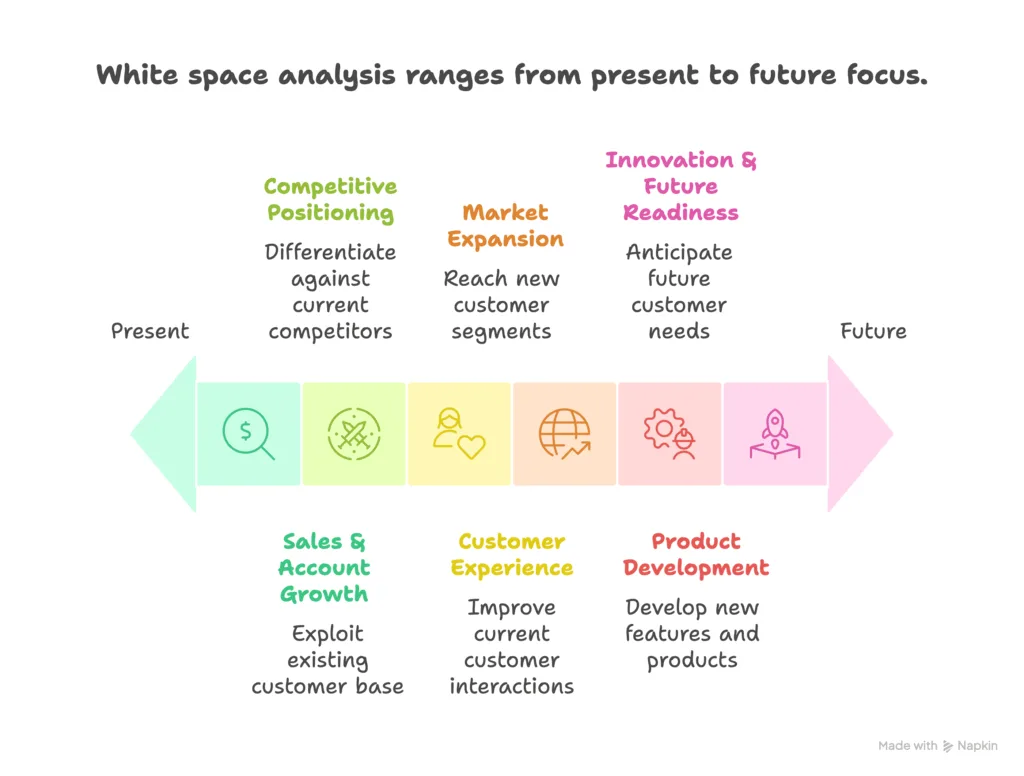
- Product Development: The white space strategy is primarily used in the market to identify missing features customers expect but aren’t available in current solutions.
Upon review, a company can come up with new features or an entirely new line of products to ensure that it doesn’t let go of its stronghold in the market.
The mechanism can also be defined as one of the most essential tools for a company’s research and development process, as it curates entire data sets from real customers.
- Market Expansion: If your product is loved, the next step is to look for a new set of audience that showers you with the same love.
White space analysis helps you identify customer segments underserved by current offerings by pinpointing new geographies, demographics, or industries to target.
It operates on the principle of expanding your core capabilities into an adjacent market that has the potential for similar success.
- Customer Experience: Elevating customer experience is a constant process, one that asks stakeholders to continuously map pain points in the customer journey where current solutions fall short.
White space analysis can help identify areas for improvement in personalization, automation, or self-service options, while also shedding light on after-sales service support or other processes, such as billing.

- Competitive Positioning: While there can be many players in the market, there still will be an area that no one might be addressing.
White space analysis strategy helps you spot the difference that can make your brand stand out.
It could be in the form of better pricing structures, add-ons, or after-sales service, among others.

- Sales & Account Growth: Remember how we mentioned R&D earlier, this is a mere extension of that point, as with deep exploration of customers’ interest, you can know where to upsell or present cross-sell opportunities in existing accounts.
- Innovation & Future Readiness: If you want to stay ahead of the curve, you need to know where you can invest further. When you learn about the market and your competitors thoroughly, you can patent innovation for the future that you know will cater to the upcoming demands of consumers.
The innovation could be anything, from new delivery models and automation to embedding AI layers, among others.
What are the key components of White Space Analysis?
Think of it as navigating both known and uncharted territory. When conducting a white space study, a stakeholder would like to refresh their current knowledge while also updating their knowledge with new information.
This is where these key pillars make the entire study comprehensive:
- Customer Mapping: Before a product is introduced, a company does well to know about its customers. From primary requirements (also known as articulated demands) to secondary requirements (unarticulated demands).
This allows product managers to understand what their user base is looking for, including even the most minute details.
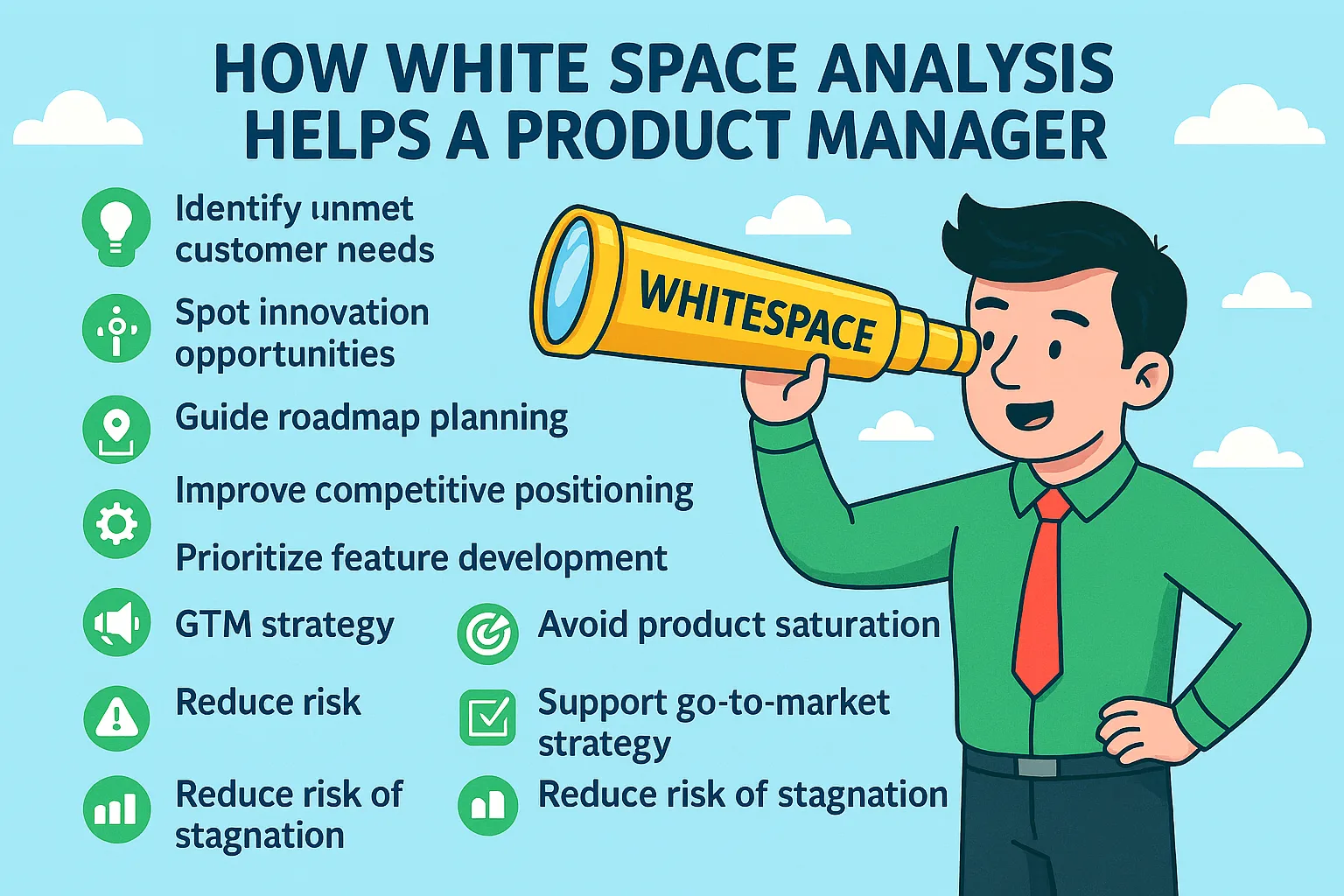
- Competitor offerings assessment: “If you’re a true warrior, competition doesn’t scare you. It makes you better.”
These words by Andrew Whitworth couldn’t be better placed.
An able competitor can help you learn a lot about yourself by understanding the impact of your own product in comparison. You can get to know which features you are lacking and how you can be better in a quick turnaround time.
- Capability evaluation: Another critical aspect is to know how well your resource skillset matches the standards of the market. If there’s an upgrade to be made, consider investing in upskilling before launching your product or service in the market.
- Opportunity sizing: Knowing your potential and how well you can ace the market requirement helps you make the most of the opportunity.
You need to answer a few questions before diving straight into the market, like “Does your company have the scale to go against competitors?”, or “Can you keep up with the demands if your products click with the customers?”
- Validation: You need to study whether the market accepts what you have to offer. From gathering feedback directly from potential customers to understanding their pain points and preferences, your product should thoroughly evaluate all parameters before making its grand debut.
Common Mistakes to Avoid in White Space Analysis Template
Just like any other function, white space analysis’s major contributor to its success is the quality of data used.
The input subsequently leads to the eventual chain reaction of analytics and proactive planning.
When you decide to go ahead with your white space analysis, here are the key pitfalls that you need to avoid:
- Insufficient or biased data: As we mentioned above, data is central to all your success, and this covers having insufficient or biased data that might lead you to make ill-informed decisions.
Using data with insufficient factors may not provide the precise insights you need to expand your services or when developing new product launches.
- Overlooking capability constraints: There’s one thing in identifying a gap and another in knowing whether your company has the capabilities to service that anomaly. It’s always better to be aware of your own skillset before committing to a market need.
- Chasing every gap instead of focusing: There might be instances when you might find many areas or pain points of customers that you can serve. At that time, the wisest thing to do is to prioritize what is best for you, citing your own scale.
Because as a leader, the last thing you want is to spread your operations over many underutilized projects compared to one that is fully committed. - Ignoring customer validation: Once you get your analysis done, it is important to double-check with prospective users to know whether it is what they want. It is a crucial step to confirm the viability or desirability of the identified opportunities.
- Underestimating competitor response/Market Dynamics: Understanding the market is a very dicey process. A strategy that might be working now may not be fruitful afterward.
Therefore, as an organization, it becomes crucial for you to be adaptive when required, keeping in mind your competitors who are also trying to fill the same market gap.
What are some of the prominent tools, templates, and frameworks for white space analysis?
Here’s a brief list of tools, templates, and frameworks that can help you get the best market gap analysis going for you.
Frameworks
- SWOT + Gap Analysis: The most grounded methodology that helps you understand the opportunities with real-time competition in context to market gaps. An essential step to gain a comprehensive understanding of the opportunity.
- Jobs-to-Be-Done (JTBD): This framework helps you understand the details to the last bit, making you know the services that users want you to cater to.
It’s a customer-centric theory that outlines the necessity of services to get desired outcomes.
- Ansoff Matrix: Crucial framework from a product launch perspective, the Ansoff Matrix covers: Market Penetration, Product Development, Market Development, and Diversification.
All stages range from product launch to expansion.
Template
Templates demonstrate how effectively you can identify market gaps through text or visuals.
- Visual Maps: One of the most prominent white space mapping techniques, companies often use visual aids to highlight market gaps, customer needs, and competitor offerings. It also covers other parameters like affluence, median age, etc.
- Market Opportunity Templates: It’s a simple layout technique that covers information through FAQ formatting or presentation. Leadership mostly prefers this template for internal use.
Tools
White space analysis is based on the data provided. And these are the tools that can help you attain that.
- Customer insight tools like Quantilope, SurveyMonkey, and Typeform are used for collecting feedback and to check for unmet needs.
- You get competitive intelligence with tools like Crayon and SimilarWeb, which mine data for proactive intelligence.
Image content reference
- Unilever: https://www.imd.org/research-knowledge/strategy/case-studies/unilever-opportunities-in-the-white-spaces/
- Sleepyhug: https://www.growthjockey.com/blogs/whitespace-analysis-how-sleepyhug-identified-and-captured-a-d2c-space
- Strop Insights: https://www.strop.com/case-studies/brand-performance-white-space-analysis
For a market to evolve, its contributors must also evolve.
This means staying ahead of the curve by understanding what users want, identifying areas for improvement, pinpointing exact pain points, and, most importantly, actively listening to feedback.
All this framework is engulfed in a detailed white space analysis, which, if done methodically, can place a company not only ahead of competitors but at the top rankings of user satisfaction metrics.
While we have listed all the essentials to keep in mind when proceeding with the analysis, the most important thing to remember is to start at a smaller level with accurate information.
Make the most of the template, seek out feedback, and employ it in your product development. Continue to refine it until it strikes the perfect note that users have always been seeking.
Remember that innovation works better if your strategy is backed by data and active user feedback.
FAQs
1.What is white space analysis?
White space analysis can be defined as a strategic process that helps businesses identify unmet customer needs, unexplored markets, or product opportunities.
It is done by studying market trends, competitor offerings, insights, and customer behavior. This is very much helpful in placing an organization ahead when launching a new product, expanding services, or entering new markets.
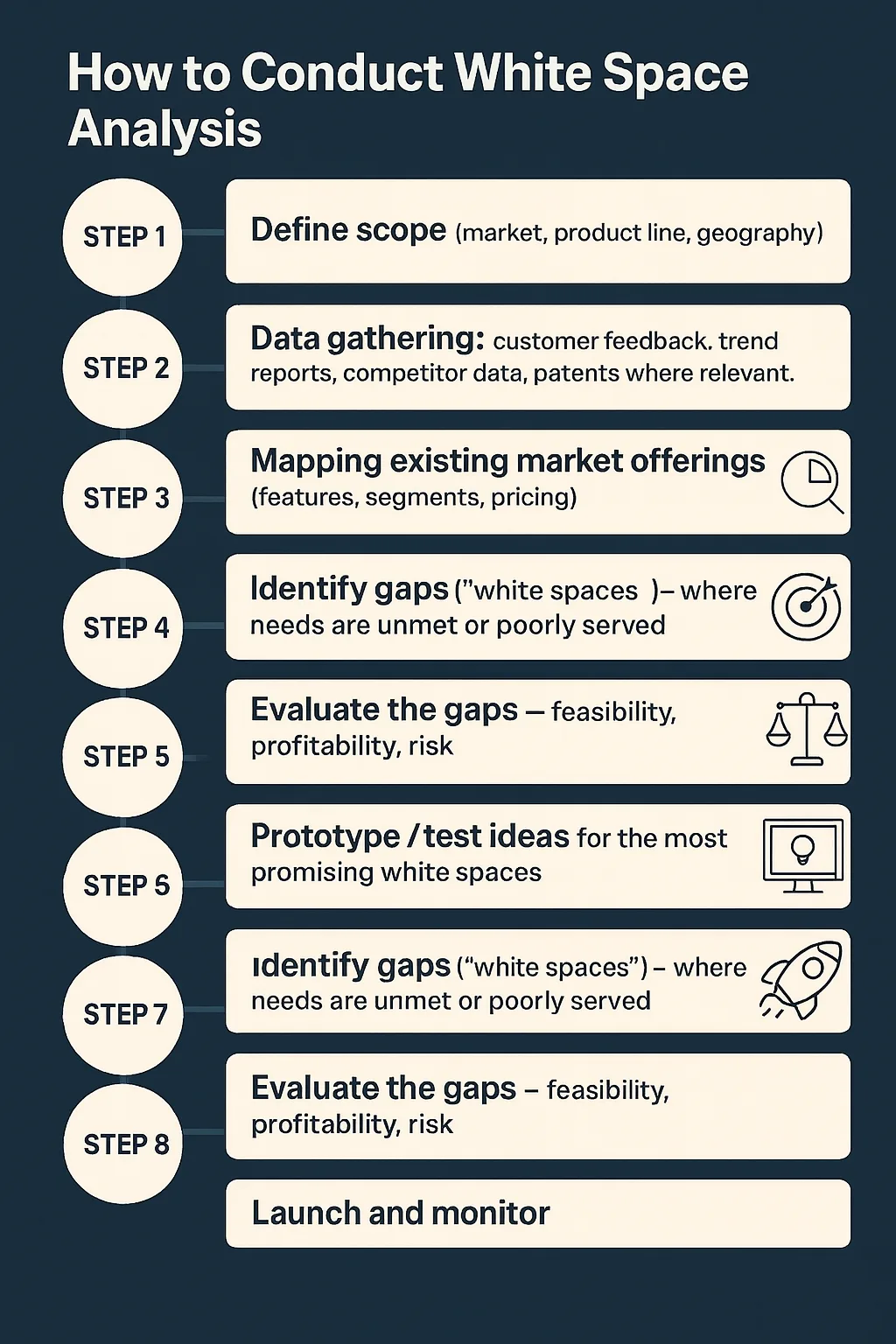
2. What are the most important steps in White Space Analysis?
Here are some of the essential steps you need to keep in mind for the white space analysis template:
- Market Research: Accumulate data that covers customer pain points, preferences, and emerging trends of the market.
- Competitive Benchmarking: Know what your competitors are doing well. Evaluate to understand if there is market saturation or not.
- Gap Identification: Look for underserved segments or unmet customer needs.
- Customer Validation: Use surveys or focus groups to test ideas and validate whether the demands still exist.
- Strategic Action: Build a perfect GTM strategy, listen to feedback, and make changes as and when required.
3. What are common mistakes to avoid in white space analysis?
Some frequent mistakes include:
- Relying on incomplete research or assumptions rather than active user feedback.
- Ignoring competitor, their strategies, their stronghold, and market saturation.
- Failing to validate opportunities with potential users.
- Misreading the market by overestimating the reach of your own resources.
A leadership that keeps these pointers in mind can have a white space analysis that benefits them while being realistic.