ManyChat built its name on one thing. It automates direct messages on Instagram, Facebook Messenger, and WhatsApp. ManyChat reports more than one million businesses use its platform. For creators running comment-to-DM campaigns and small e-commerce teams sending broadcasts, that is often enough.
Then the business grows. Conversations get more complex. Customers expect real answers, not scripted button flows. ManyChat starts to feel like a ceiling.
That is when teams start searching for a ManyChat alternative. Some want sharper Instagram DM automation. Some want an open-source bot they can host themselves. Many want something ManyChat was never built to do, which is to resolve customer support at scale.
As the VP of customer support, I have faced this one to many times. And I think its about time I put my thoughts down on paper.
I tested 13 alternatives across that full range. I ranked them on AI quality, ease of use, channels, lead and ticket handling, and real results. This guide is organized the way buyers actually shop, by use case, so you can jump straight to the tool that fits your job.
The shift is already underway. 75% of CX leaders expect 80% of customer interactions to be resolved without a human agent within the next few years, according to Zendesk CX Trends research. The tool you pick now should be ready for that, not stuck in a Messenger bubble.
See Kayako resolve tickets autonomously Book Session >
How I tested these ManyChat alternatives
I did not just read marketing pages. I signed up for trials, built real bots, connected integrations, and measured how each tool performed against the jobs people hire ManyChat for.
I scored every platform on six things:
- Ease of use. Can a non-technical user get value fast.
- Marketing and conversation automation. Does it move leads, not just look busy.
- Integration support. Does it connect to the stack you already run.
- Can you shape the bot and the flows to your brand.
- Live chat and human handoff. Because some conversations still need a person.
- Real performance data, not vanity metrics.
I also weighted pricing transparency. Hidden per-contact costs were the most common complaint I found across reviews.
ManyChat alternatives at a glance
Here is the full shortlist before the in-depth reviews. Kayako leads because it solves the problem most teams hit when they outgrow ManyChat, which is resolving support volume without adding headcount.
| Tool | Rating | Best for | Starting price | Free plan | AI |
| Kayako | 4.7 | Autonomous customer support at scale | $79/seat + $1 per resolved ticket | No | Yes |
| Tidio | 4.7 | E-commerce live chat and chatbots | Free; from $24.17/mo | Yes | Yes |
| Chatfuel | 4.5 | Simple Facebook Messenger bots | Free; from $14.99/mo | Yes | Limited |
| SetSmart | 4.8 | AI lead qualification and call booking | From $99/mo | Trial | Yes |
| Customers.ai | 4.0 | Multi-channel marketing automation | From $199/mo | No | Basic |
| Landbot | 4.5 | Conversational landing pages | Free; from $45/mo | Yes | Limited |
| Botpress | 4.6 | Open-source, developer-built bots | Free self-hosted; usage cloud | Yes | Yes |
| Meta Business Suite | 3.5 | Free, basic auto-replies | Free | Yes | No |
| Respond.io | 4.4 | Multi-channel team inboxes | From $79/mo | Trial | Basic |
| Salesloft Drift | 4.4 | B2B conversational sales | Custom (from ~$2,500/mo) | No | Yes |
| Intercom | 4.5 | Product-led customer communication | From $39/seat/mo | Trial | Yes |
| HubSpot Chatbot Builder | 4.4 | CRM-connected automation | Free; from $20/mo | Yes | Limited |
| GoHighLevel | 4.6 | Agencies running client campaigns | From $97/mo | Trial | Limited |
Why look for a ManyChat alternative
ManyChat is a capable marketing tool. It also has clear limits that push growing teams to look elsewhere.
- Flow-based, not truly conversational. ManyChat runs on decision trees. When a prospect says something off-script, the bot breaks or sends a generic fallback.
- No real qualification or resolution. It collects data through forms. It does not understand intent or resolve a support issue end to end.
- Tied to the Meta ecosystem. Strong on Instagram and Messenger, weak on website chat, email, and voice.
- Pricing scales with contacts. Costs climb as your audience grows, even for contacts who never convert.
- Thin support features. No ticketing, no unified customer context, no agent workflows.
Customer behavior is moving the other way. 62% of consumers would rather use a chatbot than wait for a human agent, and 82% of shoppers are more likely to buy from brands that deliver omnichannel conversational experiences. A single-channel DM tool leaves that demand on the table.
What Real Users Say About ManyChat (Reddit Sentiment)
- “It got expensive fast.” The most common complaint isn’t the entry price — it’s the scaling curve. Users describe starting on the free tier, jumping to Pro at a few thousand contacts, then watching the bill climb past $100–$200/month within a year.
- “Support is thin.” Multiple threads describe slow response times from ManyChat support, particularly during account or billing issues. For a tool that markets itself on conversation automation, the meta-complaint isn’t lost on Reddit.
- “Botpress for devs, SuperProfile for creators, Wati for WhatsApp.” When other Redditors ask for recommendations, those three names come up more than any others. It’s a useful map of the buyer split the rest of this article walks through.
The 13 best ManyChat alternatives in 2026
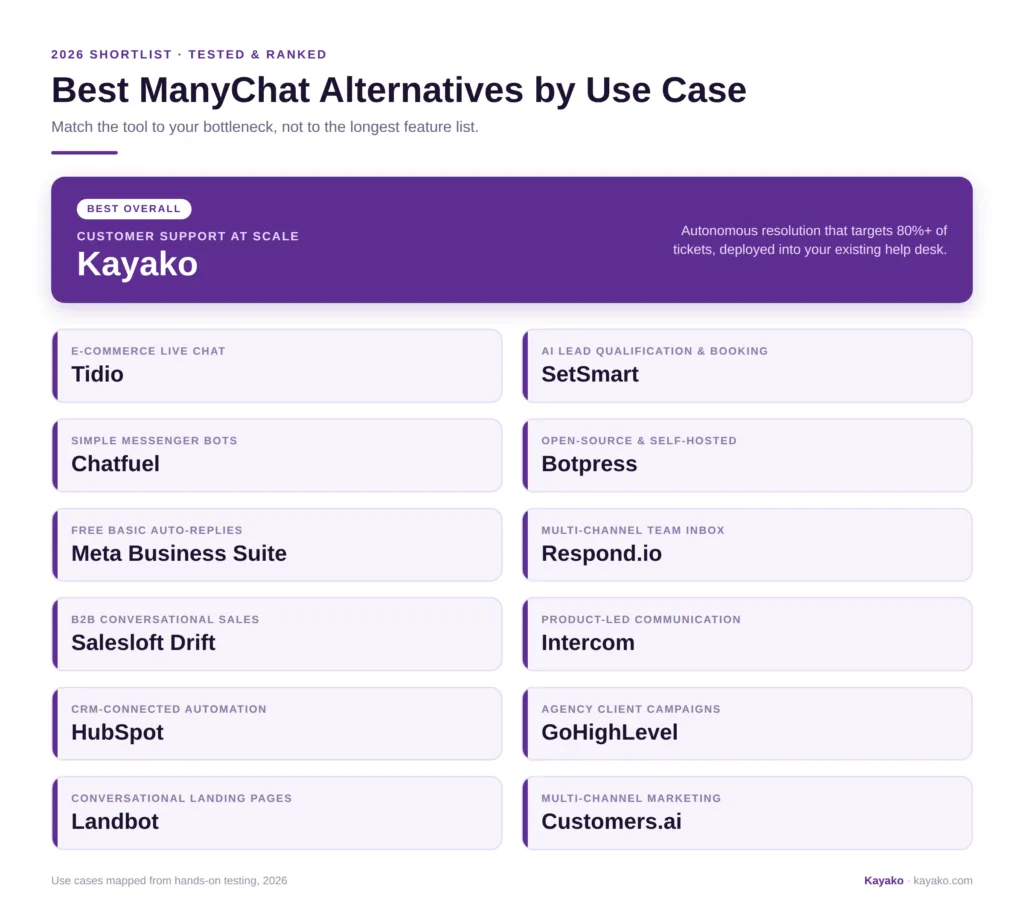
Each tool below is rated for a specific job. Match the tool to your bottleneck, not to the longest feature list.
1. Kayako: Best for autonomous customer support at scale
Kayako is the number one alternative for any team that outgrew ManyChat because support volume, not marketing, became the bottleneck. It is not a chatbot bolt-on. It is an autonomous resolution platform that deploys into your existing help desk and resolves tickets across every channel.
Key features
- Agent Kay resolves tickets autonomously across email, live chat, voice, and social
- SingleView gives every conversation a unified customer timeline, not just contact fields
- AI Triage auto-classifies, prioritizes, and routes tickets through automation workflows
- Omnichannel support that includes social media and e-commerce
- A knowledge base and integrations that keep answers consistent and connected
Pros: Built for autonomous resolution, targeting 80% and above. Deployed for you, not left for you to configure. Per-resolution pricing aligns cost with value.
Cons: Built for support operations, not Instagram marketing funnels. Best suited to mid-market teams with real ticket volume.
Pricing: 90-day pilot from $15K including platform and services, then $79 per seat plus $1 per AI-resolved ticket.
See pricing. A Backlog Breakthrough Guarantee returns your fee if there are no measurable results.
Rating: 4.7/5 from 100+ G2 reviews
Versus ManyChat: ManyChat automates marketing messages. Kayako resolves customer issues. If your pain is ticket backlog, rising costs, and slow replies, Kayako is the obvious move. Compare it directly on the Compare Kayako page.
Scale support without adding headcount Talk to Expert >
2. Tidio: Best for e-commerce live chat and chatbots
Tidio pairs a clean live chat widget with chatbots and its Lyro AI agent, which makes it a favorite for Shopify and WooCommerce stores that want support and sales in one place.
Key features
- Drag-and-drop chatbot builder with ready-made templates
- Lyro AI agent for automated, natural responses
- Shopify and WooCommerce integrations
- Live chat with smooth bot-to-human handoff
Pros: Generous free plan. Strong e-commerce fit. Easy for non-technical teams.
Cons: Built for website chat first, social DMs are secondary. Advanced automation sits on higher tiers.
Pricing: Tidio is free to start, with paid plans from $24.17 per month.
Rating: 4.7/5 on G2
Versus ManyChat: Tidio beats ManyChat for website support and AI-assisted replies. ManyChat still wins for pure social broadcast campaigns.
3. Chatfuel: Best for simple Facebook Messenger bots
Chatfuel is one of the oldest Messenger bot builders and remains a solid pick for straightforward automation on Facebook and Instagram.
Key features
- Visual no-code flow builder
- Strong Facebook Messenger integration
- Template library for quick setup
- Basic AI responses for common queries
Pros: Beginner friendly. Cheaper than ManyChat. Free plan for low volume.
Cons: Still primarily flow-based. No in-chat booking or real qualification.
Pricing: Chatfuel is free to start, with Pro from $14.99 per month.
Rating: 4.5/5 on G2
Versus ManyChat: Chatfuel is a lighter, cheaper ManyChat. It shares the same core limit, which is scripted flows that break off-script.
4. SetSmart: Best for AI lead qualification and call booking
SetSmart is an AI setter rather than a chatbot. It uses generative AI to hold natural DM conversations, qualify leads, and book calls inside Instagram, WhatsApp, and Messenger. It is popular with coaches, course creators, and agencies.
Key features
- GPT-powered conversations that adapt to each prospect
- Built-in lead qualification against your criteria
- Appointment booking inside the DM, no external link
- Automatic AI follow-ups and comment-to-DM
Pros: Natural, human-like conversations. Books calls without leaving the chat. Fast setup.
Cons: Priced for sales teams, not support. Focused on social DMs only.
Pricing: From $99 per month after a 7-day trial.
Rating: 4.8/5
Versus ManyChat: SetSmart fixes ManyChat’s biggest weakness for creators, which is rigid flows. It is a sales tool, not a support platform.
5. Customers.ai (formerly MobileMonkey): Best for multi-channel marketing automation
Customers.ai is the rebrand of MobileMonkey. It pivoted from pure chat automation toward a broader marketing suite with website visitor identification, email, and SMS outreach.
Key features
- Multi-channel outreach across chat, email, and SMS
- Website visitor identification for B2B
- Ad retargeting integrations
- Audience segmentation
Pros: Useful for B2B lead generation. Combines several outreach channels.
Cons: Moved away from pure DM automation. Complex pricing. Overkill for simple DM needs.
Pricing: Customers.ai starts at $199 per month for the marketing suite.
Rating: 4.0/5 on G2
Versus ManyChat: If you only need DM automation, this is heavier and pricier than ManyChat. It suits B2B teams that want visitor identification.
6. Landbot: Best for conversational landing pages
Landbot replaces static forms with conversational landing pages. It is built for capturing and qualifying leads through interactive flows on web, WhatsApp, and Messenger.
Key features
- Conversational landing pages instead of forms
- No-code builder for branching logic
- 500+ app integrations through Zapier
- Multi-channel deployment
Pros: Engaging form alternative. Flexible branching. Customizable UI.
Cons: Still flow-driven. Limited native support features.
Pricing: Landbot is free to start, with paid plans from $45 per month.
Rating: 4.5/5 on G2
Versus ManyChat: Landbot wins for lead capture experiences. ManyChat wins for ongoing social broadcast and comment automation.
7. Botpress: Best for open-source, developer-built bots
Botpress is the most-recommended open-source ManyChat alternative for technical teams. It combines visual flow building with full code-level control, and offers both self-hosted and managed cloud options. Rasa and Tock are similar open-source routes for teams with engineering capacity.
Key features
- Self-hostable open-source runtime
- Code-level extensibility for custom logic
- Knowledge ingestion from sites, PDFs, and docs
- Integrations with WhatsApp, Telegram, and more
Pros: Full control over bot logic. No per-contact pricing on self-hosted. Strong developer community.
Cons: Requires engineering resources. More setup than no-code tools.
Pricing: Botpress is free when self-hosted, with usage-based cloud plans.
Rating: 4.6/5 on G2
Versus ManyChat: Botpress is for teams who want to own and extend their bot. ManyChat is for marketers who want speed over control.
8. Meta Business Suite: Best for free, basic auto-replies
Meta Business Suite is Meta’s own free tool for managing Instagram and Messenger, including basic automated replies, away messages, and FAQ responses. It is the simplest free ManyChat alternative.
Key features
- Automatic replies and away messages
- FAQ responses
- Native Instagram and Messenger management
- No third-party tool required
Pros: Completely free. Reliable, it is Meta’s own. Easy to set up.
Cons: Very limited automation. No AI or qualification. No follow-ups or booking.
Pricing: Meta Business Suite is free.
Rating: 3.5/5 (basic by design)
Versus ManyChat: Meta’s native tools cover simple auto-replies. ManyChat adds flows and broadcasts on top, which is why people upgrade.
9. Respond.io: Best for multi-channel team inboxes
Respond.io is a conversational platform for teams handling high message volume across many channels. It is closer to a shared inbox with automation than a marketing bot.
Key features
- Unified inbox across WhatsApp, Instagram, Messenger, and Telegram, similar in spirit to a shared inbox
- Team collaboration with assignments and notes
- Workflow automation builder
- API access for custom integrations
Pros: Strong multi-channel inbox. Good for support teams. Flexible automation.
Cons: Expensive for solo users. Automation is mostly rule-based. Steeper learning curve.
Pricing: Respond.io starts at $79 per month.
Rating: 4.4/5 on G2
Versus ManyChat: Respond.io centralizes conversations for teams. ManyChat focuses on marketing automation for one or two channels.
10. Salesloft Drift: Best for B2B conversational sales
Drift, now part of Salesloft, is built to turn website visitors into sales conversations. Its bots qualify leads and book meetings automatically, which suits B2B teams with a high-value pipeline.
Key features
- AI bots that qualify and book meetings
- Playbooks for personalized engagement
- Smart routing based on visitor data
- Pipeline-focused analytics
Pros: Strong for B2B sales. Meeting booking automation. CRM integrations.
Cons: Premium pricing. Overbuilt for simple needs.
Pricing: Salesloft Drift uses custom pricing, typically from around $2,500 per month.
Rating: 4.4/5 on G2
Versus ManyChat: Drift is built for sales conversations and pipeline. ManyChat is built for marketing broadcasts and DM funnels.
11. Intercom: Best for product-led customer communication
Intercom blends support, in-app messaging, and its Fin AI agent into one platform. It is a strong fit for product-led businesses that guide users through onboarding and adoption.
Key features
- Fin AI agent for automated resolutions
- In-app messaging for product adoption
- Multi-channel support inbox
- Advanced segmentation
Pros: Polished product experience. Good AI resolution. Deep customization.
Cons: Costs climb quickly. Steeper learning curve.
Pricing: Intercom starts at $39 per seat per month, with usage-based Fin pricing. See our Intercom alternatives guide for a closer look.
Rating: 4.5/5 on G2
Versus ManyChat: Intercom delivers full support and product messaging. ManyChat cannot match that depth outside social channels.
12. HubSpot Chatbot Builder: Best for CRM-connected automation
HubSpot’s chatbot builder shines when you already use HubSpot. It connects chat to the full CRM, so interactions are personalized with real customer data and leads are scored automatically.
Key features
- Deep CRM integration
- No-code builder tied to the marketing stack
- Automated lead qualification and scoring
- Reporting connected to broader analytics
Pros: Seamless inside HubSpot. Strong reporting. Free tier available.
Cons: Best value only within HubSpot. Higher tiers get expensive.
Pricing: HubSpot is free to start, with paid plans from $20 per month.
Rating: 4.4/5 on G2
Versus ManyChat: HubSpot connects your chatbot to your entire CRM. ManyChat runs as a standalone social tool with no CRM backbone.
13. GoHighLevel: Best for agencies running client campaigns
GoHighLevel is an all-in-one platform with CRM, funnels, email, SMS, and chat automation. Agencies white-label it to run campaigns for many clients from one dashboard.
Key features
- All-in-one CRM, funnels, and messaging
- White-label option for agencies
- Built-in calendar and booking
- Active marketplace and community
Pros: Huge feature set. White-label ready. Built-in booking.
Cons: Overwhelming for simple needs. DM automation is not its core strength. Pricey at scale.
Pricing: GoHighLevel starts at $97 per month.
Rating: 4.6/5 on G2
Versus ManyChat: GoHighLevel is a CRM-first platform for agencies. ManyChat is a focused DM tool. They solve different problems.
Kayako vs ManyChat: a feature-by-feature comparison
Since Kayako is the top pick for teams that outgrow ManyChat on support, here is the head-to-head.
| Feature | ManyChat | Kayako |
| Primary use case | Social DM marketing automation | Autonomous customer support resolution |
| Conversation type | Flow-based decision trees | AI resolution with human escalation |
| Channels | Instagram, Messenger, WhatsApp, SMS, email | Email, live chat, voice, social, and your existing help desk |
| Customer context | Limited to contact fields | SingleView unified customer timeline |
| Triage and routing | Not available | AI Triage auto-classifies and routes |
| Complex queries | Breaks or sends a fallback | Agent Kay resolves or escalates with full context |
| Reporting | Marketing flow metrics | Resolution rate, CSAT, and cost per ticket |
| Pricing model | Tiers that scale with contacts | $1 per AI-resolved ticket, no per-seat lock-in |
| Implementation | Self-serve flow building | Done-for-you deployment into your help desk |
| Best fit | Creators and small e-commerce running DM funnels | Mid-market teams scaling support without headcount |
The takeaway is simple. ManyChat asks you to build every conversation path by hand for marketing. Kayako resolves real support conversations for you and learns from each one.
Reset your support cost curve Get Started >
Reviews: what real users say
Where reviewers praise these tools
Across G2 and Capterra, reviewers consistently praise Tidio and Chatfuel for ease of use, Intercom and HubSpot for polish and integrations, and Botpress for control. Kayako reviewers highlight the done-for-you deployment and the measurable drop in backlog and cost per ticket.
Where reviewers raise concerns
The most common complaints follow a pattern. Flow-based tools break when conversations go off-script. Per-contact pricing surprises teams as audiences grow. Enterprise tools carry steep learning curves. These themes line up with the broader data, since 73% of consumers are turned off by slow replies and more than half have abandoned a purchase because of lagging responses. Speed and resolution, not flow length, decide satisfaction.
How to switch from ManyChat without losing momentum
Migrating off ManyChat is straightforward when you sequence it. Use this checklist.
- Map your active flows. List every automation that drives real outcomes, and retire the rest.
- Export contacts and conversation history. Keep your audience and context intact.
- Pick by job, not by hype. Use the table above to match the tool to your bottleneck.
- Reconnect your channels. Link Instagram, Messenger, WhatsApp, email, and your website.
- Rebuild only what earns its place. Recreate high-value flows first, then expand.
- Run both in parallel briefly. Validate results, then sunset ManyChat to avoid double messaging.
How to choose the right ManyChat alternative
The best tool is the one that removes your biggest bottleneck. Use this quick mapping.
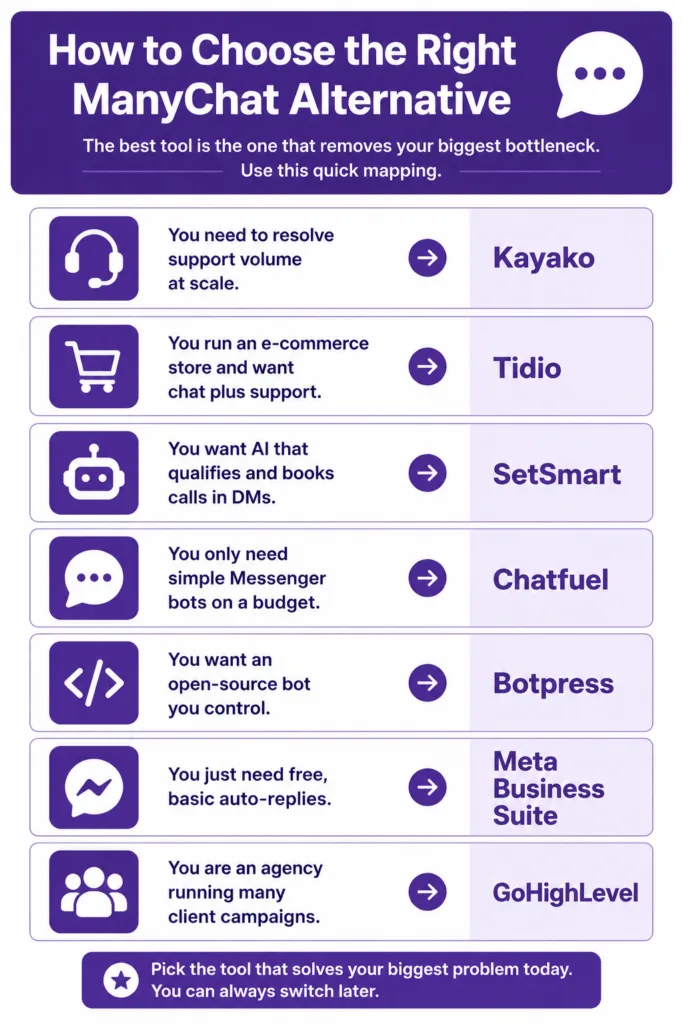
- You need to resolve support volume at scale. Choose Kayako.
- You run an e-commerce store and want chat plus support. Choose Tidio.
- You want AI that qualifies and books calls in DMs. Choose SetSmart.
- You only need simple Messenger bots on a budget. Choose Chatfuel.
- You want an open-source bot you control. Choose Botpress.
- You just need free, basic auto-replies. Choose Meta Business Suite.
- You are an agency running many client campaigns. Choose GoHighLevel.
Be honest about your team’s skill level, your channel mix, and your true cost at scale. Then test before you commit.
Which ManyChat Alternative Should You Pick?
Don’t start with feature lists – start with your use case. The right tool depends on what you’re actually trying to do.
- Customer support — Kayako. Pick Freshchat or Intercom if your support is primarily product-led and in-app.
- Instagram DMs — SuperProfile if you need a storefront too; LinkDM for conversion-focused funnels; Replient.ai for AI-first replies.
- WhatsApp Business — Wati for API-native templates and broadcasts; UChat if you also need Messenger and Instagram.
- Free or open-source — Botpress (most flexible); Meta Business Suite if you only need basic Meta replies.
- E-commerce / SMB — Tidio for Shopify, Chatfuel for Messenger/Instagram, and Landbot for conversational landing pages.
- Enterprise sales — Drift if you have the budget; HubSpot if you’re already in the HubSpot stack; Customers.ai for visitor unmasking and outbound.
The Bottom Line
ManyChat is a capable tool inside its Meta-first sweet spot. The reason buyers search for alternatives in 2026 isn’t that ManyChat is bad; it’s that the chatbot category has fractured into specialist categories, and most teams now need a tool optimized for one of those categories rather than a generalist.
Pick the alternative that matches your primary use case. Kayako leads customer support. SuperProfile and LinkDM lead for Instagram. Wati leads for WhatsApp. Botpress leads on flexibility. The right answer for your team probably isn’t the most popular tool; it’s the one that solves the specific bottleneck you’re hitting.
Start with a 90-day pilot Book Session >
The bottom line
ManyChat is good at what it was built for, which is social DM marketing. It is not the right tool for every job, and it was never built to resolve support.
For Instagram DM automation, look at SetSmart, Chatfuel, or Meta’s native tools. If you’re looking for e-commerce chat, Tidio. For control, Botpress. For B2B sales, Drift or Intercom. However, for agencies, GoHighLevel.
For the problem most growing teams actually face, which is rising support volume and cost, Kayako is the clear number one. Pick the tool that removes your bottleneck, then move.
Frequently asked questions
What is the best ManyChat alternative in 2026?
It depends on the job. For autonomous customer support at scale, Kayako is the strongest alternative. For social DM marketing and lead qualification, SetSmart and Chatfuel lead.
What is the best free ManyChat alternative?
Meta Business Suite is free for basic auto-replies. Botpress is free when self-hosted. Tidio, Chatfuel, HubSpot, and Landbot all offer free tiers to start.
What are ManyChat’s main limitations?
ManyChat relies on flow-based decision trees, stays tied to the Meta ecosystem, offers thin website and support features, and prices by contact volume, so costs grow with your audience.
Is ManyChat free?
ManyChat has a limited free plan. Paid plans start cheap, then scale with your contact count and the features you enable.
Does Kayako replace ManyChat?
For customer support, yes. Kayako resolves tickets across email, live chat, voice, and social, which ManyChat does not do. For pure Instagram marketing funnels, a dedicated marketing tool is a better fit.
What is the best ManyChat alternative for Instagram DM automation?
SetSmart leads for AI-driven Instagram DM qualification and booking. Chatfuel suits simple Messenger and Instagram bots. Meta Business Suite covers free basic replies.