Nail your customer service interview with expert questions, STAR answers, tech tools, and real-world strategies for remote and on-site roles.
You’re Minutes Away From Your Interview—Here’s How to Nail It
You’re minutes from your interview. Your laptop camera opens to a panel of smiling faces, or you step into a room with a clipboard and a firm handshake. The first question lands: “Tell me about yourself.”
In that moment, the difference between winging it and winning it is preparation—deep, deliberate, and focused on what interviewers want to hear and why.
Customer service interviews mix classic questions, real scenarios, technical checks, and tests of your empathy and patience. What makes them challenging also makes them fair: interviewers want proof you can handle customers, collaborate with colleagues, and deliver results under pressure.
This guide walks you through everything you need to shine. You’ll explore common and behavioral questions, learn how to demonstrate core competencies, prepare strategically for both in-person and remote interviews, respond to tough scenarios, and show your mastery of modern systems like CRM tools, Microsoft Teams, and Asana.
Whether you’re applying for your first support role or stepping up to customer success management, you’ll find detailed, actionable guidance with examples that help you stand out.
Got your dream customer service job? Now. let’s make it easier.
15 Common Customer Service Interview Questions (and How to Answer Them)
- Why do you want to work in customer service?
Explain what draws you to service roles and why now. Emphasize the impact of helping customers, building loyalty, and strengthening the brand. For example: you enjoy problem-solving, you thrive on making a measurable difference, and you value the human connection that keeps customers coming back.
“I’m drawn to customer service because I genuinely enjoy solving problems and seeing the immediate impact of my work. There’s something satisfying about turning a frustrated customer into a loyal advocate. I thrive in environments where I can make a measurable difference—whether that’s resolving an issue quickly or going the extra mile to exceed expectations. Plus, I value the human connection aspect. Building relationships and trust with customers is what keeps them coming back, and that directly strengthens the brand.”
- What does excellent customer service mean to you?
Define excellence as empathy, clarity, speed, and consistency over time. Explain why this matters: customers remember how you made them feel, not just what you did.
“Excellent customer service is empathy, clarity, speed, and consistency—all working together. It’s about understanding what the customer needs, communicating clearly about how you’ll help, responding quickly, and delivering that same quality every single time. Here’s why this matters: customers remember how you made them feel, not just what you did. If they feel heard and valued, they’ll stay loyal even when things go wrong.”

- How would you handle an angry customer?
Describe staying calm, listening actively, empathizing without defensiveness, and resolving or escalating with ownership. Explain when you’d escalate and why.
“First, I’d stay calm and let them vent without interrupting. People just want to feel heard. Then I’d acknowledge their frustration and apologize sincerely—not defensively. From there, I’d work to resolve the issue or escalate it to someone who can. I’d escalate when the solution is outside my authority or when the customer specifically requests a manager. The key is taking ownership and following through so they know someone’s accountable.”
- Tell me about a time you went above and beyond for a customer.
Use a real or closely related example. Explain what the customer needed, what you did, when you did it (timelines matter), and why it mattered to the customer and the business.
“In my last role, a customer ordered a gift for their daughter’s birthday, but it arrived damaged two days before the party. They were understandably upset. I immediately arranged for a replacement to be expedited overnight at no extra cost and included a handwritten apology note. The replacement arrived on time, and the customer sent us a thank-you email saying we’d saved the day. It mattered because we retained a loyal customer who could’ve easily switched to a competitor.”
- How do you stay motivated in a fast-paced environment?
Share how you set goals, organize tasks, and protect your focus. Mention tools like Asana and practices like daily priorities or time blocking. Explain why they work for you.
“I set daily priorities at the start of each shift and use time blocking to protect my focus during peak hours. I also rely on tools like Asana to track tasks so nothing falls through the cracks. These practices work for me because they turn chaos into structure. When I can see what needs to get done and check things off as I go, I stay motivated even when things get hectic.”
- What would you do if you didn’t know the answer to a customer’s question?
Be honest about knowledge gaps. Outline how you’d find the right answer and explain when and how you’d follow up. Emphasize accuracy over speed when needed.
“I’d be honest and tell them I don’t have the answer right now, but I’ll find it. Then I’d consult our knowledge base, ask a team member, or escalate to someone who knows. I’d give them a clear timeline for when I’ll follow up—and I’d actually follow up. I prioritize accuracy over speed because giving the wrong answer wastes everyone’s time and erodes trust.”
- How do you handle stress and pressure?
Describe your approach: prioritization, short breaks, deep breathing, or reframing. Explain where you’ve applied these techniques and why they helped you stay effective.
“I prioritize ruthlessly—focusing on what’s urgent and impactful first. I also take short breaks between calls or tasks to reset, even if it’s just 30 seconds of deep breathing. I’ve used these techniques during high-volume holiday periods, and they help me stay calm and effective instead of burning out. When I’m clear-headed, I deliver better service while maintaining my productivity.”
- Describe a situation where you had to say no to a customer’s request.
Show empathy first, then policy clarity, and offer alternatives. Explain how and when you’d communicate constraints to maintain trust.
“A customer once asked for a full refund on a product they’d used for three months, which was outside our 30-day return policy. I empathized with their disappointment first, then explained the policy clearly and why it exists. I offered alternatives—a discount on a replacement or store credit—and they appreciated that I was trying to help within the constraints. The key was delivering the ‘no’ with empathy and options, not just shutting them down.”
- How would you handle a situation where a customer is wrong?
Discuss respectful correction: clarify facts, provide options, and maintain dignity. Explain why tone and word choice matter.
“I’d correct them respectfully without making them feel stupid. I’d say something like, ‘I can see why that’s confusing—here’s how it actually works,’ and then offer solutions based on the correct information. Tone and word choice matter because you want to preserve their dignity while still getting to the right outcome. Nobody likes being told they’re wrong, so how you say it makes all the difference.”
- What experience do you have with CRM software?
Name platforms you’ve used (Zendesk, Salesforce) and where you used them. Emphasize your ability to learn new tools quickly and why that benefits ramp-up time.
“I’ve used Kayako and Zendesk in my last two roles to manage customer tickets, track interactions, and pull reports on response times. I also have some experience with Salesforce for logging customer details and follow-ups. That said, I learn new tools quickly—I was fully proficient in Zendesk within my first week on the job. Fast ramp-up time means I can start contributing right away, which benefits the team and the customers.”
- How do you prioritize tasks when dealing with multiple customers?
Outline urgency, impact, and complexity as criteria. Explain how you keep stakeholders informed and where you track progress.
“I assess urgency first—anything time-sensitive or with a tight deadline goes to the top. Then I look at impact and complexity. Quick wins get handled immediately, while more complicated issues get ongoing updates so the customer knows I’m on it. I use tools like Microsoft Teams and Asana to track everything so nothing slips. I also keep stakeholders informed with quick status updates, which builds trust.”
- Give an example of turning a negative experience into a positive one.
Choose a story that shows recovery—what went wrong, how you fixed it, when you followed up, and why the customer stayed loyal.
“A customer received the wrong product and called frustrated because they needed it for an event the next day. I apologized immediately, confirmed the correct item, and arranged same-day delivery at no charge. I also followed up the next day to make sure it arrived on time. The customer was so impressed that they left a five-star review and became a repeat buyer. The key was acting fast, owning the mistake, and following through.”
- How do you stay updated on company products and policies?
Explain your routine: reading releases, attending trainings, using knowledge bases, and asking clarifying questions in team channels. Share why staying current builds credibility.
“I make it a habit to read product release notes and policy updates as soon as they’re shared. I also attend all training sessions and use our knowledge base regularly to refresh my memory. If something’s unclear, I ask clarifying questions in our team Slack channel. Staying current matters because customers expect accurate information, and outdated answers kill credibility fast.”
- What would you do if a customer asked for a refund against company policy?
Lead with empathy and clarity, then explore alternatives like credit or exchange. Explain when you’d seek an exception and why.
“I’d start with empathy—acknowledging why they’re upset—then explain the policy clearly and why it’s in place. From there, I’d explore alternatives like store credit, an exchange, or a discount on a future purchase. If the situation is truly exceptional, I’d escalate it to a manager to see if we can make an exception. The goal is to find a solution that respects the policy while still helping the customer.”
- How do you handle constructive criticism?
Share how you receive feedback, what you do next, and where that led to better outcomes. Emphasize a growth mindset.
“I listen without getting defensive, ask clarifying questions if needed, and thank the person for the feedback. Then I actually do something with it. For example, a manager once pointed out that my emails were too long and customers weren’t reading them. I started using bullet points and shorter sentences, and my response satisfaction scores went up. Feedback is how you get better, so I treat it as a gift.”
Related Read: How do you tell what’s constructive criticism vs. just tearing you down?
- Question: How do you prioritize tasks when dealing with multiple customers?
Answer: “When managing several customer issues at once, I first assess which matters are time-sensitive or have tight deadlines. I also evaluate complexity—quick fixes get immediate attention, while complicated concerns require ongoing updates to maintain transparency. Tools like Microsoft Teams and Asana help me keep track of tasks so nothing falls through the cracks.”
Tips for Handling These Questions
- Tie your answers to the employer’s needs, mission, and metrics
- Use the STAR method (Situation, Task, Action, Result) to keep stories structured
- Demonstrate genuine enthusiasm for service and its impact
- If you lack direct experience, borrow from academics, internships, or volunteering
- Be candid and optimistic—feedback and growth go hand in hand
These foundational questions open the door to deeper discussions about how you work with people, process, and technology. When you master them, the conversation naturally transitions into behavioral and situational scenarios that reveal your consistency under pressure.
Behavioral and Situational Interview Questions for Customer Service Roles
Interviewers use behavioral and situational questions to predict performance. What you did before is the strongest evidence of what you’ll do next. When a customer is stuck, when a system breaks, or when a policy disappoints, your response shows your judgment and your values.
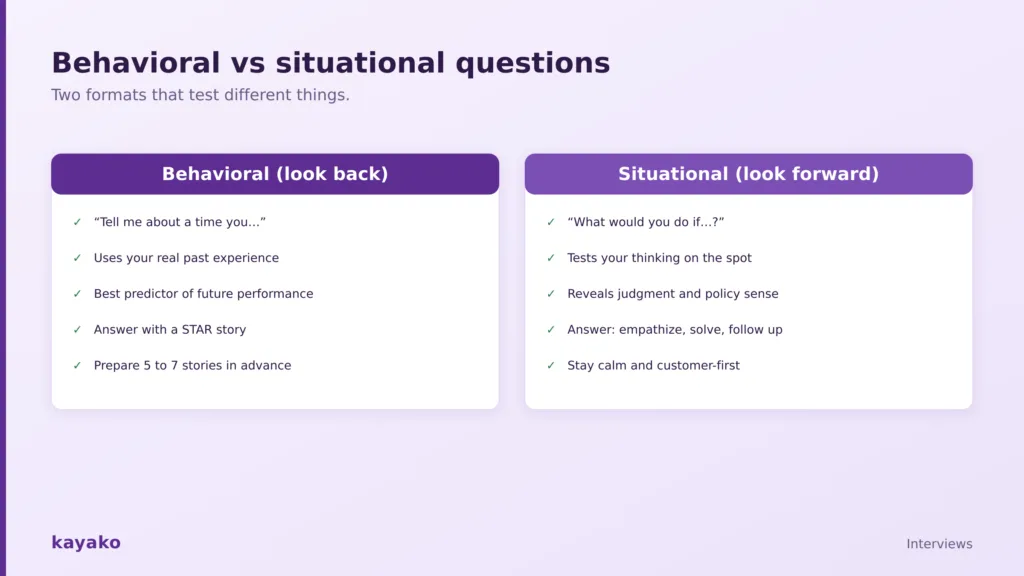
Understanding Behavioral vs. Situational Questions
- Behavioral questions look backward: “Tell me about a time…” They want to know what happened, when it happened, where it took place, and why you chose your approach.
- Situational questions look forward: “What would you do if…?” They test your thinking process, policy awareness, and problem-solving in context.
Key Behavioral Questions to Practice
- Describe a time you had to change your approach because your first efforts failed
- Give an example of resolving a complex problem for a dissatisfied customer
- Tell me about a situation that tested your patience with a customer
- How have you dealt with a policy you disagreed with but still had to enforce?
- Describe a successful upsell or cross-sell you executed
- Give an example when you had to escalate a customer recommendation that led to product improvement
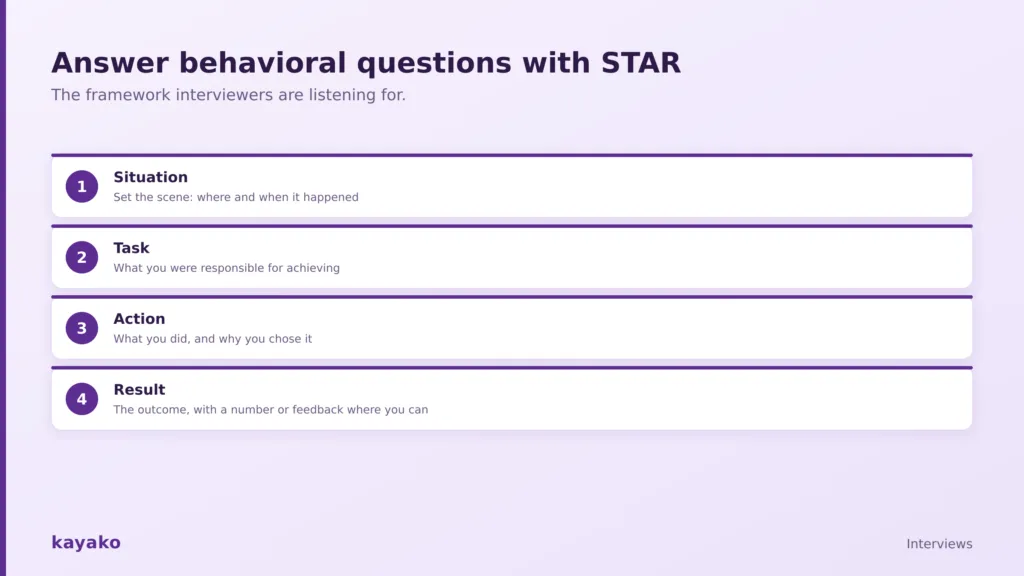
How to Answer Using STAR
- Situation: Set the where and when. Provide enough context to understand the what.
- Task: Clarify your responsibility—what you had to achieve and why it mattered.
- Action: Explain what you did, how you did it, and the rationale behind your choices.
- Result: Share outcomes with metrics or feedback where possible, plus lessons learned

Sample Behavioral Answer
Question: Tell me about a time you had to handle an angry customer.
Answer: “In my previous role, a customer called upset over a delayed shipment. I listened fully without interruption, ensuring he felt heard. Then I apologized sincerely and investigated the cause. Upon discovering a system error, I arranged expedited shipping and provided a discount voucher. The customer thanked me in a follow-up call and remained loyal to our brand. This taught me the value of empathy and proactiveness.”
Handling Situational Questions
Interviewers may ask how you’d respond when a refund is outside policy, when multiple customers need urgent help, or when leaders provide conflicting guidance. Walk them through your process: gather facts, consult resources, propose options, clarify trade-offs, and follow up. Emphasize adherence to policy and customer-centric thinking.
Additional Behavioral Dimensions Interviewers Assess
- Patience and empathy: staying calm and caring in tense situations
- Adaptability: adjusting your approach as products, policies, and people change
- Communication: active listening, clear writing, and professional tone
- Problem-solving: diagnosing issues methodically and collaborating internally
- Ethics and integrity: applying policy fairly while preserving trust
Behavioral and situational answers are your chance to prove you can “walk the talk.” With a few well-rehearsed stories and a clear decision-making approach, you demonstrate credibility and composure.
Key Customer Service Skills and Competencies to Demonstrate
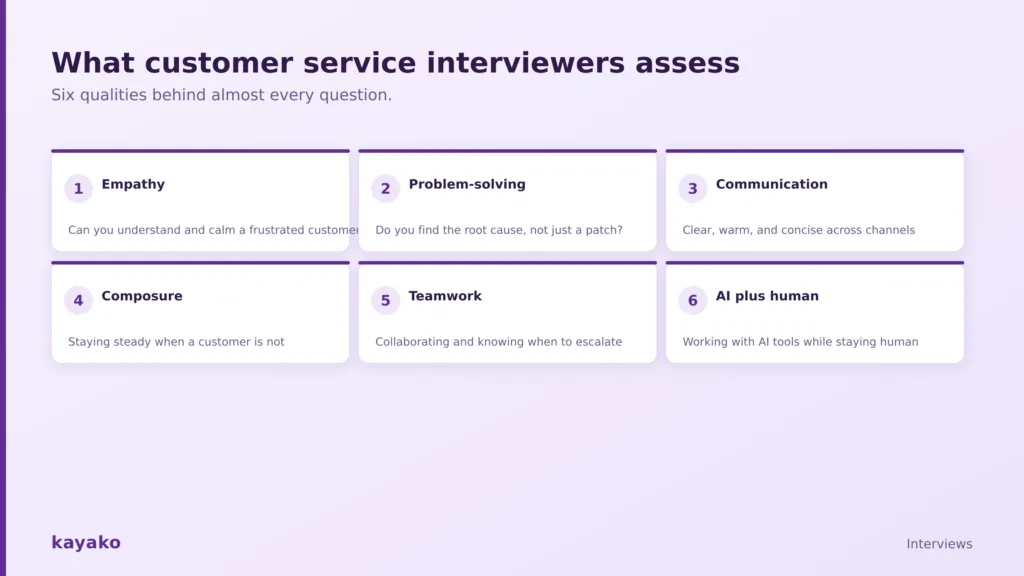
Customer service excellence is a blend of mindset, method, and modern tools. Employers want to know what you can do, when you’ve done it, where you learned it, and why you chose that approach. This section helps you showcase both your soft skills and your technical readiness.
Crucial Customer Service Skills
- Empathy and active listening
Understand the customer’s perspective and respond with care. Explain how you confirm understanding and why that reduces repeat contacts. - Communication skills
Speak and write clearly. Ask clarifying questions. Tailor your tone. Confirm next steps so customers know what happens next and when. - Problem-solving and critical thinking
Identify root causes, evaluate options, and propose solutions that balance speed, accuracy, and policy. - Patience and stress management
Maintain professionalism through peaks and pressure. Share techniques and where you apply them (during high-volume hours, for example). - Technical savvy
Use CRMs like Zendesk or Salesforce, communication tools like Microsoft Teams or Slack, and task managers like Asana or Trello. Be up-to-date on AI customer support tools like Kayako and Tidio. Explain why these tools help you deliver faster, more reliable service.
Adaptability
Learn new systems and procedures quickly. Share when you had to pivot and why it improved outcomes.
Time management and organization
Juggle multiple customers without losing quality. Mention methods like Pomodoro or the Eisenhower Matrix and where they fit into your day.
8. Technological Competencies
Modern service runs on integrated systems. CRMs track interactions and history. Chat and video tools enable fast collaboration. Task platforms ensure nothing slips. When you explain where you’ve used these tools and why you trust them, you show readiness for today’s workflows.
How to Show Competencies in Interviews
- Name the software and describe what you did with it
- Share a quick metric or before-and-after result (for example: “Using Asana to triage tickets improved our first response time by 20%”)
- Provide people examples too—how empathy, clarity, or patience turned a situation around
- Illustrate adaptability with a short learning curve story
Example Interview Snippet
“In my last role, I mastered Zendesk and Kayako to handle up to 60 tickets a day, ensuring timely resolutions. I also leveraged Microsoft Teams for asynchronous communication, which helped my remote team stay aligned across time zones. I believe technology is the backbone enabling exceptional customer service in today’s work environment.”
Employers seek professionals who blend heart, judgment, and systems. When you connect your skills to real results and relevant tools, you make it easy for hiring managers to picture you succeeding on their team.
|
Preparing for Your Customer Service Interview: Step-by-Step
Preparation is your performance multiplier. What you research, when you rehearse, where you set up, and why you choose certain examples all shape your confidence and clarity.
Essential Preparation Steps
- Research the company: Review the website, product pages, recent news, social channels, and customer reviews. Learn what they sell, who they serve, and why customers choose them.
- Understand the job description: Highlight required skills and recurring tasks. Note keywords and prepare stories that match them.
- Prepare your interview answers: Practice responses to the common and behavioral questions above. Personalize answers to the company’s mission and customer base.
- Practice your elevator pitch: In 45–60 seconds, cover who you are, what you’ve done, where you add value, and why you’re excited about this role.
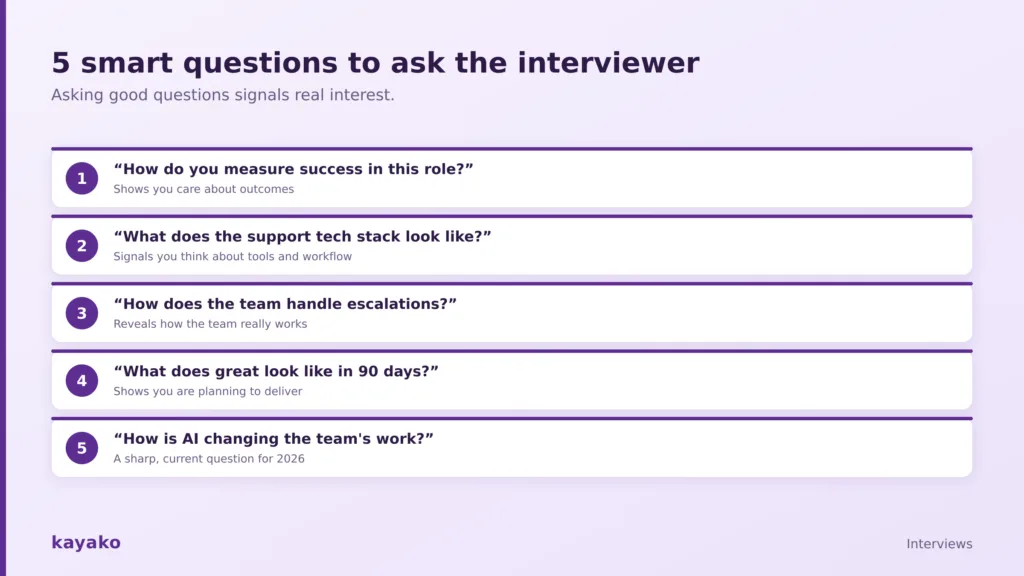
- Plan your questions for the interviewer: Ask about success metrics, training, team dynamics, and tools. Show curiosity and initiative.
- Dress professionally: Whether in person or on camera, polished presentation signals respect and readiness.
- Set up your environment: For remote interviews, test your camera, mic, lighting, and internet. Minimize distractions and have a notepad ready.
- Prepare to discuss tools and technology: Be ready to talk about Zendesk, Microsoft Teams, Asana, and your comfort with learning new systems.
Additional Tips for Remote Interviews
- Show you can self-manage by sharing how you plan your day, track tasks, and communicate proactively
- Acknowledge potential tech hiccups and share your backup plan (hotspot, phone dial-in, alternate device)
- Highlight virtual communication habits: concise writing, meeting etiquette, and thoughtful asynchronous updates
Sample Preparation Timeline
7+ days before: Research the company and role in depth. Draft STAR stories aligned to key competencies. Gather metrics or examples that show impact.
3–5 days before: Practice answers out loud. Confirm your interview outfit. Test your technology and update software.
1–2 days before: Prepare thoughtful questions for the interviewer. Confirm time zones, platform links, and panel names.
Day of: Eat well. Arrive or log in early. Dress professionally. Review notes briefly. Take a moment to breathe.
Solid preparation lowers anxiety and elevates performance. When you know the company, the role, and your stories, you can focus on building rapport and demonstrating value.
Handling Challenging Scenarios and Difficult Customers in Interviews
Tough moments reveal true capability. Interviewers want to see how you think and act when emotions run high or information is incomplete. By explaining what you’d do, when you’d do it, where you’d seek help, and why your approach works, you prove you can handle pressure without passing it on to the customer.
Common Challenging Scenarios Discussed in Interviews
- Managing an irate or impatient customer
- Enforcing a policy when a customer asks for exceptions
- Handling high-volume periods with competing priorities
- Responding when you don’t have all the information
- Navigating unclear or conflicting internal instructions
Strategies to Showcase in Your Answers
- Stay calm and professional to maintain control of the interaction
- Listen actively to understand the underlying issue and emotion
- Empathize and validate to rebuild trust without assigning blame
- Clarify and take ownership so the customer knows who’s accountable and by when
- Offer solutions and options within guidelines, and escalate when appropriate
- Communicate clearly about policies and goodwill alternatives to preserve long-term loyalty
- Follow through and confirm resolution so the customer isn’t left wondering
Sample Tough Scenario Answer
Question: How would you handle a customer demanding a refund that violates company policy?
Answer: “I’d listen empathetically to the customer’s concerns, making sure they feel heard. Then I’d clearly but gently explain the refund policy and the reason their request falls outside it. I’d look for alternative solutions, like store credit or a product exchange, to meet their needs where possible. If the situation escalated, I’d involve a supervisor to ensure the customer feels their issue is taken seriously.”
Technical or System Issues Handling
- Be transparent about outages or delays and share expected timelines
- Use backup procedures or manual workarounds when available
- Coordinate with IT and keep customers informed of progress
- Document incidents so future customers benefit from improved processes
Stress Management Examples
Share sustainable techniques like brief resets between calls, deep breathing, or structured prioritization during peak hours. Explain when you use them and why they help you deliver consistent service.
Your approach to conflict and uncertainty shows your maturity as a service professional. When you present a calm, structured process, interviewers can trust you with their customers.
Frequently Asked Questions About Customer Service Interviews
Some questions come up in nearly every interview cycle. Clear, confident responses to these FAQs help you avoid surprises and keep the conversation focused on your strengths.
How important is prior customer service experience?
Experience helps, but potential matters. If you don’t have direct experience, draw from adjacent roles, projects, or volunteering. Explain where you learned to listen, solve problems, and communicate clearly—and why those skills transfer.
Should I mention weaknesses?
Yes, briefly and strategically. Choose a real but manageable area, explain what you’re doing about it, and share where you’ve made progress.
How do I answer “Tell me about yourself”?
Cover your relevant background, top strengths for this role, and genuine interest in the company. Keep it focused on what you bring and why this position is the right next step.
What technologies should I be familiar with?
CRMs like Zendesk or Salesforce, communication tools like Microsoft Teams or Slack, and task/project platforms like Asana. Explain where you used them and how they improved outcomes.
How should I approach remote customer service interviews?
Demonstrate time management, written and verbal communication, technical readiness, and habits that support remote collaboration and customer responsiveness.
How can I prepare for “Sell me this stapler” or similar sales tests?
Start with discovery: ask about needs and context, then link features to benefits. Show that you solve problems rather than push products.
How do I handle salary questions?
Research the range in advance. When asked, share your target range with flexibility and reiterate your enthusiasm for the role and growth opportunities.
With concise, well-prepared answers to these FAQs, you keep momentum in the interview and make space for deeper discussion of your impact.
Leveraging Modern Technologies and Work Systems in Customer Service
Today’s customer service runs on connected systems. When you explain how you use tools to collaborate, prioritize, and deliver, you show that you can thrive in distributed teams and dynamic environments.
Why Knowing Tools Like Microsoft Teams and Asana Matters
- They enable asynchronous communication across time zones, reducing bottlenecks
- They support task and project management so customer issues are tracked from intake to resolution
- They integrate with CRMs, creating a seamless flow of customer information that supports faster, more personalized service
How to Incorporate This Into Your Interview
- Highlight when and where you’ve used these tools to improve responsiveness or reduce errors
- Share strategies for maintaining work-life balance in remote settings, like calendar blocks, status updates, and notification management
- Demonstrate your ability to write concise, actionable updates suitable for async collaboration
- Explain how you handle distractions or technical difficulties and why your plan keeps customers protected
Example
“In my previous remote internship, we used Microsoft Teams for daily updates and Asana to track service tickets. I became proficient in scheduling messages for different time zones and writing concise updates. This allowed me to manage customer issues efficiently while maintaining a healthy work-life balance.”
By tying your toolset to tangible outcomes—faster replies, fewer handoffs, clearer accountability—you signal that you can scale your service in modern workplaces.
|
The 15 Most Common Customer Service Systems (and Their Benefits)
| System | Primary Use | Key Benefit |
| Kayako | Ticket management and analytics | Streamlines support workflows |
| Salesforce Service Cloud | CRM with support integration | Personalized service at scale |
| Freshdesk | Multi-channel support | Automation features |
| Intercom | Live chat and engagement | Real-time customer connection |
| Microsoft Teams | Team communication | File sharing and collaboration |
| Asana | Workflow organization | Cross-department priorities |
| Slack | Real-time messaging | Tool integration |
| Trello | Visual task tracking | Boards and cards |
| Google Workspace | Document collaboration | Scheduling and productivity |
| JIRA Service Desk | Technical support | Issue tracking |
| Help Scout | Email-based support | Customer-focused tools |
| Zoho Desk | Multi-channel communication | AI-based assistance |
| HubSpot Service Hub | Marketing, sales, and support | Unified customer success |
| RingCentral | VoIP systems | Customer data integration |
| Salesken | Call analysis | AI-assisted coaching |
Benefits of Using These Systems
- Improved productivity through clear workflows and automations
- Better customer experience via consistent, personalized support
- Data-driven insights that inform staffing, training, and process improvements
- Faster team collaboration with shared context and searchable histories
- Healthier work-life balance supported by remote-friendly features and async practices
Familiarity with these tools, especially customer support tools positions you as a future-ready hire. In interviews, connect the system to the service outcome so hiring managers see the value immediately.
Put It All Together and Stand Out
Customer service interviews are your chance to show who you are when it counts: empathetic, organized, tech-savvy, and solution-focused. When you master common and behavioral questions, demonstrate core competencies, prepare deliberately, and handle tough scenarios with grace, you become the obvious choice.
Layer in credibility with your understanding of CRM platforms and collaboration tools like Microsoft Teams and Asana, and you signal that you can contribute from day one—whether you’re on-site or remote.
Customer service is more than a role. It’s a mindset powered by empathy, clear communication, and continuous improvement. Let your preparation reveal your potential. Let your stories prove your impact.
Best of luck on your interview journey.