AI Chatbot: What It Is, How It Works, and Types (2026)
| An AI chatbot is a software program that uses artificial intelligence, such as natural language processing, machine learning, and large language models, to understand what a person means and reply in natural, human-like language. Unlike a rule-based chatbot that follows fixed scripts, an AI chatbot interprets intent, handles unexpected questions, and improves over time. |
Key takeaways
|
The term AI chatbot covers everything from a simple website assistant to an autonomous agent that resolves a support ticket end-to-end. This guide explains what an AI chatbot is, how it differs from a rule-based chatbot, the main types, how the technology works, its benefits and limits, and how AI chatbots are used in customer service, where they have become core infrastructure rather than a novelty.
What is an AI chatbot?
An AI chatbot is a computer program that simulates human conversation using artificial intelligence. It interprets what a person types or says, works out their intent, and produces a relevant, natural-language response. The key phrase is artificial intelligence: not every chatbot uses it.
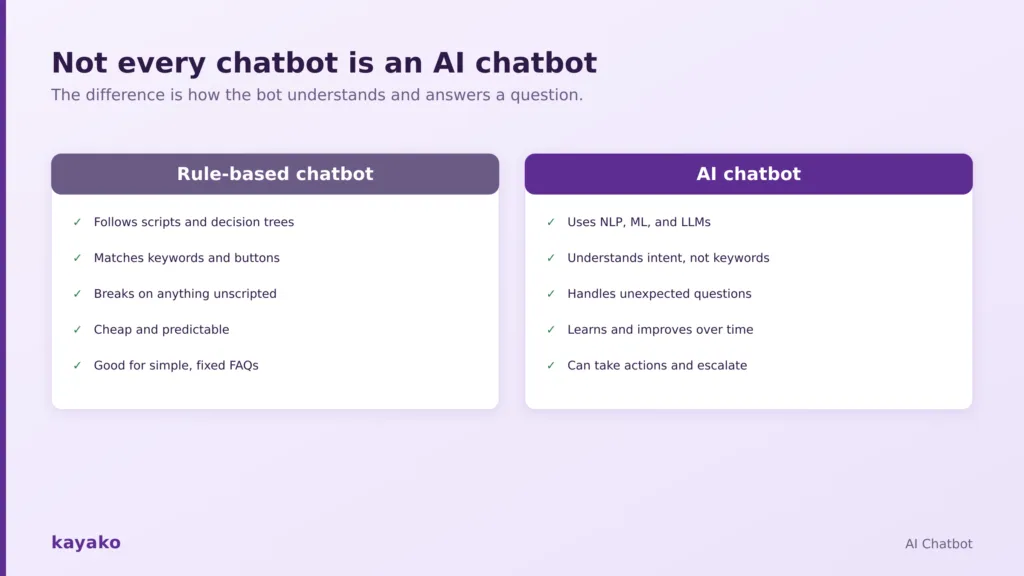
The difference is how the bot understands and answers a question.
Traditional chatbots follow predefined rules, decision trees, and scripted flows. They work for predictable requests but stall the moment a question falls outside their programming. AI chatbots use technologies such as natural language processing, machine learning, and large language models to understand intent, generate more natural responses, and adapt to a far wider range of conversations. Modern AI chatbots can also connect to business systems to retrieve information, complete a transaction, or guide a user through a process, and hand off to a human when a conversation needs one.
AI chatbot vs rule-based chatbot: what is the difference?
A rule-based chatbot follows a fixed script and matches keywords, so it can only answer questions it was explicitly programmed for. An AI chatbot uses natural language processing and machine learning to understand the meaning behind a message, which lets it handle questions it has never seen, hold context across a conversation, and improve over time.
Types of chatbots
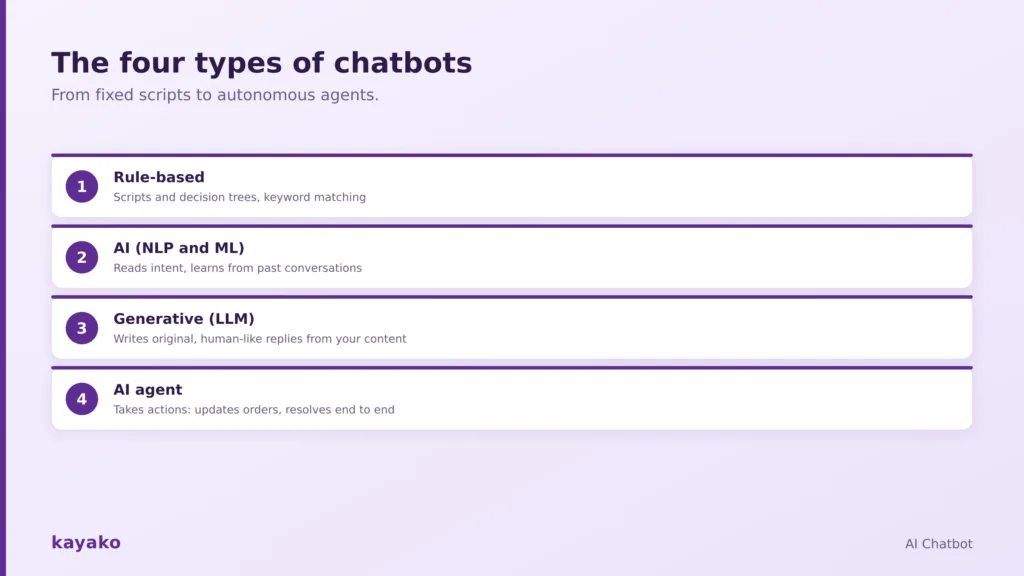
Vendors use inconsistent labels, so it helps to sort chatbots by what they can actually do. There are four practical types, in rising order of capability.
From fixed scripts to autonomous agents.
- Rule-based chatbots. Follow decision trees and keyword matching. Predictable and cheap, but rigid.
- AI chatbots (NLP and ML). Read intent rather than keywords and learn from past conversations, so users can type freely.
- Generative chatbots (LLM-powered). Use a large language model to write original, human-like replies word by word. To stay accurate, they are grounded in your own content so they do not invent answers.
- AI agents. The frontier: bots that do not just answer but take autonomous actions inside your systems, such as updating an order or resolving a request from start to finish. See our guide to AI agents vs chatbots for the full distinction.
Many real deployments are hybrids, combining rule-based structure for predictable tasks with AI for everything else.
How does an AI chatbot work?
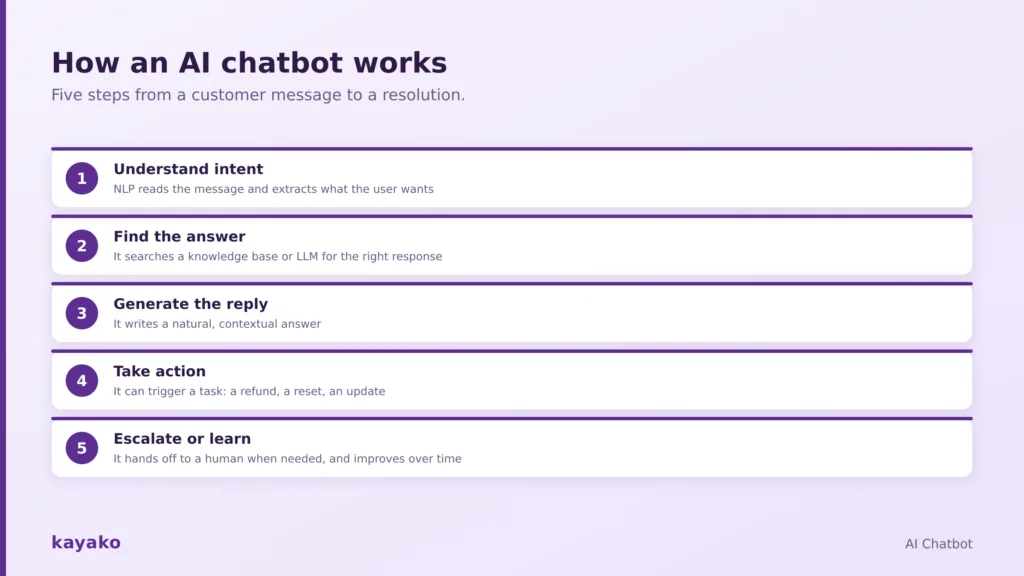
An AI chatbot turns a message into a resolution through a sequence of steps, powered by natural language processing to parse language, natural language understanding to read intent, and natural language generation to write the reply.
Five steps from a customer message to a resolution.
- 1. Understand intent. NLP reads the message, catches typos and phrasing, and works out what the user actually wants.
- 2. Find the answer. The bot searches a connected knowledge base, or uses an LLM grounded in your content, to find the right response. This grounding technique, retrieval-augmented generation, is what keeps answers accurate.
- 3. Generate the reply. It composes a natural, contextual answer rather than reading a canned line.
- 4. Take an action. When connected to business systems, it can do something: send a refund update, reset a password, or book a return.
- 5. Escalate or learn. If the query is complex or emotionally charged, it hands off to a human with full context, and machine learning sharpens its answers over time.
|
|
Key features of an AI chatbot
The best AI chatbots share a core set of capabilities.
- Natural language understanding, so customers can type freely instead of following buttons.
- 24/7 availability, delivering instant answers at any hour without staffing.
- Knowledge base integration, connecting to your FAQs, product data, and customer history for accurate answers.
- Multilingual support, engaging customers in many languages out of the box.
- Context awareness, remembering earlier messages so a conversation flows naturally.
- Seamless human handoff, transferring complex issues to an agent with the conversation intact.
- Analytics, capturing intent, sentiment, and performance data to improve over time.
Benefits of AI chatbots
Used well, AI chatbots produce measurable gains, which is why adoption keeps rising across industries.
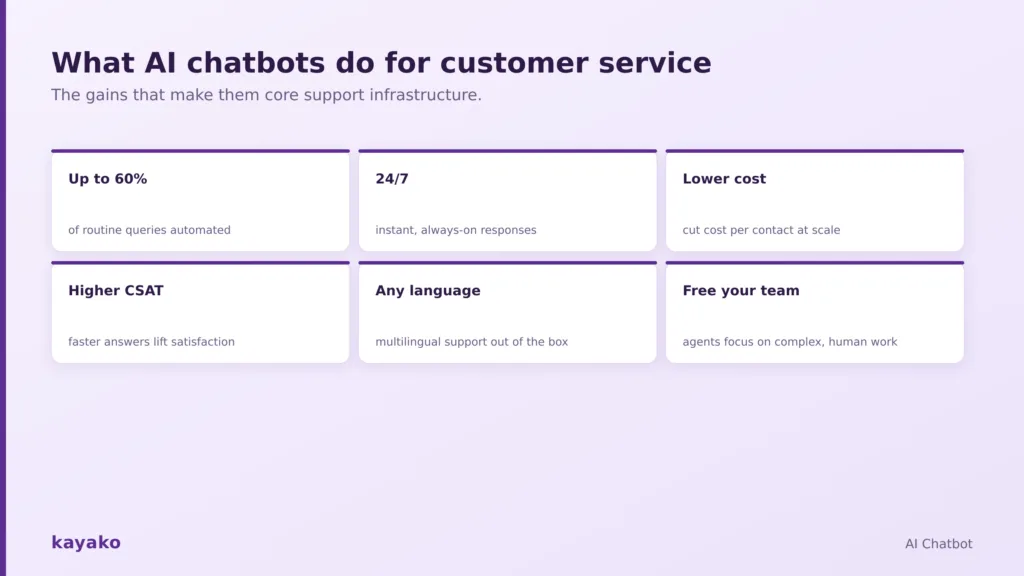
The gains that make AI chatbots core support infrastructure.
The headline benefit is efficiency. McKinsey estimates that AI can automate up to 60% of customer queries, especially routine FAQs, cutting cost per contact and easing agent workload (McKinsey). Beyond cost, AI chatbots deliver faster responses that lift satisfaction, scale instantly during demand spikes, run around the clock, and support many languages at once. Around 70% of consumers say they appreciate a chatbot’s 24/7 availability (Forbes). And by automating repetitive work, they free agents to focus on the complex, human conversations where judgment and empathy matter.
AI chatbot use cases
AI chatbots fit anywhere speed, volume, and personalization matter.
- E-commerce and retail: order tracking, returns, product recommendations, and promotions.
- Banking and finance: balance inquiries, transaction history, and fraud alerts, escalating advice to humans.
- Healthcare: appointment booking, symptom triage, and FAQs, with humans for sensitive cases.
- Telecommunications: billing questions, troubleshooting, and plan changes.
- Internal support: employee help desks for HR, IT, and facilities questions.
The most common use across all of them is customer service, where AI chatbots handle the front line of support.
Limitations of AI chatbots
AI chatbots are powerful, not perfect, and knowing the limits is how you deploy them well.
- Complex or emotional issues. Nuanced, sensitive, or high-stakes conversations still need human judgment and empathy.
- Accuracy and hallucination. An ungrounded generative bot can invent answers, which is why it must be tied to your own verified content.
- Trust and privacy. Some customers are wary of sharing sensitive data with a bot, so transparent data handling matters.
- Integration effort. The payoff depends on clean integration with your knowledge base and support systems.
The answer to all four is the same: ground the bot in trusted content, and give it an easy path to a human.
AI chatbots in customer service
Customer service is where AI chatbots have moved from novelty to necessity. Gartner projects that chatbots will become the primary customer service channel for roughly a quarter of organizations. The reason is simple: a modern support AI chatbot resolves the routine questions that make up most of the queue, instantly and around the clock, so human agents handle only what genuinely needs them. This is the support automation that lets a team scale without adding headcount, and where AI is taking customer service.
This is exactly what Kayako is built for. Its AI agent, Agent Kay, is grounded in your knowledge base and past conversations, so it answers accurately rather than guessing, and it resolves routine tickets end to end while escalating the rest to an agent with full context intact through the shared inbox. Because Kayako is priced per resolution rather than per seat, automating more conversations lowers your cost per contact instead of raising your bill. After adopting Kayako, Trilogy resolved 76% of tickets autonomously, cut ticket age from 17.6 hours to under 2 minutes, and eliminated 80% of its ticket volume within a 90-day rollout. You can see the wider approach on Kayako’s AI customer support page.
|
How to choose and implement an AI chatbot
A successful rollout is less about the model and more about the setup. A few principles carry most of the weight.
- Define the scope. Decide which routine queries the bot will handle and where it must escalate.
- Ground it in your content. Connect it to a current, accurate knowledge base, so answers are trustworthy, not invented.
- Design a clean human handoff. Make reaching a person easy, and carry the conversation context across.
- Measure and refine. Review chat logs, track resolution and CSAT, and update content where the bot struggles.
- Be transparent. Tell customers they are talking to a bot and how their data is used.
|
Frequently asked questions
What is an AI chatbot?
An AI chatbot is a software program that uses artificial intelligence, including natural language processing, machine learning, and large language models, to understand what a person means and reply in natural language. Unlike a rule-based chatbot that follows fixed scripts, an AI chatbot interprets intent, handles questions it was never explicitly programmed for, holds context across a conversation, and improves over time.
How does an AI chatbot work?
An AI chatbot reads a message with natural language processing to work out the user’s intent, finds the right answer in a connected knowledge base or by using a language model grounded in your content, generates a natural reply, and can take an action such as processing a refund. When a query is too complex, it escalates to a human agent with full context, and it learns from each interaction to improve.
What is the difference between a chatbot and an AI chatbot?
A traditional chatbot follows predefined rules and decision trees, matching keywords to scripted answers, so it only handles questions it was programmed for. An AI chatbot uses natural language processing and machine learning to understand the meaning behind a message, which lets it answer unexpected questions, hold a multi-turn conversation, and get better over time. In short, all AI chatbots are chatbots, but not all chatbots use AI.
What are the types of chatbots?
There are four practical types: rule-based chatbots that follow scripts and decision trees; AI chatbots that use natural language processing and machine learning to read intent; generative chatbots powered by large language models that write original replies; and AI agents that take autonomous actions to resolve a request end to end. Many real systems are hybrids that combine rule-based structure with AI.
What is the difference between an AI chatbot and an AI agent?
An AI chatbot mainly answers questions in a conversation. An AI agent goes further: it takes autonomous actions inside your systems, such as updating an order, issuing a refund, or resolving a support ticket from start to finish, not just replying. AI agents are the next step in the progression, moving from answering to acting.
Are AI chatbots safe to use?
They are safe when deployed responsibly. The main risks are inventing inaccurate answers and mishandling sensitive data. Both are managed by grounding the chatbot in your own verified content so it does not guess, applying clear data-privacy safeguards, and giving customers an easy path to a human. A well-configured AI chatbot is both secure and accurate.