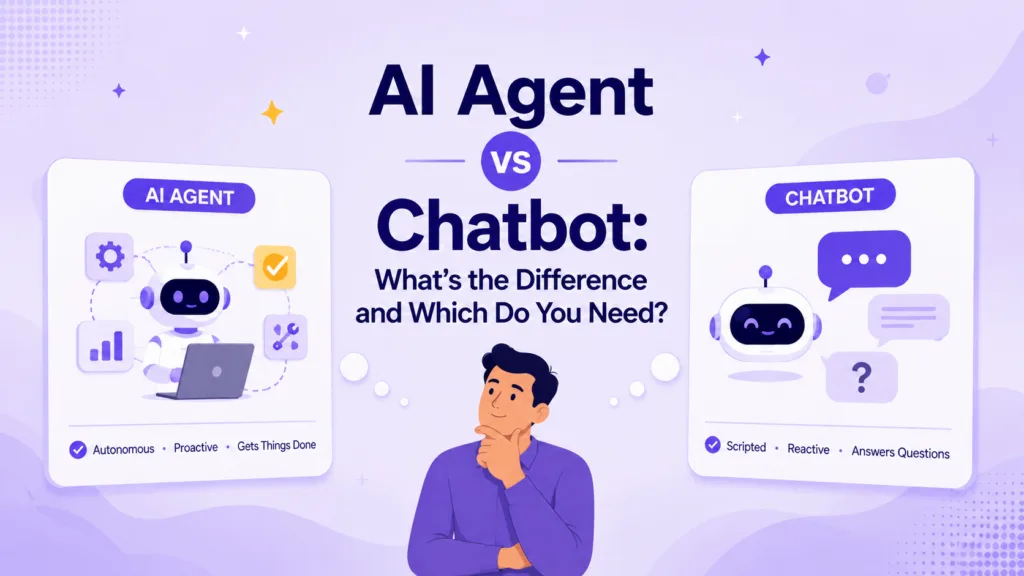
Quick summary: A chatbot follows scripts to answer common questions and then hands off to a human. An AI agent reasons, remembers context, takes actions across systems, and resolves the request on its own. The core difference is autonomy: a chatbot deflects, an AI agent resolves. This guide defines both, compares them side by side, explains when to use each, and covers the fast-moving market, including the honest caveat that many tools labeled as agents are really chatbots in disguise.
The phrases get used as if they mean the same thing, but AI agent vs chatbot is a real distinction with real consequences for cost and customer experience. Both talk to customers in natural language, and to a customer opening a chat window, they can look the same. The difference is what happens next: a chatbot answers what it was scripted to answer and escalates the rest, while an AI agent works the problem until it is solved. One is a menu of prepared responses; the other is a problem-solver that decides its own next step. That gap explains why two tools that look identical in a demo can produce completely different results once real customers start using them. Getting the choice right decides whether automation actually reduces your workload or just adds another layer in front of it. Buy a chatbot expecting resolution, and you will be disappointed; buy an agent for a job a simple bot could do, and you overspend.
The distinction is not academic. It changes how much you spend, how many tickets your team touches, and how customers feel about reaching out in the first place. The stakes are rising because the technology is moving fast. Gartner projects that 40% of enterprise applications will include task-specific AI agents by the end of 2026, up from under 5% in 2025, per the Gartner press release. A useful way to hold the distinction in mind: a chatbot is a receptionist who answers common questions and directs you to the right desk, while an AI agent is the specialist who actually handles your case from start to finish. The confusion is understandable because vendors have every incentive to call a chatbot an agent, and because the two genuinely do share an interface. This guide starts with clear definitions, then compares the two head-to-head, and ends with how to tell a real agent from a relabeled chatbot. If you take one thing away, let it be the test at the end, since it is the fastest way to see past a marketing label. Start with the more familiar of the two.
What is a chatbot?
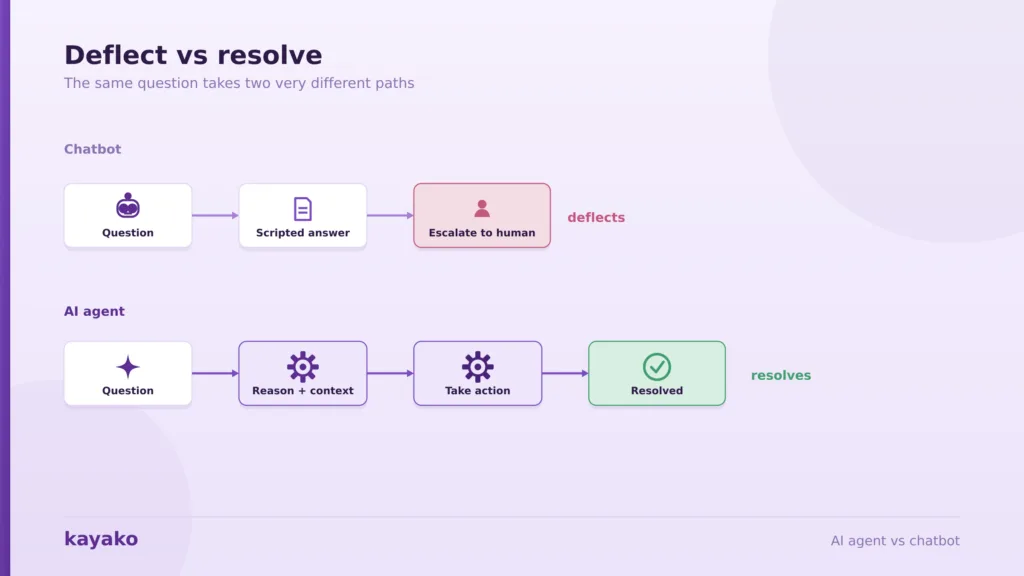
A chatbot is software that holds a conversation by following predefined rules or a decision tree, sometimes with a layer of natural language processing to interpret phrasing. It is built to answer known questions: business hours, order status, password resets, and the like. The more advanced ones use natural language processing to understand different phrasings of the same question, but the underlying logic is still a set of predefined paths. If the customer stays on a path the designer anticipated, the experience is smooth; if they step off it, the bot stalls. Think of it as a phone tree with a nicer interface: fast for the questions it expects, and a dead end for the ones it does not. When a request falls outside its script, it does one of two things: it apologizes, or it escalates to a human. Most people have met the frustrating version of this, the loop where a bot repeats the same three canned answers because the question was never in its playbook.
That design makes chatbots useful for high-volume, predictable questions, but it also caps what they can do. A chatbot cannot reason about a situation it was not scripted for, cannot remember what happened in a previous conversation, and cannot take an action in another system unless that exact action was wired in ahead of time. This is why chatbot projects so often stall after launch: teams keep adding rules to cover new questions, the decision tree grows unwieldy, and the bot still cannot handle anything genuinely new.
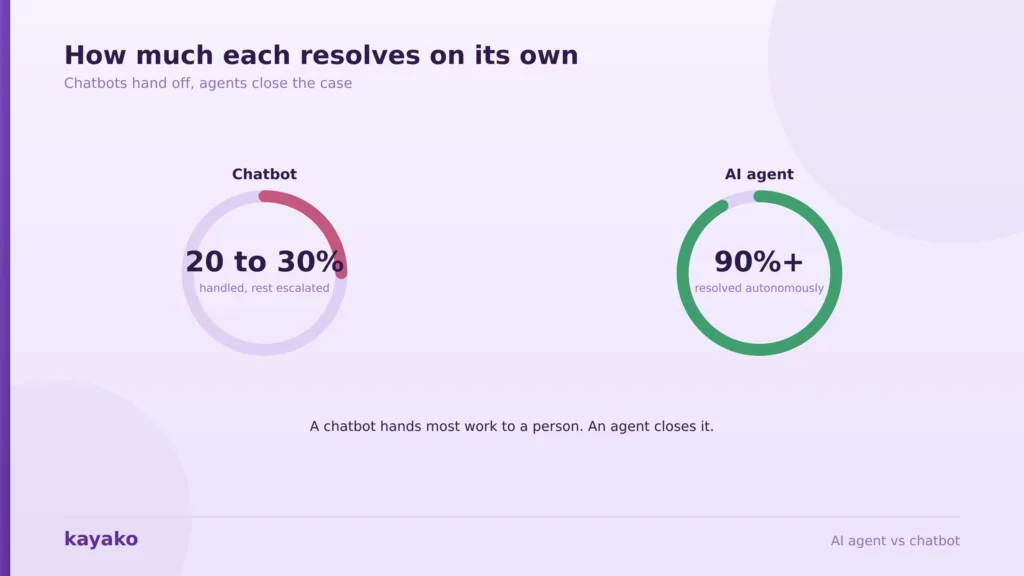
Maintenance becomes a job in itself, and the return on that effort shrinks with every rule added, because no finite set of scripts can anticipate the full range of ways real people ask for help. Because they follow flows rather than reasoning, so-called chatbots typically handle only about 20% to 30% of interactions before a person has to step in, per analysis from MavenAGI. The remaining majority still lands on a human, which is why a chatbot alone rarely delivers the cost savings teams hope for. Independent benchmarks are starker still: Gartner has found that only about 14% of customer service issues are fully resolved in self-service, per the California Management Review. A scripted bot is one reason so much still ends up in a live queue or on proactive chat. They are a front door, not a resolution engine. This is not a criticism so much as a description of scope: a chatbot is doing exactly what it was designed to do, which is triage. The limitation only becomes a problem when a business expects it to do more than triage, which is exactly what happens when a company deploys a chatbot to cut support costs and then finds the same number of tickets still landing on agents, just a step later in the conversation. Understanding that the ceiling is what makes the contrast with an AI agent clear, so here is the other side.
What is an AI agent?
An AI agent is software that can reason through a problem, remember context, and take actions across systems to complete a task, not just answer a question about it. Where a chatbot picks a scripted reply, an agent can read the full customer history, decide what needs to happen, process a refund or update a record, and confirm the outcome, all without a human in the loop for routine cases. The key words are reason, remember, and act. A chatbot answers; an agent does. Given a request like a customer asking why they were charged twice and wanting it fixed, an agent can check the billing record, confirm the duplicate, issue the refund, and explain what happened, whereas a chatbot would at best describe the refund policy and create a ticket. Same question, same interface, entirely different outcome for the customer and for the queue behind it. That is why an agent can take a vague, multi-part request and work through it step by step, the way a trained human would, rather than looking for the one branch of a script that matches.
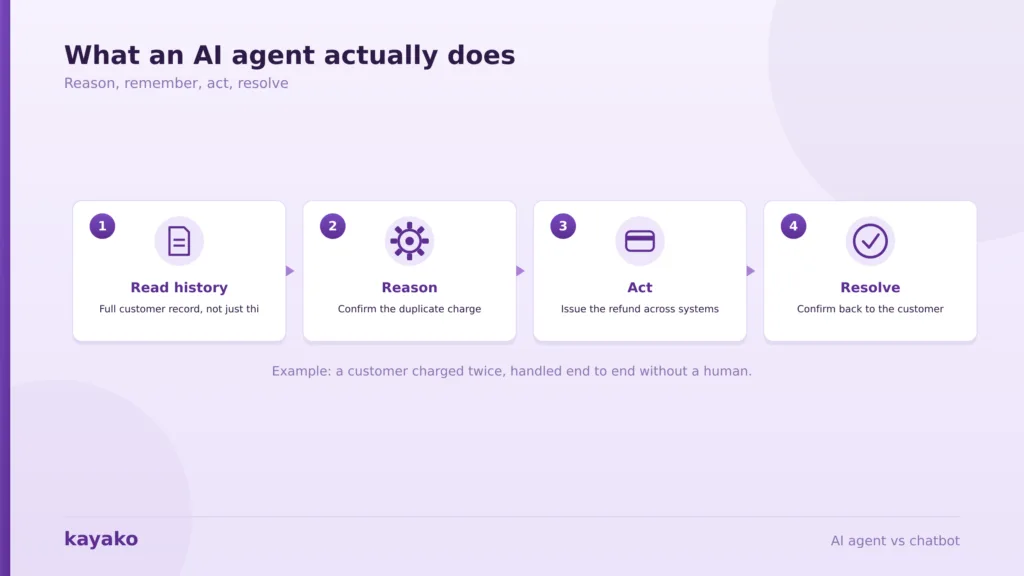
The word that separates an agent from a chatbot is autonomy. A chatbot needs a human to finish the job; an agent is designed to finish it. An agent can also improve over time, learning from resolved cases rather than waiting for someone to hand-write a new script for every scenario, which is why its capability compounds while a chatbot’s stays fixed until the next manual update. This is the category the market is betting on. The global AI agents market is projected at roughly $10.9 to $12.1 billion in 2026, growing about 45% a year toward $50 billion by 2030, per figures compiled by Paul Okhrem. The reason for the investment is simple: an agent that resolves is worth far more than one that deflects, because every resolved case is a ticket that never reaches a person, and every ticket that never reaches a person is time your team spends on the harder work only humans can do. Salesforce research tracks AI-resolved cases on a 30% to 50% trajectory, which means AI is on course to handle the majority of support interactions within a couple of years, per Unthread. That is the quiet promise of agents: not replacing the team, but freeing it from the repetitive volume that burns people out. That difference deserves a proper side-by-side look.
AI agent vs chatbot: the key differences
The two overlap on the surface, since both chat in natural language, but they differ on every dimension that matters. Read the table as a spectrum rather than a strict binary, since some tools sit in between, but the direction of each column is what counts. The single most important row is the outcome one: deflect versus resolve. Everything else follows from it, because a tool that only deflects will always leave the hardest, most expensive work for your team, no matter how polished its conversation feels.
| Dimension | Chatbot | AI agent |
|---|---|---|
| Approach | Scripted flows and basic NLP | Reasoning and planning |
| Context and memory | Limited, mostly per session | Full history and context |
| Actions | Answers and routes | Takes actions across systems |
| Typical outcome | Deflects and escalates | Resolves autonomously |
| Best for | Simple, predictable questions | Complex, multi-step requests |
| Improvement | Manual script updates | Learns and adapts from data |
The practical gap is large. Unified AI agents that can see the full customer record reach autonomous resolution rates above 90%, well past the deflect-and-escalate ceiling of a scripted bot, per MavenAGI. That resolution advantage also shows up in cost per interaction: an AI-handled interaction averages around $0.50 against roughly $6.00 for a human agent, about twelve times cheaper, per Magai. A chatbot might report that it handled a conversation, but handling is not resolving, and a deflection dashboard can look busy while the human queue stays just as long. The reason the numbers diverge so much is that a deflected question still becomes a ticket for a human, while a resolved one does not, so tracking the right customer support metrics makes the gap between the two visible. Knowing the differences is one thing; knowing which to deploy is another.
When to use a chatbot vs an AI agent
Neither is universally better. The right choice depends on the work you need done.
- Use a chatbot when the questions are simple, predictable, and high volume, such as store hours, tracking links, or basic lead capture. A scripted bot answers these instantly and cheaply, and about 62% of customers prefer a chatbot when speed is the priority for a simple question, per Fullview.
- Use an AI agent when requests are varied and multi-step, when resolving them means pulling context and taking an action, or when you want automation to actually close cases rather than pass them along. Password resets, billing questions, order changes, and troubleshooting all fall here, because each can require checking a record and taking an action, not just reciting a policy.
In practice, many teams end up wanting an agent because most real support volume is not a single scripted question but a mix that requires context and action. The classic pattern is a business that layers chatbot after chatbot to catch more cases, only to realize it has built a maze of scripts that a single reasoning agent could have handled. Each new bot solves one narrow problem and adds its own maintenance burden, and the customer still ends up bouncing between them. The two are not mutually exclusive, and a chatbot can sit in front of an agent, but the resolution work belongs to the agent. A sensible setup often uses simple automation for the truly trivial and an agent for everything that needs a decision, so the question is less which one and more where the line between them sits, and that line keeps moving toward the agent as the technology improves. Pairing that automation with the right helpdesk automation tools is what turns a promising demo into a working system, and it is worth comparing options against the wider field of customer service tools. The market context explains why agents are pulling ahead, and why buyers should stay skeptical.
The rise of AI agents (and agent-washing)
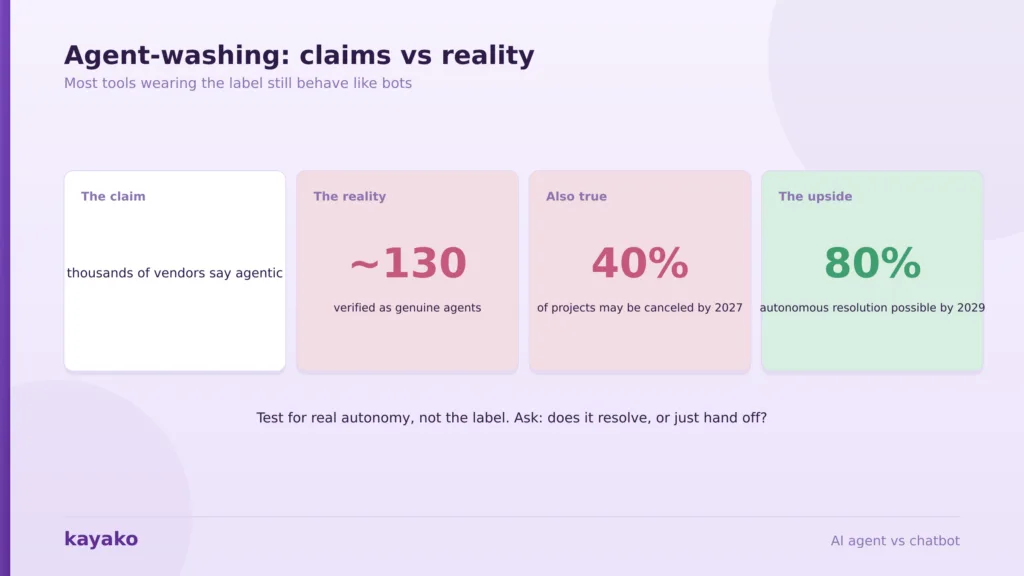
AI agents are the fastest-moving category in customer service software, and the projections are striking. Gartner expects agentic AI to autonomously resolve 80% of common customer service issues by 2029, cutting service costs by 30%, per OneReach. Much of that value comes from the cost side, since automation that resolves rather than deflects is central to customer support cost reduction.
The honest caveat is that the label is being overused. Of the thousands of vendors marketing agentic AI, Gartner estimated only about 130 were genuinely agentic, a pattern the industry calls agent-washing, and it expects 40% of agentic AI projects to be canceled by 2027, often because the tool never delivered the autonomy it promised, per MavenAGI and First Page Sage. Adoption is still early, with only about 31% of organizations running an agent in production, per Digital Applied. The gap between the hype and the production numbers is the tell: plenty of pilots, far fewer live systems, because getting to real autonomy is harder than the marketing suggests. The takeaway for buyers is to test for real autonomy, which is exactly where Kayako is built to deliver.
Turn support questions into autonomous resolutions with Kayako
Kayako in practice: an AI agent that resolves
Kayako is built around an AI agent, not a chatbot. Agent Kay does not follow a script and hand off; it reads the full customer history through SingleView, reasons about the request, and resolves routine cases end-to-end. Because it works across email, chat, and the help center as one system, it behaves like the unified architecture the research links to resolution above 90%, rather than a bolt-on bot. The distinction matters in practice: a bot that only sees the current message guesses, while an agent that sees the whole relationship acts with context, which is the difference between a generic reply and a correct resolution. Pricing is per resolved ticket rather than per seat, so automation that works lowers your cost instead of adding a license. That model only makes sense for a tool confident in resolving, since a vendor charging per resolution is betting on outcomes rather than seats, which is the opposite of how a deflect-and-escalate chatbot is usually sold. You can see more in these examples of AI in customer service and in how it pairs with a strong knowledge base.
For a concrete sense of what this looks like in production, Trilogy adopted Kayako and reached 76% autonomous resolution, with ticket age falling from 17.6 hours to under 2 minutes as the agent closed routine cases on its own. The number that matters for this comparison is the resolution rate, since it counts cases genuinely closed without a human rather than merely deflected. Kayako is one option among several building in this direction, not the only one, but it is a clear illustration of the capability the whole AI-agent-versus-chatbot question turns on.
The difference between an AI agent and a chatbot comes down to autonomy. A chatbot follows a script, answers what it knows, and escalates the rest, which suits simple, high-volume questions. An AI agent reasons, remembers, acts, and resolves, which suits the complex, multi-step requests that make up most real support. For most customer service teams, that is the majority of the queue, which is why the momentum is with agents rather than bots. None of this makes chatbots useless; it makes them a narrow tool for a narrow job, best kept to the handful of questions that never need a decision. The chatbot era taught customers to dread automated support; the agent era is the chance to change that impression by actually solving problems, which is ultimately what customers wanted from automation in the first place. The market is moving decisively toward agents, and the cost and resolution data explain why: autonomous agents are expected to cut cost per contact by 20% to 40% by 2026, per Second Talent, and organizations deploying them well report around 171% average ROI, per AI Stratagems.
The one thing to watch is agent-washing: plenty of tools wear the agent label while behaving like bots. The test is simple, and it is worth repeating because it saves months of buyer’s remorse. Ask whether the tool resolves the request on its own or just hands it to a person. If it truly resolves, you have an AI agent, and that is the capability worth buying, and the one most likely to move the customer satisfaction numbers that follow from actually solving problems. Run your own hardest, most multi-step requests through any tool that claims to be an agent, and watch whether it completes them or quietly routes them to a person. That single test cuts through the marketing faster than any feature list, and it is the one question every buyer evaluating this category should insist on answering for themselves.
Frequently asked questions
What is the difference between an AI agent and a chatbot?
A chatbot follows predefined scripts or decision trees to answer known questions and escalates anything outside its script to a human. An AI agent reasons through a request, remembers context, takes actions across systems, and resolves the issue on its own. The core difference is autonomy: a chatbot deflects and hands off, while an AI agent resolves the request end-to-end. That is why agents handle far more complex, multi-step work than chatbots can.
Is an AI agent better than a chatbot?
Neither is universally better; it depends on the job. For simple, predictable, high-volume questions like store hours or order tracking, a chatbot is fast and cost-effective. For varied, multi-step requests that require pulling context and taking action, an AI agent is far more capable because it resolves rather than deflects. Most support teams find that an agent fits the majority of real volume, since few requests are a single scripted question.
Can an AI agent replace a chatbot?
An AI agent can do everything a chatbot does and more, since it can also handle the simple, scripted questions a bot answers. In that sense, an agent can replace a chatbot, though some teams still use lightweight bots for very narrow tasks like basic lead capture. The more important move is from deflection to resolution: an agent aims to close the request, not just answer part of it and pass the rest to a person.
What is an example of an AI agent in customer service?
A customer service AI agent might receive a request to change a delivery address, read the order history, verify the order has not shipped, update the address in the system, and confirm the change to the customer, all without human involvement. That combination of reasoning, memory, and action across systems is what separates an agent from a chatbot, which would typically only answer a question about how to change an address and then route the customer to a person. The agent completes the task; the chatbot explains the task and hands it off. For the customer, the first feels like being helped, and the second feels like being given homework. Multiply that across thousands of interactions, and the difference stops being about one conversation and becomes about whether your support function scales without adding headcount.
How do I know if a tool is a real AI agent or just a chatbot?
Ask one question: does it resolve the request on its own, or does it answer and escalate? A real AI agent takes actions across your systems and closes routine cases without a human, and it can show autonomous resolution rates rather than just deflection rates. Because many tools are marketed as agents while behaving like scripted bots, a practical test is to run your own complex, multi-step requests through a demo and see whether the tool actually completes them.