Zendesk vs Intercom: An Honest 2026 Comparison
The bottom line
|
As far as debate goes, “Zendesk vs Intercom” nearly captures the imagination of all the customer service representatives. Our write-up, though, is slightly different. It is a practitioner-led comparison from someone who has run support on Zendesk, deployed Fin inside Intercom, and signed both invoices.
The two platforms grew from opposite ideas: Zendesk built a ticketing engine for structure and scale, and Intercom built a messenger for conversation and engagement. That origin shapes everything from how your agents work to what your bill looks like at month-end.
We cover the quick verdict, the key differences, a feature-by-feature table, real pricing and the AI bill that surprises people, honest pros and cons, what users say on G2, Capterra, and Reddit, and a use-case matrix. Every figure is sourced, and no vendor gets a free pass.
Zendesk vs Intercom: the quick verdict
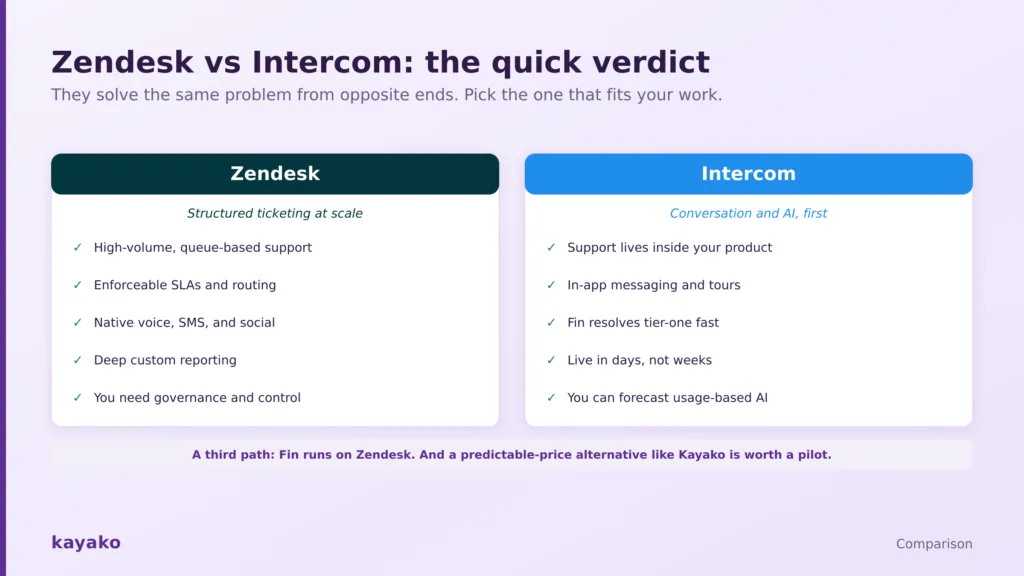
They solve the same problem from opposite ends. Pick the one that fits how your team works.
Choose Zendesk if you run structured, high-volume support, need enforceable SLAs and skills-based routing, cover voice and social at scale, and answer to governance requirements.
Choose Intercom if your support happens inside your product, you want conversation-first messaging with product tours, and you want a team productive in days. The close calls almost always come down to AI cost, and there is a third path most comparisons hide: because Fin can run on Zendesk, the smartest answer for some teams is not one platform or the other.
Zendesk vs Intercom at a glance
Prices are per agent or per seat, per month, on annual billing, and were current in mid-2026. Confirm both vendor pricing pages before committing, because this category changes fast.
| Dimension | Zendesk | Intercom |
|---|---|---|
| Best for | Structured high-volume ticketing, SLAs, omnichannel | Product-led, conversation-first, in-app engagement |
| Starting paid price | $19 per agent (limited); $55 for omnichannel | $29 per seat (Essential, annual) |
| Free plan | None, 14-day trial | None, 14-day trial |
| Native voice | Zendesk Talk, per-minute add-on | Bundled in Advanced and Expert plans |
| AI billing | Advanced AI $50/agent, plus about $1.50 to $2.00 per resolution | Fin $0.99 per resolution; Copilot about $29/seat |
| AI on the rival platform | Not applicable | Yes, Fin can run on Zendesk via API |
| Time to live | Weeks to months for advanced AI | Days to a couple of weeks |
| Integrations | About 1,800 | About 350 to 450 |
| G2 rating | About 4.3 out of 5 (6,800+ reviews) | About 4.5 out of 5 (3,500+ reviews) |
| Capterra / TrustRadius | 4.5 out of 5; 8.7 out of 10 | 4.5 out of 5; high |
A table cannot capture the part that trips teams up later, which is how the AI line behaves once usage grows. Before that, here are the differences that actually decide the fit.
The key differences between Zendesk and Intercom
Strip away the marketing and the two diverge on five things that matter more than any feature list.
- Origin and shape. Zendesk is a ticketing engine built for structure, queues, and SLAs. Intercom is a messenger built for real-time, in-app conversation.
- AI philosophy. Intercom’s Fin is a customer-facing agent built to resolve end-to-end. Zendesk’s AI leans toward assisting and triaging human agents, with autonomous resolution as an add-on.
- Channels. Zendesk offers mature native voice, SMS, and social in one workspace. Intercom is strongest on web and in-app chat and bundles phone into higher plans.
- Reporting and governance. Zendesk goes deep on custom reporting, QA, and multi-brand controls. Intercom is lighter here and leans on the conversation model.
- Pricing model. Zendesk is seat-based and forecastable at the seat level. Intercom’s seat price is friendly, but its usage-based AI layer makes the total harder to predict.
Those differences show up concretely in a feature-by-feature view.
Zendesk vs Intercom: feature comparison
Eight capabilities that decide most deals, with the edge based on how they play out in practice rather than a spec sheet.
| Capability | Zendesk | Intercom | Edge |
|---|---|---|---|
| Ticketing and SLAs | Purpose-built, complex routing, SLA policies | Real but lighter ticketing layer | Zendesk |
| In-app messaging and tours | Works, reads as secondary | Native, proactive, code-free tours | Intercom |
| AI autonomy and deflection | Add-on, needs setup | Fin resolves more end-to-end | Intercom |
| Omnichannel and native voice | Email, chat, voice, SMS, social, WhatsApp | Fewer native channels, phone bundled | Zendesk |
| Setup speed | Weeks to months, often needs admin | Days, usually self-serve | Intercom |
| Reporting depth | Deep, customizable via Explore | Solid for engagement, thinner overall | Zendesk |
| Integrations | About 1,800 apps | About 350 to 450 apps | Zendesk |
| Pricing predictability | Seat model easier to forecast | Usage layer harder to forecast | Zendesk |
Tally those and a pattern appears. Zendesk takes the structure and scale rows, Intercom takes the conversation and AI-autonomy rows, and neither sweeps. The right pick depends on which rows you weigh most, and on the one line every buyer misjudges: AI cost.
Zendesk vs Intercom pricing
Zendesk charges per agent in suite tiers, which makes the seat cost predictable. Intercom charges per seat plus usage, and the usage half is where forecasts fall apart.
| Plan level | Zendesk | Intercom |
|---|---|---|
| Entry | Support Team $19 (email); Suite Team $55 | Essential $29 per seat (annual) |
| Mid-tier | Suite Professional $115 | Advanced: about $85 per seat |
| Top tier | Suite Enterprise: about $169 | Expert: about $132 per seat |
| Agent-assist AI | Advanced AI +$50 per agent | Copilot about $29 per seat |
| Customer-facing AI | About $1.50 to $2.00 per resolution | Fin: $0.99 per resolution |
| Native voice | Zendesk Talk, per-minute add-on | Bundled in Advanced and Expert |
A quick anchor. A 20-agent team on Zendesk Suite Professional lands near $1,100 a month on seats. The same team on Intercom Advanced is closer to $1,700 to $2,000 before a single AI resolution is counted. Neither figure includes the AI layer, which for both platforms is now billed by the resolution, and that layer is the single biggest reason these bills surprise people.
The AI bill nobody warns you about
This is the section every vendor page skips and every buyer needs. In 2026, both platforms charge for AI by the resolution, and both definitions of resolution can quietly work against you.
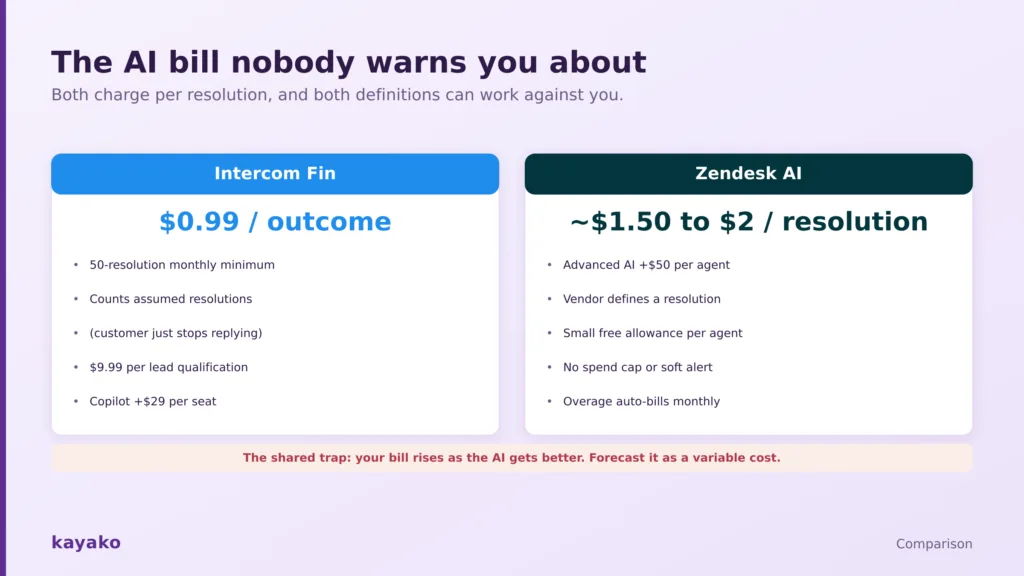
Both charge per resolution, and the shared trap is that your bill rises as the AI gets better.
Intercom Fin bills $0.99 per resolution with a 50-resolution monthly minimum on the standalone plan. The catch is how a resolution is counted: Intercom books one when the customer confirms the answer helped, and also when the customer simply stops replying without asking for more, which it calls an assumed resolution.
A customer leaving is not the same as a customer being helped. Fin also charges for other outcomes, such as $9.99 for a lead qualification. Real reports show the pattern, with one team describing a monthly Fin bill climbing from about $4,000 to $9,000 and a legacy customer jumping from $119 to $854 after migrating to the new model (ClearFeed).
Zendesk is not simpler. Its Advanced AI add-on runs about $50 per agent, and on top of that it charges roughly $1.50 per automated resolution on committed usage or about $2.00 pay-as-you-go, with a small free allowance. Zendesk decides what counts as an automated resolution, and the only overage control is to pause the AI, since there is no spend cap or alert.
The structural trap is shared: every improvement you make to your knowledge base produces more billable resolutions, so forecast the AI layer as a variable cost that scales with success, not as a flat subscription (getMACHA analysis).
|
The fact that changes the decision: Fin runs on Zendesk
Here is the part most comparisons bury, because it complicates their preferred answer: you may not have to choose at all. Intercom’s Fin can be deployed on top of an existing Zendesk instance through the API. It syncs your data and can start resolving queries in about an hour, with no migration required. Intercom itself confirms Fin works with any major help desk.
That reframes the question. If your real goal is autonomous deflection and you already run Zendesk for structured ticketing, you can keep Zendesk and add Fin as the AI layer, or run Fin alongside to compare performance before committing to anything bigger. Plenty of mature teams now run exactly this hybrid, using conversational AI for tier-one volume and a heavy ticketing engine for everything that escalates. The decision shifts from picking a platform to deciding which architecture you want underneath and which AI you want on top.
Zendesk vs Intercom: pros and cons
Aggregated from thousands of reviews, here is where each platform earns praise and where it draws complaints.
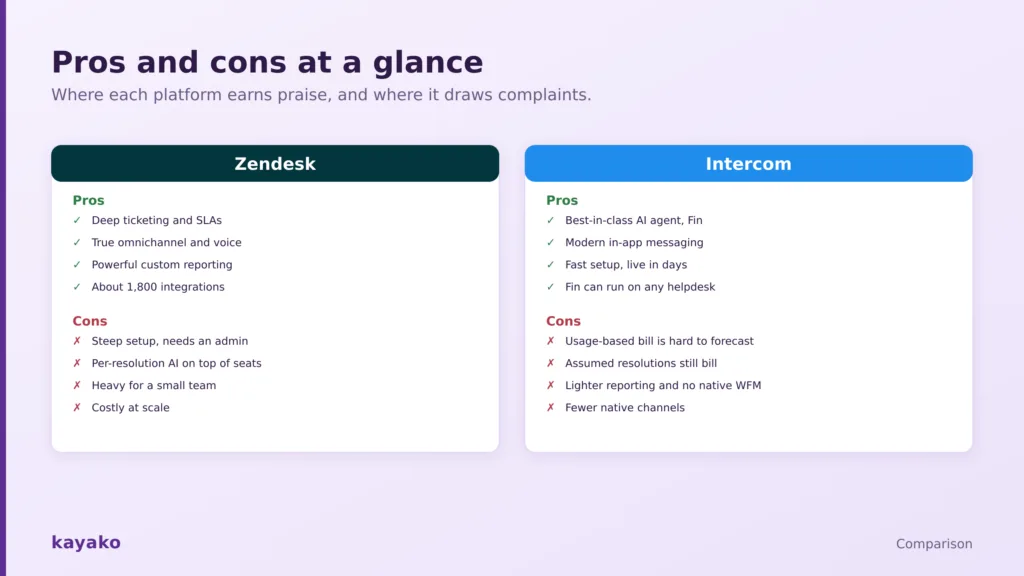
Where each platform earns praise, and where it draws complaints.
Zendesk pros and cons
Pros: purpose-built ticketing and SLAs, true omnichannel with native voice, powerful custom reporting through Explore, native QA and workforce management, and a large app marketplace.
Cons: a steep setup that often needs a dedicated admin, per-resolution AI billing stacked on top of seat costs, a feel that is heavy for a small team, and a total cost that climbs at scale.
Intercom pros and cons
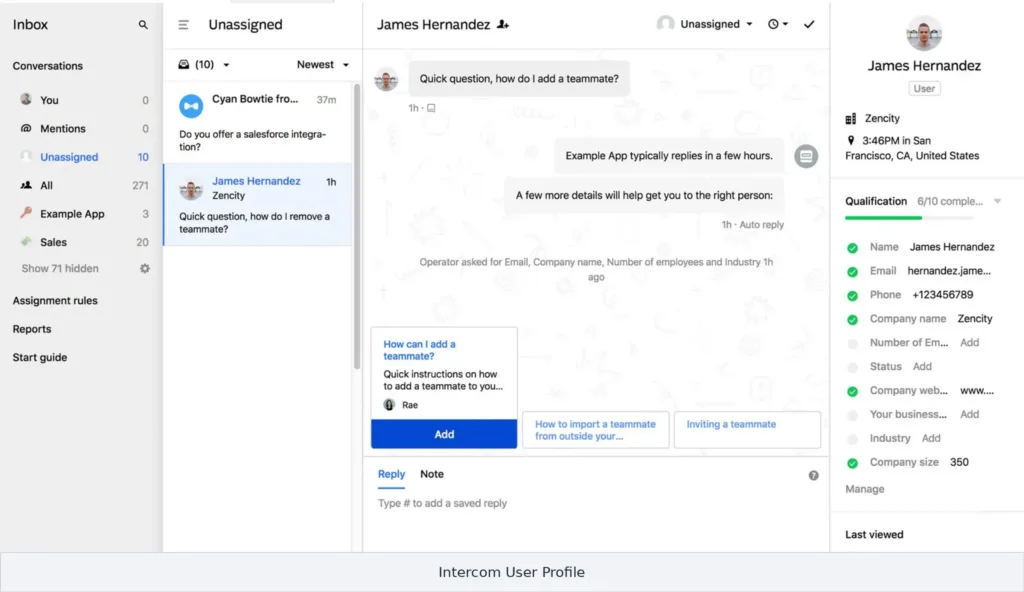
Pros: a best-in-class autonomous AI agent in Fin, modern in-app messaging and product tours, fast self-serve setup, and the flexibility to run Fin on almost any help desk.
Cons: a usage-based bill that is hard to forecast, assumed resolutions that still charge, lighter reporting with no native workforce management, and fewer native channels than Zendesk.
What real users say on G2, Capterra, and Reddit
Marketing describes the dream. Reviews describe the day-to-day, and a few themes repeat once you read enough of them.
Zendesk
On G2, Zendesk sits around 4.3 across more than 6,800 reviews, with 4.5 on Capterra and 8.7 out of 10 on TrustRadius. Reviewers praise organized tickets, reliable routing, and steady performance at volume, while the steady criticism is setup effort and a sense that it is heavy or costly for a small team. On Reddit, teams describe the per-resolution AI as poor value, with one thread calling automated resolutions “a rip-off” and flagging that you cannot export what customers asked the bot.
Intercom
Intercom rates a little higher at about 4.5 on G2, with especially high satisfaction for Fin. Users love the modern interface and how quickly Fin starts deflecting. The loudest complaint by far is the bill: reviewers consistently say they love the product and dread the invoice.
A widely shared r/SaaS analysis of 215 reviews summed it up as a “resolution tax,” noting that everyone raves about Fin itself but the $0.99-per-resolution model frustrates finance teams. One tracker also found that 78% of Essential users upgrade within six months, so the entry tier behaves more like a trial.
Which is better for your team? Use cases
The right answer depends on your situation, so match your case against the scorecard below rather than a single verdict.
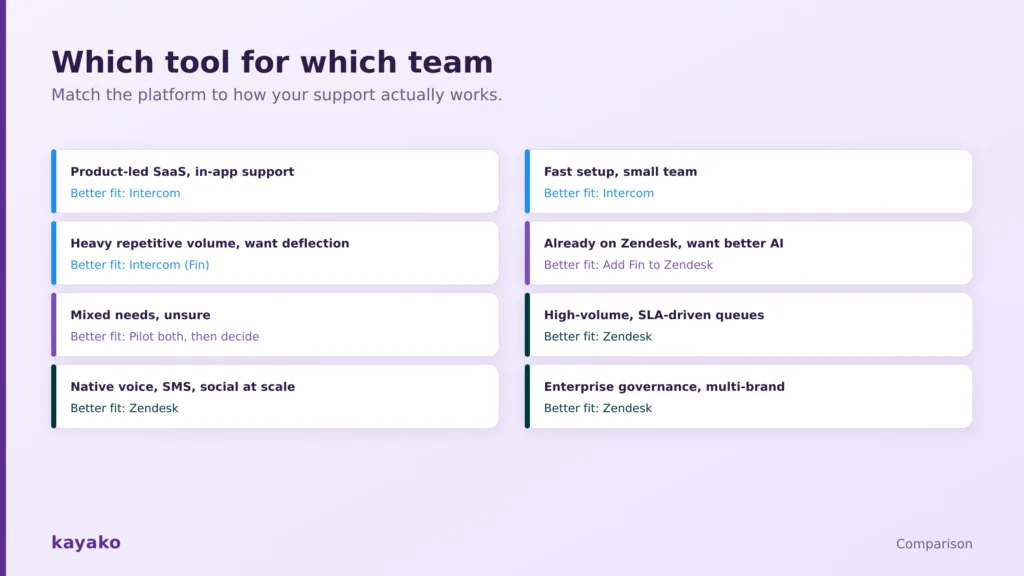
Match the platform to how your support actually works.
| Your situation | Better fit | Key reason and watch-out |
|---|---|---|
| Product-led SaaS, support inside the app | Intercom | Native messaging and tours. Forecast the Fin bill as you grow. |
| Small team, want fast setup | Intercom | Live in days and self-serve. Watch the Essential-to-Advanced jump. |
| Heavy repetitive volume, want deflection | Intercom (Fin) | Fin resolves tier-one well. Model the per-resolution cost at full volume. |
| Already on Zendesk, want better AI | Add Fin to Zendesk | Deploy Fin on your instance in about an hour, no migration. |
| High-volume, SLA-driven queues | Zendesk | Purpose-built ticketing and routing. Budget setup and an admin. |
| Native voice, SMS, social at scale | Zendesk | Mature omnichannel in one workspace. Voice is a per-minute add-on. |
| Enterprise governance, multi-brand | Zendesk | Deep controls, QA, and reporting. Plan a longer rollout. |
Migration and exit reality
Switching either way is a project, not an afternoon, so price the exit before you price the entry. Operations leads who have done it warn that the quoted migration figure rarely matches the real one once you account for data export gaps, API rate limits, and conversation history that does not come across cleanly, especially on closed tickets. Intercom does make inbound migration easier with a hands-on implementation team, and Fin’s ability to sit on your current Zendesk lets you sidestep a full migration while you test. If you are leaving a platform, export your historical data deliberately and confirm what each method silently drops before you flip the switch.
If you would rather avoid the per-resolution meter
Some teams want enterprise capability without an AI meter that climbs every time it works, and without the admin overhead of a heavy platform. If that is you, it is worth looking at platforms built around predictable pricing before you sign. Kayako, for example, combines a unified workspace, an AI agent, and a knowledge base with pricing you can forecast, and a short pilot on your live queue at full volume will tell you more than any feature grid.
You can read our take on AI customer support, or compare the wider field in our best Zendesk alternatives and best Intercom alternatives guides.
Two moves will tell you more than any sales demo. Run a two-week pilot on your live queue with your real knowledge base loaded, then look hard at the invoice that pilot would produce at full volume, every AI resolution included. And if you are already on Zendesk and the real itch is smarter deflection, put Fin on top of it before you entertain a move at all. The cheapest switch is usually the one you never have to make.
|
|
Frequently asked questions
Which is cheaper, Zendesk or Intercom?
On seats, Zendesk usually wins on predictability and often on total at scale. Intercom’s entry seat price can look lower, but its usage-based AI and add-ons can push the real bill higher. Model both at your expected volume, not the headline rate, and treat Fin’s per-resolution cost as a variable expense that grows as it resolves more.
What does Intercom Fin actually cost?
Fin is $0.99 per resolution with a 50-resolution monthly minimum on the standalone plan. You can be billed when a customer leaves without asking for more help, which Intercom calls an assumed resolution, and other outcomes such as a lead qualification cost more. Because the bill rises as Fin resolves more, forecast it as a variable expense rather than a flat subscription.
Can Intercom Fin run on Zendesk?
Yes. Fin connects to an existing Zendesk instance through the API and can start resolving queries in about an hour, with no migration required. Many teams run this hybrid, keeping Zendesk for structured ticketing and adding Fin as the AI deflection layer, rather than choosing one platform outright.
Which has better AI, Zendesk or Intercom?
Fin is the stronger autonomous resolver today and can take real actions through its Procedures, while Zendesk’s AI is the stronger agent assistant and triage engine. The better choice depends on whether you want to remove tickets from the queue entirely or speed up the humans handling them. Your volume of repetitive, self-contained questions decides which matters more.
Is Intercom good for enterprise ticketing?
It has improved with a real ticketing layer, but it still trails Zendesk on complex routing, SLA enforcement, governance, and native workforce management. For heavy structured ticketing at enterprise scale, Zendesk remains the stronger fit, while Intercom shines for conversation-first, product-led support.
Which is better for a startup?
Often Intercom, for product-led teams that want fast setup, in-app messaging, and conversational AI out of the box. Watch the Fin bill as you grow, since usage-based costs climb with success, and reassess once volume and workflow complexity increase. Teams that need structured queues and SLAs from day one may prefer Zendesk.