Intercom vs Freshdesk: An Honest 2026 Comparison
|
Intercom is a messenger-first, AI-first platform built for product-led SaaS teams that want the strongest AI agent, Fin, and in-app engagement, at a premium, usage-based price. Freshdesk is an affordable, ticketing-first help desk that is faster to deploy and cheaper to run, best for cost-conscious and traditional support teams. |
|
The bottom line
|
The Intercom vs Freshdesk decision comes down to two different ideas of what customer support software should be. Intercom is a messenger that has bet its future on AI, rebranding around its Fin agent and selling an AI-first platform where the help desk wraps around the automation.
Freshdesk is a traditional help desk that treats AI as one feature among many, built for structured, affordable, omnichannel ticketing. That difference in DNA, chat-and-AI versus ticket queue, explains almost every other contrast below.
This comparison is non-partisan. It draws on public pricing, aggregated G2 and Capterra scores, and independent reviews to show where each platform wins. We cover the quick verdict, the key differences, a feature table, real pricing, the AI trade-off, honest pros and cons, what users say, and a use-case matrix.
Intercom vs Freshdesk: the quick verdict
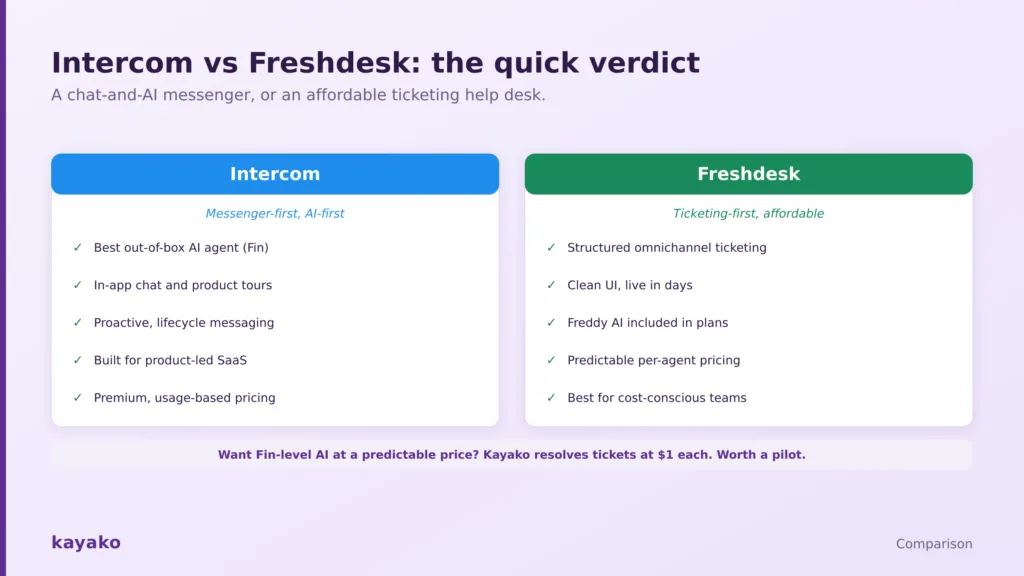
A chat-and-AI messenger, or an affordable ticketing help desk.
Choose Intercom if you run a product-led SaaS business, support lives inside your app, and you want the strongest AI agent and proactive messaging, and can absorb premium, usage-based pricing. Choose Freshdesk if you want structured, affordable omnichannel ticketing, a clean interface, fast setup, and predictable per-agent costs. Most cost-conscious and traditional support teams get more from Freshdesk, while AI-first, in-app SaaS teams get more from Intercom.
Intercom vs Freshdesk at a glance
Prices are per seat or per agent, per month, on annual billing, and were current in mid-2026. Confirm both vendor pricing pages before committing.
|
Dimension |
Intercom |
Freshdesk |
|---|---|---|
|
Core model |
Messenger-first, AI-first |
Ticketing-first help desk |
|
Best for |
Product-led SaaS, in-app support |
Cost-conscious, traditional support |
|
Entry price |
Essential from $29 per seat |
Free plan; Growth $15 per agent |
|
Customer-facing AI |
Fin, $0.99 per resolution |
Freddy, included in paid plans |
|
AI resolution rate |
About 55 to 65% |
About 40 to 50% |
|
Time to value |
Weeks |
Days |
|
Pricing model |
Seats plus usage, less predictable |
Per agent, predictable |
|
G2 rating |
4.5 out of 5 (3,100+ reviews) |
4.4 out of 5 (3,700+ reviews) |
|
Capterra |
About 4.5 out of 5 |
About 4.5 out of 5 |
Read it this way: Intercom wins on AI and conversation; Freshdesk wins on price and structure. The clearest way to see the gap is the difference in what each platform is fundamentally built to do.
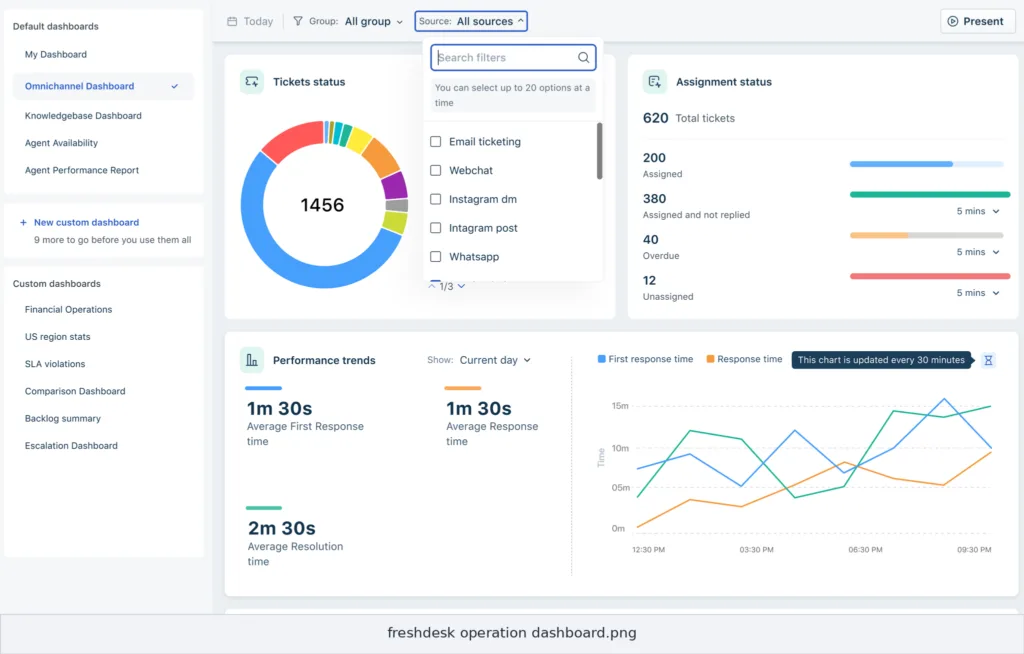
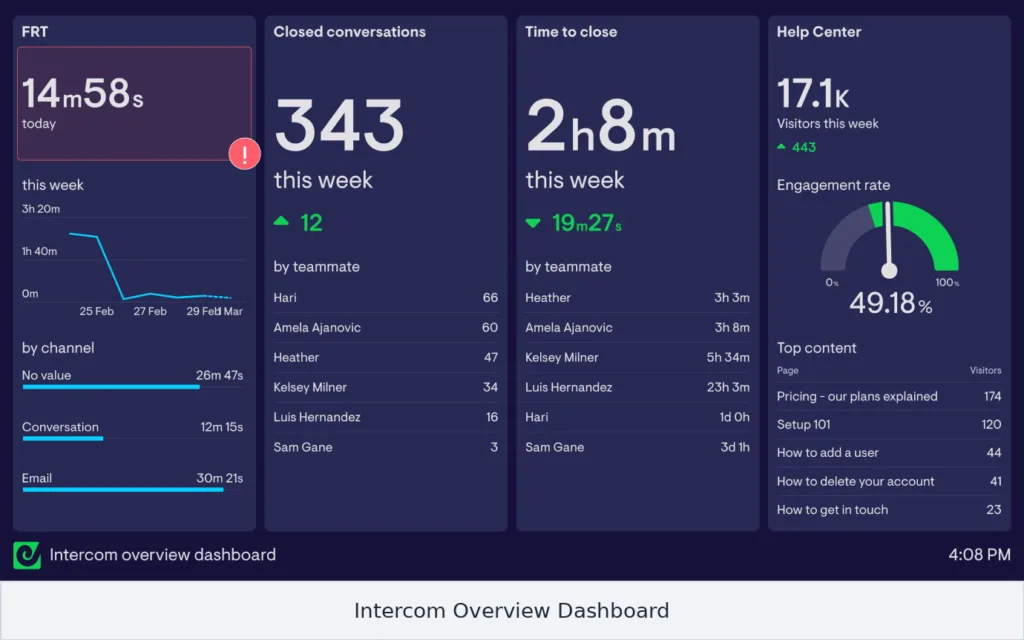
What is the difference between Intercom and Freshdesk?
The main difference is the model. Intercom is a messenger-first, AI-first platform built around its Fin AI agent and in-app chat, priced at a premium with usage-based AI. Freshdesk is a ticketing-first help desk built for structured, omnichannel support at a lower, predictable price, with Freddy AI included in its plans.
Beyond that core split, five differences decide the fit:
- DNA. Intercom is a chat-and-AI messenger. Freshdesk is a ticket queue. Everything else follows from that.
- AI. Intercom’s Fin is the strongest out-of-the-box AI agent, billed per resolution. Freshdesk’s Freddy is weaker but included in the plan.
- Price. Freshdesk is far cheaper and predictable. Intercom is premium and usage-based, so the bill moves with volume.
- Setup. Freshdesk goes live in days. Intercom typically takes weeks.
- Best fit. Intercom suits product-led SaaS and in-app support. Freshdesk suits cost-conscious, traditional, ticket-based teams.
Those differences show up concretely in a feature-by-feature view.
How we evaluated this
We pulled list pricing from each vendor and confirmed it in mid-2026, read aggregated scores and recent reviews on the major platforms, and drew on independent hands-on analyses. Where AI cost depends on volume rather than a flat fee, we flag it rather than presenting one number as fixed.
- Ratings: Intercom and Freshdesk on G2 and Capterra.
- Independent analysis: third-party teardowns of pricing and AI, such as getMACHA’s comparison and Fini’s guide.
Vendor claims are attributed in text rather than linked, so the sourced links here point only to independent platforms.
Intercom vs Freshdesk: feature comparison
The table scores the capabilities that decide most deals. Edge means which platform tends to win that row for most teams, not an absolute rule.
|
Capability |
Intercom |
Freshdesk |
Edge |
|---|---|---|---|
|
Customer-facing AI |
Fin, best out-of-the-box, per-resolution |
Freddy, included, weaker |
Intercom |
|
In-app messaging |
Native, polished, proactive |
Available, less central |
Intercom |
|
Product tours and lifecycle |
Built in, a core strength |
Limited |
Intercom |
|
Structured ticketing |
Lighter, chat-oriented |
Purpose-built, robust |
Freshdesk |
|
Omnichannel breadth |
Strong on chat and email |
Broad email, chat, phone, social |
Freshdesk |
|
Ease of setup |
Weeks |
Days |
Freshdesk |
|
Pricing predictability |
Seats plus usage, variable |
Per agent, predictable |
Freshdesk |
|
Price level |
Premium |
Affordable |
Freshdesk |
|
Integrations |
Solid app store |
Broad marketplace |
Freshdesk |
|
Reporting |
Good, conversation-focused |
Solid, ticket-focused |
Tie |
|
Best-fit buyer |
Product-led SaaS |
SMB and traditional support |
Depends |
The pattern is clear. Intercom takes the AI and conversational rows; Freshdesk takes the ticketing, breadth, and cost rows. The single line that decides most budgets is pricing.
Which is cheaper, Intercom or Freshdesk?
Freshdesk is significantly cheaper. It starts at $15 per agent with Freddy AI included, while Intercom starts around $29 per seat plus $0.99 for every AI resolution. For a 20-agent team, Freshdesk typically runs $300 to $980 a month, while Intercom can exceed $580 in seats plus $1,000 or more in AI charges.
|
The Budget Choice |
||
|
Tier |
Intercom |
Freshdesk |
|
Free |
None, 14-day trial |
Free, up to 2 agents |
|
Entry |
Essential from $29 per seat |
Growth $15 per agent |
|
Mid-tier |
Advanced about $85 to $99 |
Pro $49 (Freddy AI included) |
|
Top tier |
Expert about $132 to $139 |
Enterprise $79 |
|
Customer-facing AI |
Fin, $0.99 per resolution |
Freddy, included; Copilot add-on |
The gap is not just the seat price; it is the model. Freshdesk’s per-agent cost is predictable, so you can budget it. Intercom’s Fin bills by the resolution, which rewards heavy automation but makes the total move with your ticket volume. At 1,000 Fin resolutions a month, that is roughly $990 on top of seats, about the cost of a full extra agent. Model it against your real volume before you commit.
Is Freshdesk or Intercom AI better?
Intercom’s Fin is the better AI agent, resolving 55 to 65% of queries out of the box, the strongest in the category, but it bills $0.99 per resolution. Freshdesk’s Freddy resolves 40 to 50% and is included in paid plans with no per-resolution charge, making it far cheaper at high volume even though it is less capable.
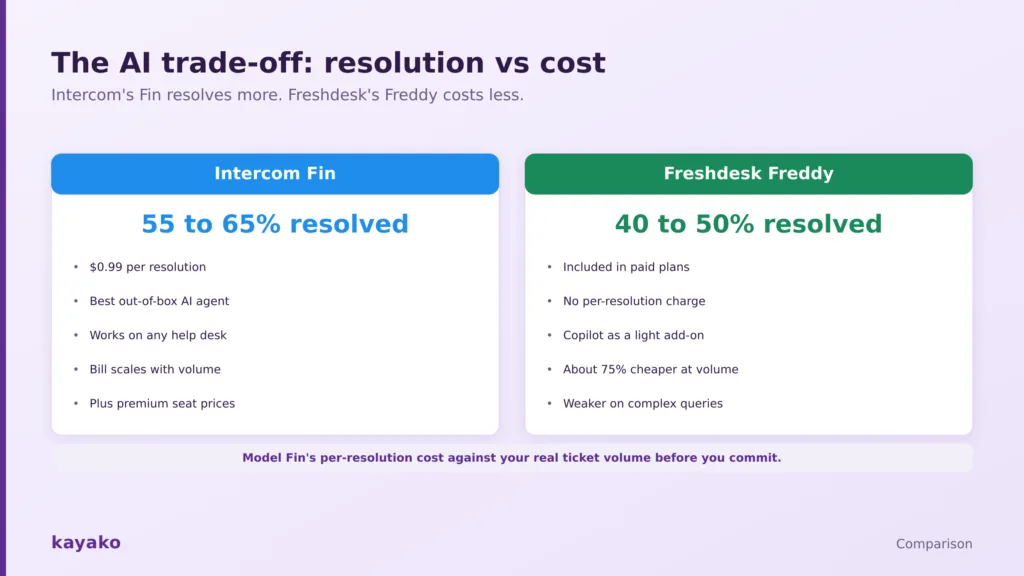
Intercom’s Fin resolves more. Freshdesk’s Freddy costs less.
The choice depends on your shape. If you have few agents but high, automatable conversation volume, Fin’s deflection can pay for itself despite the per-resolution cost. If you have many agents and moderate AI use, Freddy’s included model is far cheaper. Notably, Fin can also run on top of other help desks, including Freshdesk, so a team can keep Freshdesk for ticketing and add Fin as the AI layer rather than choosing one platform outright.
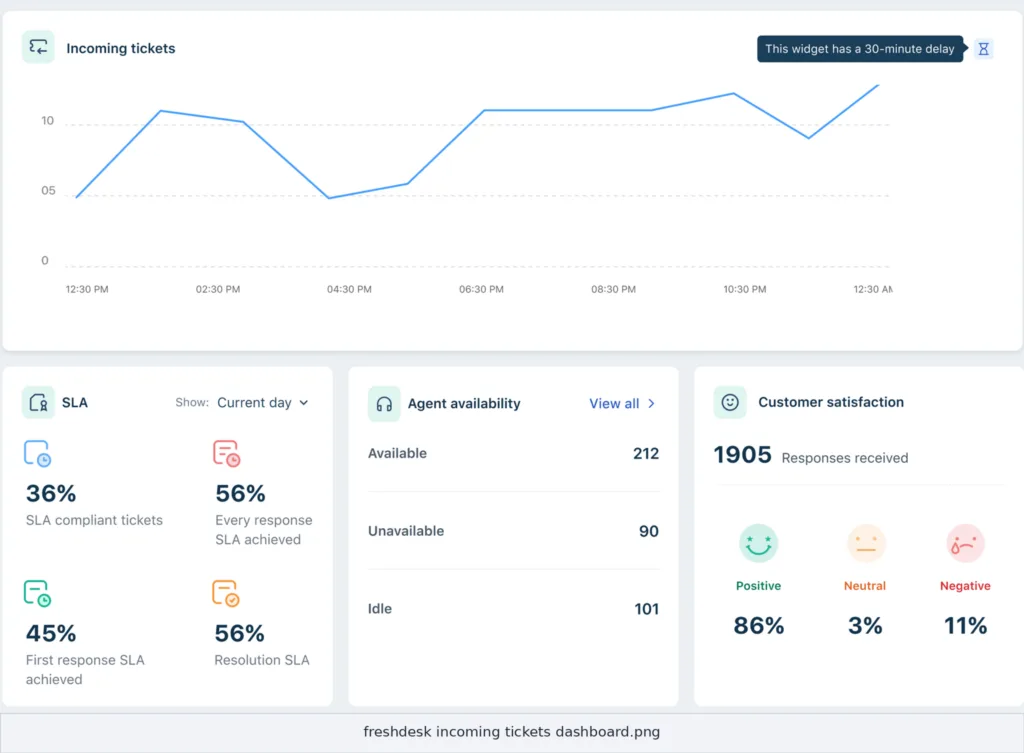
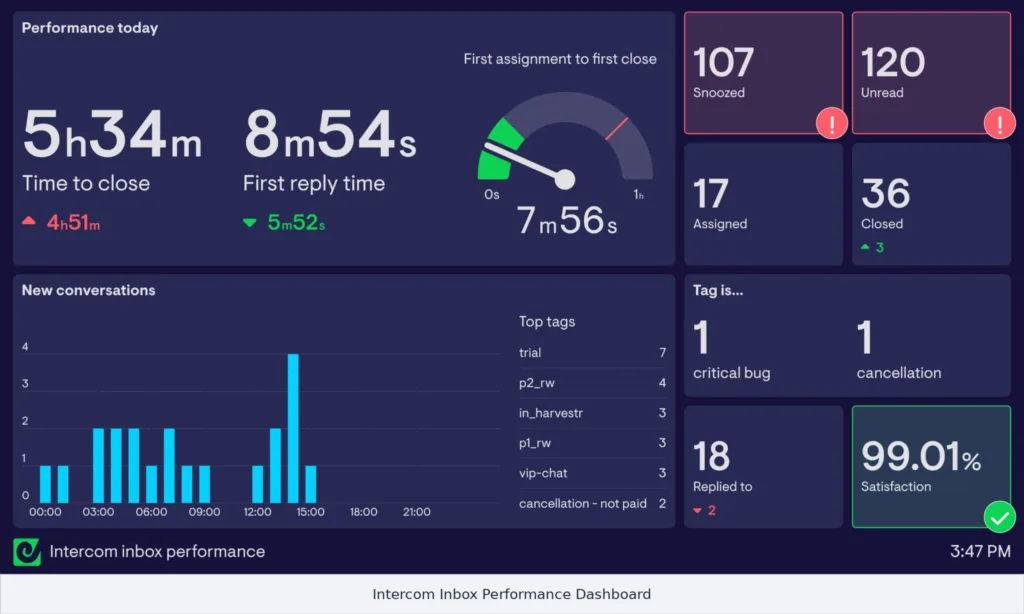
|
Intercom vs Freshdesk: pros and cons
Aggregated from thousands of reviews, here is where each platform earns praise and where it draws complaints.
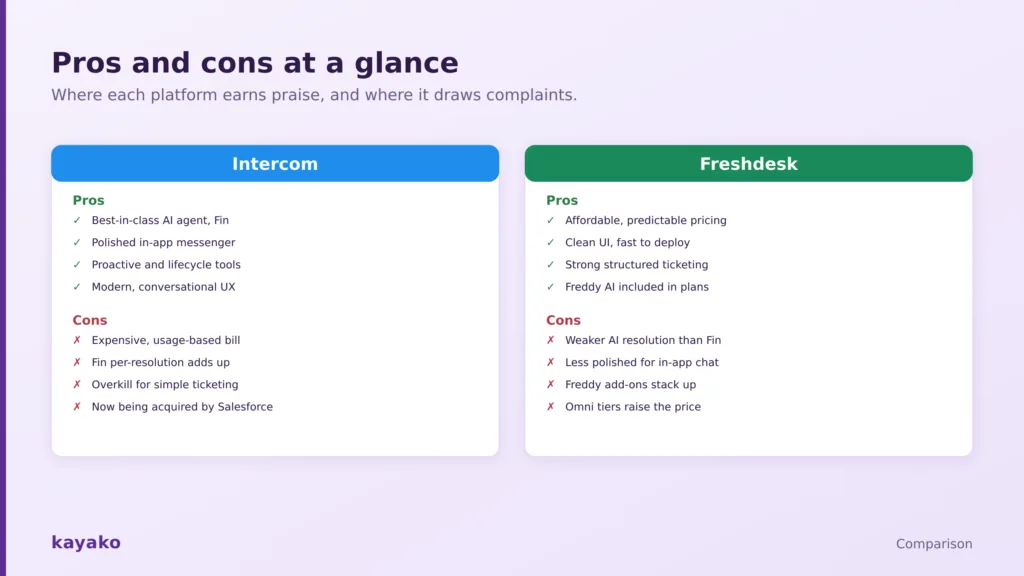
Where each platform earns praise and where it draws complaints.
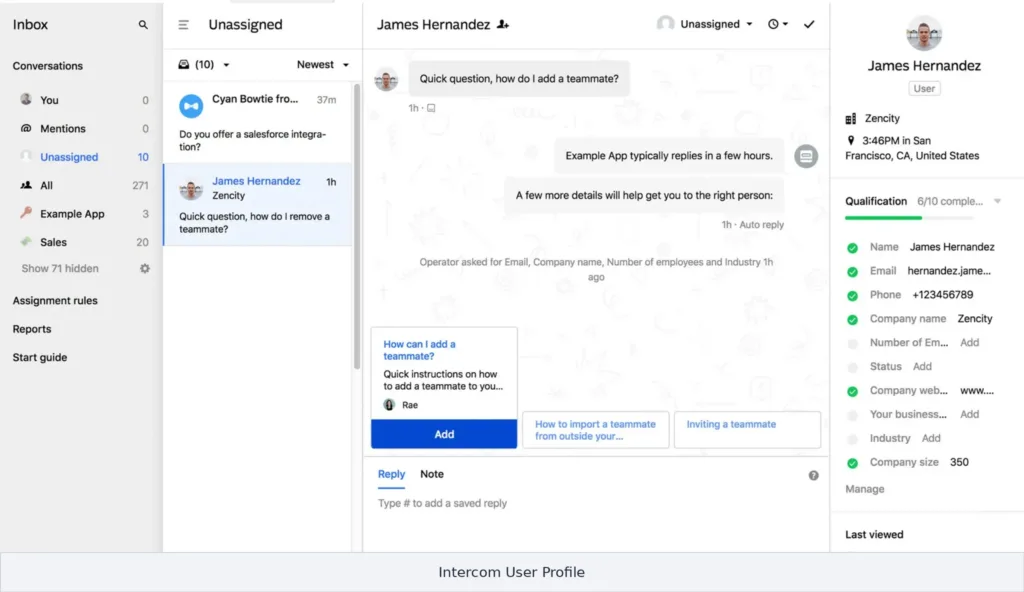
Intercom pros and cons
Pros: a best-in-class AI agent in Fin, a polished in-app messenger, strong proactive and lifecycle messaging, and a modern, conversational experience built for product-led SaaS.
Cons: expensive, usage-based pricing where Fin resolutions add up, more platform than a simple ticketing team needs, and the uncertainty of its pending acquisition by Salesforce.
Freshdesk pros and cons
Pros: affordable and predictable pricing, a clean interface, fast deployment, strong structured omnichannel ticketing, and Freddy AI included in paid plans.
Cons: weaker AI resolution than Fin, a less polished in-app chat experience, Freddy add-ons that stack up, and Omni tiers that raise the price.
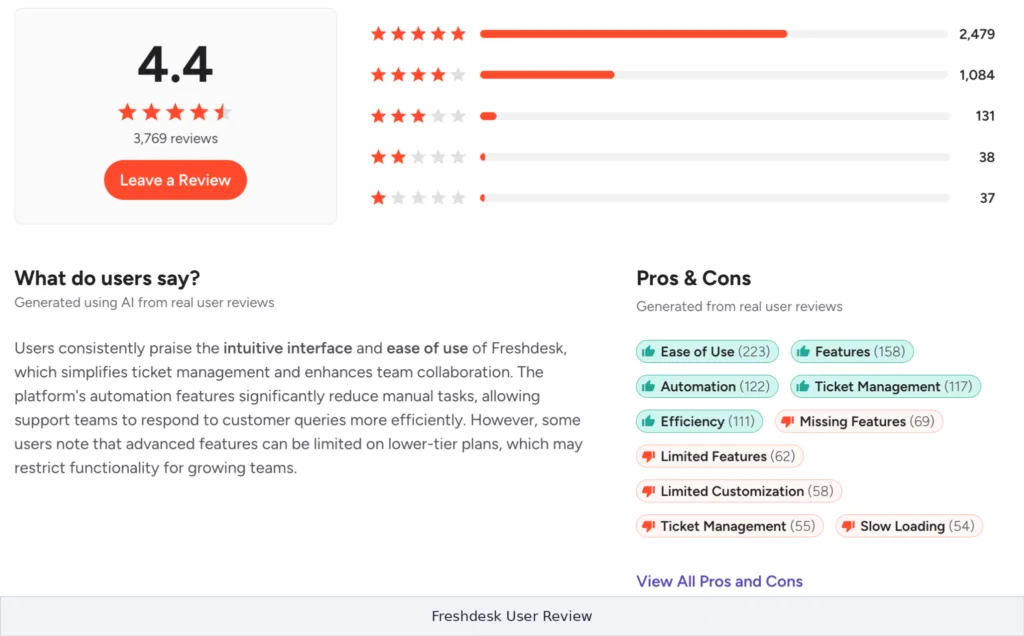
What real users say on G2 and Capterra
Both platforms are highly rated, and the review themes match their positioning.
Intercom
On G2, Intercom holds about 4.5 across roughly 3,100 reviews, similar on Capterra. Reviewers praise Fin’s resolution quality and the polished messenger, and say it feels modern and powerful. The dominant complaint is cost: users consistently love the product and dread the usage-based invoice, especially as Fin volume grows.
Freshdesk
On G2, Freshdesk sits at 4.4 across about 3,700 reviews, near 4.5 on Capterra. The steady praise is for value, ease of use, and structured ticket management, with teams noting fast onboarding and low training. The common criticism is that its AI trails Fin and that advanced capabilities can require add-ons.
Which is better for your team? Use cases
The right answer depends on your model, budget, and AI needs. Match your case against the scorecard below.
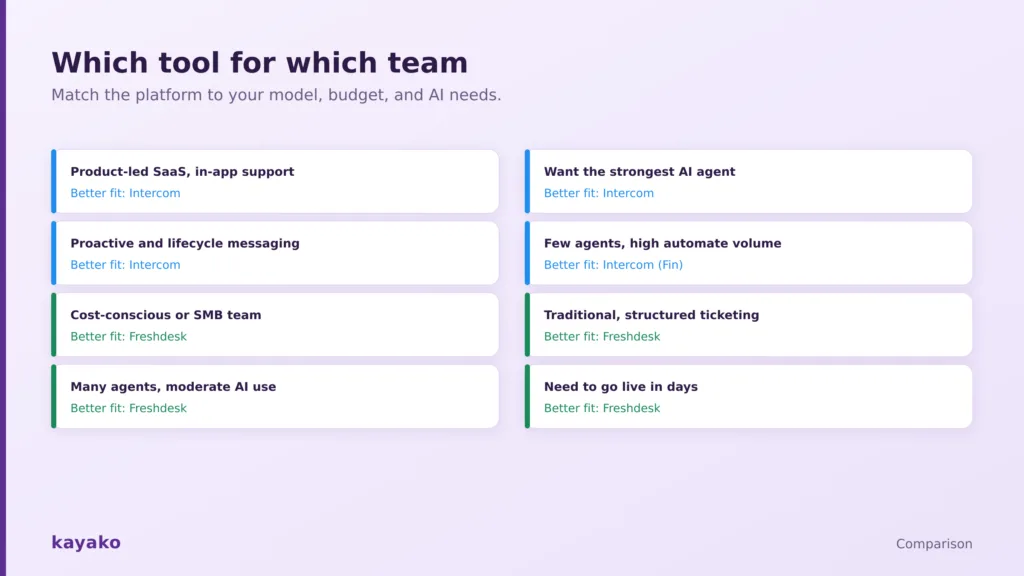
Match the platform to your model, budget, and AI needs.
|
Your situation |
Better fit |
Key reason and watch-out |
|---|---|---|
|
Product-led SaaS, in-app support |
Intercom |
Native messenger and Fin. Model the usage-based bill. |
|
Want the strongest AI agent |
Intercom |
Fin leads on resolution. Costs $0.99 per resolution. |
|
Few agents, high automatable volume |
Intercom (Fin) |
Fin deflection can pay for itself. Watch total volume. |
|
Cost-conscious or SMB team |
Freshdesk |
Cheaper and predictable. AI is capable, not class-leading. |
|
Traditional, structured ticketing |
Freshdesk |
Purpose-built ticket queue. Less polished in-app chat. |
|
Many agents, moderate AI use |
Freshdesk |
Freddy included beats per resolution at this stage. |
|
Need to go live in days |
Freshdesk |
Fast setup, low training. Intercom takes weeks. |
A note on the Salesforce acquisition
One timely factor belongs in any 2026 decision. In June 2026, Salesforce signed a definitive agreement to acquire Intercom for roughly $3.6 billion. For buyers, that raises normal questions about roadmap, pricing, and integration direction as Intercom moves under a much larger owner. It does not make Intercom a wrong choice, but if long-term product independence matters to you, it is worth weighing, and worth asking direct questions during a sales conversation.
If you want strong AI at a predictable price
The whole Intercom versus Freshdesk debate is a trade between AI power and predictable cost. Some teams want both: Fin-level automation without a usage meter that climbs every month, and without the add-on math. If that is you, it is worth testing a focused alternative against your real workflows.
Kayako resolves tickets with an AI agent at a flat $1 per resolution, alongside a unified workspace and a knowledge base, so your automation cost is easy to forecast. You can read our take on AI customer support, or compare the field in our best Intercom alternatives and best Freshdesk alternatives guides. Whichever way you lean, run a two-week pilot on your live queue and price the fully loaded cost, AI included, before you sign.
|
Frequently asked questions
Is Intercom better than Freshdesk?
Neither is better in the abstract. Intercom is better for product-led SaaS teams that want the strongest AI agent and in-app messaging and can absorb premium, usage-based pricing. Freshdesk is better for cost-conscious and traditional support teams that want affordable, structured omnichannel ticketing. On G2, they are close, at 4.5 and 4.4, so the choice is about fit.
Which is cheaper, Intercom or Freshdesk?
Freshdesk is much cheaper. It starts at $15 per agent with Freddy AI included, while Intercom starts around $29 per seat plus $0.99 per AI resolution. Freshdesk’s per-agent pricing is predictable, whereas Intercom’s Fin usage makes the total rise with ticket volume, so model Intercom against your real numbers before committing.
Is Freshdesk or Intercom AI better?
Intercom’s Fin is the stronger AI agent, resolving 55 to 65% of queries out of the box, the best in the category- but it bills $0.99 per resolution. Freshdesk’s Freddy resolves 40 to 50% and is included in paid plans, making it far cheaper at high volume. Fin wins on capability; Freddy wins on cost.
Does Intercom Fin work with Freshdesk?
Yes. Fin can run on top of other help desks, including Freshdesk, connecting through the API. That lets a team keep Freshdesk for structured ticketing and add Fin as the AI resolution layer, rather than migrating fully to Intercom, though you then pay Fin’s per-resolution rate on top of your Freshdesk plan.
Is Freshdesk good for SaaS companies?
Freshdesk works well for SaaS companies that run traditional, ticket-based support and want to control costs. Product-led SaaS teams whose support lives inside the app, and who prioritize proactive messaging and the strongest AI agent, often prefer Intercom. Many SaaS teams also run Freshdesk for ticketing and add a dedicated AI layer on top.
Which is easier to use, Intercom or Freshdesk?
Freshdesk is generally faster to set up, going live in days with low training overhead, which suits smaller teams. Intercom is polished but typically takes weeks to implement and is more of a platform than a simple ticketing team needs. For a clean, quick start, Freshdesk is easier; for a modern conversational experience, Intercom feels more refined.