Zendesk vs Freshdesk: An Honest 2026 Comparison
|
The bottom line
|
Search “Zendesk vs Freshdesk” and almost every result is written by one of the two companies, each certain it wins. This one is not. It is a practitioner-led comparison built from public pricing, aggregated review scores, and unfiltered community threads, with every figure sourced so you can check it. The goal is simple: help you pick the right help desk for your team, not sell you either one.
We cover the quick verdict, the key differences, a feature-by-feature breakdown, real pricing and total cost, honest pros and cons, what users actually say on G2, Capterra, and Reddit, and a use-case matrix that maps each tool to the teams it fits best.
Zendesk vs Freshdesk: the quick verdict
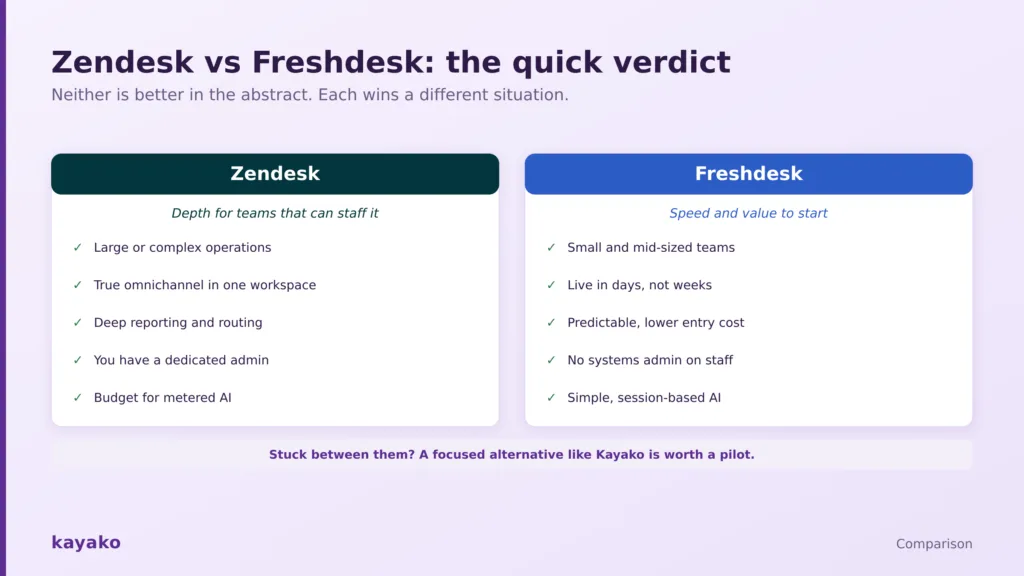
Neither wins in the abstract. Each is built for a different kind of team.
Choose Freshdesk if you are a small or mid-sized team, you want to be running in days, you do not have a systems admin, and you value a predictable bill.
Choose Zendesk if you run a large or complex operation, your cases cross several channels, you need deep reporting and routing, and you can staff someone to own the tool and watch the AI meter. Most teams under ten agents are better served starting on Freshdesk and revisiting once a real workflow or channel need forces the question.
Zendesk vs Freshdesk at a glance
Figures are per agent per month on annual billing unless noted, and every number is sourced in the methodology section that follows.
|
Dimension |
Zendesk |
Freshdesk |
|---|---|---|
|
Entry paid plan |
Support Team $19 (email only); Suite Team $55 (omnichannel) |
Growth $19 (email-first); Omni Growth $29 (multichannel) |
|
Free plan |
None. 14-day trial; startup program for qualifying teams |
Free Program, up to 2 agents |
|
Mid-tier |
Suite Professional $115 |
Pro $55; Omni Pro about $69 to $79 |
|
Top tier |
Suite Enterprise, sales-quoted (about $155 and up) |
Enterprise $89; Omni Enterprise about $109 to $119 |
|
Agent-assist AI |
Copilot, historically +$50, absorbing into Suite in 2026 |
Freddy Copilot +$29 to $35 |
|
Customer-facing AI |
Per verified resolution, about $1.20 to $2.00 above allowance, no cap |
Per session, $49 per 100 sessions, 500 free once |
|
Time to first value |
Weeks, often four or more |
Days to about a week |
|
Marketplace apps |
About 1,500 to 2,000 |
About 1,000 |
|
G2 rating |
4.3 out of 5 (about 6,800 reviews) |
4.4 out of 5 (about 3,750 reviews) |
|
Capterra / TrustRadius |
Capterra 4.5; TrustRadius 8.7 out of 10 |
Capterra about 4.5 |
Read it this way: Freshdesk wins the entry decision on price and speed, while Zendesk pulls ahead on depth once you have the scale and staff to use it. The picture changes sharply once AI is switched on, which is where most regret stories begin.
How we evaluated this
A comparison is only as trustworthy as its receipts, so here is the method. We pulled list pricing from each vendor and confirmed it in mid-2026. We read aggregated scores on the major review platforms and sampled recent individual reviews for repeated themes. We read current practitioner threads on Reddit, because that is where teams describe what actually broke. Where a figure is contract-dependent, such as Zendesk’s per-resolution AI rate, we say so rather than presenting one number as fixed.
- Ratings: Zendesk and Freshdesk on G2, Capterra, and TrustRadius.
- Hands-on and community: Zapier’s tested comparison, the eesel 2026 cost teardown, and threads across r/SaaS and r/sysadmin.
Pricing was confirmed on each vendor’s own pricing pages at the time of writing. We attribute vendor claims in text rather than linking them, so the sourced links here point only to independent platforms.
The key differences between Zendesk and Freshdesk
Strip away the marketing and the two platforms diverge on five things that actually decide the fit.
- Depth vs speed. Zendesk is a deep, configurable platform that rewards investment. Freshdesk is built to be live in days and easy for a small team to run itself.
- Unified vs multichannel. Zendesk lands every channel in one timeline. Freshdesk handles multiple channels well but can split context between products, so a chat and a ticket may not share history.
- AI billing model. Zendesk charges per resolution with no spend cap, so the bill scales with automation. Freshdesk sells session packs you can forecast.
- Admin dependency. Zendesk generally needs a dedicated admin to run well. Freshdesk is designed for self-service configuration.
- Cost trajectory. Freshdesk is cheaper at entry and stays predictable. Zendesk starts close on seat price but climbs fast once AI and services are added.
Those differences show up concretely in a feature-by-feature view.
Zendesk vs Freshdesk: feature comparison
The table below scores the core capabilities. Edge means which platform tends to win that row for most teams, not an absolute rule.
|
Capability |
Zendesk |
Freshdesk |
Edge |
|---|---|---|---|
|
Core ticketing |
Deep and highly flexible |
Solid, clean, and simple |
Tie |
|
Omnichannel |
Unified workspace, one timeline |
Multichannel, context can split |
Zendesk |
|
Customer-facing AI |
High ceiling, per-resolution, uncapped |
Session-based, predictable cost |
Depends |
|
Agent-assist AI |
Copilot, absorbing into Suite |
Freddy Copilot add-on |
Tie |
|
Automation and routing |
Advanced skills-based, complex rules |
Simpler, sequential modules |
Zendesk |
|
Reporting |
Deep, custom dashboards |
Clean, pre-built dashboards |
Depends |
|
Knowledge base |
Strong, mature |
Strong, easy to run |
Tie |
|
Integrations |
About 1,500 to 2,000 apps |
About 1,000 apps |
Zendesk |
|
Ease of setup |
Weeks, needs an admin |
Days, self-service |
Freshdesk |
|
Support and onboarding |
24/7 on paid tiers; paid implementation |
24/7 email; free onboarding and migration |
Freshdesk |
|
Pricing predictability |
Seats plus metered AI, variable |
Seats plus session packs, steady |
Freshdesk |
The clearest split is philosophical, and it shows up the moment you open each product.
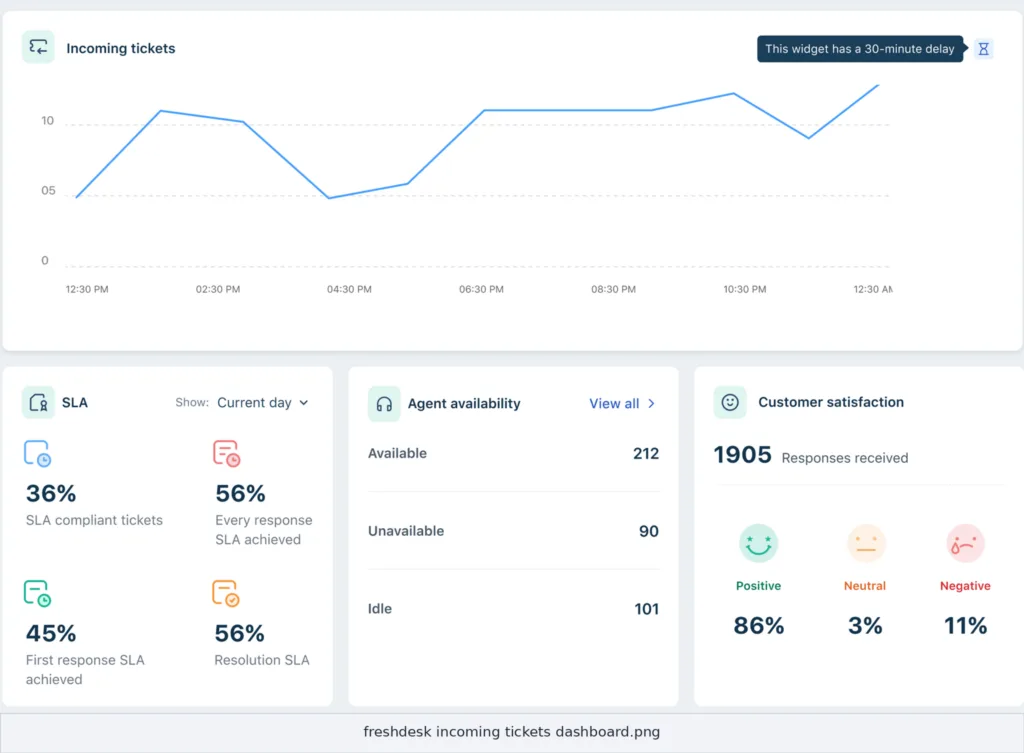
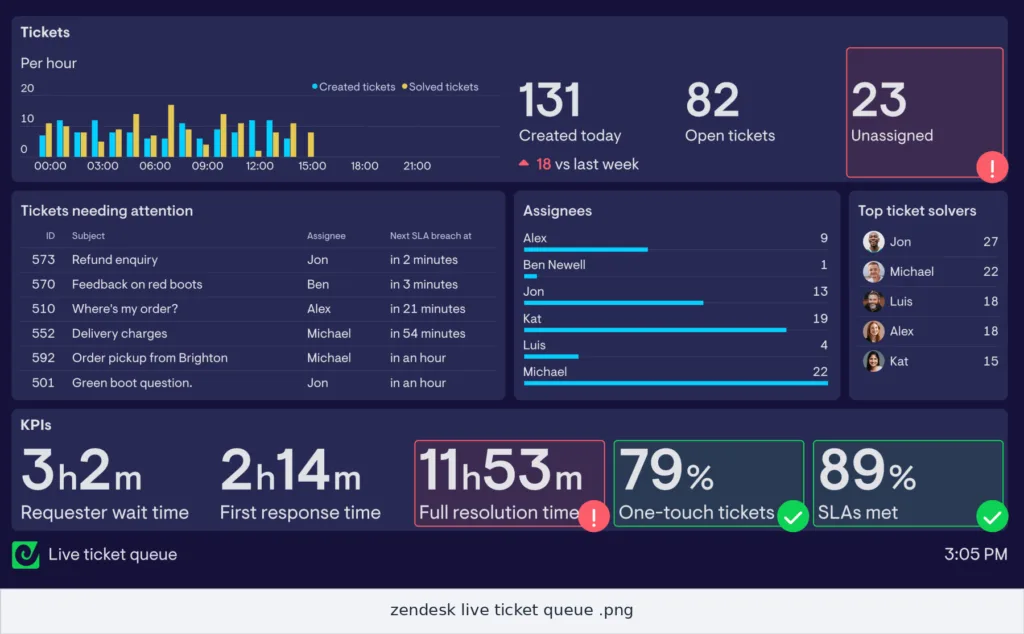
A concrete test from Zapier’s hands-on review makes the omnichannel gap tangible. Searching a customer name in Freshdesk returned full context only for conversations already converted into tickets, while chats handled without conversion showed basic details and none of the history. Zendesk avoids that split with a single workspace where email, chat, voice, and social land in one timeline. If most of your tickets stay in one channel, the gap barely matters. If a typical case crosses three channels before it closes, Zendesk’s unified view starts to pay for itself.
|
Zendesk vs Freshdesk pricing
Both charge per agent per month with a discount for annual billing. The headline gap at entry is small. The real spread opens once you add channels, AI, and the services needed to run either platform.
|
Plan level |
Zendesk |
Freshdesk |
|---|---|---|
|
Free |
None (14-day trial) |
Free Program, up to 2 agents |
|
Entry |
Support Team $19 (email); Suite Team $55 |
Growth $19 (email); Omni Growth $29 |
|
Mid-tier |
Suite Professional $115 |
Pro $55; Omni Pro about $69 to $79 |
|
Top tier |
Suite Enterprise, about $155 and up |
Enterprise $89; Omni Enterprise about $109 to $119 |
|
Agent-assist AI |
Copilot +$50 (absorbing into Suite) |
Freddy Copilot +$29 to $35 |
|
Customer-facing AI |
Per verified resolution, no spend cap |
$49 per 100 sessions, 500 free once |
Monthly billing runs higher on both. Two line items decide the true total: neither platform includes implementation, and Zendesk professional services for a mid-market rollout commonly run from several thousand dollars into the tens of thousands. Zendesk also auto-bills AI overage every month with no cap, a change teams flagged loudly after it took effect in early 2026.
What teams actually pay
A 10-agent team on Freshdesk Omni Pro lands near $1,000 to $1,300 a month all-in with moderate AI use. The same team on Zendesk Suite Professional with Copilot and metered AI can reach about $2,500 a month, with the AI line alone exceeding the entire Freshdesk bill. Push automation harder, and the Zendesk AI overage can pass $9,000 a month, more than five times the human seat cost. These are modeled estimates on stated assumptions, not vendor quotes, but the direction is consistent across every teardown we read.
Zendesk vs Freshdesk: pros and cons
Aggregated from thousands of reviews, here is where each platform earns praise and where it draws complaints.
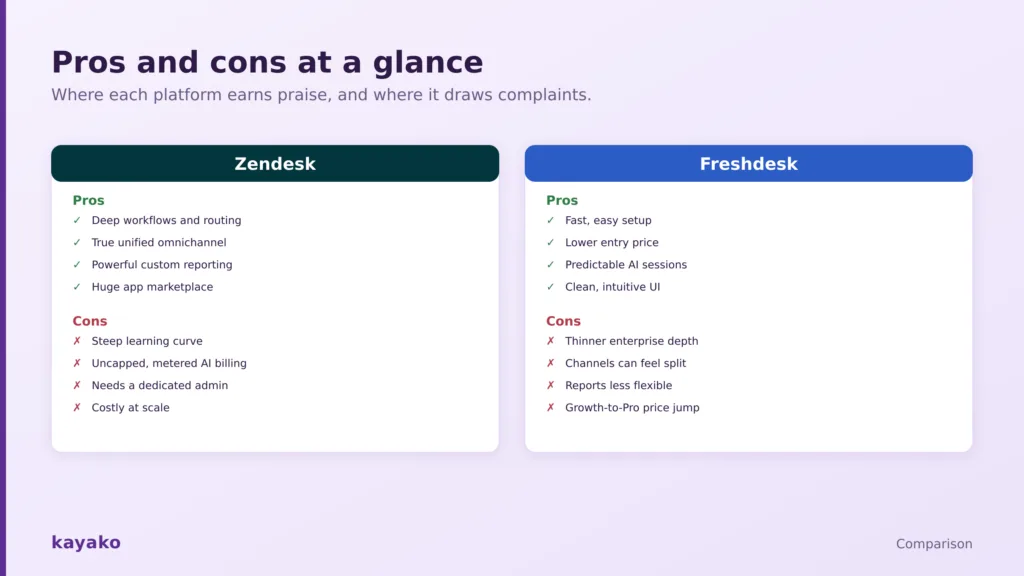
Where each platform earns praise, and where it draws complaints.
Zendesk pros and cons
Pros: deep workflow automation and skills-based routing, a genuinely unified omnichannel workspace, powerful custom reporting, a large app marketplace, and enterprise-grade security and controls.
Cons: a steep learning curve, uncapped per-resolution AI billing, a real need for a dedicated admin, and a total cost that climbs quickly at scale.
Freshdesk pros and cons
Pros: fast, self-service setup, a lower entry price, predictable session-based AI, a clean and intuitive interface, and free onboarding and migration support.
Cons: thinner depth for complex enterprise needs, context that can split across channels, less flexible reporting, and a noticeable price jump from Growth to Pro.
AI in 2026, honestly
AI is the headline feature on both platforms and the most oversold. Vendor decks point to autonomous resolution rates of 50 to 80 percent. Real deployments start closer to 20 percent and climb only with months of knowledge-base work. Treat it as a first-line deflection engine, not a replacement for your team.
The most sobering data point comes from inside Zendesk. At its ProductLab 2025 conference, a live poll found that only about 10 percent of AI agents built in the prior six months were still in use, as reported by eesel. The rest were quietly retired, usually because the knowledge base was not clean enough. That number should temper any AI promise on either side. On billing, Freshdesk meters by session, which is easy to forecast. Zendesk bills per verified resolution with a higher capability ceiling but only a hard pause as an overage control, so the bill can move faster than the budget.
What real users say on G2, Capterra, and Reddit
Marketing pages agree on everything and practitioners do not, which is why the unfiltered sources are the most useful part of any comparison. The points below are paraphrased from public reviews and threads, with links so you can read the originals.
On Reddit
The dominant 2026 complaint about Zendesk is the per-resolution AI bill. In widely cited Reddit discussions, users describe the automated-resolution model as poor value, say they stopped using it, and note that you cannot export the bot data to analyze it.
Others report the AI misclassifying tickets and giving wrong information, so they rolled it back to an assist role. On the Freshdesk side, commenters call Freddy reliable and affordable for early-stage teams that want the basics. Across r/sysadmin, both tools are often called overkill for a small team, while Freshdesk earns steady praise for quick setup and reasonable cost.
On G2 and Capterra
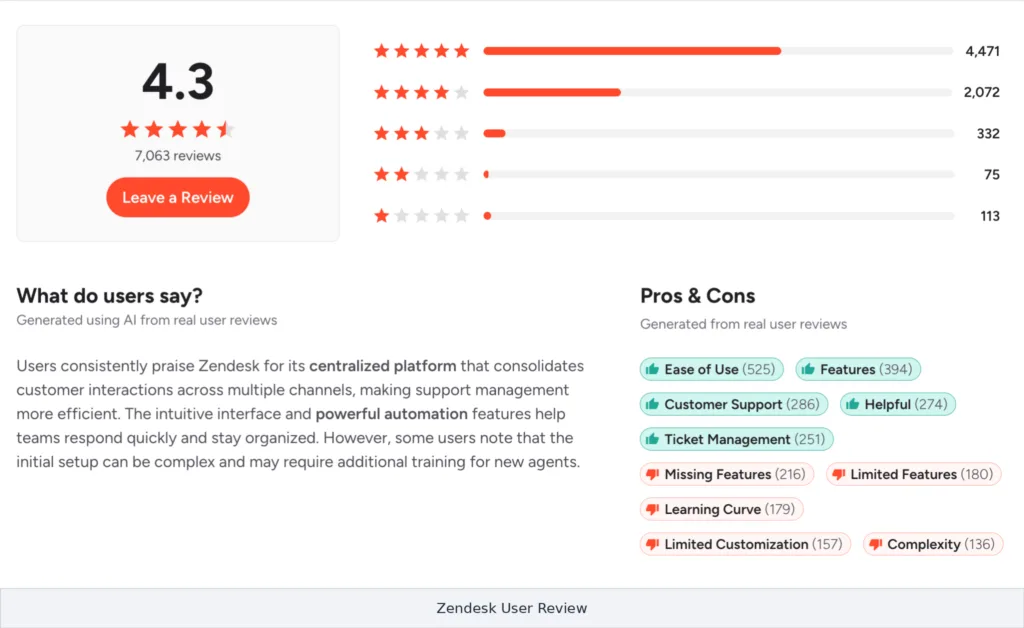
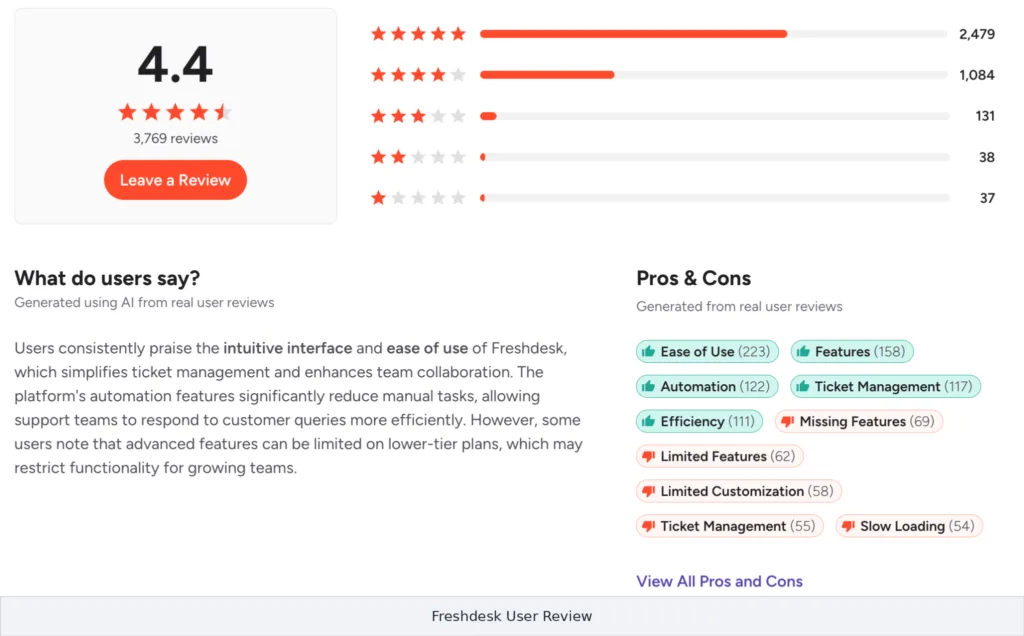
On G2, Zendesk holds a steady 4.3 across about 6,800 reviews, with ticket and channel management praised and learning curve and rising cost dominating the criticism. Freshdesk sits a touch higher at 4.4 across about 3,750 reviews, where intuitive onboarding and clean dashboards lead the praise and thinner enterprise depth leads the complaints.
Capterra scores both near 4.5. Trustpilot scores look far lower for both, but that platform collects feedback from the end customers of companies using these tools, not the buyers who run them, so G2 and TrustRadius are the more relevant buyer signals.
Which is better for your team? Use cases
The right answer depends on your situation, so here is a scorecard by team type rather than one general verdict. Find the row closest to yours, then read the watch-out before you commit.
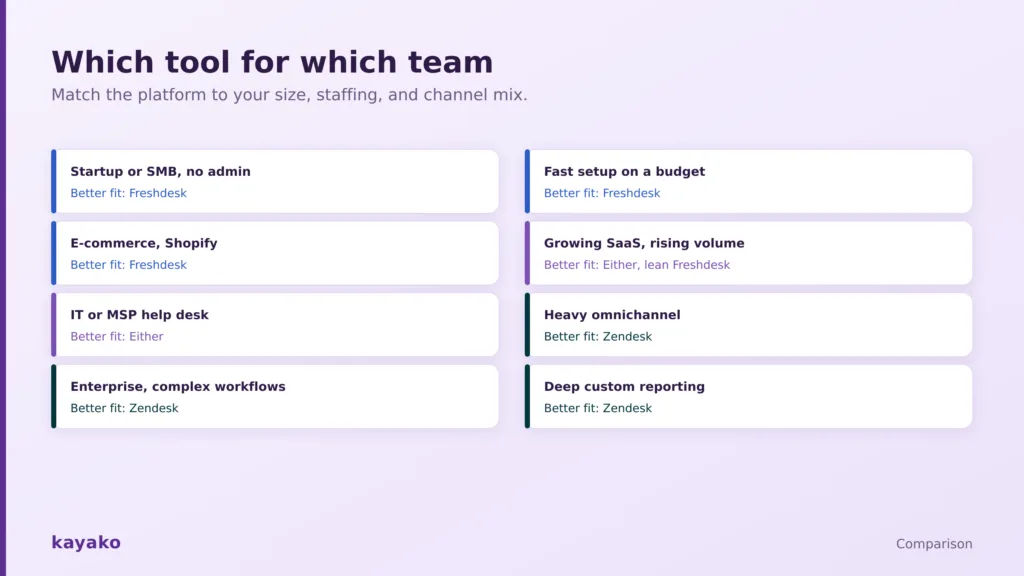
Match the platform to your size, staffing, and channel mix.
|
Your situation |
Better fit |
Key reason and watch-out |
|---|---|---|
|
Lean SMB or startup, 1 to 10 agents, no admin |
Freshdesk |
Free program and fast setup. Watch the Growth-to-Pro jump once you need routing and CSAT. |
|
Growing SaaS, rising ticket volume |
Either, lean Freshdesk |
Freddy covers FAQ deflection cheaply. Move to Zendesk when workflows outgrow it. |
|
E-commerce on Shopify |
Freshdesk |
Pre-built vertical agents and order context. Confirm API limits fit your sync volume. |
|
IT or MSP internal help desk |
Either |
Both handle tiered support. Compare knowledge base strength and per-seat cost at your headcount. |
|
Mid-market, heavy omnichannel |
Zendesk |
Unified workspace pays off across channels. Budget the AI overage and an admin. |
|
Enterprise or global, complex workflows |
Zendesk |
Depth, routing, and API actions. Negotiate AI resolution rates and plan a long setup. |
Migration and lock-in, the cost teams find last
Switching cost is the line nobody models before signing, and it is where regret concentrates. Freshdesk publishes API call limits that rise by tier, and the entry limit is tight for a store that syncs order data on every inquiry.
Zendesk’s lock-in is sharper around AI, since practitioners note you cannot export the underlying bot conversation data to analyze it yourself, which makes both leaving and forecasting harder. Neither platform makes the exit clean, so plan it before you commit: keep your knowledge base and ticket data in portable formats, and confirm what each vendor lets you export before you sign.
If you keep landing between the two
Some teams find Zendesk is more platform than they can staff, while Freshdesk runs short on depth as they grow. If you keep landing in that gap, it is worth testing a focused alternative against your hardest workflows and busiest hours before committing budget.
Kayako, for example, aims at enterprise-grade reliability without the administrative overhead, with a unified workspace, an AI agent, and a knowledge base in one platform. A short pilot on your real peak-volume scenarios will tell you more than any feature grid. You can read our take on AI customer support or compare the field in our best Zendesk alternatives and best Freshdesk alternatives guides.
|
|
Frequently asked questions
Is Zendesk better than Freshdesk?
Neither is better in the abstract. Zendesk is stronger for large, complex, high-volume operations with a dedicated admin, while Freshdesk is stronger for small and mid-sized teams that value speed and a lower entry cost. The right choice depends on your scale and your staffing, not on which platform is objectively superior.
What are the key differences between Zendesk and Freshdesk?
Zendesk is a deep, unified platform with advanced routing, custom reporting, and per-resolution AI billing, but it needs an admin and climbs in cost. Freshdesk is faster to deploy, cheaper at entry, and predictable on AI through session packs, but it is thinner for complex enterprise needs and can split context across channels. Depth versus speed is the core difference.
Which is cheaper, Zendesk or Freshdesk?
Freshdesk is cheaper for most teams, both at entry and over time. Entry seat prices are close, but Zendesk’s total cost rises quickly once you add Copilot, metered AI with no spend cap, and paid implementation. Freshdesk’s session-based AI and free onboarding keep its all-in cost lower and easier to forecast for small and mid-sized teams.
Does Freshdesk or Zendesk have a free plan?
Freshdesk offers a Free Program for up to two agents on its email-first product. Zendesk does not offer a free plan, though it provides a 14-day trial and a startup program for qualifying early-stage companies. For a team that wants to start at zero cost, Freshdesk is the only option of the two.
Is Zendesk or Freshdesk AI better?
Zendesk’s AI has a higher capability ceiling and can run multi-step actions, but it bills per resolution with no cap and needs a clean knowledge base to work well. Freshdesk’s Freddy is lighter and session-priced, which suits lean teams that want predictable costs. Both do well on simple, repetitive tickets and degrade on anything needing product-specific judgment.
Who are the main competitors to Zendesk and Freshdesk?
They are each other’s most direct rival in the help desk category, alongside platforms such as Intercom, Zoho Desk, Help Scout, and Kayako. The closest fit for any given team depends on size and on whether the priority is depth or simplicity. Running a short pilot against your hardest tickets is the fastest way to decide.