Gorgias Review 2026: Pricing, Pros, Cons, and Is It Worth It?
An honest look at Gorgias, the Shopify-native ecommerce help desk: what it does well, where the bill bites, and who should buy it.
| Gorgias review: Gorgias is an ecommerce help desk built for Shopify, with a built-in AI Agent that resolves tickets. Pricing is ticket-based plus a per-resolution AI meter, and an AI-resolved ticket can be billed on both, which spikes in peak season. It rates 4.6 on G2 but 2.1 on Trustpilot. This review covers pricing, real pros and cons, and who it fits.
Key takeaways
|
A Gorgias review comes down to two things: how good the Shopify integration is, and how much the ticket-plus-AI pricing will cost you. On the first, Gorgias is excellent and the reason most of its customers chose it. On the second, it is the single most common complaint, and the gap between the two is what this review works through.
This review covers what Gorgias is, how it is priced, what the ratings say, and the pros and cons reviewers raise most, with each point linked to its source. It closes with a feature-by-feature verdict and an honest read on who should buy it.
Gorgias review: what it is and who it is for
Gorgias is an ecommerce-native help desk built primarily for Shopify, with BigCommerce and Magento on higher tiers. It unifies email, chat, social, SMS, and voice, and its 2026 positioning is AI: a built-in Agent and a shopping assistant billed on usage.
Gorgias is an ecommerce-native help desk built primarily for Shopify stores, with support for BigCommerce and Magento on higher tiers. It consolidates email, live chat, social, SMS, and voice into one inbox, and surfaces Shopify order data and actions, such as refunds and order edits, directly inside each ticket, so agents do not toggle between systems.
Its 2026 positioning is AI. A built-in AI Agent resolves tickets and a shopping assistant makes product recommendations, both priced on usage rather than per seat. Gorgias says it powers customer experience for a large share of Shopify brands, and its audience is mostly small-business and mid-market direct-to-consumer stores, with a thinner presence at enterprise.
Gorgias sits in a crowded ecommerce support market, but its Shopify depth is what sets it apart from general help desks, and it is usually chosen by brands that want order actions and support in one place. It is less suited to businesses outside retail, which is worth keeping in mind as the review weighs its strengths against its pricing.
How I evaluated Gorgias
Gorgias rates 4.6 on G2 and Capterra but drops to about 2.1 on Trustpilot. A large share of recent five-star G2 reviews are incentivized, so this review leans on the organic reviews and the independent sites, especially on billing.
This review draws on Gorgias’s ratings across four sites plus its own pricing and help documentation. On G2, Gorgias holds 4.6 from about 582 reviews; on Capterra, 4.6 from 135; on TrustRadius, 8.3 out of 10 from 32; and on Trustpilot, a much lower 2.1, where billing and cancellation issues dominate.
A note on sourcing: a large share of Gorgias’s recent five-star G2 reviews are explicitly incentivized, so this review leans on the organic G2 reviews and the independent sites for the critical points, and treats the competitor-run analyses as pricing corroboration rather than opinion.
With that weighting in mind, the pattern across sources is consistent enough to trust: broad agreement on the product, broad agreement on the pricing frustration, and a gap that shows up most clearly on the sites where end customers and billing complaints land.
Gorgias pricing
Gorgias runs two meters at once — a helpdesk line on ticket buckets and an optional AI Agent line per automated interaction. Ticket overage runs 36 to 40 cents and automated interactions 85 cents to a dollar, and the bill spikes at seasonal peaks.
Gorgias runs two meters at once: a helpdesk line based on ticket buckets, and an optional AI Agent line billed per automated interaction. The pricing page defaults the AI toggle on, so the advertised stickers are the combined figure. Helpdesk-only, Starter is $10 a month, Basic $50, Pro $300, and Advanced $750 on annual billing, with Enterprise custom. With the AI Agent included, those rise to roughly $40, $77, $471, and $1,227.
The detail that catches teams is how tickets and AI stack. Ticket overage runs about thirty-six to forty cents each, and automated interactions cost roughly eighty-five cents to a dollar within the bundle and around a dollar fifty beyond it. Crucially, per Gorgias’s own help documentation, a ticket resolved entirely by the AI can incur both a ticket fee and an automation fee, so AI-resolved tickets are billed twice. Add voice and SMS as usage-based extras, and the bill becomes hard to forecast, especially during seasonal peaks.
The practical takeaway is to price Gorgias on your real ticket and automation volume, not the headline plan. A brand that comfortably fits Basic in a quiet month can spill into overage and higher AI charges during a launch or a holiday peak, so the number that matters is the projected cost of your busiest month, counting both meters.
|
|
Gorgias ratings: what the scores actually say
The aggregator scores are strong, but the drop to Trustpilot shows where to look: the help desk is well-liked, while billing and cancellation draw the complaints. A 4.6 on G2 reflects the Shopify integration; a 2.1 on Trustpilot reflects unpredictable bills.
The aggregator scores are strong, but the spread to Trustpilot tells a buyer where to look closely. The helpdesk itself is well-liked; the billing and cancellation experience is not.
| Review site | Reviews | Score |
|---|---|---|
| G2 | 582 reviews | 4.6 / 5 |
| Capterra | 135 reviews | 4.6 / 5 |
| TrustRadius | 32 reviews | 8.3 / 10 |
| Trustpilot | 152 reviews | 2.1 / 5 |
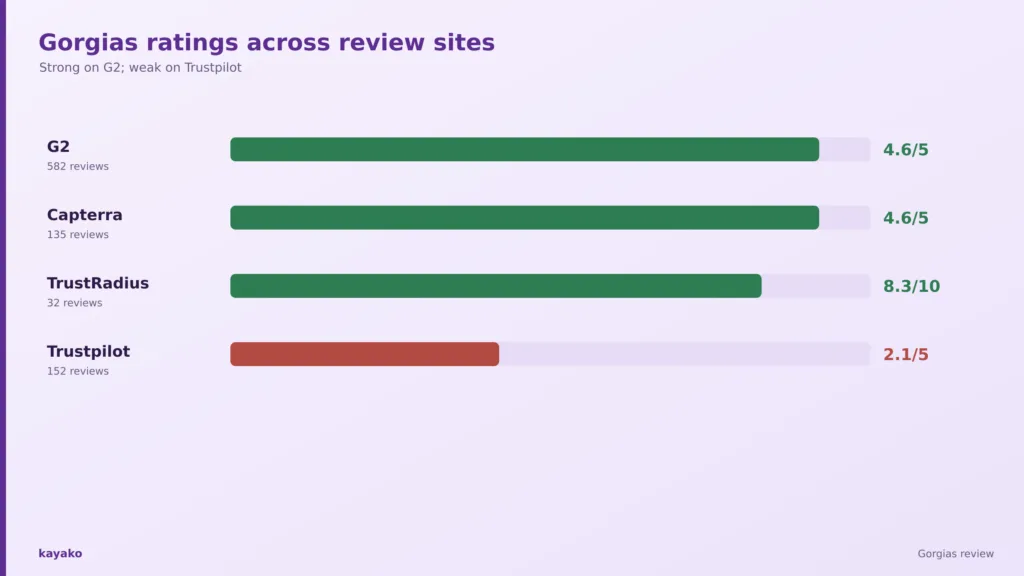
A 4.6 on G2 and Capterra reflects brands that value the Shopify integration and the unified inbox. A 2.1 on Trustpilot reflects a different complaint set, centered on unpredictable bills, sales pressure and friction when downgrading or canceling. Both are consistent with the pricing model, where a good product sits behind a meter that surprises people.
The practical read is that Gorgias scores well on what it does day to day and poorly on what it costs and how easy it is to leave. For a Shopify brand with steady volume, the first matters more; for a brand with big seasonal spikes, the second can dominate, which the pros and cons below make concrete.
For a buyer, the useful read is to separate the product review from the pricing review, because Gorgias scores very differently on each, and the pros and cons below keep the two apart.
What users praise about Gorgias
Reviewers credit a best-in-class Shopify integration with order actions inside the ticket, a unified multichannel inbox, strong automation rules and macros, and a built-in AI Agent that handles common ecommerce questions.
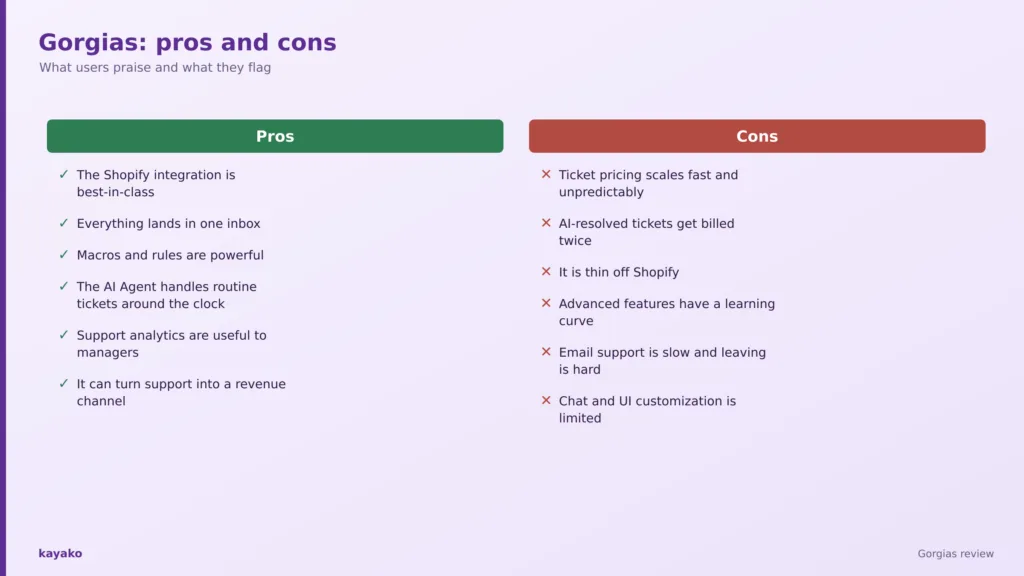
- The Shopify integration is best-in-class. Order data, history, and actions like refunds and order edits live inside the ticket, with no system toggling. For a store living inside order data, that alone can justify the switch. The G2 reviews make this point consistently.
- Everything lands in one inbox. Email, chat, social, and SMS are consolidated with full customer context across channels. Teams running several stores praise managing them from a single screen.
- Macros and rules are powerful. Teams build automation around their own workflows and save real time on repetitive tickets. Well-built rules are where experienced teams get the most time back.
- The AI Agent handles routine tickets around the clock. It resolves order-status and return questions out of the box, freeing agents for complex cases. It handles the predictable order-status and returns questions without supervision.
- Support analytics are useful to managers. Volume, response time, CSAT and contact-reason reporting help CX leads run the team. Contact-reason reporting helps managers fix the root causes of volume.
- It can turn support into a revenue channel. The shopping assistant and recommendations let support drive sales, with responsive CSMs. That revenue angle is a genuine differentiator for growth-minded brands. The TrustRadius write-ups return to it often.
|
|
What users flag about Gorgias
The flags cluster on cost: ticket pricing scales fast and unpredictably, AI-resolved tickets can be billed twice, bills spike at holiday peaks, and the integration thins out beyond Shopify.
- Ticket pricing scales fast and unpredictably. Cost climbs in ways that are hard to forecast, and bills spike during holiday peaks. Holiday peaks are exactly when the bill is hardest to predict. The G2 reviews flag this repeatedly.
- AI-resolved tickets get billed twice. Per Gorgias’s own documentation, an AI-only resolution can carry both a ticket fee and an automation fee. The double charge quietly erodes the savings the AI is meant to deliver. This comes up again and again in the Reddit feedback.
- It is thin off Shopify. The best in-ticket actions are Shopify-only, with gaps for BigCommerce, Magento, and third-party logistics. Off-Shopify stacks lose the in-ticket actions that make the product shine. You will find the same complaint on TrustRadius.
- Advanced features have a learning curve. Rules are powerful but clunky, and getting the most from them takes time. Getting the most from rules takes time that smaller teams may not have.
- Email support is slow, and leaving is hard. General support can take days, and users report friction around billing and cancellation. The slow general queue is the complaint behind much of the low Trustpilot score.
- Chat and UI customization is limited. The chat widget cannot be fully brand-tailored, and interface options are narrow. Brands that want a fully on-brand chat widget feel the limit quickly.
Gorgias feature by feature
Across Shopify integration, the inbox, automation, the AI Agent, channels, reporting and pricing, Gorgias is strongest inside the Shopify world and weakest on cost predictability and non-Shopify stacks.
Shopify and e-commerce integration. Best-in-class and the main reason to buy. Order lookup, refunds, cancellations, and order edits sit inside the ticket and sync fast. Weaker on BigCommerce, Magento, and headless stacks. For a multi-store brand, running several Shopify shops from one screen is a standout.
Ticketing and inbox. A strong unified multichannel inbox with good tagging, views, and macros, able to run several stores from one screen. Search is well-liked. Views and macros are the day-to-day workhorses reviewers mention most.
Automation and AI Agent. Included on all plans and handles order status and returns autonomously, but rules can be clunky at scale, and the AI can misfire, with docs lagging fast product changes. A preview or test mode before responses go live is a common request.
Channels. Email, live chat, social, SMS, voice, and WhatsApp. Live-chat widget customization is limited, and the WhatsApp flow is flagged as needing work. SMS and voice are usage-priced, so they add to the bill as volume grows.
Reporting and revenue stats. Good support dashboards plus revenue attribution on higher tiers. Deeper analysis often means exporting data, and reporting thins out at high volume. Revenue attribution on the higher tiers appeals to brands treating support as a growth lever.
Ease of use. Consistently rated easy to set up and get around, especially for Shopify stores. Advanced configuration has a learning curve. New agents tend to be productive within days rather than weeks.
Pricing model. The main weakness. Ticket buckets plus a per-resolution AI meter make the bill unpredictable; it spikes at peak season, and AI-resolved tickets are billed on both meters. Modeling a peak month, counting both meters, is the single most useful thing a buyer can do.
Support. CSMs and account reps are praised, but the general support queue is slow, and cancellation friction drives the low Trustpilot score. The gap between CSM quality and general-queue speed is wide enough that reviewers call it out.
| Feature | Verdict | Notes |
|---|---|---|
| Shopify integration | Strong | Order actions inside the ticket, best-in-class |
| Ticketing and inbox | Good | Unified, good tagging, views and search |
| Automation and AI Agent | Mixed | Capable but can misfire; rules clunky at scale |
| Channels | Good | Broad; chat-widget customization is limited |
| Reporting and revenue stats | Good | Good dashboards; thins out at high volume |
| Ease of use | Strong | Easy to set up, especially for Shopify |
| Pricing model | Weak | Ticket plus AI meter; AI tickets billed twice |
| Support | Mixed | CSMs praised; general queue slow |
Is Gorgias worth it in 2026?
Gorgias is worth it for a steady-volume Shopify brand that lives inside order data; the value weakens as volume spikes and as you move away from Shopify, because the ticket-plus-resolution model peaks exactly when support does.
Whether Gorgias is worth it comes down to how Shopify-centric and how seasonal you are. For a steady-volume Shopify brand that lives inside order data, the integration alone can justify the price, because the time agents save by not toggling between systems is real and compounding, and the built-in AI removes a chunk of routine volume.
The value case weakens as volume spikes and as you move away from Shopify. The ticket-plus-resolution model means your busiest months, when support volume peaks, are also your most expensive, and the double charge on AI-resolved tickets erodes the saving the AI is supposed to deliver. If your volume is large or lumpy, model a peak month before you commit.
Who Gorgias is best for, and who should look elsewhere
Best for Shopify and Shopify Plus direct-to-consumer brands with steady, moderate volume that want order actions inside tickets; non-ecommerce, headless or high-volume brands with big seasonal spikes should look elsewhere.
Best for. Gorgias fits Shopify and Shopify Plus direct-to-consumer brands that want order actions inside tickets, teams with a large support rotation but steady, moderate volume, where the seat model does not penalize headcount, and brands using support as a revenue channel through the shopping assistant. For that buyer, the integration and the built-in AI are hard to match. For that brand, few tools match the day-to-day fit.
Look elsewhere if. Look elsewhere if you are non-ecommerce or run headless and marketplace-heavy stacks, where order actions thin out, if you are a high-volume brand with big seasonal spikes where ticket-plus-resolution pricing bites hardest, if you are very price-sensitive or tiny and will burn through the Starter ticket cap, or if your support is B2B or internal, which the consumer-ecommerce shape serves poorly. In each of these cases, the pricing model tends to be the deciding factor.
Gorgias alternatives by use case
Teams leave Gorgias over cost or a non-Shopify stack, looking for flat or per-resolution pricing that does not spike at peak, while others stay but want steadier AI economics without the double charge on resolved tickets.
Teams that move off Gorgias tend to split by reason. Brands that leave over cost look for flat or per-resolution pricing that does not spike at peak season, and model their busiest month against each option. Brands that leave because they are no longer Shopify-first look for a general help desk with broader ecommerce and business-to-business coverage.
There is also a group that likes Gorgias but wants steadier AI economics, and for them the question is whether the automation saving survives the double charge on AI-resolved tickets. A platform that folds AI into a single per-resolution price, such as Kayako, removes that specific problem, which is why it comes up in these comparisons.
How Kayako compares with Gorgias
For teams outside ecommerce, or Shopify brands tired of bills that spike with volume, Kayako resolves tickets autonomously at transparent per-resolution pricing. IgniteTech saw $5.4M in first-year value and a 73 percent cut in resolution time.
For teams outside ecommerce, or Shopify brands tired of a bill that spikes with volume, Kayako is a different model. Agent Kay resolves tickets autonomously, SingleView gives agents one screen of context, and pricing is a flat one dollar per resolved ticket with no separate ticket-plus-automation double charge. Where Gorgias is shaped around Shopify order actions, Kayako is a general AI support platform, and it helps to understand how AI agents differ from basic chatbots when comparing their automation. For a Shopify brand with steady volume Gorgias may still win, and for everyone else the comparison is worth running.
Case study: IgniteTech. IgniteTech saw $5.4M in first-year value with Kayako, a 6.5 times savings ratio and a 73 percent reduction in resolution time, on transparent per-resolution pricing rather than a ticket-plus-AI meter.
|
The verdict on Gorgias
Gorgias is an excellent help desk for Shopify brands. The order actions inside tickets, the unified inbox and the built-in AI Agent are genuinely strong, and for a store with steady volume the day-to-day experience is hard to beat, which the G2 and Capterra scores reflect.
The pricing is the catch. Ticket buckets plus a per-resolution AI meter, with AI-resolved tickets billed twice, make the bill unpredictable and painful at seasonal peaks, and the Trustpilot score captures the frustration around billing and cancellation. Shortlist Gorgias if you are a Shopify brand with steady volume and value the integration. If you are off Shopify, or want flat, forecastable per-resolution pricing, compare an alternative first. Either way, the right test is a projected peak-month bill set next to the value the integration and the AI actually deliver.
|
Frequently asked questions
1. What is Gorgias?
Gorgias is an ecommerce help desk built primarily for Shopify, consolidating email, chat, social, SMS and voice into one inbox and surfacing Shopify order data and actions inside each ticket. It includes an AI Agent that resolves routine tickets and a shopping assistant, and targets direct-to-consumer brands.
2. How much does Gorgias cost?
On annual billing, helpdesk-only plans are Starter $10 a month, Basic $50, Pro $300 and Advanced $750, with Enterprise custom. With the AI Agent included, those rise to roughly $40, $77, $471 and $1,227. Tickets and AI interactions are metered, and overage applies beyond each bundle.
3. Does Gorgias double-charge for AI?
Per Gorgias’s own help documentation, a ticket resolved entirely by the AI Agent with no human involvement can incur both a ticket fee and an automation fee. In effect, a fully automated resolution is billed on both meters, which is a common source of bill surprises.
4. Is Gorgias worth it?
Gorgias is worth it for Shopify brands with steady volume that value order actions inside tickets and built-in AI. For non-ecommerce teams, or high-volume brands with seasonal spikes where the ticket-plus-resolution pricing bites, a flat per-resolution platform may be a better fit.
5. Why is Gorgias rated lower on Trustpilot?
Gorgias rates 4.6 on G2 and Capterra, where support teams praise the product, but 2.1 on Trustpilot, where reviews center on unpredictable bills, sales pressure and cancellation friction. The split reflects a well-liked product behind a pricing model that surprises people.
6. What are the best Gorgias alternatives?
For Shopify brands, other ecommerce help desks compete directly. For teams wanting flat, forecastable per-resolution pricing or support outside ecommerce, Kayako is a strong alternative, and comparing AI agents against basic chatbots helps frame the automation choice.
7. Is Kayako an alternative to Gorgias?
Yes. Kayako offers autonomous AI resolution through Agent Kay at a flat one dollar per resolved ticket, without Gorgias’s ticket-plus-automation double charge, which makes it a steadier option for teams that want forecastable pricing or support beyond ecommerce.
8. Is Gorgias only for Shopify?
Gorgias is built first for Shopify, with the deepest order actions there, and also supports BigCommerce and Magento on higher tiers. Its value drops for non-ecommerce, headless or marketplace-heavy operations, where the in-ticket order actions matter less.
9. What counts as a billable ticket in Gorgias?
A ticket is billable when at least one message is sent from the helpdesk, whether by a human, the AI Agent or an automatic rule. Unanswered inbound mail, internal notes and tag changes are free, but an AI-only resolution can carry both a ticket fee and an automation fee.
10. Is Gorgias worth it for a small store?
For a small Shopify store with steady volume, Gorgias can be worth it on Basic, since the integration saves real time. The risk is the Starter ticket cap running out and overage plus AI charges climbing, so a small store should project a busy month before committing.
11. How does Gorgias compare with Zendesk?
Gorgias is Shopify-native with order actions inside tickets and is usually simpler for a DTC brand, while Zendesk is broader and better suited to non-ecommerce and enterprise support. Pricing differs too, with Gorgias on tickets plus AI and Zendesk on seats plus AI.