Quick summary: The strongest customer engagement strategies unify customer data, personalize in real time, get onboarding right, reward loyalty, move support from reactive to proactive, and build community. Each one should map to a metric, so you can prove it worked. Start with two or three, measure them, then expand.
Two customers buy the same plan on the same day. One logs in twice and never returns. The other joins your community, answers a survey, upgrades in month three, and refers a colleague by month six. Same product, same price, wildly different value. The difference is engagement, and engagement is something you can design on purpose.
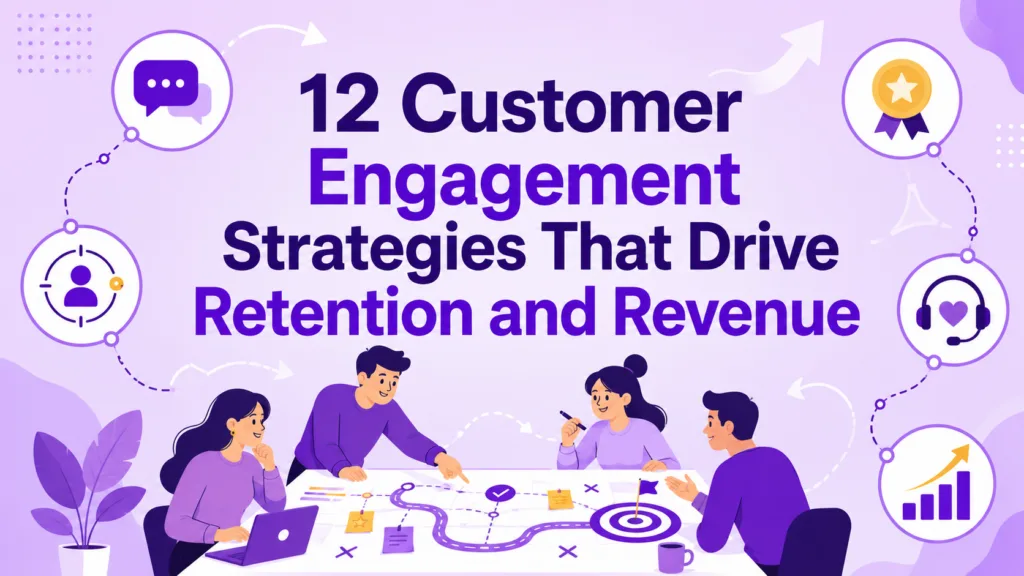
Customer engagement strategies are the deliberate plays a company runs to build an ongoing, two-way relationship across the customer lifecycle. Done well, they turn passive buyers into active, loyal, higher-value customers. This guide walks through twelve strategies that move retention and revenue, with examples, the metric each one targets, and how to build the whole thing into a plan you can actually run.
What is a customer engagement strategy?
A customer engagement strategy is a coordinated plan for the interactions a company creates with its customers over time, aimed at deepening the relationship rather than closing a single sale. It sets the goals, the channels, and the messages that turn one-off buyers into people who stay, spend more, and advocate. For the wider definition and the platform layer behind it, the customer engagement platform guide is the anchor.
The word strategy matters. A one-off campaign chases a short-term spike, whereas a strategy is a repeatable system that keeps working as the market and the product change. A campaign asks how to get attention this quarter. A strategy asks how to keep earning it every quarter after.
The core idea: engagement is a relationship you build, not a metric you chase. Design the interactions, and the numbers follow.
If that sounds like effort, it is, so the next question is whether the return justifies it. The numbers say it does.
Why a customer engagement strategy matters
A deliberate engagement strategy matters because it changes the economics of your customer base. Engaged customers cost less to keep, buy more over time, and bring in others, so the effort compounds instead of resetting every renewal cycle.
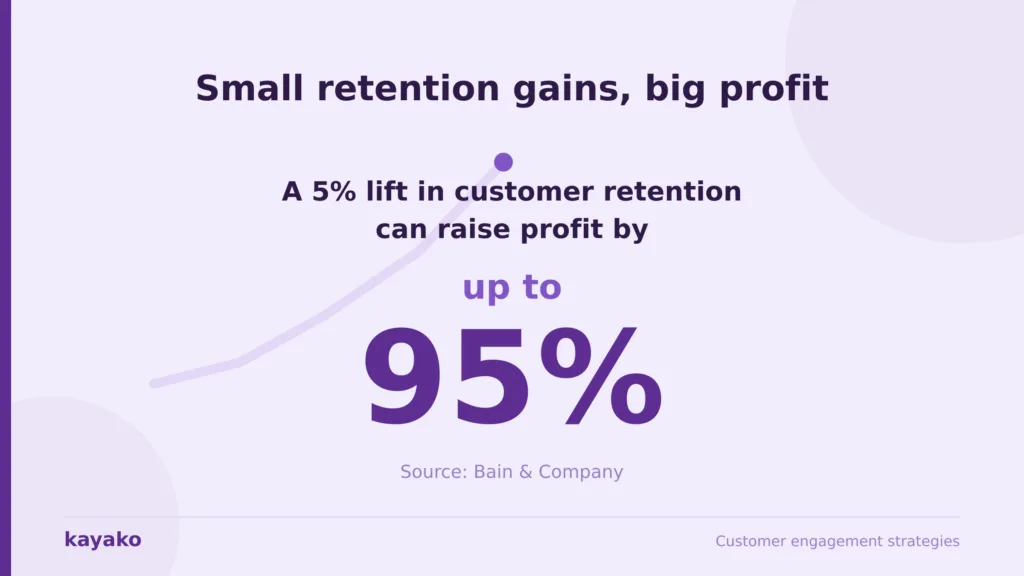
The numbers are hard to argue with. Gallup found that a fully engaged customer delivers a 23% premium in share of wallet and revenue over the average customer. Bain & Company research shows that a 5% lift in retention can raise profits by 25% to 95%. And existing customers, on data cited by Yotpo, already account for around 65% of most companies’ revenue. Engagement is where that base is protected and grown.
There is an emotional layer under the math. Gallup research also finds that emotional factors drive the majority of buying decisions, which is why a strategy built only on price and speed leaves value on the table. So the goal is to earn feeling, not just efficiency.
See how Kayako deepens every customer relationship
The four types of customer engagement to design for
Before the tactics, it helps to know what you are trying to create. Engagement shows up in four types, and different strategies target different ones. Naming them keeps your plan from over-indexing on a single kind.
- Emotional: how a customer feels about your brand, built through values, tone, and care.
- Contextual: interactions shaped by where the customer is and what they need in the moment.
- Convenient: engagement earned by removing effort, so the easy path is also the branded one.
- Social: the interactions customers have with each other around your brand, in communities and reviews.
Most durable programs touch all four. A loyalty program leans social and emotional, proactive support leans convenient and contextual, and community building spans them all. The reason the split matters is balance. A brand that competes only on convenience can be undercut by a faster rival, whereas one that also earns emotional and social engagement is much harder to replace. Keep this map in view as the twelve strategies below get specific.
12 customer engagement strategies
Here are twelve strategies that reliably move engagement, each with what it is, how to run it, and the metric it targets. You will not launch all twelve at once. Pick the two or three that fit your biggest gap, prove them, then widen.
1. Unify your customer data into one view
Personalization and proactive service both depend on seeing the whole customer, so a single source of truth comes first. Pull product usage, support history, purchases, and survey results into one profile rather than four tools. When an agent has to stitch context together from separate systems, response quality drops, and customers end up repeating themselves, which is a fast way to erode a relationship. The metric to watch is time to context, how fast an agent or system can see everything about an account.
2. Personalize in real time
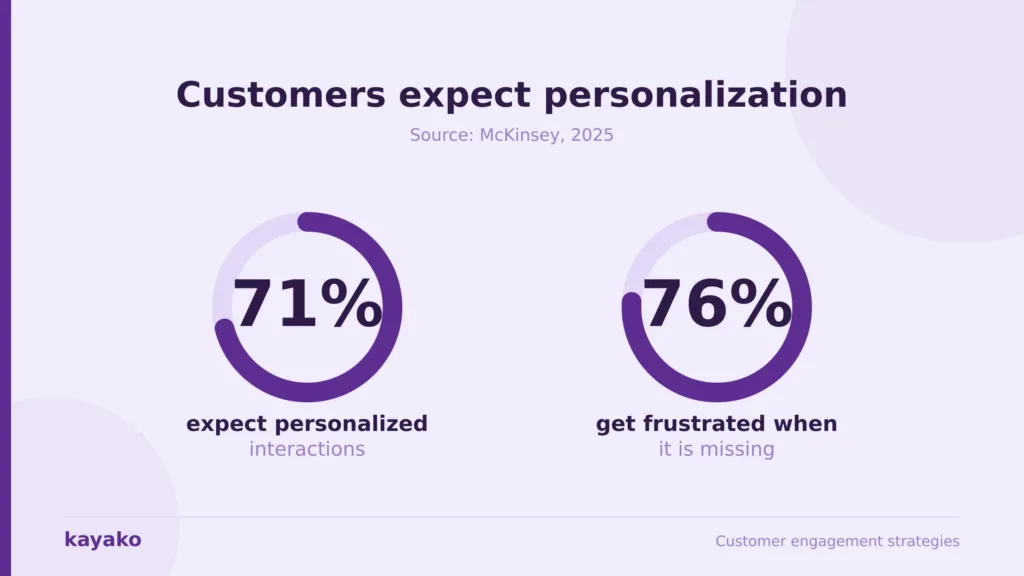
Generic outreach gets ignored, while relevant outreach gets acted on. Use behavior and lifecycle stage to tailor content, offers, and timing. McKinsey found that personalization leaders drive a 5% to 15% revenue lift, and that 71% of consumers expect personalized interactions, while 76% get frustrated when they are missing. Target conversion rate and repeat-purchase rate here.
3. Get onboarding and activation right
Most disengagement starts early, when a new customer never reaches the first moment of value. Design onboarding to guide people to that moment quickly, with checklists, in-product prompts, and a proactive check-in. The metric is activation rate, which quietly feeds retention for months afterward.
4. Run a loyalty or rewards program
A well-built loyalty program gives customers a reason to keep choosing you and to consolidate their spend. Reward the behaviors you want, such as repeat purchases, referrals, and engagement, rather than discounts alone. Programs of this kind commonly lift retention by 15% to 45%, depending on design. Track repeat-purchase rate and share of wallet.
5. Move support from reactive to proactive
Waiting for customers to report problems guarantees some of them leave quietly instead. Proactive support reaches out before an issue escalates, with status updates, usage nudges, and early fixes. This is convenient and contextual engagement at once, and it targets churn rate directly by removing the frustration that precedes it.
6. Build a customer community
A community turns customers into participants who help each other, share ideas, and stay for the relationships as much as the product. It is the clearest form of social engagement, and it lowers support load while raising loyalty. Watch active community members and their retention against non-members, which is usually markedly higher.
7. Close the feedback loop
Collecting feedback and doing nothing with it does more harm than not asking. Run a voice-of-the-customer process that captures input, acts on it, and tells customers what changed. Closing the feedback loop builds trust and better products together. The metric is the close-the-loop rate, the share of feedback that leads to a visible response.
8. Educate with self-service and content
Customers engage more with brands that make them better at something. A strong knowledge base, guides, and proactive tips reduce effort and build competence, which deepens the relationship. Self-service also scales support without adding headcount, so the same team can cover more customers without a drop in quality. Track content usage and its correlation with retention, and watch which articles resolve issues before a ticket is ever opened.
9. Win back at-risk and lapsed customers
Not every disengaging customer is lost, so a structured win-back play is worth running. Use engagement signals to flag accounts going quiet, then reach out with relevant value rather than a generic discount. The metric is reactivation rate, and even a modest recovery protects revenue you already earned.
10. Keep a human in the loop
Automation handles volume, yet the highest-stakes moments still need a person. Route complex, emotional, or high-value interactions to a human, and let automation clear the routine. This balance keeps efficiency and empathy in the same system, so customers get speed on simple questions and real care on hard ones. The failure mode to avoid is an automated wall that traps a frustrated customer with no way through. Watch CSAT on escalated interactions to confirm the handoff works, and make the path to a person obvious rather than hidden.
11. Use AI to time the next best action
AI can read engagement signals and suggest the right move at the right moment, from an upsell prompt to a retention outreach. Applied to service, AI in customer service also resolves routine issues instantly, which itself is an engagement win. Target next-best-action acceptance and resolution rate together.
12. Map the customer lifecycle and fix friction
Every strategy above works better when you know where customers stall. Map the full lifecycle, from first touch to renewal, and find the points where effort spikes or interest drops. A lifecycle map makes those friction points visible so you can fix the worst one first. Track the effort score at each stage, and start with the stage that leaks the most customers.
Run these plays inside one Kayako platform
How to build your customer engagement strategy step by step
Twelve tactics only help if they fit into a plan. Building an engagement strategy follows a repeatable sequence, and skipping steps is why many programs feel busy but flat.
First, define the outcome and the metrics that prove it, whether that is lower churn, higher expansion, or faster activation. Second, map the customer lifecycle and mark the friction points. Third, choose the channels your customers actually prefer, rather than the ones you already own. Fourth, personalize the interactions using your unified data. Fifth, launch small on the highest-friction stage and measure the effect. Then iterate, because the strategy that keeps working is the one you keep refining.
A short worked example makes the sequence concrete. Say activation is your weak point. You define the outcome as more new customers reaching the first value in week one. You map onboarding and find the drop-off at a setup step. You add an in-product prompt and a proactive check-in from support at that exact moment. Two weeks later, the activation rate is up, and only then do you move to the next friction point. That is the whole loop, run once, on the stage that mattered most.
Sequence over scale: one strategy launched, measured, and improved beats five launched and forgotten. Prove the loop, then widen it.
Map friction and fix it with Kayako
Frameworks land better with faces on them, so here is what these plays look like at brands you already know.
Customer engagement examples that work
A few well-known patterns show these strategies in practice, described by mechanism rather than by any single number. Spotify turns usage data into a yearly personalized recap that customers share on their own, which is personalization and social engagement in one motion. Sephora blends a tiered loyalty program with a community forum, so points and peer advice reinforce each other.
Duolingo uses streaks and reminders to build a daily habit, a behavioral-engagement play that keeps learners returning without heavy discounting. In B2B, the strongest examples pair proactive success outreach with an active user community, so customers get help before they ask and answers from peers when a rep is offline. Different industries, the same underlying moves. Each of those moves only counts if you can prove it worked, which is what measurement is for.
How to measure engagement strategy success
A strategy you cannot measure is a guess with good intentions. Tie each play to a metric, then read them together so a win in one place is not hiding a loss in another. Personalization should move conversion and repeat purchases. Loyalty programs should move the share of wallet. Proactive support should move churn.
Set a north-star engagement metric for the whole program, often a customer health score, and let each strategy report into it. Watch both immediate and delayed effects, because a tactic can lift this month’s activity while quietly hurting next quarter’s retention. Measurement keeps the strategy honest and shows leadership where to invest next.
A simple habit makes the difference. Review the numbers on a fixed cadence, and end each review with a decision rather than a note. If personalization moved conversion, scale it. If the loyalty program moved sign-ups but not share of wallet, the rewards are aimed at the wrong behavior. Reading the metrics beside each other is what stops one strategy from borrowing results from another and calling it a win. Measurement also sets up the biggest change to how these strategies run, which is AI.
How AI is reshaping engagement strategy in 2026
AI has changed engagement strategy from scheduled campaigns toward real-time decisioning. Instead of a fixed email calendar, models now choose the next best action per customer, timed to the moment they are most receptive. That makes personalization at scale practical rather than aspirational.
It also folds service into the strategy. When AI resolves a customer’s issue instantly, it removes friction that would have driven a detractor, so support becomes an engagement channel rather than a cost center. Predictive churn scoring flags at-risk accounts before a human notices, and generative tools personalize outreach without a marketer writing each variant. The strategy stays human at the top and automated underneath, and putting that balance in one place is where Kayako comes in.
Add AI-driven engagement with Kayako
How Kayako helps you engage customers
Several of these strategies share one requirement: seeing the whole customer and acting fast. Kayako’s SingleView unifies a customer’s history, events, and conversations into one profile, which is the foundation for personalization, proactive support, and lifecycle mapping alike. Read against the customer engagement platform category, Kayako sits where communication, resolution, and context meet.
The proactive and automated pieces come built in. Agent Kay resolves routine issues autonomously, which turns support into an engagement win rather than a queue. The effect is measurable. Trilogy used Kayako to eliminate 80% of ticket volume, cut ticket age from 17.6 hours to under 2 minutes, and save $5 million within a 90-day rollout. Read as an engagement story, that is, friction removed at scale, which is what every strategy here is ultimately trying to do.
That single foundation is what ties the twelve strategies together. The unified profile feeds personalization, the automation powers proactive outreach, and the same record makes lifecycle mapping and win-back possible. So instead of running each play in its own tool, a team can run them off one system, measure them against one health score, and improve the whole program together rather than in fragments.
Customer engagement is not luck, and it is not a single feature. It is a set of deliberate plays, unify your data, personalize, onboard well, reward loyalty, get proactive, build community, close the feedback loop, and let AI handle the timing while people handle the moments that matter. Each one maps to a metric, so you can prove it earned its place.
Start where the friction is worst. Launch one or two strategies, measure the effect, and improve the loop before adding more. The compounding is the point. Engaged customers stay longer, spend more, and bring others, and that base is where durable growth actually comes from.
Build your engagement plan with Kayako
Frequently asked questions
What are the best customer engagement strategies?
The highest-value strategies for most teams are unifying customer data, personalizing in real time, nailing onboarding and activation, running a loyalty program, moving support from reactive to proactive, and building a community. Each targets a specific metric, so pick the two or three that address your biggest gap, measure them, and expand from there rather than launching everything at once.
How do you improve customer engagement?
Improve engagement by making interactions more relevant and less effortful. Start with a single view of each customer, use it to personalize outreach and timing, reach out proactively before problems escalate, and give customers ways to participate through community and feedback. Then measure the effect on a health score or retention metric so you know which changes actually worked.
What are the four types of customer engagement?
The four types are emotional, how a customer feels about the brand; contextual, interactions shaped by the moment and need; convenient, engagement earned by removing effort; and social, the interactions customers have with each other around your brand. A strong strategy touches all four rather than leaning on just one, since each reinforces the others.
What is the difference between customer engagement and customer experience?
Customer experience is everything a customer perceives across their relationship with a brand, and the company largely designs it. Customer engagement brings in the customer’s own agency, how they choose to participate, respond, and interact over time. Experience is the stage you set. Engagement is what the customer does with it, which is why engagement is a two-way relationship rather than a one-way delivery.
How do you measure the success of a customer engagement strategy?
Tie each strategy to a metric and read them together. Personalization should move conversion and repeat purchases, loyalty programs should move share of wallet, and proactive support should move churn. Set one north-star engagement metric, often a customer health score, and track both immediate and delayed effects so a short-term win does not mask a long-term cost.