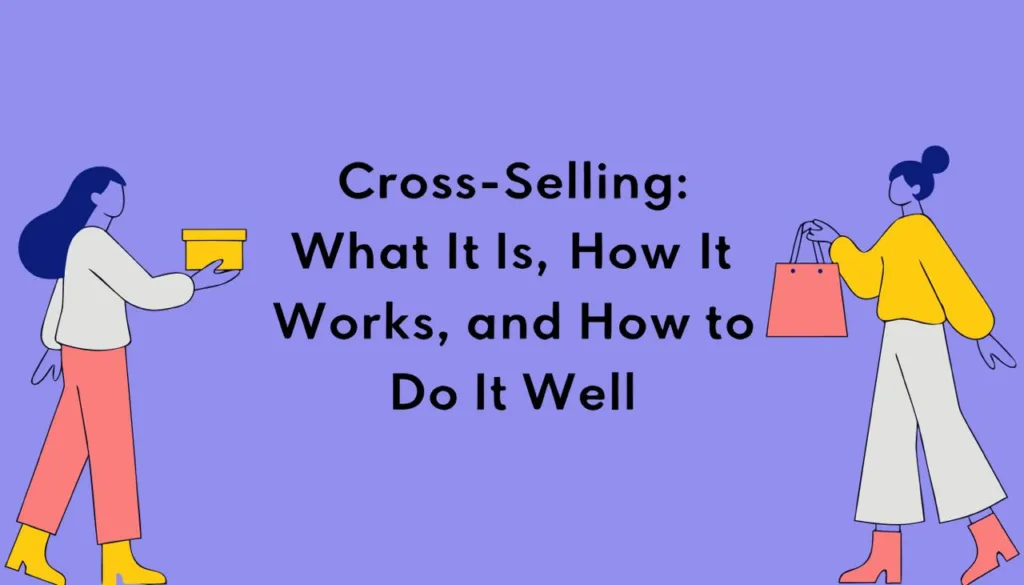
Cross-Selling: What It Is, How It Works, and How to Do It Well
Cross-selling is the practice of offering a customer an additional product or service that complements what they are already buying or using. In this guide, learn what cross-selling is, how it works, and how to do it well, with real-world examples from banking, SaaS, ecommerce, and call centers. Explore timing, segmentation, AI, and best practices that grow revenue without damaging trust.
A customer buys one thing. Almost instantly, the business faces a choice.
It can offer something useful that fits the purchase, or it can fire off a random add-on that makes the customer feel sold to instead of served. That choice matters more than most people think.
Cross-selling can run as a quiet growth engine or as a fast track to annoyance. The difference usually comes down to timing, relevance, channel, and whether the company understands what the customer needs in that moment. So the strongest cross-selling programs work as customer experience systems, not bare sales motions.
In this guide, we break down what cross-selling is, how it works in the real world, the benefits and risks, examples across industries, and the strategies companies use to do it well. We also cover segmentation, AI-driven recommendations, product-led growth, call-center operations, and the ethics of selling more without losing trust.
If you are building a sales motion, improving retention, or trying to avoid those awkward offers that make people mentally hit “unsubscribe,” this is for you.
What Is Cross-Selling?
Cross-selling is the practice of offering a customer an additional product or service that complements what they are already buying or using. The word that matters most here is complementary.
If someone buys a checking account, a credit card or savings account might be a logical cross-sell. If they buy a laptop, a bag, mouse, or warranty may make sense. If they sign up for SEO services, content creation might be a natural add-on.
The simplest way to think about it: cross-selling expands the customer’s basket without replacing the core purchase.
That makes it different from upselling, which pushes a customer toward a more expensive or more feature-rich version of the same thing. A premium flight seat is an upsell, while in-flight food or Wi-Fi is cross-selling. A “Plus” software plan is an upsell, while a connected security product is a cross-sell.
Watch: cross-selling vs. upselling
The academic literature frames cross-selling more strategically. In banking research, it goes beyond asking for more. It works as a dynamic way to deepen customer relationships over time. The goal reaches past the current order value, toward moving customers further along a financial lifecycle, improving loyalty, and reducing churn.
That framing changes the intent. A cross-sell should feel like a tailored recommendation rather than a random pitch, and customers now expect that level of relevance. McKinsey reports that 71% of consumers expect companies to deliver personalized interactions, and 76% get frustrated when that does not happen.
The best cross-sells usually fall into one of five categories:
- Complementary products: items that improve the original purchase
- Frequently bought together items: common pairings the market already validates
- Bundles: packaged offers that reduce friction and sometimes discount the combined price
- Upgrades or add-ons: extras that increase usefulness, convenience, or protection
- Personalized recommendations: suggestions based on behavior, segment, or lifecycle stage
So cross-selling works as both a revenue tactic and a service tactic. Done well, it helps customers solve more of their problem in one place. Done poorly, it feels like noise. That tension is why cross-selling is a customer experience decision as much as a sales move, and why it depends on understanding what the customer actually needs.
Next, let us look at how it actually works inside a company’s sales and marketing system.
How Does Cross-Selling Work?
Picture a customer opening a banking app to check a balance, finishing a software demo, calling a support line, or clicking “checkout” on an ecommerce site. Those are the moments where cross-selling lives or dies.
The offer matters. The timing around the offer matters just as much.
At its core, cross-selling works through a simple chain: observe behavior, infer need, match a product, choose a channel, then deliver the offer when receptivity is highest.
The challenge is that “highest” is never universal. Customers differ in purchase intent, channel preference, budget, and stage in the buying process. So the strongest cross-selling systems rely on segmentation and data rather than guesswork.
One white paper on timing makes an important point. Many campaigns fail because they pair good segmentation and decent creative with bad timing. In financial services, the strongest cross-sell results often happen early in the relationship, especially in the first 90 days of a demand deposit account relationship. Recent data backs the broader principle: McKinsey finds that 65% of customers see targeted promotions as a top reason to make a purchase, which raises the stakes on getting the moment right.
So the same offer can perform very differently depending on whether it arrives during a customer’s window of opportunity. Trigger-based signals, such as a life event, an inquiry, or a recent purchase, help identify those windows.
A longitudinal study adds another layer. Cross-selling can be educational and persuasive over time, not only promotional. In a study of 4,000 households over 27 months, solicitations played three roles: immediate promotion, longer-term advertising, and a much larger educational effect. The educational role accounted for 83% of the total long-run effect, compared with 15% for advertising and just 2% for immediate promotion.
In plain English, customers often buy more later because prior offers taught them what they might need next.
Cross-selling also works differently by channel. Some customers respond better to email, others to postal mail, a call-center rep, a checkout prompt, or an in-product message. The academic model shows that age and channel preference affect responsiveness, which is why one-size-fits-all outreach underperforms.
In SaaS, product-led growth teams apply the same principle by surfacing recommendations only after a user has reached enough usage or value realization to care.
So cross-selling works when firms stop treating it as “send another offer” and start treating it as a timed, segmented, channel-aware decision. That naturally leads to the big question. Does this actually help, or can it backfire? Let us weigh the upside against the risks.
Benefits and Drawbacks of Cross-Selling
A customer walks into a store for one item and leaves with three that genuinely make life easier. That is the dream.
Sometimes, though, the same customer leaves feeling manipulated, over-sold, or distracted from the product they actually wanted. Cross-selling sits right on that boundary between helpful and irritating, which is exactly why the benefits and drawbacks need to be understood together.
The biggest benefit is obvious. Cross-selling increases revenue without the cost of acquiring a brand-new customer.
Cross selling is easier than selling
Selling to existing customers is far more efficient than prospecting. Existing customers are typically much more likely to buy than new prospects, and the cost of retention runs well below the cost of acquisition. The economics show up clearly in subscription data. By the 2025 Benchmarkit SaaS Performance Metrics report, expansion revenue from upsell and cross-sell makes up about 58% of new ARR at companies between $50M and $100M, and roughly 67% above $100M.
Cross selling can lift AOV
That means cross-selling can lift average order value, net revenue retention, customer lifetime value, and profit per account. The compounding effect is large: High Alpha’s 2025 research finds that SaaS companies with high net revenue retention grow about 2.5 times faster than low-retention peers.
Cross selling can add value to your customers
There is also a relationship benefit. Done correctly, cross-selling makes customers feel understood. Relevant offers make customers feel valued, and that relevance can increase loyalty and repeat purchases.
In banking, offering a checking customer a savings account or credit card can create a more complete financial relationship. In SaaS, bundling complementary tools can make the platform stickier and more deeply embedded in the customer’s workflow.
The drawbacks are real, though.
Cross selling may seem sale-sy and reduce customer trust
First, cross-selling can turn pushy. A car-rental study found that upselling and cross-selling can hurt satisfaction, because sales effort may crowd out service effort, especially when agents earn mainly on commission. If the customer feels the rep is optimizing for commission instead of fit, trust drops.
It can eat away team’s bandwidth
Second, irrelevant offers waste attention. Many marketers confuse cross-selling with basic direct marketing, sending offers that ignore recipient interest or timing.
Operational overload can hurt service quality. In call centers, cross-selling adds workload and can lengthen waits if it is not controlled, which may reduce customer experience and even cut the effectiveness of the sale itself. There is an ethical drawback too. Aggressive cross-selling can push customers toward products they do not need or understand. That may boost short-term metrics, yet it can damage long-term retention, referrals, and brand trust.
So the practical lesson is to qualify cross-selling rather than avoid it. Good cross-selling adds value, while the bad kind just drains attention. Next, let us bring this down to earth with concrete examples across industries.
Kayako gives every agent full customer context in a single view.
4. Cross-Selling Examples and Use Cases
A bank customer opens a checking account. A few days later, the bank suggests savings, a debit card, or an insurance product. A laptop shopper sees a sleeve and wireless mouse at checkout. A SaaS customer on a starter plan gets prompted to add analytics, session replay, or team collaboration after usage increases.
Different industries, same logic. The customer already showed intent, and the company responds with a related offer.
Ecommerce
In ecommerce, cross-selling is probably the most familiar. “Frequently bought together” modules, accessory pop-ups, and bundle discounts all work because the customer is already in purchase mode. A camera can be paired with memory cards and tripods, a mattress with pillows and protectors, a blender with a second cup or recipe book. The best ecommerce cross-sells genuinely reduce the effort needed to get the desired outcome rather than dressing up random upsells as recommendations.
Financial services
In financial services, the data-driven opportunity is even richer. Research on timing argues that most cross-selling in the first two years of a demand deposit account relationship occurs in the first 90 days, which makes early relationship-building critical.
Banking research goes further by showing that different customer states favor different products. In the convenience state, checking and savings are more relevant. In the flexibility state, loans and certificates of deposit become more relevant. In the growth state, investments become more attractive. That is cross-selling as lifecycle design.
SaaS
In SaaS, cross-selling often appears as land and expand. A company can enter with a free or low-cost plan, then cross-sell complementary products as the customer adopts the platform. Microsoft is the classic example: Microsoft 365 can lead naturally to Defender, Copilot, and Authenticator because each product expands the value of the ecosystem. A clever use case here is product-qualified leads, where usage signals tell teams which accounts are ready for a new module or a higher plan.
Car rental
In car rental, the add-ons are classic cross-sells: GPS, insurance, satellite radio, fuel products. The research shows a cautionary twist, though. Upselling can lower satisfaction even when the add-on itself is useful, because the customer may dislike the pressure of being sold to.
Call centers
In call centers, the use case becomes operational. A customer calls for service, and after the issue is resolved, the agent offers a relevant product based on the customer’s segment and wait time. Research here shows that segmentation, routing, and staffing all affect profitability and service quality.
These examples prove that cross-selling reaches well beyond a checkout box or a scripted sales line. It can show up anywhere a company understands customer intent well enough to offer something useful. The next step is learning how to do that consistently, which is where strategy and technique come in.
5. Cross-Selling Strategies and Techniques
A good cross-sell is rarely accidental. It usually comes from a system: the right data, the right segment, the right moment, and the right message. The best strategies combine customer understanding with product knowledge and disciplined execution.
Start with segmentation
Not all customers are equally ready for the same offer. Behavioral segmentation looks at purchase frequency, basket size, channel preference, cart abandonment, and loyalty patterns. Preference-based segmentation looks at motivations, demographics, product usage, and lifestyle. Once segments are clear, you can tailor recommendations instead of blasting the same message to everyone.
Use timing triggers
Successful cross-selling depends on catching customers when they have both need and propensity to act. Trigger-based strategies use behavioral, lifestyle, or credit signals to identify these windows. In practical terms, a refinance offer may follow a mortgage inquiry, an upgrade prompt may follow a product milestone, and a bank offer may be timed around a life event.
Focus on product recommendation logic
Recommendation engines can use collaborative filtering, content-based filtering, session-based recommendations, and AI-driven personalization. In plain language, you can recommend products based on similar users, product attributes, current session behavior, or a combined machine-learning view. The more contextual the recommendation, the less it feels random.
Use psychological persuasion carefully
Three principles prove especially useful: scarcity, social proof, and authority. Scarcity can create urgency, but only when it is real. Social proof, such as reviews, testimonials, and success stories, helps the customer feel reassured. Authority works when the recommendation is backed by credible expertise or certifications. The aim here is to reduce decision friction, which also protects loyalty and repeat purchases, instead of pressuring the buyer.
Package and trial in SaaS
In SaaS, a strong technique is tiered packaging. Good, better, best plans let customers start small and expand as they experience value. Another technique is reverse trials, where users temporarily access premium features, then decide whether to upgrade to keep them. That is not classic cross-selling, yet it supports expansion because the customer learns what additional value looks like before purchasing.
Train your team on service-first selling
One blunt idea captures this: serve well, then sell. Solve the customer’s original problem first. Then, if a recommendation truly improves the outcome, offer it. That principle matters in every channel, from email to branch to call center to in-product prompt.
Taken together, these strategies show that cross-selling is a coordinated set of decisions about who to target, what to offer, when to offer it, and how to keep the interaction useful. But strategy only matters if it can be measured and improved, which brings us to the next layer.
Kayako resolves the issue first, then surfaces the right next step.
Measuring and Optimizing Cross-Selling Performance
A sales team can call its cross-sell program “working” long before the numbers prove it. That is dangerous.
Cross-selling can raise immediate revenue while quietly hurting retention, satisfaction, or future conversion. The fix is to measure the right KPIs and keep improving them over time.
Start with the basics:
- Cross-sell ratio: how many customers buy an additional product
- Attach rate: how often add-ons are purchased alongside the primary item
- Average order value: whether orders are actually getting larger
- Conversion rate: whether offers are being accepted
- Customer lifetime value: whether the extra sale improves long-term value
- Net revenue retention in SaaS: whether expansion outpaces churn
- ROI: whether the campaign’s revenue exceeds its cost
The most important lesson is that a short-term sales bump is not enough.
In banking, the longitudinal model showed that cross-selling has major long-run effects, with educational value dominating immediate promotion. In the call-center and car-rental studies, more selling could damage service quality or satisfaction, which then hurts future choice and retention. So you should test both immediate and delayed effects.
For example:
- Did the offer increase sales this week?
- Did it reduce churn next quarter?
- Did customers who accepted the offer renew more often?
- Did support tickets or complaints increase?
- Did satisfaction scores fall after the campaign?
The evidence also points to the value of A/B testing and iterative experimentation. A sensible approach tests pricing, packaging, and messaging before scaling, then keeps learning from performance data. Personalized, well-timed offers reward this discipline. McKinsey reports that targeted promotions can lift sales by 1% to 2% and improve margins by 1% to 3%, with one North American retailer seeing about a 3% boost in annualized margins after pacing offers more carefully (McKinsey, January 2025).
AI can act as a major optimization engine too. Recommendation systems should combine high-quality data, target-group understanding, and multiple modeling approaches, then keep learning from feedback. The banking study shows the same idea in academic form: households move through latent financial states, and the best offers depend on where they sit in that evolution.
So optimization is about matching evolving customer readiness, not only chasing conversion rates. In short, judge cross-selling by a balanced scorecard of revenue, retention, satisfaction, and operational efficiency. If one metric rises while the others fall, the strategy needs adjustment.
Next, we will zoom out and look at how cross-selling becomes even more powerful when combined with AI, product-led growth, and operational design.
Cross-Selling in AI-Driven SaaS, Banking, and Call Centers
A customer opens an app, clicks around, submits a form, or calls support, and the system already knows what to suggest next. That is where cross-selling is heading: not human intuition alone, but human judgment supported by AI-driven timing and operational logic.
Banking, SaaS, and call-center research all point the same way: more data, better segmentation, and more precise offers.
In SaaS, product-led growth has turned cross-selling into a data problem. Instead of waiting for a customer to ask about an upgrade, companies watch feature usage, cohort behavior, and activation patterns. Segmentation charts, funnel charts, and account analysis can reveal when users are ready to upgrade or add another product. The product itself becomes the sales channel. That logic shows up in the numbers: SaaS Capital’s 2025 retention research finds that private B2B SaaS companies with net revenue retention of at least 110% grow faster than the 24% median for companies above $1M in ARR, since expansion from existing accounts compounds. When users hit usage limits, repeatedly explore premium features, or adopt a workflow that needs more advanced tools, the system can prompt a cross-sell at the moment of need.
In banking, the same logic appears in the longitudinal study. The authors built a multivariate customer-response model with latent financial states and found that households differ in both responsiveness and channel preference. Email and mail have different effects, and age and product maturity influence which offer makes sense. Most importantly, cross-selling should be dynamic: checking and savings early, lending and CDs later, investments at a more advanced stage. That is AI-like thinking even before modern AI tools became mainstream.
Practical guidance makes this concrete by emphasizing product recommendation algorithms, collaborative filtering, content-based filtering, session-based recommendations, and real-time machine learning. One case study describes Sidem, an automotive parts distributor that moved from Excel-based opportunity tracking to an AI platform for better cross-sell and upsell detection, with recommendations delivered in customer portals. The takeaway is simple: manual opportunity hunting does not scale well once customer portfolios get large.
In call centers, AI and operations have to work together. Staffing, routing, and cross-selling interact in complicated ways. More cross-selling increases workload, yet segmentation and better targeting can improve profitability. A deterministic relaxation of the model shows that in large systems, simple threshold policies, where agents cross-sell only under certain queue conditions, can be near-optimal. AI is only useful if the operational system can absorb the offers without hurting service.
The broader lesson is that cross-selling is evolving from sales-rep intuition to a decision system. AI identifies the opportunity, segmentation prioritizes the audience, and operations ensure the offer lands without annoying the customer. That is the real promise of modern cross-selling, and it is why the FAQ section below matters so much. Before you deploy any of this, you need to know how cross-sell differs from upsell, what is ethical, and which best practices protect trust.
6. Cross-Selling FAQ: Cross-Sell vs. Upsell, Ethics, and Best Practices
A customer hears “Would you like the premium plan?” and assumes it is a cross-sell. Another hears “Would you like the matching case?” and assumes it is an upsell. The difference matters more than many teams realize, because confusion here often leads to muddled strategy and sloppy measurement.
What is the difference between cross-sell and upsell?
Upselling persuades the customer to choose a more expensive or more feature-rich version of the same product. Cross-selling adds a complementary product or service. If a software user moves from Starter to Growth, that is upselling. If they add analytics or session replay to their existing plan, that is cross-selling. In retail, a bigger TV is an upsell, while a wall mount or warranty is a cross-sell.
Is cross-selling ethical?
Yes, if it is relevant, transparent, and timed to customer need. The ethical problem is poor selling rather than selling more. The car-rental study is a good cautionary tale, since aggressive upselling can reduce satisfaction and harm future business, especially when the rep’s incentives crowd out service quality. Batch-and-blast behavior that ignores customer readiness causes the same harm. Ethical cross-selling solves a problem the customer actually has, which is why it relies on customer trust.
What are best practices?
Start with relevance. If the offer does not improve the original purchase, do not send it. Next, choose the right time. The banking research shows that many opportunities occur early in the relationship and that the best product depends on the customer’s stage. Then choose the right channel, whether email, in-app, branch, chat, or call center, based on preference and context. Finally, measure both revenue and satisfaction so you do not accidentally optimize one at the expense of the other.
How do you avoid being pushy?
Use the serve well, then sell mindset. Resolve the customer’s issue first. Offer only one or two highly relevant options. Use social proof instead of pressure. And give the customer an easy way to decline.
What is the simplest rule to remember?
Cross-sell when the customer is likely to say, “That actually helps.” If the likely reaction is “Why are you offering me this now?” you are too early, too late, or too broad. The real test is whether the offer will feel useful, not whether you can sell more. That closes the loop between strategy and customer trust.
Conclusion
Cross-selling is one of the most powerful growth levers a company has, but only when it is treated as a customer-value strategy rather than a pressure tactic.
The best programs do four things well. They segment customers intelligently, they time offers around real intent, they match the right product to the right lifecycle stage, and they measure results beyond the first sale.
The research tells a consistent story. In banking, the best cross-sells are dynamic and educational, not merely promotional. In SaaS, product usage data reveals when a customer is ready to expand. In call centers, workload and segmentation shape whether an offer helps or hurts. In service businesses like car rental, incentives must be designed carefully so sales effort does not undermine customer satisfaction.
If you are building a cross-selling motion, keep this simple framework in mind:
- Relevance: does the offer truly complement the customer’s need?
- Timing: is this the moment the customer is most receptive?
- Channel: are you using the medium the customer prefers?
- Value: does the offer improve the customer’s outcome?
- Measurement: are you tracking long-term value, not just immediate conversion?
When those five pieces come together, cross-selling stops feeling like a sales trick and starts functioning like good service. That is the real goal: to help customers buy more, but only in ways that make their purchase better, easier, and more complete.
See how Kayako turns full customer context into faster resolution.