Customer Experience Trends 2026: AI, Agents & Growth
AI is moving from pilot projects into the front line of service; customers research brands inside AI assistants before they ever reach you, and CX leaders are being asked to prove returns. Here are the trends defining customer experience in 2026, with the research and examples behind each one.
The biggest customer experience trends in 2026 are agentic AI and autonomous service, AI answer engines changing where customer research begins, hyper-personalization built on first-party data, memory-rich omnichannel support, and a firm move from AI experiments to measurable ROI. Across industries, customer experience is now treated as a core business strategy, tied directly to revenue and retention.
Economic pressure, higher digital expectations, and rapid advances in AI have raised the bar for what counts as good service. Customers want help that is fast, personal, and consistent across every channel they use. This guide covers the trends shaping CX in 2026, backed by current research, and it is written for CX leaders, support managers, and executives who want to turn better service into stronger relationships and measurable growth.
See how AI can handle the routine so your team focuses on what matters.
AI and automation reshape customer engagement
Generative AI moves from pilot to production
Generative AI has moved past the experiment stage in customer service. McKinsey now reports that 78% of organizations use AI in at least one business function, though only about one-third have scaled it across the business. The early results are concrete. One bank replaced a rule-based bot with a generative model and eliminated wait times for around 20% of contact-center requests within seven weeks. Banks now use AI for routine queries, retailers use it for recommendations and support, and healthcare providers are testing AI triage. The aim is consistent: faster, scalable, round-the-clock service.
Agentic AI and the rise of autonomous service
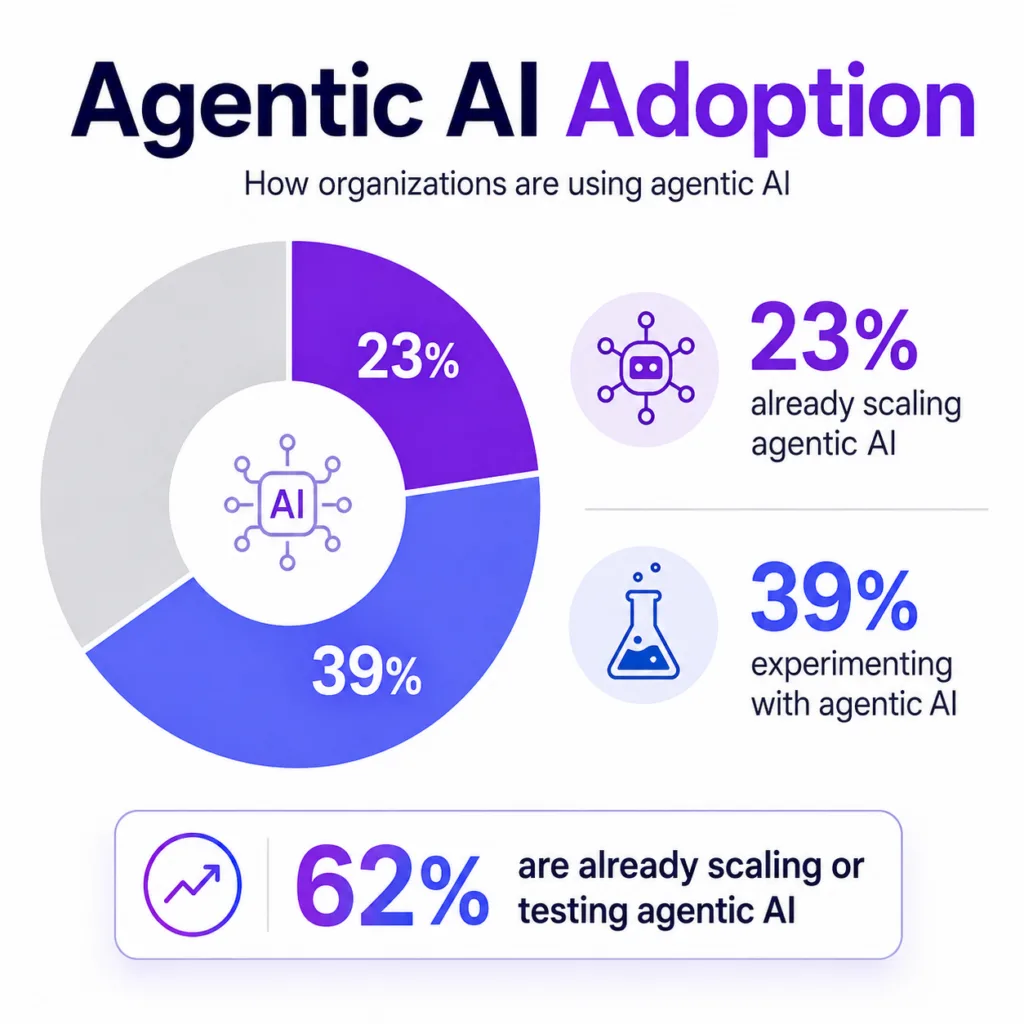
The defining AI story of 2026 is agentic AI. Where a chatbot answers a question, an AI agent completes the task. It interprets context, follows your business rules, updates systems, and resolves a request end to end before escalating only the genuine edge cases. Adoption is climbing quickly, with McKinsey finding 23% of organizations already scaling agentic AI and another 39% experimenting with it. As a result, the traditional reactive support model is starting to give way to autonomous service that runs in the background.
This changes the economics of the contact center. According to analysts surveyed by Zoom, agent seats and voice investment are declining as virtual agents deliver higher satisfaction across many industries. Human teams are being freed to focus on complex, high-value conversations.
Automation changes which metrics matter
Gartner has forecast that chatbots will be a primary customer service channel for roughly 25% of organizations by 2027. As automation absorbs routine volume, the way teams measure success is changing too. Call volume and average handle time are losing their place as primary KPIs, with outcome-based measures like resolution and retention taking over. If you still benchmark on speed alone, our guide to average handle time standards shows where it fits and where it no longer should.
Balancing AI with the human touch
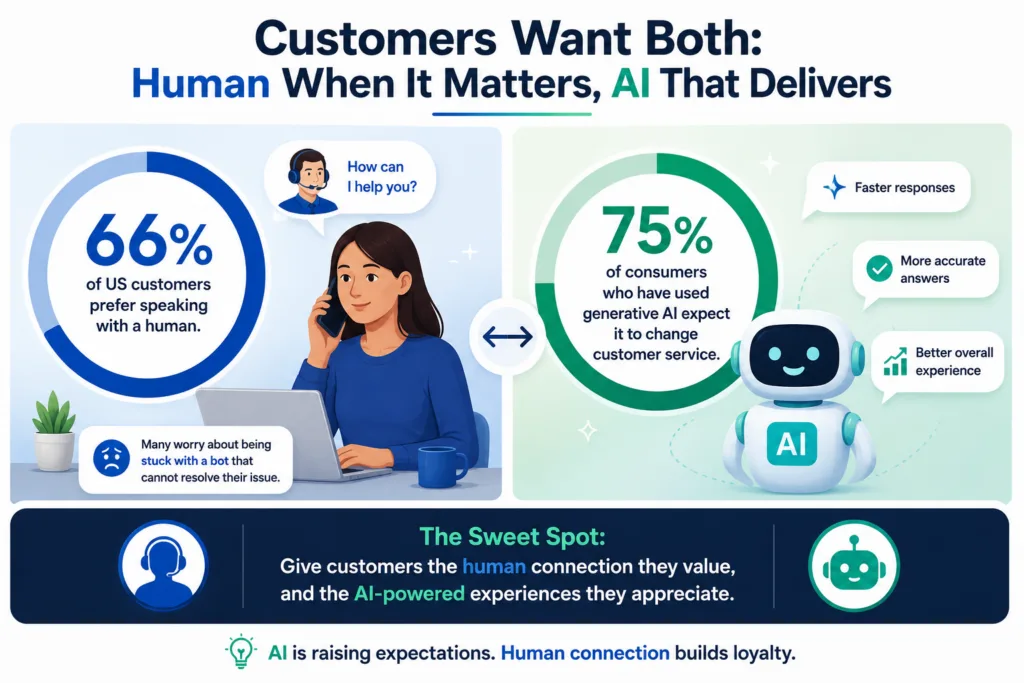
AI works best when it supports people rather than replacing them. Customers still want a human for sensitive or complex problems. Talkdesk found that 66% of US customers prefer speaking with a human, and many worry about being stuck with a bot that cannot resolve their issue. At the same time, Zendesk reports that 75% of consumers who have used generative AI expect it to change customer service, so attitudes are warming as the technology improves.
The gap between good and bad AI is now visible to customers. Research cited in the Zendesk CX Trends 2026 work shows 70% of consumers see a clear difference between companies that use AI well and those that do not. Leading brands close that gap by being transparent about AI use and making escalation to a human fast and easy. Our overview of AI customer support covers how that partnership works in practice.
Put agentic AI to work in your support queue. Book a Kayako demo →
Customer experience now starts inside AI
A new trend reshapes everything upstream of support. Customers increasingly research products and validate decisions inside AI assistants like ChatGPT and Gemini, and inside AI Overviews in search, long before they reach a brand website. CX Dive describes how a large share of people now do primary research within an AI answer engine, which forces teams to redesign where the customer path actually begins.
OpenText frames it well: in 2026, the digital front door is a conversation, not a homepage. Brands no longer fully control where an experience starts, so they must be discoverable and accurate to the AI systems that now advise customers. Optimizing content and data for AI discovery is becoming as important as classic search optimization. For support teams, that means your help content, product facts, and policies need to be structured and trustworthy enough for an AI to represent them correctly.
Hyper-personalization and data-driven insight
First-party data fuels personalization
With third-party cookies fading and privacy rules tightening, businesses are rebuilding their data strategies around first-party and zero-party data, the information customers share willingly. Loyalty programs, preference centers, and interactive surveys are the new collection points. Clean, consented, centralized data is what makes personalization work at scale, so data quality has become a CX priority rather than a back-office concern.
Real-time and predictive experiences
Personalization is now an expectation. Talkdesk reports that 81% of customers prefer companies that recognize their preferences and tailor support. Machine learning models read past interactions, browsing behavior, and real-time signals to anticipate what a customer needs next, whether that is a relevant offer or an early warning about a delay. This is how proactive support moves teams from reacting to predicting.
Memory-rich, contextual intelligence
The 2026 evolution of personalization is contextual intelligence. The Zendesk CX Trends 2026 research describes memory-rich AI that carries context across channels and time, so customers never repeat themselves. This pairs with a long-standing expectation: Salesforce found that 70% of customers expect any agent they reach to have full context on their history. A unified customer experience depends on that shared memory across every touchpoint.
Personalization still has to feel respectful. Qualtrics found that the brands earning trust in 2026 treat personalization as a value exchange, transparency and control in return for tailored experiences. Relevance without consent reads as intrusion, so the best teams are explicit about how customer data improves the service.
Omnichannel and the human touch
Voice support and the rise of voice AI
Even in a digital-first world, the phone call still matters for emotional or high-stakes situations. What has changed is the technology behind it. AI now supports live agents with real-time context and suggested responses, and AI voice agents handle a growing share of calls. As noted earlier, analysts report virtual agents delivering higher satisfaction as voice investment is reallocated. Voice is becoming faster and more informed, while staying human where it counts.
Seamless cross-channel support
Customers move between mobile, desktop, chat, phone, and in-store, and they expect each step to carry over. A customer who starts with a chatbot and later calls does not want to start again. Meeting that expectation means connecting CRM, communication, and customer data so context travels with the person. Strong omnichannel support produces measurably higher satisfaction and retention than fragmented systems. The most successful teams in 2026 offer full channel choice and let the customer lead.
Phygital and industry-specific experiences
The blending of physical and digital continues to mature. Retailers turn stores into experience centers where customers scan for reviews, check inventory in an app, and pay contactless as one connected flow. Banks turn branches into advisory hubs where staff pull up a full digital profile on a tablet. Healthcare connects chatbots, video visits, and in-person care through a single record. Consistency is the test. A recommendation made online should be remembered when the customer walks into a store.
Give every agent full context on every channel. See Kayako in action →
Customer trust, privacy, and ethical experience
Trust through reliability and honesty
Technology alone does not earn loyalty. Many organizations in 2026 are rediscovering a simpler advantage: doing what they say they will do. Customers value honest communication and consistent delivery over flashy features. When something goes wrong, they expect to be told promptly and truthfully. Qualtrics research reinforces this, finding that trust and satisfaction are highest when quality and service, rather than price, drive the buying decision. Some companies now track customer trust as an explicit business metric.
Ethical AI and governance
As AI becomes embedded in everyday interactions, customers want to know it is used responsibly. They expect disclosure when AI is involved, easy handoff to a human, and algorithms that are tested for bias. Regulatory pressure is rising too, with the EU AI Act phasing in obligations through 2025 and 2026. Forward-looking companies are adopting clear frameworks: disclosing AI use, allowing human escalation, auditing models, and explaining how recommendations are generated.
Accessibility and inclusive design
Accessibility has moved to the front of the agenda. The European Accessibility Act came into force in June 2025, and its requirements now drive real investment in accessible digital experiences, from screen-reader support and contrast standards to voice interfaces and multilingual support. True inclusion goes beyond a compliance overlay. It requires co-design with diverse users and integration into the product lifecycle. The payoff is broad, because an interface with voice control helps users with disabilities and also busy parents or drivers.
Customer experience as a growth driver
Linking CX to revenue
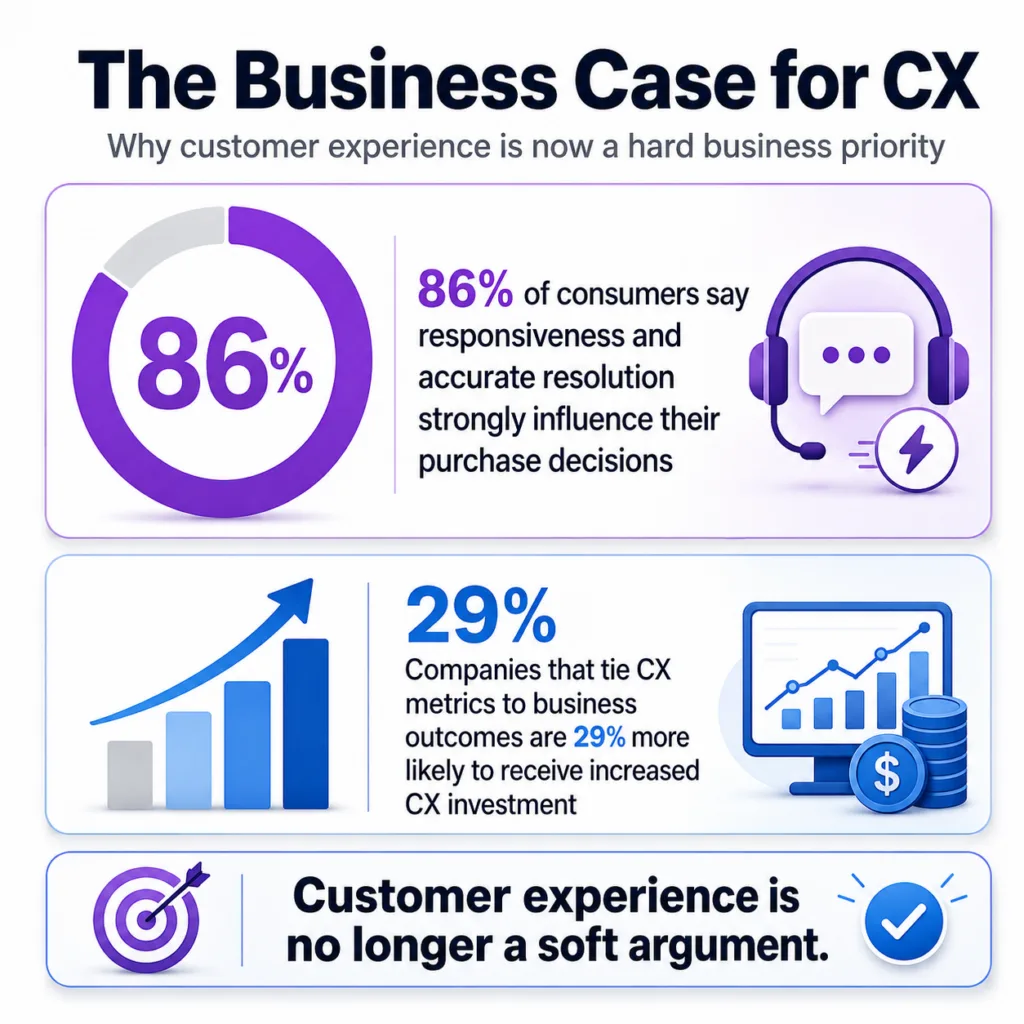
Customer experience is now a measurable lever for growth, and the data backs it up. Research in the Zendesk CX Trends 2026 work shows 86% of consumers say responsiveness and accurate resolution strongly influence their purchase decisions. The financial case extends to budgets, as companies that can tie CX metrics to business outcomes are 29% more likely to receive increased CX investment. The importance of customer experience is no longer a soft argument.
Loyalty, retention, and lifetime value
Experience is one of the strongest predictors of loyalty, and loyalty drives sustainable revenue. Customers have more options and higher expectations than ever, so a poor experience sends them elsewhere. Economic pressure sharpens this. Qualtrics found that good value for money is now the leading factor in customer choice, which is why businesses are moving from acquisition-first models to lifecycle strategies that protect customer loyalty and retention across onboarding, support, and renewal. In subscription and B2B markets, even a small retention gain compounds, so churn and effort scores are now executive-level metrics.
AI moves from experiments to measured ROI
If 2025 was the year of AI pilots, 2026 is the year teams measure returns. HappyOrNot describes the new risk as execution debt, the growing gap between knowing and doing. With only about a third of organizations scaling AI so far, the winners are the ones who wire insight into daily workflows and prove improvements customers can feel. OpenText warns of a related danger after the sale, silent churn, when customers leave because the experience failed to keep pace, which is pushing investment toward onboarding, servicing, and renewals.
Value and empathy under economic pressure
Economic uncertainty is testing loyalty in new ways. CX Dive reports that consumers have moved into a recessionary mindset, prioritizing value and price over brand loyalty. Some companies protect margins with tactics like shrinkflation, which tend to erode trust over time. CX leaders are responding instead with meaningful loyalty perks, flexible payment options, and AI that helps customers find the best value. Customers remember the brands that showed up for them, and that goodwill outlasts the downturn.
Turn customer experience into measurable growth. Talk to a Kayako expert →
Frequently asked questions about customer experience in 2026
What are the top customer experience trends in 2026?
The leading trends are agentic AI and autonomous service, AI answer engines changing where customer research begins, hyper-personalization built on first-party data, memory-rich omnichannel support, ethical and accessible AI, and a move from AI experiments to measured ROI.
What is agentic AI in customer experience?
Agentic AI describes AI agents that complete tasks end to end rather than only answering questions. They interpret context, follow business rules, update systems, and resolve requests, escalating to a human only when needed. McKinsey reports that 23% of organizations are already scaling agentic AI.
How is AI changing customer experience in 2026?
AI now handles routine volume, assists agents in real time, and personalizes support at scale. It is also changing where experiences begin, since customers research brands inside AI answer engines first. See more examples of AI in customer service for how teams apply it.
Why is customer experience important for business growth?
Because it drives revenue and loyalty. Consumers say responsiveness and accurate resolution strongly influence what they buy, and companies that connect CX to outcomes attract more investment. Our guide to the importance of customer experience goes deeper.
The foundation of sustainable growth
Customer experience in 2026 is defined by smarter technology, richer data, higher expectations, and a renewed focus on trust. Businesses are using generative and agentic AI to deliver faster service, first-party data to build real relationships, and connected omnichannel systems to keep context with the customer. They are also being held to account, with privacy, ethical AI, and honest communication central to how they operate.
The plan for 2026 is straightforward. Use AI to scale, keep humans where empathy matters, personalize with consent, and prove the returns. Customer experience has become a core driver of revenue and loyalty, which is why CX leaders are investing where customer emotion runs highest. To see where this is heading next, read our take on the future of AI in customer service.
Ready to build a customer experience that scales without losing the human touch?