
15 Live Chat Best Practices for Customer Support Teams (2026)
Faster replies and sharper agents turn a chat widget into real revenue. Here are 15 live chat best practices, with ready-to-use scripts, the mistakes that quietly cost you customers, and the metrics that prove it works.
Live chat best practices are the habits that make live chat fast and genuinely helpful: replying within seconds, reaching out at the right moment, personalizing each conversation, balancing automation with real agents, and tracking the metrics that matter. Done well, they turn live chat into one of your strongest channels for customer satisfaction and revenue.
Customers now expect instant answers. Around 52% customers remain more loyal to companies that offers live chat, and most expect a near-immediate reply the moment they reach out. However, speed on its own will not carry you. The practices below cover the full picture, followed by ready-to-use scripts, the most common mistakes, and the metrics worth watching.
Make instant responses your standard. Talk to a Kayako CX strategist →
Live chat best practices: An actionable practitioner’s guide
Follow these 15 simple steps to ensure your customer’s live chat experience is as smooth as butter:
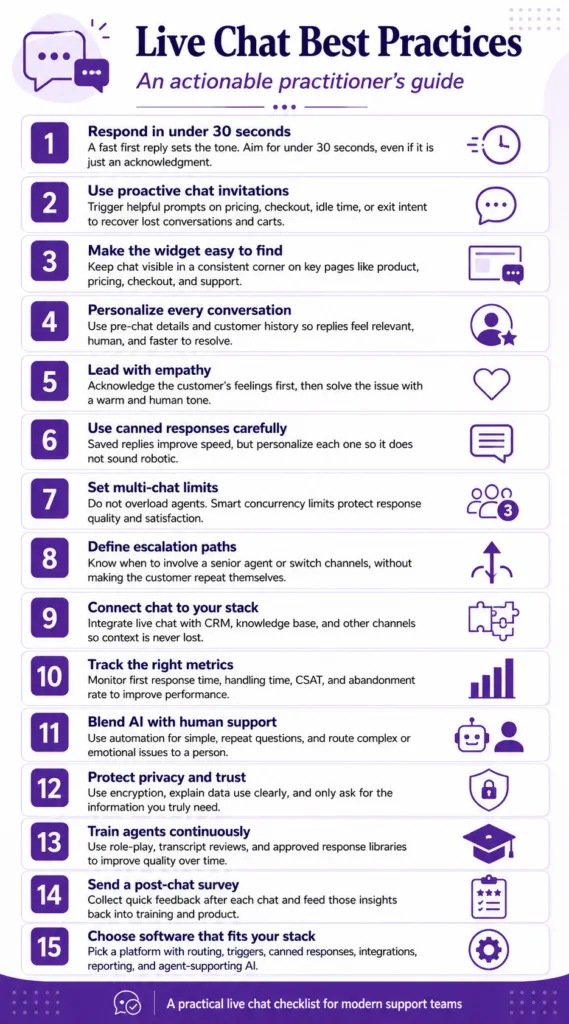
1. Respond in under 30 seconds
Speed is the first thing customers judge. Expectations moved from days on email to seconds on chat, and a quick first reply sets the tone for everything that follows. Aim for a first response time under 30 seconds, even if that first message only confirms a person is on it. To hit that consistently, route chats to available agents automatically, cap how many chats each agent runs at once, and let automation handle the simple, repeat questions.
2. Be proactive with well-timed chat invitations
Do not wait for every customer to start the conversation. A proactive chat invitation, triggered when someone lingers on pricing or hesitates at checkout, can recover a meaningful share of carts that would otherwise be abandoned. Moreover, a contextual prompt reads as help rather than a sales push.
Make proactive invitations land:
- Use the customer’s name and mention the page or product they are viewing.
- Offer something genuinely useful, such as a direct answer or a relevant recommendation.
- Time it to behaviour like idle time or exit intent, rather than a fixed pop-up that interrupts everyone.
3. Make your live chat widget easy to find
Your chat widget should never be hard to spot. Most consumers judge a company on its website experience, so a hidden widget quietly costs you conversations. Place it in the same corner across the pages that matter most, including product, pricing, checkout, and support. Keep it visible as visitors scroll, so help stays one click away.
4. Personalize every conversation
Generic, scripted replies make a customer feel like a case number. Use pre-chat data and past sessions to greet people in context and tailor your help. When an agent can see a customer’s full history with your brand, they resolve issues faster and convert more often.
5. Lead with empathy
Customers on chat carry emotions, the same as anyone. Most people rate empathy as essential in a support interaction. So let customers finish their point, acknowledge how they feel, and reply in a warm, human tone before you move to the fix. Efficiency still counts, and the best agents pair it with genuine care.
6. Use canned responses without sounding robotic
Saved replies keep answers quick and consistent for common questions. Used carelessly, however, they read as cold. Treat each canned response as a starting point, then personalize the opening, add the customer’s name and specifics, and adjust the closing. The scripts section below gives you templates to adapt.
7. Set sensible limits for multi-chat handling
Agents can run several chats at once, though quality drops when that number climbs too high. Set a concurrency limit so replies stay quick and considered. Teams with the highest satisfaction scores tend to keep average chat duration tight, often under about 12 minutes, which is far easier when agents are not buried in parallel conversations.
8. Define clear escalation paths
Not every issue belongs in a single chat. Document when to bring in a senior agent, when to move to a call or email, and how to hand off without making the customer repeat themselves. Clear rules protect both response time and resolution quality.
9. Connect live chat to your CRM, knowledge base, and other channels
Live chat works best as part of a connected system. Integrate it with your CRM so agents see the full relationship history, with your knowledge base so they can share articles instantly, and with your other channels so a conversation can move from chat to email without losing context. As a result, customers never have to start over.
10. Track the metrics that matter
You cannot improve what you do not measure. Watch first response time, average handling time, CSAT, and abandonment rate to find where conversations stall or satisfaction dips, then fix the root cause. The metrics table below shows what to track and why.
11. Blend AI and automation with a human touch
Chatbots and automation handle generic, repeat questions well, and they cover you around the clock. Many customers, however, still feel bots miss the nuance of complex problems. So the strongest setup is hybrid. Let automation manage volume and routing, then send anything ambiguous or emotional to a person. That keeps quality high while you scale.
12. Protect security, privacy, and trust
Customers want to feel safe in a chat. Use proper encryption, be open about how you use their data, and train agents to ask only for the information they truly need. When personal data is required, explain why before asking for it. Strong privacy habits build the long-term trust that keeps customers coming back.
13. Train agents with role-play and quality reviews
Great chat support is a skill that improves with practice. Run regular role-play sessions with realistic scenarios, review past transcripts to coach tone and accuracy, and keep a living library of approved responses. Consistent agent training is what raises a whole team’s performance over time.
14. Close the loop with a post-chat survey
End each conversation by inviting quick feedback. Most customers are willing to share their experience, good or bad, and that signal is gold for spotting friction and recognizing strong agents. Feed survey results back into training and product, so the experience keeps improving.
15. Choose live chat software that fits your stack
Even strong habits underperform on the wrong tool. Look for fast routing, concurrency controls, proactive triggers, canned responses, CRM and knowledge-base integrations, solid reporting, and AI that supports agents rather than replacing them. A purpose-built support platform like Kayako brings these together, so your team can apply every practice above from one place. For a deeper look, see our guide to choosing live chat software.
Win the first 30 seconds, every time. Book a Kayako strategy session →
Live chat scripts and response examples
Ready-made scripts keep replies fast and on-brand. Personalize the names and details before you send. Here are templates for the most common live chat moments.
| Scenario | Example script |
| Greeting | Hi [Name], thanks for reaching out. I’m [Agent], and I’m glad to help. What can I do for you today? |
| Proactive invite | Hi [Name], I noticed you’re looking at [product]. I’m happy to answer questions or help you decide. Want a hand? |
| Asking for time | Great question. Give me a moment to pull that up so I get it exactly right. Thanks for your patience. |
| Apology / recovery | I’m sorry for the trouble this caused, [Name]. Let’s get it sorted right now. Here is what I’ll do next. |
| Escalation / hand-off | To get you the best answer, I’m bringing in [Team], who specializes in this. I’ve shared our full conversation, so you won’t need to repeat anything. |
| Recommendation | Based on what you’ve told me, [product or plan] fits well, because [reason]. Want me to walk you through it? |
| Closing | Glad I could help, [Name]. Anything else before you go? If something comes up later, just reopen this chat. Have a great day. |
Tip: save these as canned responses, then edit the details every time. A good template speeds up a human reply. It should never stand in for one.
Common live chat mistakes to avoid
Even strong teams slip into these habits. We cover them in depth in our guide to live chat mistakes companies make, and here are the ones to watch first.
- Slow or no first response. Leaving customers waiting, or offering chat when nobody is available, erases the speed advantage.
- Robotic replies. Copy-pasting canned messages without personalizing them feels worse than no script.
- Overloaded agents. Too many simultaneous chats drags down quality and lengthens every conversation.
- Over-reliance on bots. Forcing customers through automation for complex issues drives frustration and churn.
- A hidden widget. Burying chat on one page means the people who need it never find it.
- Making customers repeat themselves. Poor hand-offs and missing context are among the fastest ways to lose goodwill.
- No measurement. Running chat without tracking response time, CSAT, and abandonment leaves problems invisible.
Live chat metrics that matter
Track these core live chat metrics to know whether your best practices are working.
| Metric | What it measures | Aim for |
| First response time (FRT) | How quickly an agent sends the first reply | Under ~30 seconds |
| Average handling time (AHT) | Average length of a full chat | Tight, often under ~12 minutes |
| CSAT | Customer satisfaction from post-chat surveys | Higher is better, track the trend |
| Abandonment rate | Chats customers leave before being helped | As low as possible |
| Resolution rate | Share of chats resolved in the conversation | Higher is better |
Frequently asked questions
What are live chat best practices?
They are the habits that make live chat fast and effective: responding within seconds, reaching out proactively, keeping the widget visible, personalizing replies, leading with empathy, capping concurrent chats, integrating with your CRM and knowledge base, balancing AI with human agents, and tracking metrics like FRT and CSAT.
What are common live chat mistakes?
The most damaging are slow or unavailable responses, robotic copy-pasted replies, overloaded agents, forcing customers through bots for complex issues, a hidden chat widget, weak hand-offs that make people repeat themselves, and no performance tracking. Our guide to live chat mistakes covers each one.
What is live chat etiquette?
Live chat etiquette is the set of conventions agents follow on chat: greeting customers warmly, using their name, replying promptly, writing clearly without jargon, showing empathy, asking before a hold, and closing politely. Good etiquette protects both the customer experience and your brand reputation.
Should companies use chatbots or human agents for live chat?
Both have a place. Chatbots provide round-the-clock cover and handle high-volume, repetitive questions, while human agents bring empathy and judgement to complex or sensitive issues. The best results come from a hybrid model that automates the routine and routes everything else to a person.
How do you measure live chat performance?
Track first response time, average handling time, CSAT, abandonment rate, and resolution rate. Together they show where conversations stall and which workflows perform best. See our breakdown of live chat performance metrics for benchmarks.
How can live chat increase conversions?
Proactive, well-timed chat invitations let agents step in at decisive moments, such as hesitation at checkout or questions on a pricing page. With reminders, recommendations, and reassurance, agents recover sales that would otherwise slip away.
Bringing it together
Live chat rewards teams that move fast and stay genuinely helpful. Nail the response time, reach out at the right moment, personalize each conversation, and pair automation with empathy. Then measure, and keep improving. Done consistently, chat becomes one of your most valuable support channels.
The easiest way to apply all 15 practices is from a platform built for it, where routing, canned responses, integrations, and analytics live in one place.
Ready to make live chat your competitive advantage? Talk to a Kayako expert