|
Key takeaways
|
The top revenue intelligence platforms for B2B sales have become core infrastructure for RevOps teams, because a CRM only reports what reps type into it. Revenue intelligence adds an AI layer that captures every call, email, and meeting, then predicts which deals will close and where the pipeline is at risk. A typical enterprise revenue stack now runs $7,000 to $10,000 per user per year across CRM, conversation intelligence, and forecasting tools, so choosing the right platform matters. This guide ranks eight of them by the job they do best.
What are the top revenue intelligence platforms for B2B sales?
The top platforms are Gong for conversation intelligence, Clari for enterprise forecasting, Aviso for forecast accuracy, People.ai for activity capture, and BoostUp (Terret) for flexible, lower-cost forecasting. Revenue Grid is the most budget-friendly, and Salesforce Revenue Intelligence is the natural pick for teams already standardized on Salesforce.
Here is the shortlist at a glance, with what each platform is best for and its pricing model.
| Platform | Best for | Pricing model |
|---|---|---|
| Gong | Conversation intelligence and rep coaching | Custom, around $100 to 250 per user |
| Clari | Enterprise forecasting and pipeline roll-ups | Custom, around $150 to 200 per user |
| Aviso | Pure AI forecast accuracy | Custom enterprise |
| People.ai | Automatic activity capture and insights | Custom enterprise |
| BoostUp (Terret) | Flexible, multi-model forecasting at value | From about $79 per user |
| Revenue Grid | Transparent, lower-cost intelligence | From about $30 per user |
| Chorus by ZoomInfo | Conversation intelligence in a data stack | Custom enterprise |
| Salesforce Revenue Intelligence | Teams native to Salesforce CRM | Bundled with Salesforce plans |
Before the reviews, it is worth defining what revenue intelligence is, because teams often buy the wrong category.
What is revenue intelligence?
Revenue intelligence is a category of software that uses AI to capture and analyze every customer interaction, such as calls, emails, and meetings, alongside CRM data, to forecast which deals will close and surface pipeline risk. Unlike CRM analytics, which reports the fields reps fill in manually, revenue intelligence infers what is actually happening in a deal.
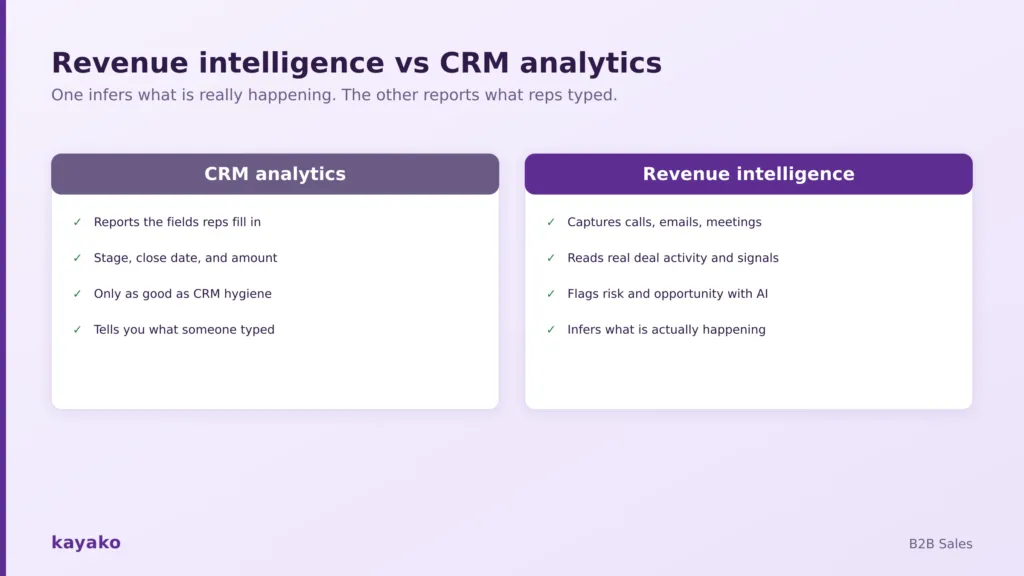
Revenue intelligence infers what is happening; CRM analytics reports what reps typed.
Every platform in this category sits on top of a CRM, usually Salesforce or HubSpot, and reads or writes data to it. None of them replace the system of record. Where they differ is which of three jobs they do best.
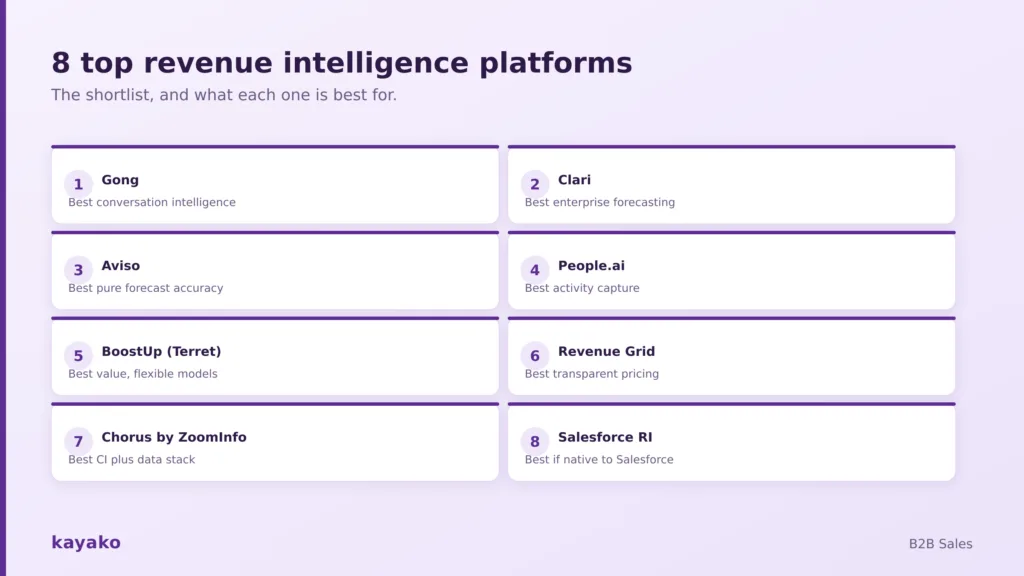
Buy the right category before you compare tools.
- Conversation intelligence. Records and analyzes sales calls to surface deal risk, coaching moments, and competitor mentions. Gong and Chorus lead here.
- Forecasting and pipeline. Aggregates CRM and activity data to predict which deals close and whether you will hit quota. Clari, Aviso, People.ai, and BoostUp lead here.
- Signal-to-action. Turns buyer signals into specific rep actions, telling reps what to do right now rather than only what happened.
With the categories clear, here are the eight platforms worth shortlisting.
The 8 top revenue intelligence platforms
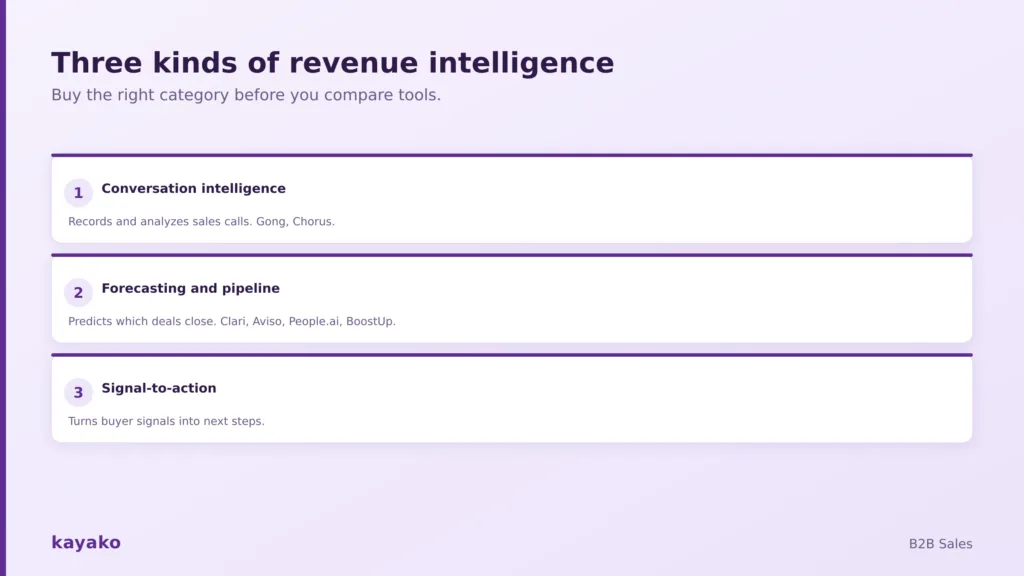
The shortlist, and what each platform is best for.
1. Gong: best conversation intelligence
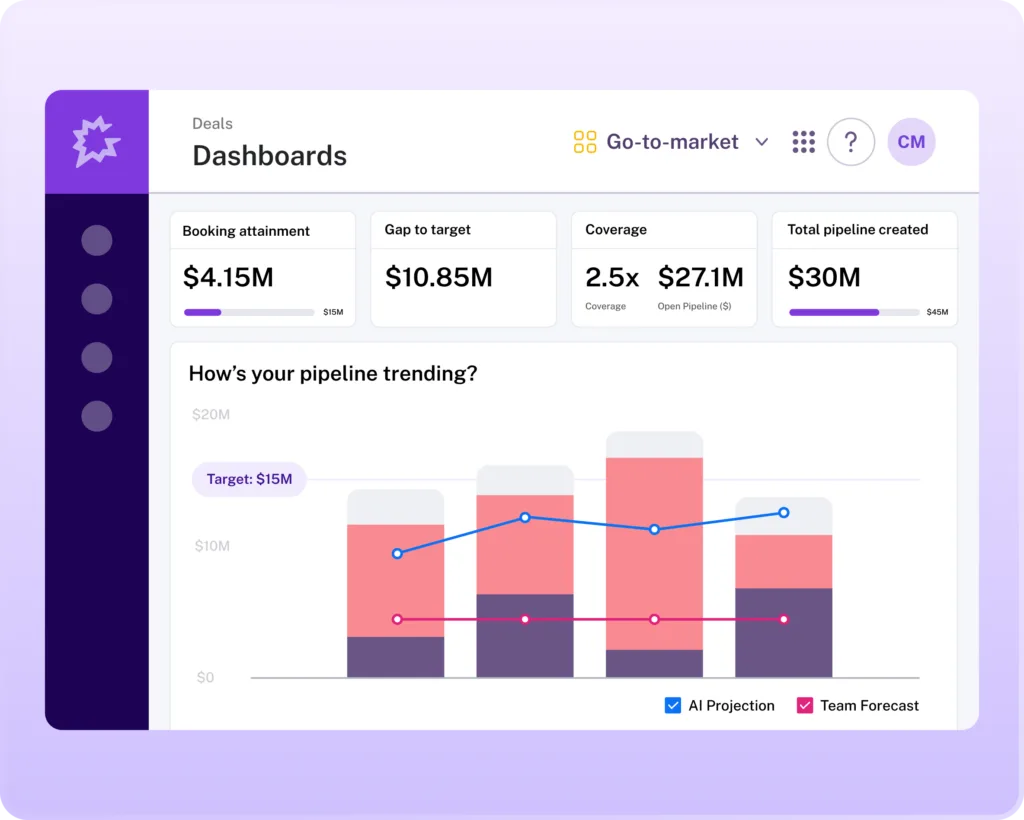
Gong is the category’s best-known platform, built around conversation intelligence and now positioned as a Revenue AI operating system. It captures calls, meetings, and emails and turns them into coaching, deal insight, and forecasting, and it is the tool reps actually use day to day. It has expanded into forecasting, but customer conversations remain its center. Pricing is custom and premium, often cited around $100 to $250 per user per month, and it is built for larger orgs.
2. Clari: best enterprise forecasting
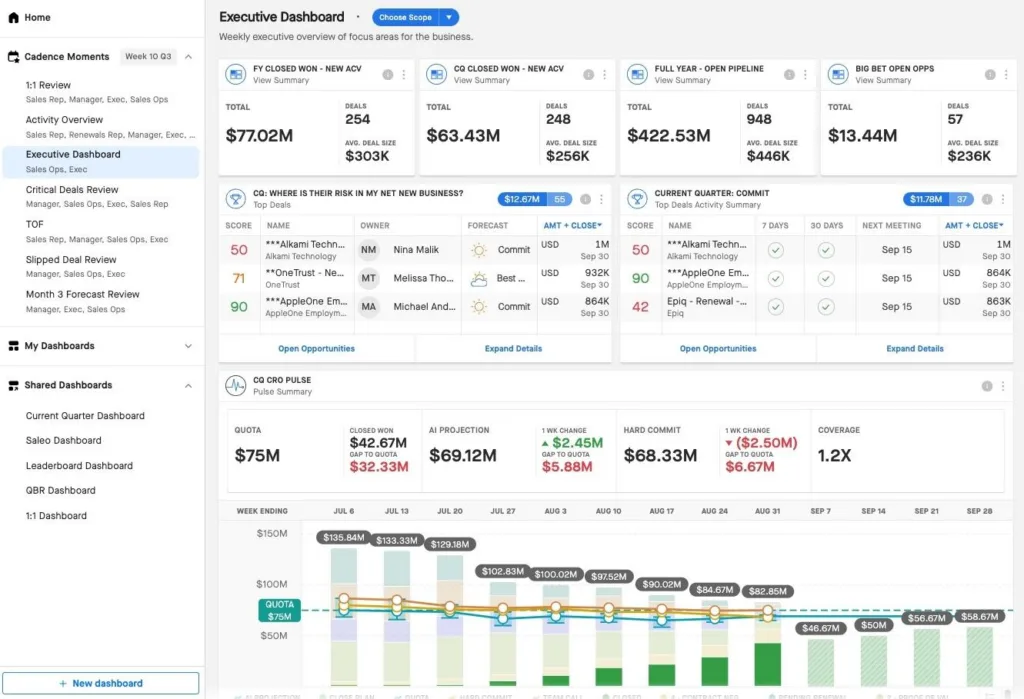
Clari is the benchmark for top-down forecasting and pipeline inspection, loved by CROs who need standardized forecast roll-ups across business units. It analyzes what reps do, such as CRM updates, email activity, and meeting patterns, to predict which deals close and whether the team hits its number. It is phenomenal for leadership visibility and less focused on the individual rep’s next action. Pricing is enterprise, often cited around $150 to $200 per user.
3. Aviso: best pure forecast accuracy
Aviso is a pure-play AI forecasting platform that markets forecast accuracy as high as 98 percent, using machine learning across CRM data, rep activity, and historical patterns. If forecast accuracy is your single top priority, Aviso delivers, and it suits RevOps teams in complex, multi-model environments. It is a specialist, without conversation intelligence or engagement automation, and reviewers note a separate login from the CRM adds workflow friction.
4. People.ai: best activity capture
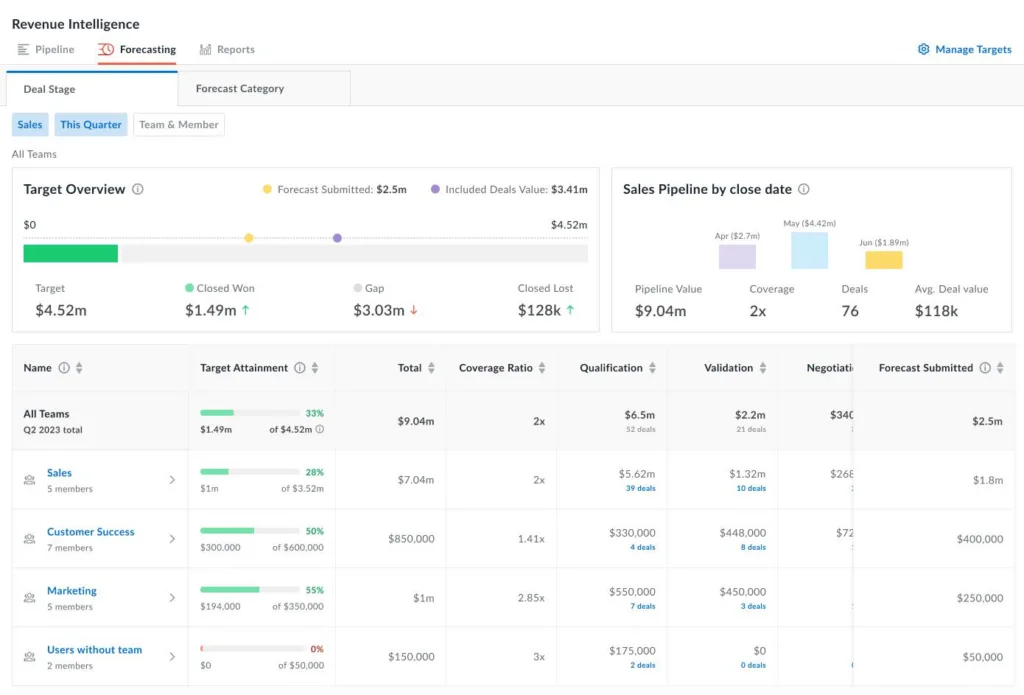
People.ai centers on automatic activity capture, logging emails, meetings, and contacts into the CRM without rep effort, then using that clean activity data for pipeline and account insights. It suits enterprises that struggle with CRM hygiene and want a complete, automatic record of engagement feeding their forecasts. Like its peers, it uses custom enterprise pricing and is built for larger sales organizations.
5. BoostUp (Terret): best value and flexibility
BoostUp, rebranded as Terret in late 2025, offers multi-dimensional forecasting that supports SaaS subscriptions, consumption and usage models, product-led motions, renewals, and expansions, at a price point well below Clari or Gong, from about $79 per user. Its key advantage is flexibility: rather than a rip-and-replace, it integrates with existing conversation intelligence tools by API, so a team already on Gong can add it for forecasting without abandoning that investment.
6. Revenue Grid: best transparent pricing
Revenue Grid stands out for transparent, published pricing starting around $30 per user per month, far below the enterprise norm, with guided-selling and revenue-signal features. It suits mid-market teams that want revenue intelligence without a five-figure commitment or a long sales-led procurement process. Its brand recognition and ecosystem are smaller than Gong’s or Clari’s, so weigh integration needs.
7. Chorus by ZoomInfo: best CI inside a data stack
Chorus is a conversation intelligence platform now owned by ZoomInfo, recording and analyzing calls for coaching and deal insight. Its main draw is for teams already invested in the ZoomInfo ecosystem that want conversation intelligence connected to their contact-data stack. As a conversation-first tool, it overlaps with Gong on capability, so the choice often comes down to your existing vendor relationships.
8. Salesforce Revenue Intelligence: best if native to Salesforce
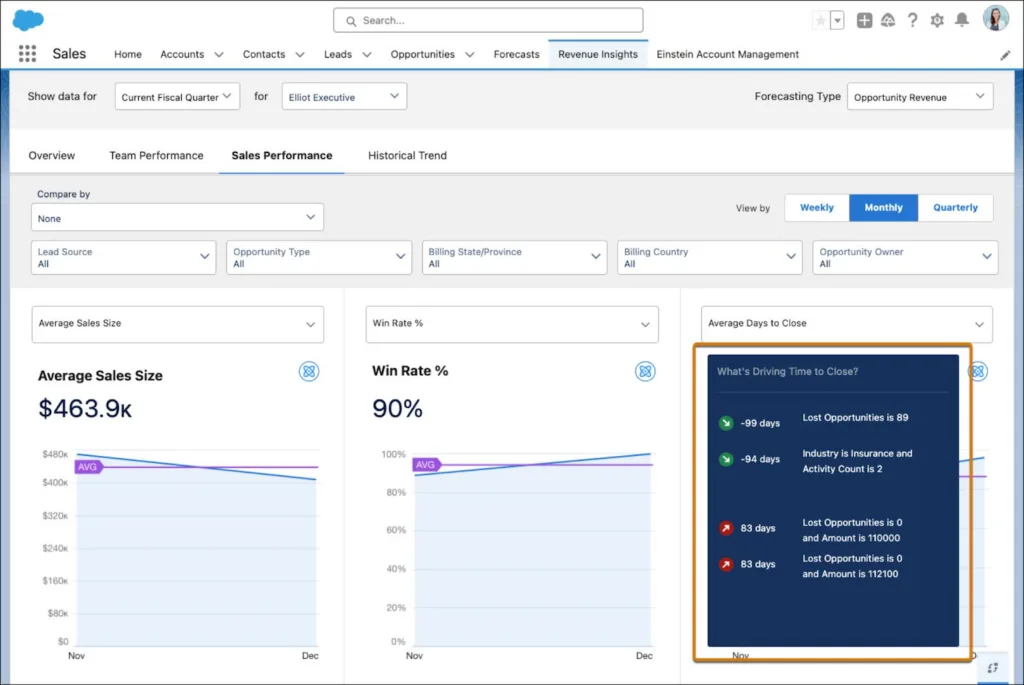
Salesforce offers revenue intelligence and forecasting as part of its platform, increasingly bundled with its Agentforce AI, without requiring a separate license for teams already on the CRM. That makes it cost-effective and native for Salesforce-centric organizations. Dedicated platforms like Gong and Clari generally go deeper on conversation analysis and forecasting sophistication, so heavy users often layer one on top.
|
Revenue intelligence pricing
Most revenue intelligence platforms use custom enterprise pricing that lands around $50 to $150 per user per month, with Gong and Clari at the higher end and meaningful minimum-seat and implementation requirements. BoostUp (Terret) is more accessible from about $79 per user, and Revenue Grid is the lowest entry point at around $30 per user per month.
| Platform and their Pricing | ||
| Platform | Pricing | Built for |
| Revenue Grid | From about $30 per user | Mid-market, budget |
| BoostUp (Terret) | From about $79 per user | Mid-market to enterprise |
| Gong | Custom, around $100 to 250 per user | 50-plus rep orgs |
| Clari | Custom, around $150 to 200 per user | Enterprise |
| Aviso, People.ai, Chorus | Custom enterprise | Enterprise RevOps |
| Salesforce Revenue Intelligence | Bundled with Salesforce | Salesforce-native teams |
Because most of these tools carry minimum-seat requirements and are built for orgs of 50 or more reps, smaller teams often get more from a CRM’s native forecasting or a lower-cost option like Revenue Grid until they scale.
How to choose a revenue intelligence platform
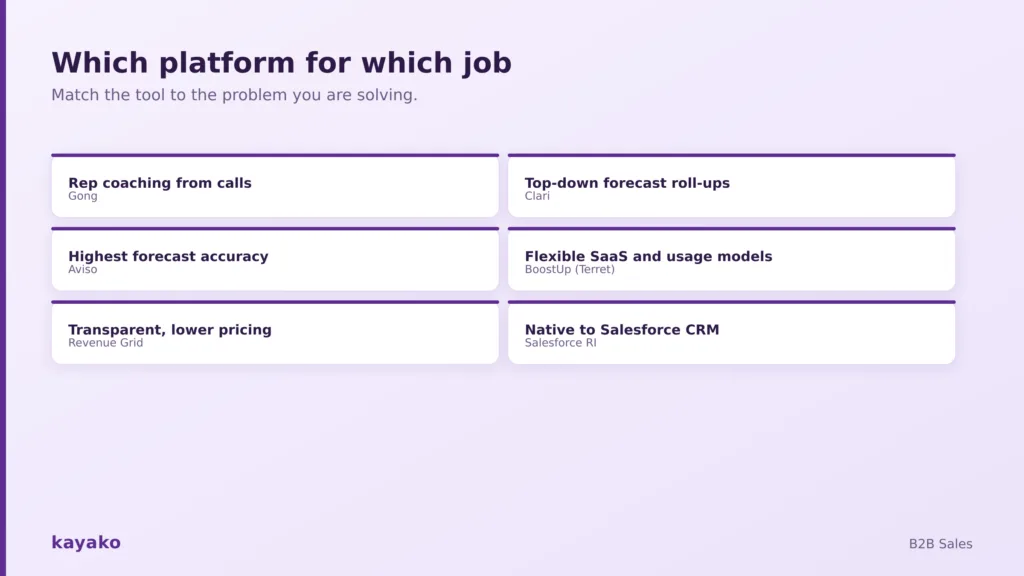
To choose a revenue intelligence platform, first pick the category, not the brand. If your problem is rep coaching, choose a conversation-intelligence tool like Gong. If it is forecast governance, choose a forecasting tool like Clari or Aviso. If your reps’ CRM hygiene is the real issue, an activity-capture tool like People.ai fits best.
Match the tool to the problem you are solving.
| If your priority is | Choose |
|---|---|
| Coaching reps from real calls | Gong |
| Top-down forecast roll-ups for leadership | Clari |
| The highest forecast accuracy | Aviso |
| Flexible SaaS, usage, and renewal models | BoostUp (Terret) |
| Transparent, lower pricing | Revenue Grid |
| Staying native to Salesforce | Salesforce Revenue Intelligence |
The most common mistake is buying the wrong category, such as a conversation tool when the real problem is forecast governance. Match the platform to your actual gap. And remember that revenue intelligence only covers one half of revenue.
Revenue intelligence and the other half of the number
Revenue intelligence platforms are built to forecast and win new deals, the acquisition side of the revenue funnel. But in a recurring-revenue B2B business, net revenue retention – the renewals and expansions that come after the sale – often matters as much as new bookings. That half of the number is decided in onboarding, support, and success, and no forecasting dashboard protects it. It is the natural extension of your B2B sales motion into the customer lifecycle.
Where a revenue intelligence tool tells leadership whether new deals will close, a support platform like Kayako protects the revenue you already booked, giving teams a unified view of every customer and an AI agent that resolves issues fast so accounts renew and expand. See our approach to AI customer support. Forecasting the pipeline and protecting retention are two halves of the same revenue engine.
|
|
Frequently asked questions
What are the top revenue intelligence platforms for B2B sales?
The top revenue intelligence platforms are Gong for conversation intelligence, Clari for enterprise forecasting, Aviso for forecast accuracy, People.ai for activity capture, and BoostUp (Terret) for flexible, lower-cost forecasting. Revenue Grid is the most budget-friendly, and Salesforce Revenue Intelligence suits teams already on Salesforce. The best choice depends on which job, coaching or forecasting, you most need to solve.
What is the difference between revenue intelligence and a CRM?
A CRM is the system of record that stores contacts, deals, and pipeline based on what reps enter. Revenue intelligence sits on top of the CRM and adds an AI layer that captures calls, emails, and meetings to infer what is actually happening in a deal and forecast outcomes. Revenue intelligence does not replace the CRM; it makes the CRM’s data more accurate and predictive.
What is the difference between Gong and Clari?
Gong is a conversation intelligence platform reps use daily, analyzing what is said on calls to surface coaching and deal risk. Clari is a forecasting platform leadership uses, analyzing what reps do in the CRM to predict whether the team hits its number. In short, Gong is software a rep uses, and Clari is a dashboard a CRO interprets. Some large teams run both, though their forecasting features increasingly overlap.
How much do revenue intelligence platforms cost?
Most use custom enterprise pricing around $50 to $150 per user per month, with Gong and Clari at the higher end and minimum-seat requirements that suit orgs of 50-plus reps. BoostUp (Terret) starts lower at about $79 per user, and Revenue Grid is the most affordable at around $30. A full enterprise revenue stack can reach $7,000 to $10,000 per user per year across all tools.
Do revenue intelligence tools replace your CRM?
No. Every major revenue intelligence platform, including Gong, Clari, Aviso, People.ai, and BoostUp, sits on top of a CRM such as Salesforce or HubSpot and reads or writes data to it. They enhance the CRM with AI-driven capture and forecasting but do not act as the system of record. You keep your CRM and add revenue intelligence as a layer above it.