|
Key takeaways
|
The modern B2B purchase looks almost nothing like the linear funnel a CRM still draws, so a B2B sales strategy built for 2020 will underperform in 2026. Buyers self-educate for months, move in committees, and only raise their hand once they have shortlisted vendors. Around 70% of the buying process is now complete before a prospect ever contacts sales (Forrester, via Tomba). This playbook lays out a practical strategy that matches that reality, from ideal customer profile to the metrics that prove it works.
What is a B2B sales strategy?
A B2B sales strategy is a documented plan defining which businesses a company sells to, how it reaches and persuades them, and how it turns them into customers and keeps them. It covers the ideal customer profile, the sales process and stages, the channels and messaging used to engage buyers, and the metrics used to measure success. A good strategy aligns the whole revenue team around how buyers actually buy.
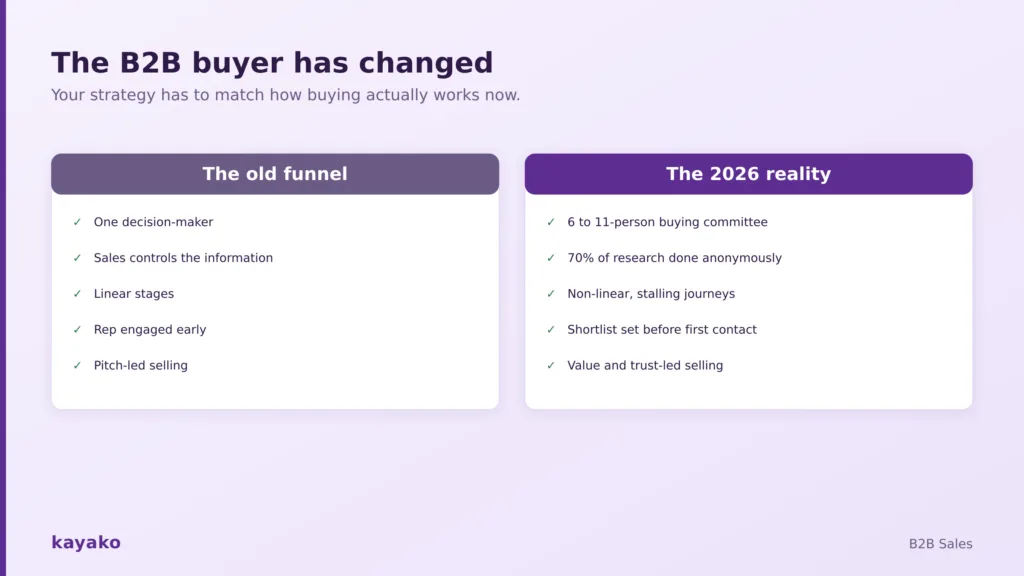
Your strategy has to match how buying actually works now.
The change is fundamental. Buyers spend only about 17% of the total purchase process with potential vendors, and 75% say they prefer a rep-free experience for parts of it. A strategy that assumes a single decision-maker reading your first email is fighting the market. The winning approach meets buyers in the anonymous phase and sells to the whole group.
The 6 pillars of a modern B2B sales strategy
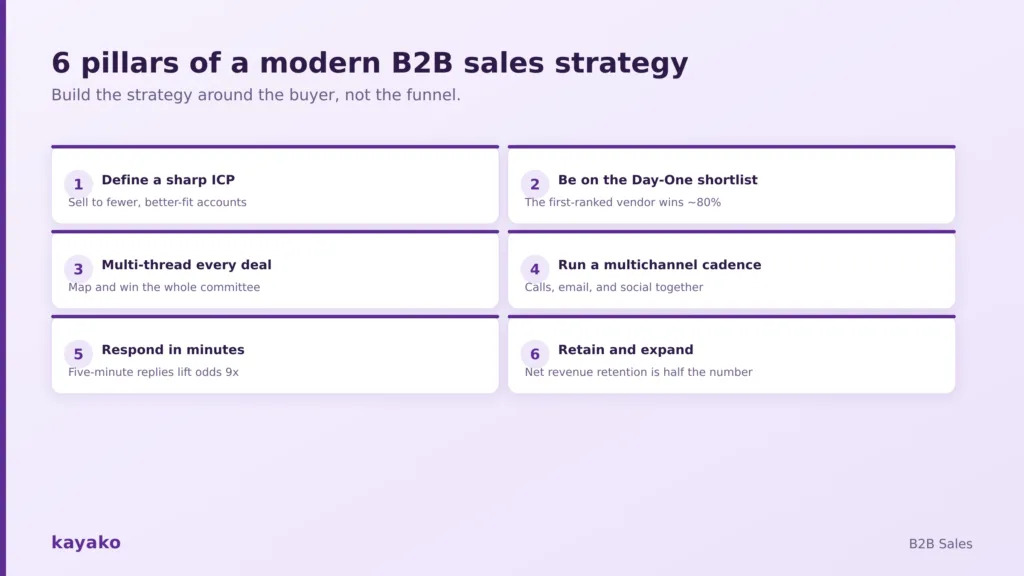
Build the strategy around the buyer, not the funnel.
1. Define a sharp ideal customer profile
Only about 5% of accounts are in-market at any time, so precision beats reach. A tight ideal customer profile, built from your best existing customers, focuses effort on the accounts most likely to buy and stay, which lifts win rates and shortens cycles.
2. Get onto the Day-One shortlist
Because 95% of the time the winning vendor is on the buyer’s initial shortlist, and the first-ranked vendor wins about 80% of deals, visibility during anonymous research is decisive. Invest in content, reviews, a strong referral program, and category presence so you are considered before a rep is ever contacted.
3. Multi-thread every deal
With buying committees of 6 to 11 people, a deal championed by a single contact is fragile. Map the committee, from economic buyer to technical evaluator to end user, and build relationships across it, since deals stall in committee far more often than in the demo. Giving each stakeholder a reason to say yes, often through value-based selling that quantifies their return, is what keeps a group deal moving.
4. Run a multichannel cadence
No single channel reaches a modern buyer reliably. Coordinated sequences across phone, email, and social outperform any one channel, and social selling alone generates 45% more opportunities. Orchestrate touches rather than relying on one motion.
5. Respond in minutes, not days
Speed is a strategy. Contacting a lead within five minutes can raise qualification odds up to ninefold versus a 30-minute delay, and buyers often reward the first vendor to respond. Build routing and alerts that make fast response the default.
6. Retain and expand existing accounts
New logos are only half the number. In a recurring-revenue business, net revenue retention- the renewals and expansions that follow the first sale- compounds faster than new business, which is why learning to build lasting customer relationships belongs inside the sales strategy. A plan that ignores post-sale leaves most of its revenue on the table.
|
|
How to build a B2B sales strategy
To build a B2B sales strategy, define your ideal customer profile and segments, set revenue and pipeline targets, map the buying committee you must win, design a repeatable sales process with clear stage exit criteria, enable the team with content and tools, then measure results and align with customer success for retention. Review and adjust the plan quarterly.
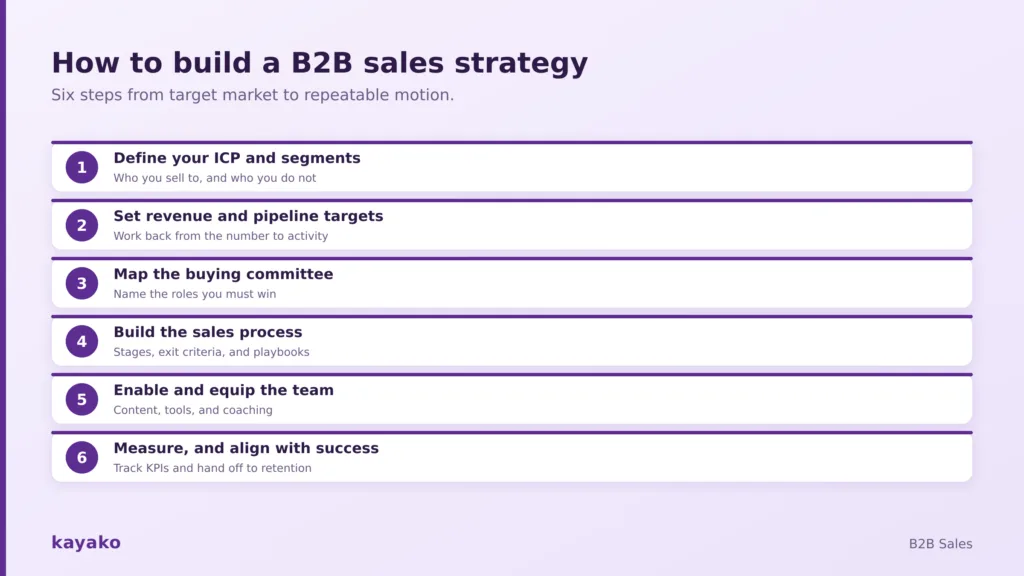
Six steps from target market to repeatable motion.
Work backward from the revenue number to the activity that produces it. If you need a set amount of new revenue, your average deal size and win rate tell you how much qualified pipeline you need, and your conversion rates tell you how much activity creates that pipeline. That chain turns a vague goal into a concrete, measurable plan.
B2B sales metrics to track
The core B2B sales metrics to track are win rate (typically 15 to 25%), sales cycle length, average contract value, pipeline coverage (a healthy 3 to 4 times quota), lead response time (under five minutes), and net revenue retention. Together, these show whether the strategy is producing efficient, durable growth rather than just activity.
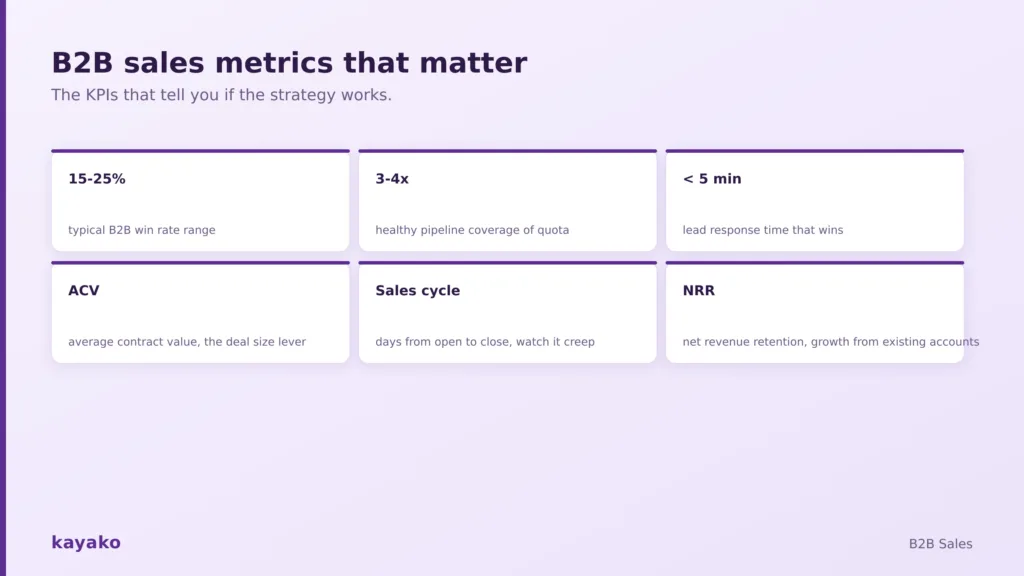
The KPIs that tell you if the strategy works.
| Metric | Healthy benchmark | What it tells you |
|---|---|---|
| Win rate | 15 to 25% | How efficiently you convert qualified deals |
| Pipeline coverage | 3 to 4x quota | Whether you have enough to hit the number |
| Lead response time | Under 5 minutes | Whether speed is costing you deals |
| Sales cycle length | Trend, not a fixed target | Whether deals are speeding up or stalling |
| Net revenue retention | Above 100% | Whether existing accounts grow on their own |
Metrics only help if they change behavior, so review them on a fixed cadence and tie them to specific plays. A few predictable mistakes undermine even a well-measured strategy.
Common B2B sales strategy mistakes
- Selling to a single contact. Single-threaded deals collapse when your champion goes quiet or leaves. Multi-thread from the start.
- Ignoring the anonymous phase. If you are invisible during self-directed research, you are off the shortlist before sales ever engages.
- Chasing volume over fit. A loose ideal customer profile fills the pipeline with deals that stall. Precision beats reach.
- Treating the close as the finish line. Handing customers off and forgetting them forfeits the retention and expansion revenue that compounds.
That last mistake is the most expensive, and it points to the part of the strategy most teams underinvest in.
The half of the strategy most teams skip
Most B2B sales strategies pour their energy into acquisition and treat everything after the signature as someone else’s job. But in a subscription or recurring-revenue business, the first contract is rarely the largest, and net revenue retention often drives more growth than new logos. That post-sale half of the B2B sales motion runs on onboarding, support, and success, not on prospecting, and, done well, it can even accelerate the next sale.
A support platform like Kayako is where that half of the strategy lives, giving teams a unified view of every customer and an AI agent that resolves issues fast, so accounts renew and expand instead of churning. See our approach to AI customer support. A complete B2B sales strategy plans for the whole customer lifecycle, not just the deal.
|
|
Frequently asked questions
What is a B2B sales strategy?
A B2B sales strategy is a plan for how a business sells to other businesses, covering which companies it targets, how it reaches and persuades them, its sales process, and how it measures success. In 2026, an effective strategy is built around how buyers actually buy, meeting them during self-directed research, selling to a buying committee, and treating retention as part of the plan rather than an afterthought.
What are the main types of B2B sales strategy?
Common approaches include inbound (attracting buyers with content during their research), outbound (proactive prospecting via calls, email, and social), account-based (concentrating effort on a defined set of high-value accounts), and channel or partner-led selling. Most successful teams blend several, for example, pairing account-based targeting with inbound content and an outbound cadence, rather than relying on one alone.
How do you create a B2B sales strategy?
Start by defining your ideal customer profile from your best existing customers, then set revenue and pipeline targets and work backward to the required activity. Map the buying committee you must win, design a repeatable sales process with clear stage criteria, enable the team with content and tools, and measure results. Review quarterly and align closely with customer success for retention.
Why do most B2B deals stall?
About 86% of B2B purchases stall at some point, usually in committee rather than at the demo. The main causes are single-threaded deals that lose momentum when one contact goes quiet, a lack of internal consensus across a 6- to 11-person buying group, and unclear next steps. Multi-threading the deal and helping the champion build internal consensus are the best ways to prevent it.
What is the most important B2B sales metric?
No single metric tells the whole story, but win rate and net revenue retention are among the most revealing. Win rate shows how efficiently you convert qualified deals, while net revenue retention shows whether existing customers grow on their own. Pipeline coverage and lead response time are the best leading indicators, since they predict future results rather than reporting past ones.