|
Key takeaways
|
The average B2B sales team now runs about ten tools, and the right combination is a real competitive advantage while the wrong one is expensive clutter. The category of B2B sales tools has exploded, so the goal is not to buy the most software; it is to cover each job in the funnel with one tool that fits your size and motion. This guide breaks the stack into seven categories, names dependable picks for each, and shows how to build it as you grow. If you are assembling the marketing side alongside it, see our companion roundup of martech tools by category.
What are B2B sales tools?
B2B sales tools are software applications that help sales teams find prospects, manage relationships, communicate at scale, forecast revenue, and close deals with other businesses. They range from the CRM that acts as the system of record to specialized tools for prospecting data, multichannel outreach, call analysis, and contract signing. Together they form a sales stack, with the CRM at its center.
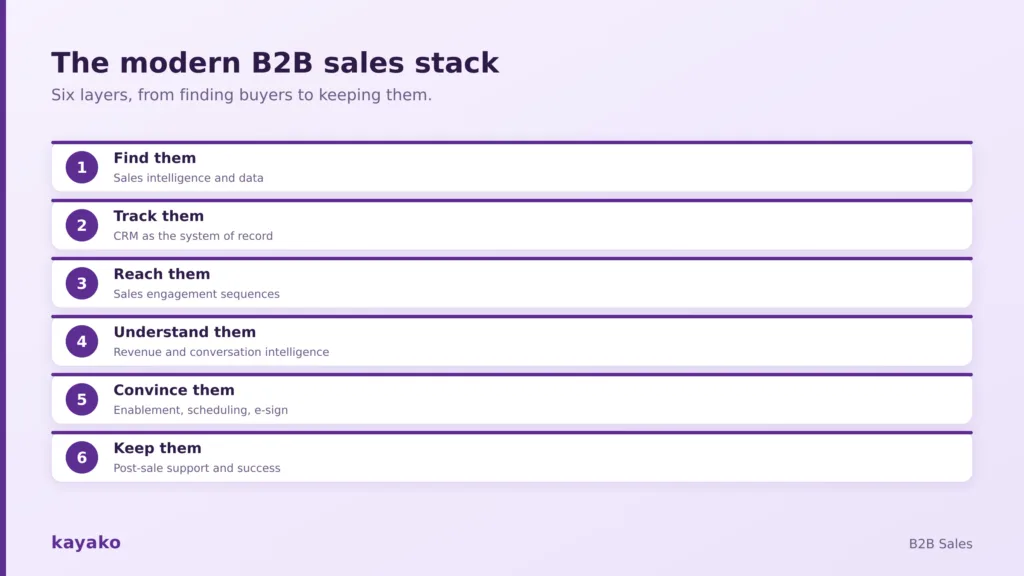
A modern stack has one tool doing each job well.
Rather than memorizing hundreds of products, it helps to think in categories. Each one solves a distinct problem, and a healthy stack has a clear answer for every category it needs, without overlap.
The 7 categories of B2B sales tools
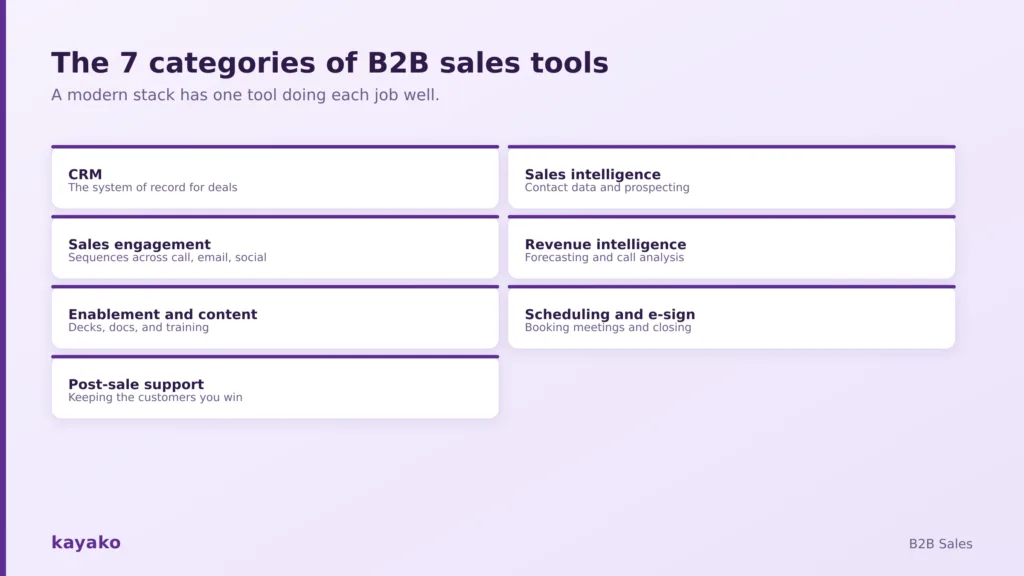
Six layers, from finding buyers to keeping them.
1. CRM: the system of record
The CRM is the foundation every other tool connects to, storing contacts, deals, and pipeline. Leading options include Pipedrive for visual pipeline management, HubSpot for inbound-led teams, and Salesforce for enterprises. For a deeper breakdown, see our guide to the best CRM for a small B2B sales pipeline.
2. Sales intelligence: contact data and prospecting
Sales intelligence tools supply the verified emails, direct dials, and firmographic and intent data that feed prospecting. ZoomInfo, Apollo, and Cognism lead here. Our roundup of the best sales intelligence tools for B2B contact data compares them in detail, including the data-accuracy problem every buyer should test for.
3. Sales engagement: outreach at scale
Sales engagement platforms run multichannel sequences across email, phone, and social, so reps can execute a consistent cadence without manual tracking. Outreach and Salesloft are the category leaders, and for call-heavy teams they pair with dedicated call center tools, sales intelligence data, and a CRM to turn a target list into booked meetings.
4. Revenue intelligence: forecasting and call analysis
Revenue intelligence tools capture calls, emails, and meetings, then use AI to forecast deals and surface risk. Gong leads on conversation intelligence and Clari on forecasting. Our guide to the top revenue intelligence platforms for B2B sales explains the difference and how to choose between them.
5. Enablement and content
Sales enablement platforms such as Highspot and Seismic manage the decks, one-pagers, case studies, and training reps use in deals, and track which content actually influences revenue. They matter most once a team is large enough that content and messaging consistency become a problem to manage.
6. Scheduling and e-signature
Friction-removing tools speed the mechanics of a deal. Scheduling apps like Calendly eliminate the back-and-forth of booking meetings, and e-signature tools like DocuSign shorten the time from verbal yes to signed contract. Small in scope, they have an outsized effect on cycle time.
7. Post-sale support: keeping the customers you win
The category most sales stacks ignore is what happens after the close. Post-sale support platforms hold the full customer history and resolve issues fast, increasingly with an AI agent rather than a basic chatbot, protecting the renewals and expansions that make B2B economics work. It is the difference between winning a logo and keeping it.
|
|
Top B2B sales tools by category
The top B2B sales tools by category in 2026 are Pipedrive and HubSpot for CRM, ZoomInfo and Apollo for sales intelligence, Outreach and Salesloft for engagement, Gong and Clari for revenue intelligence, Highspot and Seismic for enablement, and Calendly and DocuSign for scheduling and signing. Choose one per category that matches your team’s size and motion.
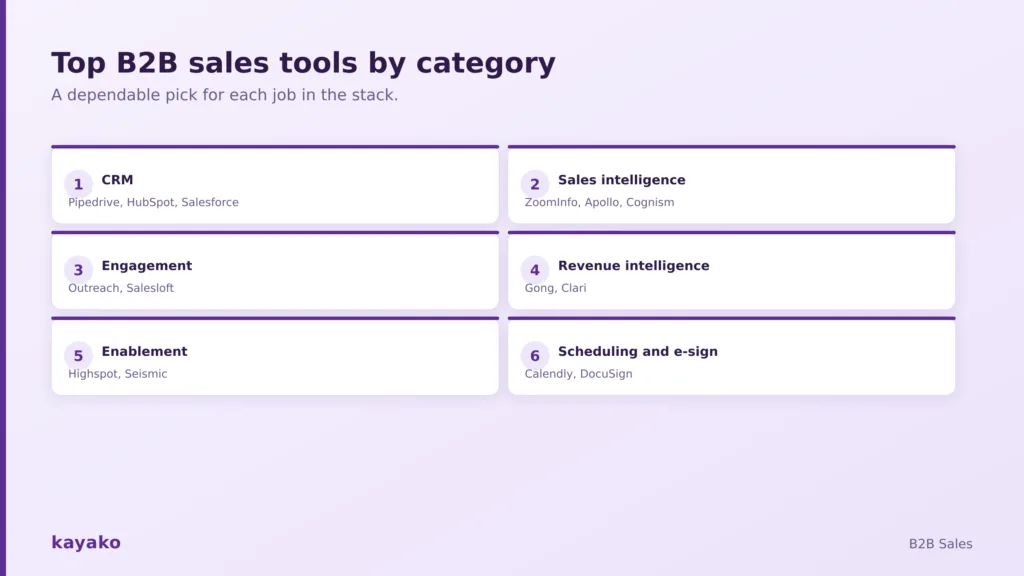
A dependable pick for each job in the stack.
| Category | Top picks | Job it does |
|---|---|---|
| CRM | Pipedrive, HubSpot, Salesforce | System of record for deals |
| Sales intelligence | ZoomInfo, Apollo, Cognism | Contact data and prospecting |
| Sales engagement | Outreach, Salesloft | Multichannel outreach at scale |
| Revenue intelligence | Gong, Clari | Forecasting and call analysis |
| Enablement | Highspot, Seismic | Content and training |
| Scheduling and e-sign | Calendly, DocuSign | Book meetings, close contracts |
| Post-sale support | Kayako | Keep and grow customers |
You do not need every category on day one. The right stack depends on your team’s size and how your motion has matured.
How to build your B2B sales stack
To build a B2B sales stack, start with a CRM as the foundation, then add one tool per category as your motion matures. A solo or small team needs a CRM plus one prospecting tool. A growing team adds engagement and scheduling. A scaling team adds revenue intelligence and enablement, and an enterprise runs the full, integrated stack.
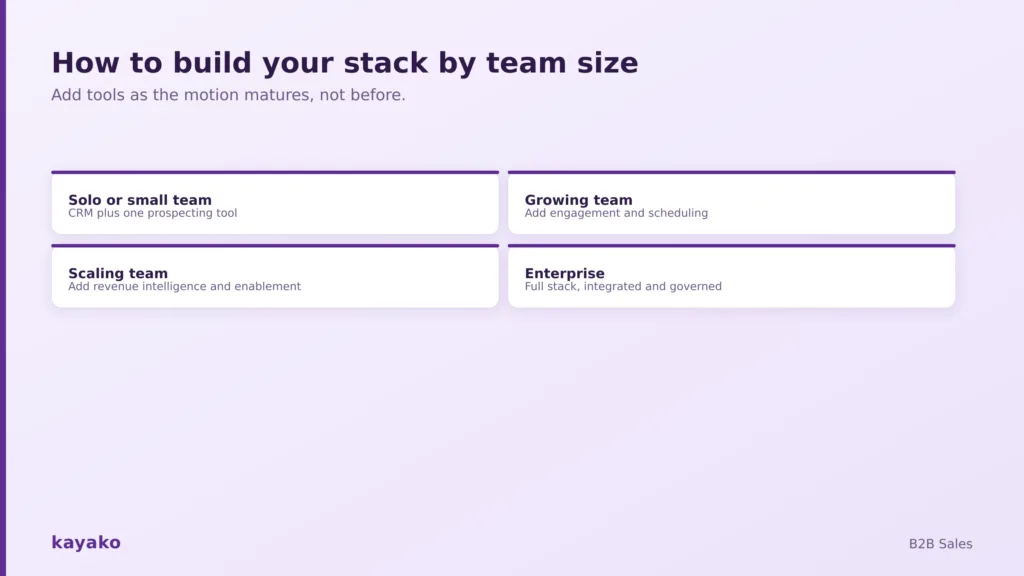
Add tools as the motion matures, not before.
Two rules keep a stack healthy. First, buy for a job you actually have, not one you might have later, since unused tools drain budget and clutter workflows. Second, prioritize integration: tools that sync cleanly with your CRM compound in value, while disconnected point solutions create silos and manual work. When in doubt, consolidate.
The tool most sales stacks forget
Nearly every category above points at winning new business, which makes sense, since that is what a sales team is measured on. But the tools that find, reach, and close a buyer go quiet the moment the contract is signed, and in a recurring-revenue B2B business that is exactly when the largest revenue is still to come. Retention and expansion are the natural extension of the B2B sales motion, and they need their own tool.
That tool is a customer support platform. Kayako gives your team the full history of every customer on one screen and an AI agent that resolves issues fast, so the accounts your sales stack worked to win renew and grow rather than churn. See our approach to AI customer support. A complete sales stack does not stop at the close; it carries through to the customer relationship that follows.
|
|
Frequently asked questions
What are B2B sales tools?
B2B sales tools are software that helps teams sell to other businesses, spanning seven main categories: CRM, sales intelligence, sales engagement, revenue intelligence, enablement, scheduling and e-signature, and post-sale support. The CRM is the foundation that stores deals and contacts, and the other tools feed it data or act on it. Together they form a sales stack that supports the full customer lifecycle.
What is the most important B2B sales tool?
The CRM is the most important B2B sales tool because it is the system of record that every other tool connects to. Without a well-adopted CRM, prospecting data, outreach activity, and forecasts have nowhere to live. Once the CRM is in place, sales intelligence for accurate contact data usually delivers the next biggest gain, since outreach is only as good as the data behind it.
How many sales tools does a B2B team need?
It depends on team size and maturity. A solo or small team can run effectively on a CRM plus one prospecting tool. A growing team typically adds sales engagement and scheduling, and a scaling team layers in revenue intelligence and enablement. The average B2B team uses around ten tools, but more is not better; each should earn its place by doing a job you actually have.
What is the difference between sales intelligence and revenue intelligence?
Sales intelligence tools such as ZoomInfo and Apollo provide contact and company data to help reps find and reach prospects at the top of the funnel. Revenue intelligence tools such as Gong and Clari analyze deal activity like calls and emails to forecast outcomes and surface risk across the pipeline. In short, sales intelligence helps you start deals, and revenue intelligence helps you predict and manage them.
Do B2B sales tools integrate with each other?
The best ones do, and integration is a key selection criterion. Most sales intelligence, engagement, and revenue intelligence tools are built to sync with major CRMs such as Salesforce, HubSpot, and Pipedrive. Prioritizing tools that connect cleanly to your CRM avoids data silos and manual work, and it is usually better to choose a slightly less powerful tool that integrates well than a stronger one that does not.