Drift wrote the playbook for conversational marketing. For most of the last decade, it turned website traffic into live chats, qualified leads through bots, and booked meetings before a visitor cooled off. That product earned its place. In 2026, the reason teams keep typing “Drift alternatives” into Google has very little to do with whether the chat widget still works.
Three things changed the calculation. Salesloft acquired Drift in February 2024, then merged with Clari, and the roadmap quietly consolidated around a broader revenue platform. Reported investment in Drift declined and the entry price stayed locked at the high end. Then in August 2025, attackers exploited Drift’s OAuth integration and pulled data from hundreds of connected Salesforce instances, after which Salesforce disabled the Drift app and kept it disabled while remediation ran. Trust took a hit at exactly the moment buyers were already price-shopping.
I have spent years inside B2B support and revenue teams choosing tools like this, so I signed up, built real bots, wired up integrations, and measured each platform against the jobs people actually hire Drift to do. This guide is organized the way buyers shop, by use case, so you can jump to the tool that fits your bottleneck instead of reading ten reviews you do not need.
The wider market moved too. 75% of CX leaders expect 80% of customer interactions to be resolved without a human agent within the next few years, according to Zendesk CX Trends. The tool you pick now should be built for autonomous resolution, not just faster typing.
Reset your support cost curve Talk to Expert >
How I tested these Drift alternatives
I did not grade off marketing pages. I ran trials, built flows, connected CRMs, and read recent reviews on G2 and Capterra to separate the demo from the daily reality. Every tool below is scored on the same six factors.
- Lead capture and qualification. Does it understand intent and move a buyer forward, or just collect form fields.
- Support and resolution depth. Can it close a ticket end to end, not only route it to a human.
- AI quality. Real generative conversation versus scripted decision trees that break off-script.
- How cleanly it connects to the CRM and help desk you already run.
- Pricing transparency. Whether the published number survives contact with real volume, or hides per-resolution and add-on fees.
- Implementation effort. Weeks of playbook configuration versus a deployment someone runs for you.
Drift alternatives at a glance
Here is the shortlist before the in-depth reviews. Kayako leads because it solves the problem most teams hit after Drift, which is resolving support and conversation volume without adding headcount.
|
Tool |
Rating |
Best for |
Starting price |
Free plan |
AI |
|
Kayako |
4.7 |
Autonomous customer support at scale |
$79/seat + $1 per resolved ticket |
No |
Yes |
|
Intercom |
4.5 |
Product-led support with AI resolution |
From $29/seat/mo + $0.99/resolution |
Trial |
Yes |
|
Qualified |
4.9 |
Enterprise Salesforce conversational sales |
From ~$40K/yr |
No |
Yes |
|
HubSpot |
4.4 |
CRM-native chat and chatbots |
Free; from $15/seat/mo |
Yes |
Yes |
|
Zendesk |
4.3 |
Enterprise support and ticketing |
From $55/agent/mo |
Trial |
Yes |
|
Tidio |
4.6 |
E-commerce live chat and chatbots |
Free; from $29/mo |
Yes |
Yes |
|
Freshchat |
4.4 |
Omnichannel messaging on a budget |
Free; from $19/agent/mo |
Yes |
Yes |
|
LiveChat |
4.5 |
Simple, reliable website live chat |
From $19/seat/mo |
Trial |
Add-on |
|
Landbot |
4.7 |
No-code conversational landing pages |
Free; from $46/mo |
Yes |
Yes |
|
Crisp |
4.5 |
SMB shared inbox and chat |
Free; from ~$25/mo |
Yes |
Limited |
Ratings reflect public G2 and Capterra scores at the time of writing. Verify live pricing on each vendor page before publishing.
Why look for a Drift alternative in 2026
Drift still answers chats. The pressure to move comes from three places, and they stack on top of each other.
- Platform direction. After the Salesloft acquisition and the Clari merger, Drift sits inside a larger revenue suite where it is no longer the headline product. Long-term development and support are widely reported to be winding down, which makes Drift a risky foundation for a system you expect to run for years.
- Security exposure. The August 2025 OAuth supply-chain incident affected more than 700 organizations, including Cloudflare, Zscaler, and Palo Alto Networks, and Mandiant advised treating any Drift integration as potentially compromised. For security and procurement teams, that history alone justifies a review.
- Cost floor. Drift carries a 4 rating across 1,256 G2 reviews with an entry price of $2,500 per month, which prices out most mid-market and SMB teams before a single conversation happens. Plenty of those teams were paying for lead capture and ended up needing support resolution instead.
Buyer behavior reinforces the move. 62% of consumers would rather use a chatbot than wait for a human agent, so the bar is now real-time resolution across channels, not a single website widget that depends on a rep being available..
What real users say about Drift (CS Community sentiment)
Three themes repeat across recent Drift reviews on G2, Capterra, and GetApp.
- Price is the number one objection. Reviewers like the chat experience, then stall on cost. On Capterra, one verified reviewer called Drift “expensive, has slick marketing,” and others say it is hard to justify for what it offers. With no free tier and a $2,500-per-month floor, every customer pays enterprise rates from day one, a point echoed across GetApp reviews that flag steep, frequently changing pricing.
- Complex setup carries a learning curve. The basic builder is easy, but multi-path flows with routing and A/B testing take real configuration time, and G2 reviewers repeatedly flag a steep learning curve for advanced use cases.
- Roadmap direction worries longtime users. Since the Salesloft acquisition, Drift’s roadmap is owned by Salesloft’s revenue orchestration team, some features are being merged or deprecated, and late-2025 G2 reviews report longer support response times and reduced dedicated CSM access.
The 10 best Drift alternatives in 2026
Each tool below is rated for a specific job. Match the platform to your bottleneck, not to the longest feature list.
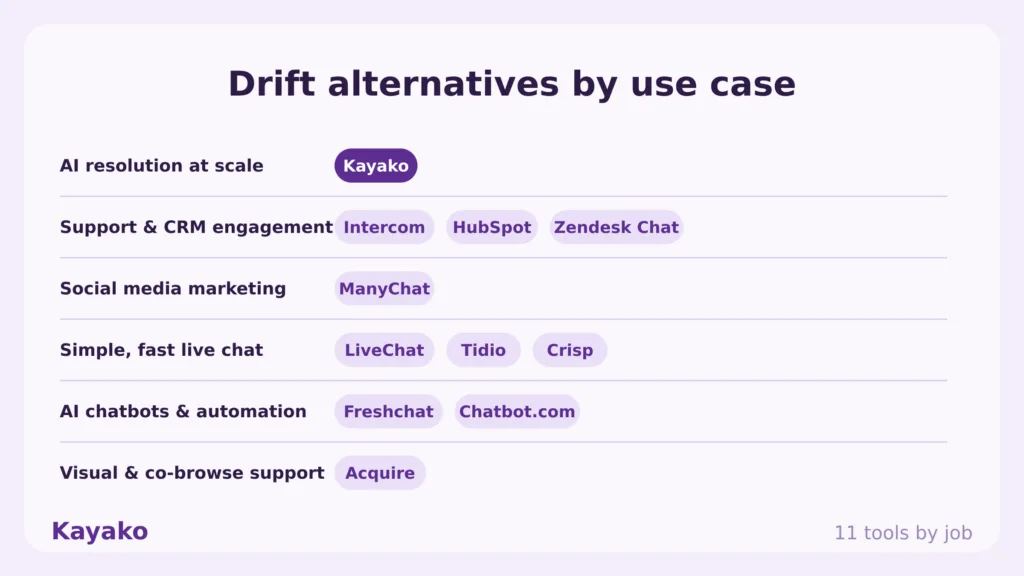
1. Kayako: Best for autonomous customer support at scale
IMAGE: Kayako SingleView product screenshot (existing /uploads/2025/08/03-single-view.webp). Insert at the top of this section.
Kayako is the number one pick for teams that left Drift because support and conversation volume, not lead capture, became the real bottleneck. It is an autonomous resolution platform built around Agent Kay, which deploys into your existing help desk and resolves tickets across every channel rather than handing each one to a rep.
Key features
- Autonomous resolution. Agent Kay targets 80% and above resolution across email, live chat, voice, and social, so routine volume never reaches an agent.
- Every conversation carries a unified customer timeline instead of a thin contact record, which is the context Drift never gave support teams.
- AI Triage. Auto-classifies, prioritizes, and routes tickets through automation workflows, removing the manual sorting that fills a queue.
- Omnichannel coverage. One platform spans social and e-commerce support, plus a knowledge base and integrations that keep answers consistent.
Pros
- Built for autonomous resolution from the ground up, so the system gets cheaper per ticket as volume grows instead of more expensive. That is the opposite of the per-seat and per-resolution math that punishes scale elsewhere.
- Kayako is deployed for you, not left as a configuration project. A team that just spent weeks tuning Drift playbooks will notice the difference immediately.
- Per-resolution pricing ties cost to outcomes, and a Backlog Breakthrough Guarantee returns your fee if there are no measurable results, which lowers the risk of switching.
Cons
- Kayako is built for support operations, not for running Instagram or website-only sales funnels. A pure lead-gen team should pair it with a sales tool rather than expect it to replace Drift’s pipeline features.
- It earns its value at real ticket volume. A very small team with a handful of monthly conversations will not stress-test the autonomous engine enough to see the full return.
Pricing: A 90-day pilot from $15K including platform and services, then $79 per seat plus $1 per AI-resolved ticket. See Kayako pricing.
Rating: 4.7/5 from 100+ G2 reviews.
Versus Drift: Drift was built to start sales conversations and book meetings. Kayako resolves support conversations end to end and learns from each one. If your pain is ticket backlog, rising cost per contact, and slow replies, Kayako is the direct upgrade, and you can see the head-to-head on the Compare Kayako page.
Scale support without new headcount Get Started >
2. Intercom: Best for product-led support with AI resolution
Intercom blends a support inbox, in-app messaging, and its Fin AI agent into one platform. It fits product-led businesses that guide users through onboarding and want AI to close repetitive tickets.
Key features
- Fin AI agent. Resolves conversations autonomously and connects to existing help desks like Zendesk and Salesforce.
- Unified inbox. Email, chat, and in-app messages in one workspace with strong segmentation.
- Workflow automation. Multi-step procedures and routing for common support paths.
- Outbound messaging. Product tours and proactive messages tied to user behavior.
Pros
- Fin genuinely resolves tickets, with public case studies citing 50% to 67% automation, so the AI is doing real work rather than deflecting to an article.
- The Messenger experience is polished and customers actually engage with it, which lifts the percentage of issues the AI ever gets a chance to solve.
Cons
- Cost compounds in a way that surprises teams. Seats run $29 to $132 each, then every Fin resolution adds $0.99 on top, so a busy month raises your usage bill rather than your plan, and reviewers repeatedly flag unpredictable spend at volume.
- Useful analytics like CX scoring sit behind a higher Pro add-on, and annual contracts can lock you in for twelve months, which stings if the model does not fit.
Pricing: Essential from $29/seat/mo, Advanced $85/seat/mo, Expert $132/seat/mo, plus $0.99 per Fin resolution with a 50-resolution monthly minimum. See Intercom pricing.
Rating: 4.5/5 on G2.
Versus Drift: Intercom delivers far deeper support and product messaging than Drift, with AI resolution Drift never matched. The trade is a pricing model that climbs with your success, so model your real resolution volume before committing.
3. Qualified: Best for enterprise Salesforce conversational sales
Qualified is the closest like-for-like replacement for what Drift did best, which is converting website traffic into pipeline. Its Piper AI SDR engages visitors, qualifies against live Salesforce data, and books meetings around the clock.
Key features
- Piper AI SDR. Holds real generative conversations, handles objections, and books meetings without a rep online.
- Salesforce-native. Built by former Salesforce executives, it uses live CRM data to personalize and route by account ownership.
- Multi-modal engagement. Chat, voice, and video on the website, with AI-generated follow-up email.
- Pipeline analytics. Reporting focused on meetings booked and influenced pipeline.
Pros
- The conversation quality is the strongest in the category. Reviewers note that visitors often cannot tell they are talking to AI, which is why it carries the highest satisfaction score among conversational platforms.
- For Salesforce-centric revenue teams, the native integration removes the data gaps and manual logging that slow most chatbots, so qualification happens against real account context.
Cons
- It is inbound and website-only, with no outbound sequences, dialer, or prospecting. It converts the small share of visitors who start a chat and never touches the buyers who leave silently.
- Pricing is enterprise-only, roughly $40K to $68K per year before the required Salesforce stack, which puts total cost into six figures and rules it out for SMBs and non-Salesforce teams.
Pricing: Custom, with Premier reported from about $40,000 per year and enterprise deployments reaching $90K and above. See Qualified.
Rating: 4.9/5 across 1,400+ G2 reviews.
Versus Drift: Qualified is the natural home for Drift sales teams that are deep in Salesforce and have the budget. It does the inbound conversion job with stronger AI, though it leaves outbound and non-Salesforce stacks to other tools.
4. HubSpot: Best for CRM-native chat and chatbots
HubSpot’s conversational tools shine when you already use its CRM. Every chat becomes part of the contact record, and the newer Breeze customer agent resolves common inquiries automatically.
Key features
- Native CRM context. Chats personalize against full HubSpot contact and deal data.
- Free chatflows. A rule-based chatbot and live chat are available on the free tier with HubSpot branding.
- Breeze customer agent. AI resolution on higher Service Hub tiers, billed on resolution.
- Cross-team reporting. Track a customer from marketing touch to support ticket in one system.
Pros
- If your stack is already HubSpot, the value is immediate because chat, CRM, and reporting share one data layer, and 91% of users on G2 report getting comfortable within a month.
- The free chatflow builder lets a small team start without spend, and Breeze adds outcome-based AI only when you need it.
Cons
- The value is concentrated inside the HubSpot ecosystem. Outside it, you are paying for integration depth you cannot use, and Professional jumps to $90 per seat plus a $1,500 onboarding fee.
- Ticketing is built for simpler setups. High-volume support teams report clunky merging and lag, which is why support-first buyers often compare it against a dedicated help desk.
Pricing: Free chatflows; Service Hub Starter ~$15/seat/mo, Professional $90/seat/mo plus a $1,500 onboarding fee, Enterprise $150/seat/mo with a 10-seat minimum. See HubSpot pricing.
Rating: 4.4/5 on G2.
Versus Drift: HubSpot ties your chatbot to your entire CRM, which Drift never did as cleanly outside Salesforce. It is the better choice for HubSpot shops and a weaker one for everyone else.
5. Zendesk: Best for enterprise support and ticketing
Zendesk is the mature help desk choice, built from day one around ticketing, routing, and large-scale support automation, now with outcome-based AI resolution.
Key features
- Deep ticketing. Custom views, macros, triggers, SLAs, and multi-brand support that high-volume teams rely on.
- AI agents. Automated Resolutions confirm a fix after 72 hours of inactivity before billing.
- Omnichannel inbox. Email, chat, phone, and social in one agent workspace.
- Mature reporting. Out-of-the-box dashboards for volume, response time, and CSAT.
Pros
- Support depth is the standout. Granular SLA management, side conversations, and reliable routing make it dependable at large volume, which is where lighter tools fall over.
- The bot-to-agent handoff keeps context intact, so escalations do not force the customer to repeat themselves.
Cons
- AI cost is layered and adds up fast. The real automation lives in an Advanced AI add-on at $50 per agent per month, then automated resolutions bill $1.50 to $2.00 each, so a thousand monthly AI interactions can run well over a thousand dollars on top of seats.
- The platform is heavier to administer than SMB tools, so a small team often pays for configuration depth it will not use.
Pricing: Suite Team from $55/agent/mo up to Enterprise $169/agent/mo, plus the Advanced AI add-on at $50/agent/mo and automated resolutions at $1.50 to $2.00 each. See Zendesk pricing.
Rating: 4.3/5 on G2.
Versus Drift: Zendesk dwarfs Drift on support and ticketing, which is the job most ex-Drift teams actually need filled. Budget for the AI add-ons separately, because the headline seat price is only part of the bill.
6. Tidio: Best for e-commerce live chat and chatbots
Tidio pairs a clean live chat widget with chatbots and its Lyro AI agent, which makes it a favorite for Shopify and WooCommerce stores that want support and sales in one inbox.
Key features
- Lyro AI agent. Answers recurring questions from your own content with natural replies.
- Visual Flows builder. Drag-and-drop automation with ready-made templates.
- E-commerce integrations. Native Shopify, WooCommerce, and BigCommerce support.
- No per-seat core. Add operators on the support plan without per-seat fees.
Pros
- Setup is genuinely fast and the human-to-bot handoff is smooth, which is why small e-commerce teams launch in a day and keep a high G2 score.
- Not charging per agent on the core plan keeps small-team costs predictable, a real contrast with seat-based rivals.
Cons
- Billing splits into three meters: billable conversations, Lyro AI conversations, and flow triggers, so the effective monthly cost is hard to forecast.
- The plan ladder has a cliff. It jumps from Growth at $59 straight to Plus at $749 with nothing in between, and a 10-seat cap on self-service plans, so scaling teams can hit a wall fast.
Pricing: Free; Starter $29/mo, Growth $59/mo, Plus from $749/mo, with the Lyro AI add-on from $39/mo. See Tidio pricing.
Rating: 4.6/5 across 1,800+ G2 reviews.
Versus Drift: Tidio beats Drift for website support and AI-assisted replies at SMB prices. Drift still wins for enterprise pipeline routing, which Tidio does not attempt.
7. Freshchat: Best for omnichannel messaging on a budget
Freshchat, from Freshworks, is a messaging-first platform that spans web, mobile, and social channels, with a generous free tier and tight links to the rest of the Freshworks suite.
Key features
- Freddy AI. Context-aware bots and agent copilot across channels.
- Team inbox. Chat, email, WhatsApp, Instagram, and Messenger in one view.
- Proactive messaging. Behavior-based triggers to engage at the right moment.
- Freshworks fit. Clean ties to Freshdesk and Freshsales for a fuller stack.
Pros
- The free plan covers up to 10 agents, which is rare among seat-based tools and lets a real team start without spend.
- Per-agent pricing is simple to explain internally, and the interface stays light compared with heavier enterprise suites.
Cons
- The all-in cost is not just the seat fee. Freddy AI agent sessions bill around $0.49 each with extra usage on top, so automation-heavy teams should track session volume.
- AI depth and channel breadth trail Intercom and Zendesk, so larger operations can outgrow it once support gets complex.
Pricing: Free for up to 10 agents; Growth from $19/agent/mo, Pro from $49/agent/mo, Enterprise from $79/agent/mo on annual billing, plus Freddy AI sessions. See Freshchat pricing.
Rating: 4.4/5 across 490+ G2 reviews.
Versus Drift: Freshchat gives you omnichannel messaging and a free starting tier Drift cannot match on price. It is lighter on AI resolution, so weigh that against your automation goals.
8. LiveChat: Best for simple, reliable website live chat
LiveChat earns its reputation on reliability and ease. It is a focused, agent-led live chat tool that teams set up quickly and trust to stay up.
Key features
- Polished chat widget. Deep customization of themes, branding, and routing.
- Goal and analytics tracking. Measure support and sales outcomes inside chats.
- Ticketing and integrations. Connects to help desks and a large app marketplace.
- Staffing predictions. Forecasts chat volume to plan agent coverage.
Pros
- Reliability and onboarding speed are the consistent praise on G2, so a non-technical team is live and answering within a day.
- The interface is clean and agent-led, which suits teams that value human conversation quality over heavy automation.
Cons
- Automation is a separate purchase. AI lives in the sibling ChatBot product, so any team that wants real bot deflection pays for a second subscription.
- Seat-based billing means cost rises with every agent you add, and the deepest analytics sit on higher tiers.
Pricing: Three editions from $19 to $79 per seat per month, with ChatBot sold separately. See LiveChat pricing.
Rating: 4.5/5 on G2.
Versus Drift: LiveChat is simpler and far cheaper than Drift for human-led website chat. It is not trying to be a sales SDR or an AI resolution engine, so pair it with one if you need either.
9. Landbot: Best for no-code conversational landing pages
Landbot replaces static forms with conversational flows on web, WhatsApp, and Messenger. It is built for marketing teams that want to capture and qualify leads through interactive chat without engineering help.
Key features
- No-code builder. Drag-and-drop branching logic with a hybrid of structured flows and native AI steps.
- Conversational landing pages. Full-page chat experiences that lift form completion.
- Multi-channel deploy. Web, WhatsApp, and Messenger from one build.
- Two-way connections to Salesforce, HubSpot, Zapier, and Google Sheets.
Pros
- Reviewers rate it well above Drift on ease of use, setup, and product direction, so a marketer can ship a working flow the same afternoon.
- The hybrid model gives you structured control plus AI flexibility, which avoids both rigid scripts and unpredictable free-form bots.
Cons
- AI and WhatsApp pricing climb quickly. The Starter plan includes only a small AI-chat allowance, and overages bill per chat, so heavy AI use gets expensive fast.
- It is text-only with no voice or phone, and native support depth is limited, so it complements a help desk rather than replacing one.
Pricing: Free forever plan; Starter from $46/mo, Pro from about $105/mo, Business custom, with a separate WhatsApp track. See Landbot pricing.
Rating: 4.7/5 across 330+ G2 reviews.
Versus Drift: Landbot wins for lead-capture experiences and is dramatically easier and cheaper than Drift. It does not handle support resolution, so treat it as a marketing front door.
10. Crisp: Best for SMB shared inbox and chat
Crisp consolidates chat, email, and social into one tidy shared inbox at a flat price, which makes it a practical pick for small and growing teams that want everything in one place.
Key features
- Unified inbox. Email, chat, and social messages in a single interface.
- Flat-rate pricing. Unlimited conversations on paid plans instead of per-conversation meters.
- Chatbots and campaigns. Basic automation and targeted messaging across channels.
- Knowledge base. Built-in self-service to deflect repeat questions.
Pros
- Flat unlimited-conversation pricing is a relief after Tidio-style meters or Intercom’s per-resolution model, so the bill stays the same as volume rises.
- The interface is genuinely simple, which is exactly what a small team wants when nobody has time to administer a heavy platform.
Cons
- AI depth is limited compared with Intercom, Zendesk, or Kayako, so it suits straightforward support more than complex resolution.
- It is built for SMB scale, so the routing, SLAs, and reporting that large operations need are thinner here.
Pricing: Free plan; paid plans from about $25/mo per workspace with unlimited conversations. See Crisp pricing.
Rating: 4.5/5 on G2.
Versus Drift: Crisp is the budget-friendly, low-admin alternative to Drift for small teams. It will not match Drift’s enterprise sales routing, and it does not try to.
Kayako vs Drift: a feature-by-feature comparison
Since Kayako is the top pick for teams that outgrew Drift on support, here is the head-to-head.
|
Feature |
Drift |
Kayako |
|
Primary use case |
B2B conversational sales and lead capture |
Autonomous customer support resolution |
|
Conversation type |
Playbook and bot flows with rep handoff |
AI resolution with human escalation |
|
Channels |
Website chat and email, Salesforce-centric |
Email, live chat, voice, social, and your existing help desk |
|
Customer context |
CRM fields and visitor data |
SingleView unified customer timeline |
|
Triage and routing |
Account-based routing to reps |
AI Triage auto-classifies and routes |
|
Pricing model |
Enterprise tiers from $2,500/mo |
$79 per seat plus $1 per AI-resolved ticket |
|
Implementation |
Weeks of playbook configuration by your team |
Done-for-you deployment into your help desk |
|
Platform direction |
Reduced investment after Salesloft and Clari consolidation |
Active development focused on resolution |
|
Best fit |
Enterprise sales teams on Salesforce with budget |
Mid-market teams scaling support without headcount |
The takeaway is simple. Drift asks your team to build and staff every conversation path for sales. Kayako resolves real support conversations for you and improves with each one.
Resolve 80% of repeat tickets Book Session >
Reviews: what real users say
Where reviewers praise these tools
Across G2 and Capterra, reviewers consistently praise Tidio and LiveChat for ease of use, Qualified for conversation quality, Intercom for Fin’s resolution speed, and Zendesk for support depth. Kayako reviewers single out the done-for-you deployment and the measurable drop in backlog and cost per ticket.
Where reviewers raise concerns
The complaints rhyme across the category. Per-resolution and per-contact pricing surprises teams as volume grows, enterprise tools carry steep setup and learning curves, and flow-based bots break when a conversation goes off-script. These themes track the broader data, since 73% of consumers are turned off by slow replies and more than half have abandoned a purchase over lagging responses. Speed and resolution, not playbook length, decide satisfaction.
How to switch from Drift without losing momentum
Migrating off Drift is straightforward when you sequence it. Use this checklist.
- Audit your Drift access logs from August 2025. If you ran the Salesforce integration during the incident window, rotate tokens and review activity before anything else.
- Map the jobs Drift actually does for you. List the flows, routing rules, and meeting paths that drive real outcomes, then retire the rest.
- Export contacts and conversation history. Keep your audience and context intact for the new platform.
- Pick by job, not by hype. Use the at-a-glance table to match the tool to your bottleneck, support or sales.
- Reconnect your channels. Link your website, email, and CRM, and rebuild only the high-value flows first.
- Run both in parallel briefly. Validate results, then sunset Drift to avoid double-handling conversations.
How to choose the right Drift alternative
The best tool removes your biggest bottleneck. Be honest about which job you are replacing.
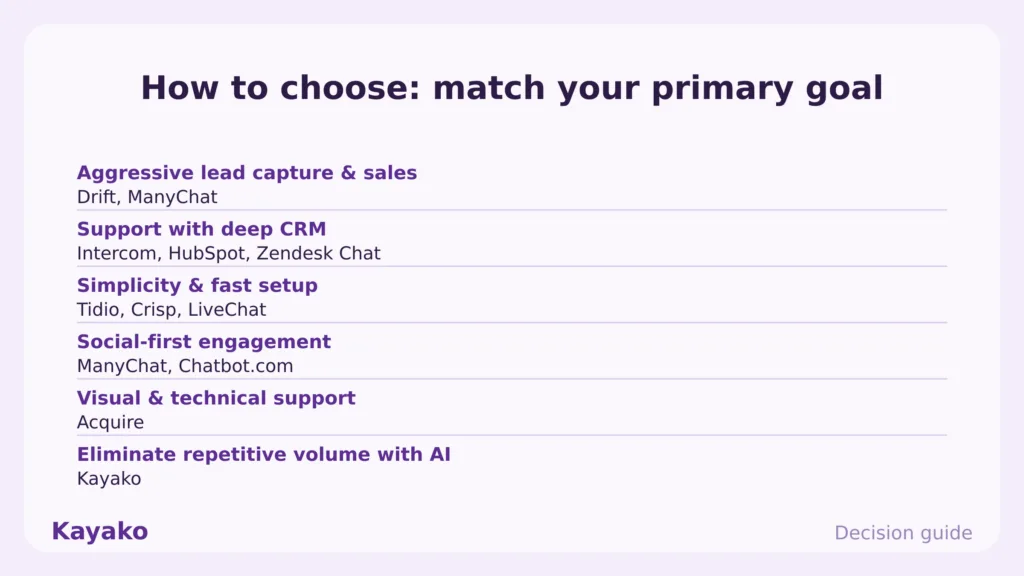
- Primary goal. Resolving support volume points to Kayako, Zendesk, or Intercom. Converting website traffic into pipeline points to Qualified or HubSpot.
- Existing stack. Salesforce-heavy teams lean Qualified or Intercom. HubSpot shops get the smoothest path from HubSpot’s own tools.
- Complexity and budget. Tidio, Crisp, and LiveChat win on simplicity and price. Zendesk and Qualified suit larger teams with deeper requirements.
- True cost at scale. Watch per-resolution and per-contact meters. Kayako’s per-resolution model and Crisp’s flat rate are the most predictable as volume grows.
Which Drift alternative should you pick
Start with the job, not the feature list. The right answer depends on what you are actually trying to do.
- Customer support at scale. Choose Zendesk or Intercom if your support is enterprise-heavy or product-led.
- Enterprise sales pipeline. Qualified on Salesforce, HubSpot if you live in the HubSpot stack.
- E-commerce chat. Tidio for Shopify and WooCommerce stores that want chat plus light AI.
- Lead-capture flows. Landbot for conversational landing pages without code.
- Simple, low-admin chat. LiveChat for agent-led chat, Crisp for a flat-rate shared inbox.
The bottom line
Drift defined conversational marketing, and it was good at starting sales conversations. In 2026, the platform sits inside a larger revenue suite with reduced investment, a security incident in its recent history, and a price floor that prices out most teams. The job most companies leaving Drift actually need filled is not lead capture, it is resolving rising support and conversation volume without adding headcount.
For B2B sales on Salesforce, Qualified is the cleanest like-for-like move. For support-first teams, the strongest answer is Kayako, because it resolves real conversations end to end and aligns cost with outcomes. Pick the tool that removes your bottleneck, then move before your current platform makes the decision for you.
Start a 90-day Kayako pilot
Frequently asked questions
What is the best Drift alternative in 2026?
It depends on the job. For autonomous customer support at scale, Kayako is the strongest alternative. For B2B conversational sales on Salesforce, Qualified leads the category.
Is Drift shutting down?
Drift is still operational, but reports indicate it is being gradually phased out inside the Salesloft and Clari revenue suite, with reduced long-term investment. There is no confirmed hard end-of-life date, however active development has slowed, so most teams are planning a migration rather than waiting.
Why is Drift so expensive?
Drift prices for enterprise sales teams, with an entry point around $2,500 per month and minimums reported above $30,000 per year. Mid-market and SMB teams usually find an alternative like Tidio, Crisp, or Kayako delivers the job they need at a fraction of the cost.
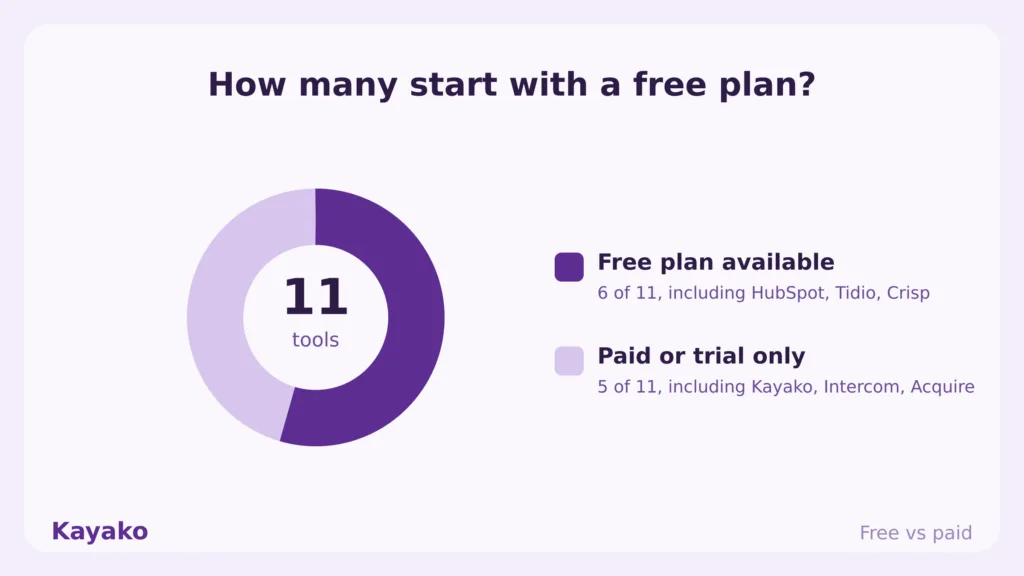
What is the best free Drift alternative?
Freshchat offers a free plan for up to 10 agents, HubSpot includes free chatflows, and Tidio, Landbot, and Crisp all offer free tiers to start. None match Drift’s enterprise sales features, though most teams do not need them.
Does Kayako replace Drift?
For customer support, yes. Kayako resolves tickets across email, live chat, voice, and social, which Drift did not do. For pure website lead capture and meeting booking, a sales-native tool like Qualified is the closer match.
Ready to transform your customer support with AI?
Join hundreds of support teams using Kayako to resolve tickets faster, raise CSAT, and scale without scaling headcount.
Move off Drift the right way