Zendesk became the default help desk for a reason. It covers every channel, the marketplace holds more than 1,500 apps, and most agents have used it at some point in their careers. For large teams with a dedicated admin, it still works.
Then the renewal quote arrives. The AI features cost extra. The workflows need a specialist to maintain. Meanwhile, the bot deflects tickets instead of resolving them, and your agents still answer the same password reset forty times a week.
That is the moment teams start searching for a Zendesk alternative. Some want a simpler help desk. Some want a cheaper one. However, a growing number want something Zendesk was never designed to do, which is to resolve customer support tickets autonomously instead of routing them faster.
I run support operations, and I have sat through this evaluation more times than I would like. So I tested 12 alternatives across the full range, scored them on the same six criteria, and organized this guide by use case. Jump straight to the tool that matches your bottleneck.
The timing matters. 75% of CX leaders expect 80% of customer interactions to be resolved without a human agent within a few years, according to Zendesk CX Trends research. Gartner projects that conversational AI will cut contact center labor costs by $80 billion by 2026. The platform you choose now should be built for that outcome.
See Kayako resolve tickets autonomously Book Session >
How I tested these Zendesk alternatives
I did not rank these from marketing pages. I signed up for trials, imported sample ticket queues, configured automations, and connected the integrations a mid-market team actually runs.
I scored every platform on six things:
- Resolution, not deflection. Does the AI close tickets end to end, or does it send an article and hope.
- Time to value. How long from signup to a working help desk, without a consultant.
- Total cost at scale. Real cost per agent per month once AI, add-ons, and usage fees stack up.
- Channel coverage. Email, chat, voice, and social handled natively, with one customer record.
- Workflow depth. Routing, SLAs, triage, and automation that survive real ticket volume.
- Resolution rate, CSAT, and cost per ticket, visible without a BI project.
I also weighted pricing transparency. Surprise add-on fees were the single most common complaint across G2, Capterra, and Reddit reviews of Zendesk itself.
Zendesk alternatives at a glance
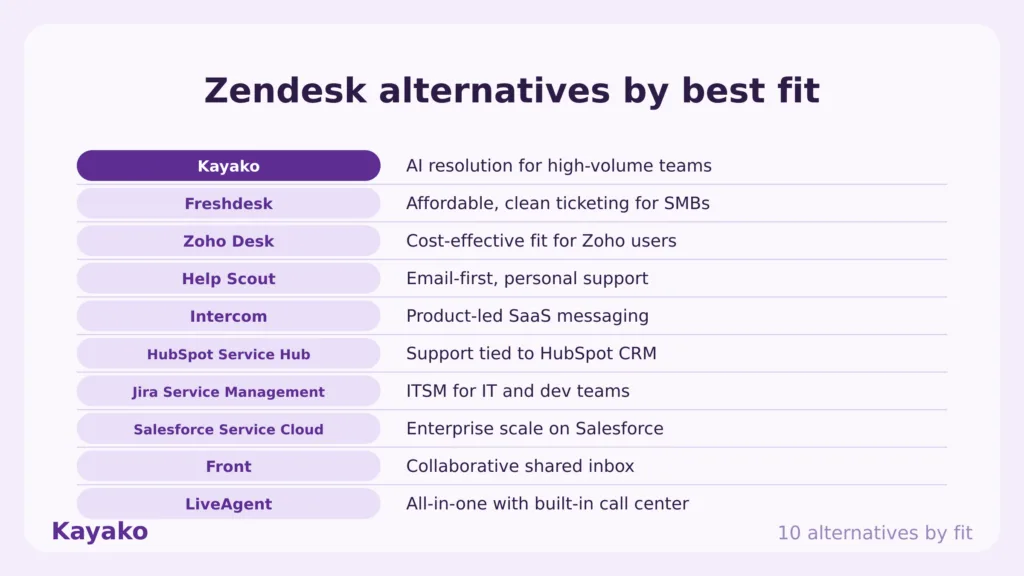
Here is the full shortlist before the in-depth reviews. Kayako leads because it removes the problem most teams are switching to escape, which is paying more every year to manage tickets that software should resolve.
|
Tool |
Rating |
Best for |
Starting price |
Free plan |
AI |
|
Kayako |
4.7 |
Autonomous support resolution at scale |
$79/seat + $1 per resolved ticket |
No |
Yes |
|
Freshdesk |
4.4 |
SMB and mid-market simplicity |
Free; from $15/agent/mo |
Yes |
Yes |
|
Intercom |
4.5 |
Product-led, in-app messaging |
From $29/seat/mo |
Trial |
Yes |
|
Help Scout |
4.4 |
Email-first small teams |
Free; from $50/mo |
Yes |
Yes |
|
Zoho Desk |
4.4 |
Budget teams in the Zoho ecosystem |
Free; from $14/agent/mo |
Yes |
Yes |
|
HubSpot Service Hub |
4.4 |
CRM-connected support |
Free; from $20/seat/mo |
Yes |
Limited |
|
Front |
4.7 |
Collaborative shared inboxes |
From $19/seat/mo |
Trial |
Basic |
|
Gorgias |
4.6 |
E-commerce stores |
From $10/mo |
Trial |
Yes |
|
Kustomer |
4.4 |
CRM-style customer timelines |
From $89/user/mo |
No |
Yes |
|
Salesforce Service Cloud |
4.4 |
Enterprises on Salesforce |
From $25/user/mo |
Trial |
Yes |
|
Jira Service Management |
4.2 |
IT and internal service desks |
Free; from $19/agent/mo |
Yes |
Limited |
|
Tidio |
4.7 |
Chat-first small businesses |
Free; from $24.17/mo |
Yes |
Yes |
Why look for a Zendesk alternative
Zendesk is a capable platform. It also carries structural costs that push growing teams to look elsewhere.
- AI is priced as an add-on. Advanced AI, quality assurance, and workforce tools each carry their own per-agent fee on top of the Suite. Costs compound as you adopt the features that matter most.
- Configuration burden. Triggers, automations, and views are powerful, yet they demand a trained admin. Many teams end up paying a consultant to maintain their own help desk.
- Deflection instead of resolution. The default AI motion suggests articles and routes tickets. The ticket still lands on an agent, so headcount still scales with volume.
- Renewal pricing pressure. Discounted first-year contracts reset at list price. Reviewers consistently describe steep increases at renewal.
- Fragmented customer context. Customer history lives across apps, side conversations, and integrations rather than in one timeline.
The market is moving against that model. 78% of organizations now use AI in at least one business function, according to McKinsey, and support is one of the highest-return places to apply it. Moreover, 90% of customers rate an immediate response as important or very important when they have a question, per HubSpot research. A help desk that only organizes the queue cannot deliver that on its own.
What real users say about Zendesk (community sentiment)
- “The renewal doubled.” The most common thread is pricing. One widely quoted Reddit post describes a bill climbing to around $5,000 per month before add-ons as the team grew to a couple dozen agents, with switching framed as tens of thousands in annual savings.
- “You need an admin just to run it.” Support managers describe weeks of trigger and automation setup, and ongoing maintenance whenever workflows change. One Reddit user notes that switching means auditing and rebuilding every integration, which keeps frustrated teams locked in. S
- “The AI add-ons changed the math.” Threads on Advanced AI pricing point out the $50 per agent per month fee plus per-resolution charges stacking on the Suite. The complaint matches the broader review record, where Zendesk holds 4.3/5 across 6,800+ G2 reviews with pricing as the dominant negative theme.
- Where Redditors send each other. Freshdesk and Zoho Desk come up for budget moves, Help Scout for small teams, FreeScout for open source, and AI-first resolution platforms for teams trying to cap headcount. That split maps to the use cases below.
The 12 best Zendesk alternatives in 2026
Each tool below is rated for a specific job. Match the tool to your bottleneck, not to the longest feature list.
1. Kayako: Best for autonomous support resolution at scale
Kayako is the number one alternative for teams leaving Zendesk because cost and backlog grew faster than headcount could. It is an autonomous resolution platform rather than another ticketing layer. It deploys into your existing stack and resolves tickets across every channel.
Key features
- Agent Kay resolves tickets autonomously across email, live chat, voice, and social
- SingleView gives every conversation a unified customer timeline instead of scattered context
- AI Triage auto-classifies, prioritizes, and routes tickets through automation workflows
- Omnichannel support that covers social media and e-commerce
- A knowledge base and integrations that keep answers consistent and connected
Pros: Built for autonomous resolution, targeting 80% and above. Deployed for you rather than left for you to configure. Per-resolution pricing ties cost to outcomes instead of seats.
Cons: Built for support operations rather than marketing campaigns. Best suited to teams with real ticket volume.
Pricing: 90-day pilot from $15K including platform and services, then $79 per seat plus $1 per AI-resolved ticket. See pricing. A Backlog Breakthrough Guarantee returns your fee if there are no measurable results.
Rating: 4.7/5 from 100+ G2 reviews. Read more on the Kayako reviews page.
Proof: Contently moved to Kayako and reached 68% autonomous resolution with a 91-second first response time. The full story is on the customers page.
Versus Zendesk: Zendesk organizes tickets and charges per agent plus AI add-ons. Kayako resolves tickets and charges $1 when it does. If your pain is backlog, rising per-agent costs, and slow replies, the comparison is short. See the Compare Kayako page for the head-to-head.
Scale support without adding headcount Talk to Expert >
2. Freshdesk: Best for SMB and mid-market simplicity
Freshdesk is the most direct like-for-like swap. It covers ticketing, automation, and a knowledge base in a cleaner interface, and Freddy AI handles suggestions and routing without enterprise setup.
Key features
- Multi-channel ticketing across email, chat, phone, and social
- Freddy AI for reply suggestions, summaries, and routing
- SLA management and collision detection
- Marketplace with 1,000+ integrations
Pros: Fast setup. Generous free tier. Familiar model for agents coming from Zendesk.
Cons: Advanced reporting and AI sit on higher tiers. Performance complaints appear at high ticket volume.
Pricing: Freshdesk is free for small teams, with paid plans from $15 per agent per month.
Rating: 4.4/5 on G2
Versus Zendesk: Freshdesk delivers most of the Suite for less money and less configuration. It shares the same core model, so agents still touch most tickets. Compare more options in the Freshdesk alternatives guide.
3. Intercom: Best for product-led, in-app messaging
Intercom pairs a polished support inbox with in-app messaging and the Fin AI agent. SaaS companies that guide users through onboarding inside the product get the most from it.
Key features
- Fin AI agent for automated resolutions
- In-app messages, product tours, and checklists
- Multi-channel inbox with advanced segmentation
- Deep API and developer tooling
Pros: Excellent product experience. Strong AI resolution rates. Best-in-class in-app messaging.
Cons: Seat fees plus per-resolution Fin fees stack quickly. Costs are hard to forecast at volume.
Pricing: Intercom starts at $29 per seat per month on annual billing, with Fin priced separately per resolution.
Rating: 4.5/5 on G2
Versus Zendesk: Intercom feels modern where Zendesk feels administrative, and its AI is further ahead. However, the pricing model trades one cost problem for another. The Intercom alternatives guide covers that trade in depth.
4. Help Scout: Best for email-first small teams
Help Scout keeps support feeling like email. Shared inboxes, Docs for self-service, and the Beacon widget cover what a small team needs without a single trigger to configure.
Key features
- Shared inboxes with collision detection, similar in spirit to an AI shared inbox
- Docs knowledge base to cut repeat questions
- Beacon widget for chat and article suggestions
- AI drafts and summaries on paid plans
Pros: Genuinely easy to run. Well-loved support team. Predictable pricing.
Cons: Reporting is shallow for larger teams. No native voice. Outgrown quickly past 20 agents.
Pricing: Help Scout offers a free plan, with paid plans from $50 per month.
Rating: 4.4/5 on G2
Versus Zendesk: Help Scout wins on simplicity and loses on depth. Teams that never use Zendesk’s advanced features will not miss them. See the Help Scout alternatives guide for adjacent options.
5. Zoho Desk: Best for budget teams in the Zoho ecosystem
Zoho Desk delivers a surprising share of Zendesk’s feature set at a fraction of the price, and it connects natively to the rest of the Zoho suite. Zia, its AI layer, handles sentiment, tagging, and reply assistance.
Key features
- Omnichannel ticketing with built-in telephony
- Zia AI for sentiment analysis and routing
- Blueprint workflow builder
- Native links to Zoho CRM, Books, and Analytics
Pros: Strong value. Scales across the Zoho suite. Free tier for three agents.
Cons: Interface feels dated in places. Support quality reviews are mixed.
Pricing: Zoho Desk is free for up to three agents, with paid plans from $14 per agent per month.
Rating: 4.4/5 on G2
Versus Zendesk: Zoho Desk costs roughly a quarter of the Suite and covers the essentials. Enterprise workflow depth is thinner. The Zoho Desk alternatives guide compares its closest rivals.
6. HubSpot Service Hub: Best for CRM-connected support
Service Hub makes sense when your company already runs on HubSpot. Tickets, chat, and feedback live on the same record as marketing and sales activity, so every agent sees the full relationship.
Key features
- Ticketing tied directly to HubSpot CRM records
- Live chat, bots, and a shared inbox
- Customer feedback surveys and health scoring
- Breeze AI assistance on higher tiers
Pros: One customer record across the funnel. Free tier to start. Clean reporting.
Cons: Real support depth requires Professional at $90 per seat. Value depends on staying in HubSpot.
Pricing: HubSpot Service Hub starts free, with paid seats from $20 per month.
Rating: 4.4/5 on G2
Versus Zendesk: Service Hub trades Zendesk’s support depth for CRM context. For HubSpot-native companies that trade often pays off. The HubSpot Service Hub alternatives guide goes further.
7. Front: Best for collaborative shared inboxes
Front treats customer messages as conversations rather than tickets. Teams comment internally on the same thread, assign owners, and keep email, chat, and SMS in one place.
Key features
- Shared inboxes with internal comments on every thread
- Rules engine for routing and SLAs
- Email, chat, SMS, and social in one view
- Analytics on response time and workload
Pros: Natural for teams that live in email. Strong collaboration. Quick adoption.
Cons: AI capabilities are basic. Less suited to high-volume consumer support.
Pricing: Front starts at $19 per seat per month.
Rating: 4.7/5 on G2
Versus Zendesk: Front removes the ticket metaphor entirely, which many B2B teams prefer. It does not try to automate resolution, so volume still equals headcount.
8. Gorgias: Best for e-commerce stores
Gorgias is built for Shopify-first brands. It pulls order data into every conversation, automates the classics like order status and returns, and prices by ticket volume rather than seats.
Key features
- Deep Shopify, BigCommerce, and Magento integrations
- AI Agent for automated order and return queries
- Revenue attribution on support conversations
- Social comment and DM management
Pros: Order context inside every ticket. Strong automation for commerce queries. Volume pricing suits seasonal stores.
Cons: Narrow outside e-commerce. Costs climb at high ticket counts.
Pricing: Gorgias starts at $10 per month for 50 tickets.
Rating: 4.6/5 on G2
Versus Zendesk: For an online store, Gorgias out-executes Zendesk on day one because the order data is already there. For anything beyond commerce it runs out of road.
9. Kustomer: Best for CRM-style customer timelines
Kustomer, independent again after its Meta chapter, organizes support around the customer rather than the ticket. Every interaction lands on one chronological timeline.
Key features
- Timeline view of every customer interaction
- AI agents for automated conversations
- Omnichannel routing with skills-based assignment
- Native CRM objects and custom data
Pros: Genuine single customer view. Strong for high-volume B2C. Flexible data model.
Cons: Premium pricing. Implementation takes real effort.
Pricing: Kustomer starts at $89 per user per month.
Rating: 4.4/5 on G2
Versus Zendesk: Kustomer solves the fragmented-context problem Zendesk creates. Kayako’s SingleView delivers the same timeline concept with autonomous resolution attached. See the Kustomer alternatives guide for that comparison.
10. Salesforce Service Cloud: Best for enterprises on Salesforce
Service Cloud is the heavyweight option. Agentforce AI agents work directly against your CRM data, and the platform scales to thousands of agents with enterprise governance.
Key features
- Agentforce autonomous AI grounded in Customer 360 data
- Case management with enterprise routing
- Field service and voice as native modules
- Deep platform customization
Pros: Unmatched scale. AI uses the same data as sales and marketing. Enterprise compliance.
Cons: Cost and complexity dwarf Zendesk. Requires admin and developer resources.
Pricing: Salesforce Service Cloud starts at $25 per user per month, with enterprise tiers from $165.
Rating: 4.4/5 on G2
Versus Zendesk: Service Cloud makes sense when Salesforce is already your system of record. Otherwise you inherit a bigger version of the same admin burden you are trying to leave.
11. Jira Service Management: Best for IT and internal service desks
Jira Service Management is the strongest pick when the queue is internal. Incident, change, and asset management connect directly to the engineering backlog in Jira.
Key features
- ITSM workflows for incident and change management
- Native link between tickets and Jira issues
- Asset and configuration management
- On-call alerting through Opsgenie heritage
Pros: Ideal for IT teams. Free for three agents. Tight engineering loop.
Cons: Customer-facing support feels secondary. Atlassian admin skills required.
Pricing: Jira Service Management is free for up to three agents, then from roughly $19 per agent per month.
Rating: 4.2/5 on G2
Versus Zendesk: For an internal IT desk, JSM beats Zendesk on engineering integration. For external customer support, Zendesk remains the more natural fit of the two.
12. Tidio: Best for chat-first small businesses
Tidio combines a clean live chat widget with the Lyro AI agent, and it answers a large share of routine questions for small stores and service businesses at low cost.
Key features
- Live chat with smooth bot-to-human handoff
- Lyro AI agent trained on your content
- Shopify and WooCommerce integrations
- Simple ticketing layered on chat
Pros: Generous free plan. Fast setup. Strong small-business fit.
Cons: Thin ticketing and reporting. Not built for complex queues.
Pricing: Tidio is free to start, with paid plans from $24.17 per month.
Rating: 4.7/5 on G2
Versus Zendesk: Tidio is the lightweight escape hatch. Small teams drowning in Zendesk admin get most of what they need for a tenth of the cost.
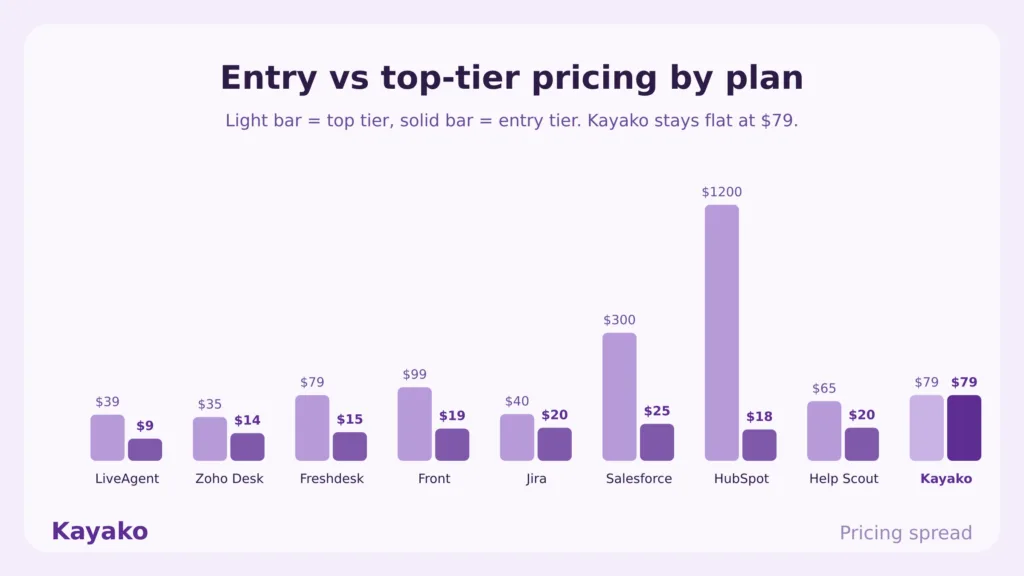
Kayako vs Zendesk: a feature-by-feature comparison
Since Kayako is the top pick for teams leaving Zendesk over cost and backlog, here is the head-to-head.
|
Feature |
Zendesk |
Kayako |
|
Primary model |
Ticket management with AI add-ons |
Autonomous ticket resolution |
|
AI outcome |
Deflects and routes, agent still replies |
Agent Kay resolves or escalates with full context |
|
Customer context |
Spread across apps and side conversations |
SingleView unified customer timeline |
|
Triage |
Manual triggers and views to configure |
AI Triage auto-classifies and routes |
|
Pricing model |
Per agent plus per-agent AI add-ons |
$1 per AI-resolved ticket plus $79 per seat |
|
Implementation |
Self-configured, often consultant-assisted |
Done-for-you deployment into your stack |
|
Reporting |
Ticket metrics, deeper analytics cost extra |
Resolution rate, CSAT, and cost per ticket |
|
Best fit |
Enterprises with dedicated help desk admins |
Teams scaling support without scaling headcount |
The takeaway is simple. Zendesk charges more as you add agents and AI features. Kayako charges when a ticket gets resolved, and the platform does the resolving.
Reset your support cost curve Get Started >
Reviews: what real users say
Where reviewers praise these tools
Across G2 and Capterra, reviewers consistently praise Freshdesk and Zoho Desk for value, Help Scout and Front for ease of use, Gorgias for e-commerce depth, and Intercom for AI quality. Kayako reviewers highlight the done-for-you deployment and the measurable drop in backlog and cost per ticket.
Where reviewers raise concerns
The complaints follow a pattern. Per-agent platforms get expensive as teams grow. Usage-based AI surprises finance at quarter end. Enterprise tools demand admin time that small teams do not have. Speed sits underneath all of it, since 73% of consumers are turned off by slow replies and more than half have abandoned a purchase because of lagging responses. Resolution speed, rather than feature count, decides satisfaction. PwC found that 32% of customers walk away from a brand they love after a single bad experience, so the stakes compound.
How to switch from Zendesk without losing momentum
Migrating off Zendesk is a sequencing problem. Use this checklist.
- Audit your triggers and automations. List the ones that drive real outcomes, and retire the rest. Most teams find half are dead weight.
- Export tickets, contacts, and help center articles. Keep history and self-service content intact.
- Map your app stack. Note which marketplace apps you actually use, then confirm equivalents or native features in the new platform.
- Pick by job, not by hype. Use the table above to match the tool to your bottleneck.
- Run both in parallel briefly. Route a slice of traffic to the new platform, validate resolution rates, then cut over.
- Time the cutover before renewal. Zendesk contracts renew at list price, so start the evaluation a quarter early.
How to choose the right Zendesk alternative
The best tool is the one that removes your biggest bottleneck. Use this quick mapping.
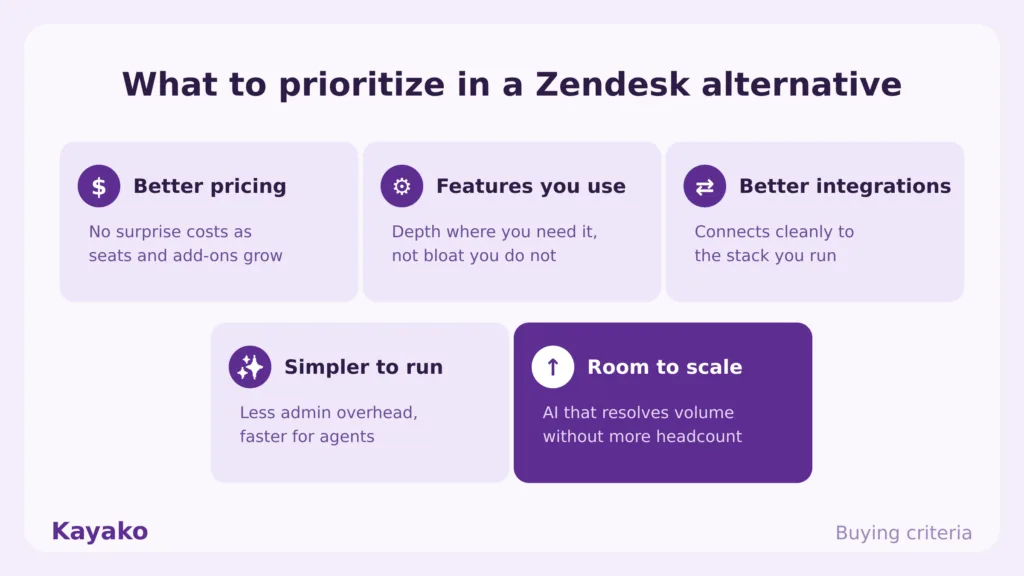
- You need to resolve support volume at scale. Choose Kayako.
- You want a cheaper like-for-like help desk. Choose Freshdesk or Zoho Desk.
- Your support is product-led and in-app. Choose Intercom.
- You are a small team that lives in email. Choose Help Scout or Front.
- You run an online store. Choose Gorgias.
- You need a single customer timeline at enterprise volume. Choose Kustomer, or get the same view with resolution built in from Kayako.
- Your company runs on Salesforce or HubSpot. Choose Service Cloud or Service Hub respectively.
- Your queue is internal IT. Choose Jira Service Management.
Be honest about your ticket volume, your admin capacity, and your true cost at scale. Then test before you commit.
The bottom line
Zendesk is good at what it was built for, which is organizing tickets for large teams with admin resources. The category has moved past organizing.
For budget swaps, look at Freshdesk or Zoho Desk. For small teams, Help Scout or Tidio. For e-commerce, Gorgias. For enterprises inside Salesforce, Service Cloud.
For the problem most growing teams actually face, which is rising volume and cost per ticket, Kayako is the clear number one. Pick the tool that removes your bottleneck, then move.
Cut backlog in ninety days Start Pilot >
Frequently asked questions
What is the best Zendesk alternative in 2026?
It depends on the job. For autonomous resolution at scale, Kayako leads. For a cheaper traditional help desk, Freshdesk and Zoho Desk lead. For e-commerce, Gorgias is the standout.
What is the best free Zendesk alternative?
Freshdesk offers a free tier for small teams, Zoho Desk covers three agents free, and Tidio and HubSpot both run useful free plans. Free tiers suit low volume, so plan the upgrade path before you commit.
Why do teams leave Zendesk?
Three reasons dominate reviews: renewal price increases, AI features priced as per-agent add-ons, and the admin effort required to keep triggers and automations working. Cost per ticket rises while resolution stays manual.
Is there a Zendesk alternative that resolves tickets instead of deflecting them?
Yes. Kayako’s Agent Kay resolves tickets end to end across email, chat, voice, and social, and escalates to a human with full context when needed. Contently reached 68% autonomous resolution on the platform.
Does Kayako replace Zendesk?
For support operations, yes. Kayako covers ticketing, knowledge base, omnichannel routing, and autonomous resolution, and it deploys into your existing stack rather than forcing a rip-and-replace on day one.
How much cheaper are Zendesk alternatives?
Traditional swaps like Zoho Desk run 60 to 75 percent below the Zendesk Suite per agent. Resolution-priced platforms change the math entirely, since cost tracks resolved tickets rather than headcount.