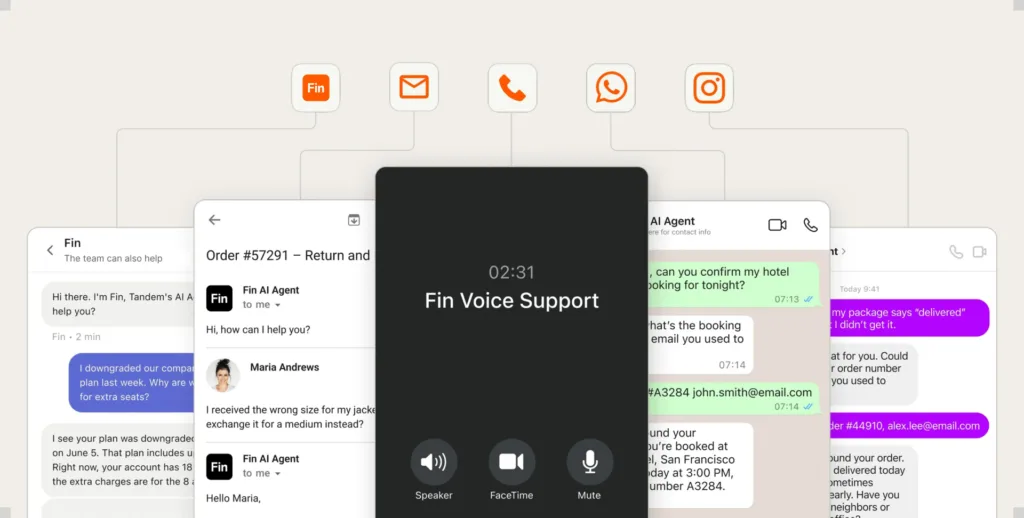
Intercom is a customer service platform built around live chat and in-app messaging, and sold in 2026 primarily as an AI agent. Fin, that agent, answers customer questions across chat, email, phone, WhatsApp and social by drawing on your own help content, then hands off what it cannot close to a human working in a shared inbox. Around it sits a full helpdesk: ticketing, workflows, a help center, outbound messaging and reporting. It is built for product-led SaaS and digital-first businesses whose customers live inside an app, and it is priced per seat plus a fee for every question the AI resolves.
I, Colin Guilfoyle, SVP of Customer Support, have a decade in the function and most of it spent leading it. I have run Intercom in production rather than in a trial: configured Fin against a live queue, rebuilt a help center to feed it, and scaled a support team alongside the product as volume grew. That is the vantage point here. Where I give an opinion, it comes from that experience. Where the evidence disagrees with my opinion, the evidence wins.
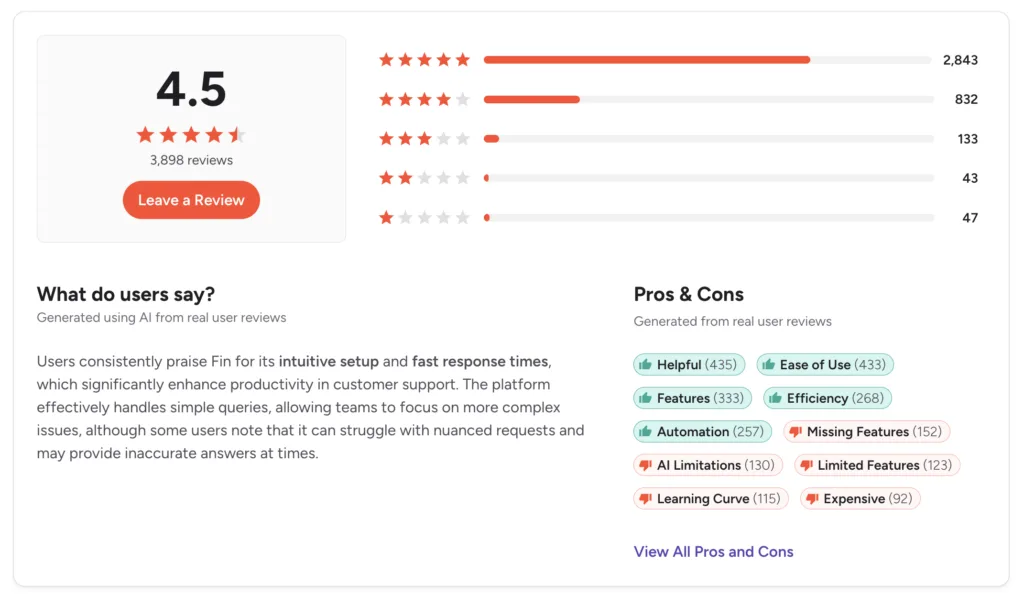
Which brings me to the number that prompted this review. Intercom scores 4.5 out of 5 on G2 and 2.9 out of 5 on Trustpilot. Same product, same year, same buyers. Aggregate scores rarely lie about product quality. They lie about what happens after the invoice arrives, and that 1.6-star gap is the most useful thing on this page. What follows reads all four platforms against each other, grades Intercom feature by feature, and names the alternatives worth a look.
How I evaluated Intercom
Six criteria, weighted the way I weigh them at renewal rather than at demo.
Hands-on use. Time in the product with a live queue behind it: Fin configuration and Guidance, help center structure, workflows, escalation paths, the admin surface and the reporting. I re-read the live pricing page, plan matrices and outcome definitions on 2 August 2026 and checked every vendor claim below against them. None of that replaces your own pilot. Intercom offers fourteen days free, and any AI agent should be judged on your ticket mix.
User reviews, at volume and in depth. G2, Capterra, Trustpilot and Reddit, read for what people describe rather than the score they gave. I sampled the most recent and lowest-rated reviews on each, read Reddit threads end to end, and used Gartner Peer Insights as a fifth reading for enterprise buyers.
Depth and breadth of features. Whether the platform covers the full support surface, or covers three channels well and charges for the rest.
Scalability. Multibrand, data residency, SSO, SLAs, language coverage, and what happens to the tool at ten times your current volume.
Pricing and forecastability. Not the sticker price. The bill you cannot predict.
Support the vendor gives you. A customer service company’s own support is the fairest test it will ever face.
Two exclusions. I dropped employer-review content from Glassdoor, because it measures the company as an employer and not as a vendor. And I checked every Reddit commenter for commercial interest, because several of the loudest criticisms of Fin turn out to be competitors talking.
What you are actually buying in 2026
Intercom is no longer, strictly speaking, Intercom. In May 2026, the company rebranded to Fin, after its AI agent. Weeks later, on 15 June 2026, Salesforce signed a definitive agreement to acquire it for approximately $3.6 billion, with closing expected in the fourth quarter of Salesforce’s fiscal 2027.
The name Intercom survives as the customer service software. Fin is the AI agent and now the parent brand. Both live at intercom.com, and Salesforce has announced no pricing or packaging changes.
The company states it serves more than 30,000 businesses and has passed $400 million in annual recurring revenue. Vendor figures, and they matter here only as a stability signal. This is not a tool at risk of disappearing. It is one at risk of being absorbed.
For a buyer, that matters in one practical way. Sign a multi-year contract this quarter, and you are signing with a company that will be owned by Salesforce before that contract is halfway through. Salesforce already sells Agentforce into the same category, and acquired products tend to align with the parent ecosystem over time. Raise it with your account team before you commit.
The ratings disagree, and the disagreement is the story
|
Platform |
Score |
Reviews |
What it captures |
|---|---|---|---|
|
G2 |
4.5 / 5 |
3,894 |
Verified business users, many review-invited |
|
Capterra |
4.5 / 5 |
1,134 |
Verified business users, incentivized and organic |
|
Trustpilot |
2.9 / 5 |
524 |
Unprompted, self-selecting, mostly complaints |
|
|
No score |
Threads |
Practitioners mid-implementation, plus vendors |
G2’s profile is heavily populated by reviews collected through seller invites and marked as incentivized, which reliably lifts a score. Trustpilot’s own page notes the company has not recently invited customers there, so what lands is unprompted, and unprompted usually means angry. Reddit is where people go mid-implementation, when the tool has stopped being exciting and has not yet started being quiet.
That is the last time I will quote a score. Stars tell you how people felt on the day they were asked. The rest of this review is about what they described, which is far more useful when you are the one signing.
Compare Kayako alternatives to Intercom if a platform-by-platform score gap gives you pause.
What users actually say about Intercom
Five themes repeat across all four platforms, and they hold whether the reviewer gave five stars or one.
Fin does real work, once your content is ready for it
This is the loudest positive, and it is not marketing. Support leaders describe reaching around 60% resolution out of the box and roughly 70% after months of content refinement, and mid-market teams describe passing 50% deflection while doubling ticket volume without adding headcount. Intercom’s own named customers report the same range. The teams reporting those numbers all have one thing in common: a maintained help center that existed before the AI did.
The interface is the least contested thing about it
Almost nobody complains about using Intercom. Reviewers describe agents becoming productive inside the first half hour, and marketing and product teams working in the same tool without a fight, which is unusual for a helpdesk. When people leave Intercom, they rarely leave because of the interface.
The bill is the most contested thing about it
The grievance is unpredictability more than expense. Reviewers describe capability sitting behind an upgrade they only need one feature from, and long-standing customers describe being moved off legacy plans, in one case repriced 25% upward with the discount halved. The structural version, which I hear from heads of support constantly, is that getting better at automation makes the invoice bigger.
Fin hallucinates, and diagnosis is harder than the error
Reviewers describe confident answers that are wrong, outdated information surfacing after content changes, and rules Fin followed last month being quietly ignored this month. The frustration is rarely the mistake itself. It is that when a bad answer appears, there is no obvious way to tell whether the cause was a content source, a Guidance rule, or retrieval picking the wrong document.
The vendor’s own support is the weak point
This is the most consistent negative anywhere, and the accounts are specific. A UK buyer was provisioned into a US workspace and told an EU move meant a full manual re-migration. A two-week deliverability case produced three agents giving contradictory guidance and pointing at settings pages that did not exist in the customer’s workspace. Others describe waiting days for a technical answer that turned out to be a known issue.
One caution on sourcing. The most-cited Reddit critique of Fin’s pricing comes from accounts selling competing products, including Tidio, eesel, and My AskAI, piling into a single support lead’s implementation thread. Their argument is legitimate. It is still a pitch, and I would not treat it as user sentiment.
Intercom pros and cons
|
Pros |
Cons |
|---|---|
|
Fin clears real tier-one volume for teams with maintained content |
Seats plus a fee per resolution make the monthly bill hard to forecast |
|
Messenger and in-app messaging remain best in category |
Better automation raises the invoice, so success is penalized |
|
Fast to set up and administer without engineering support |
The vendor’s own support is the most consistent complaint on every platform |
|
Ships new capability quickly and iterates in public |
Hallucinations persist and are awkward to diagnose |
|
Runs on an existing helpdesk with no migration required |
Admin gaps: no user merge, export-dependent reporting |
|
Chat, email, phone, WhatsApp and social in 45-plus languages |
Features gated by tier, so one capability forces a plan upgrade |
What Intercom does better than anyone
The combination, rather than any single line item. A messenger customers will open, an AI agent trained on your own content, and outbound in-app messaging, all administered by one person without a ticket to engineering. Competitors match one or two. None match the set with the same polish.
What you will be living with
A cost line that moves with your success, and a support relationship that scales with your contract rather than your problem. Neither shows up in a trial. Both are commercial problems rather than product ones, which means they get fixed at renewal or not at all.
Feature by feature
Pricing, and where the bill actually moves
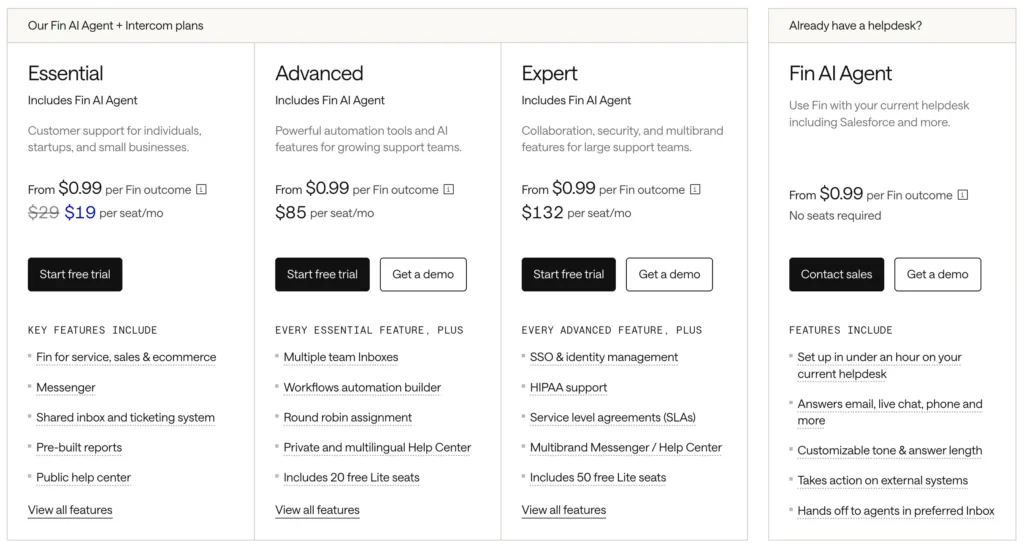
Seats are the honest part of Intercom’s pricing. They start at $29 per month on Essential, billed annually, and you can forecast them. Everything else is a usage report you receive after the fact.
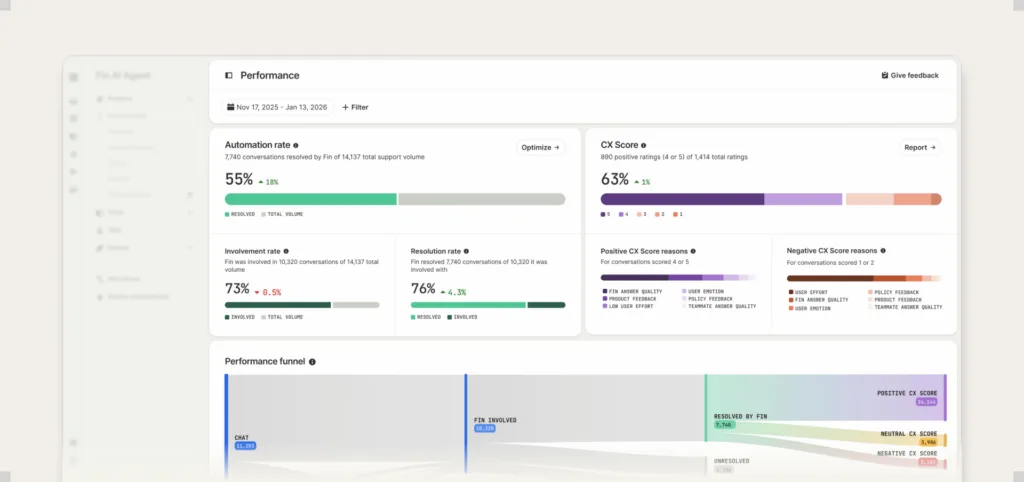
The first variable is Fin. An outcome is billed when a customer confirms resolution, when Fin completes a Procedure, or when the customer simply stops replying. That last condition is not a billing trick so much as a measurement problem, and it shows up inside the product: Fin’s content report has separate columns for conversations Fin was involved in and conversations it resolved, and the gap between them is where your real resolution rate lives. I have watched a dashboard number sit well above the rate customers would recognize, and the usual cause is an agent stepping into a struggling conversation before the customer thinks to ask for one.
The second variable is channels, and this is where people get surprised. Usage is metered per unit and billed in arrears. A bulk email is charged whether or not it lands, including to invalid addresses. A survey is charged when it is shown, not when it is answered. A product tour is charged every time it is presented, taken, or ignored. A post seen on web and again on mobile counts twice. SMS is charged from the very first segment with no included allowance, and a default ceiling of 10,000 segments a month that will block your sending if you hit it mid-campaign.
The third variable is the one nobody plans for. Bulk email bills per address, duplicate addresses bill twice, and Intercom does not let you merge duplicate user records. A messy contact list is a recurring line item, not a tidiness problem.
Then the add-ons: Copilot per agent, Pro analytics per 1,000 conversations analyzed, Proactive Support Plus for outbound with 500 messages included. And if you are on contract, seats above your contracted number are billed twice over, prorated in arrears for the month you added them and ahead for the next.
My verdict: the sticker price is fair, and the invoice is unpredictable, so instrument your usage dashboard in week one rather than month six.
User experience
The inbox is the best in the category, and I will defend that against anyone. Agents are useful inside half an hour, macros are quick to reach, and the workflow builder is genuinely usable by the support team rather than by engineering. Operator, the newer building layer, will assemble procedures and guidance from a plain prompt, which removes most of the setup dread.
The friction is all downstream of that first impression. Filtering is thinner than the volume of data justifies: you cannot slice conversations by user and timestamp together, and open and closed conversations live in separate stacks rather than one view, which makes investigating a recurring issue more clicking than thinking. The right-hand context panel gets crowded and cannot be trimmed. The help center has an awkward gap where an article has no URL until it is published, so any article that links to another has to be published first and fixed afterward, and the message shown to users hitting a restricted article cannot be edited. Dialing a number that is not already a contact means starting a call to someone else and overwriting the number.
None of it is fatal. All of it is the texture of a product built messenger-first, where agent-side administrative depth arrived later.
AI capability
Fin is trained through five surfaces, and understanding the difference between them is most of the job. Content sources feed it articles, sites, and PDFs. Snippets let you write short answers for Fin without publishing a customer-facing article, and they replaced the older Custom Answers, which some teams found more precise. Guidance sets tone and behavioral rules. Attributes inject customer data. Procedures handle multi-step tasks and can call external systems.
Two things about that stack matter in practice. First, more content is not better content. Teams who connect everything they have, including years of past conversations, routinely get worse answers than teams who connect a small, clean FAQ, because retrieval picks the wrong source with confidence. Second, Guidance is not a hard rule. Fin occasionally ignores instructions it followed last month, and the likeliest explanation is that the underlying model changed beneath your prompts, so guidance needs re-testing on a schedule rather than writing once.
The characteristic failures are recognizable. Fin loops, repeating an answer the customer has already rejected instead of asking what it missed. It lacks conversational memory in longer threads. It will suggest emailing support to a customer who is already talking to support. It will walk a desktop user through mobile steps because nothing told it which one they were on.
Diagnosis is better than it was. Analyze then Optimize reviews the conversations Fin could not close and issues weekly suggestions, and the involved-versus-resolved view per article tells you exactly which document is dragging your rate down. What remains hard is knowing why a specific answer came out wrong, because you cannot see the retrieval path. Connecting Fin to your own systems through connectors or MCP also needs someone comfortable with APIs and data transformation, which is a real staffing assumption for a product sold as no-code.
I would treat Fin as a content operations product with an AI on the front. Budget the documentation work, then judge the AI.
Helpdesk and ticketing
Competent, and shallower than Zendesk. Shared inbox, ticketing, workflows, public and private help center, and SLAs on Expert. Lite seats are free on Advanced and Expert, which matters more than it sounds: engineers and account managers can read and collaborate on conversations without a paid seat, and that quietly halves the seat count on most plans.
Two things to check before you migrate. Duplicate user records cannot be merged, so if your identity model allows one email address across several user IDs, an agent has to search manually to be sure they are not working two open threads for the same person. And first response time is measured from ticket creation rather than from human handoff, so the moment Fin fronts the queue your human response metric stops meaning what your team thinks it means. Rebuild that metric in a custom report before you set targets on it.
Check email authentication early on any migration. It is workspace-specific, and setups carried over from another tool are often the thing quietly suppressing your outbound.
Vendor support
Intercom operates support around the clock and states first response times of one to four hours on weekdays by urgency, and there is no phone line or scheduled call option. You reach the team through Messenger, and the first thing you reach is Fin.
That model works when your question is documented and degrades when it is not. Complex cases pass between agents, and because each new agent restarts from the ticket rather than the thread, technical answers can reverse from one reply to the next. Escalation is the pressure point: asking for it does not reliably produce it, and what determines your experience is whether you have a named account manager, which is a function of contract size rather than problem severity.
To their credit, the company answers publicly. Its pricing lead and support leadership respond to critical reviews by name and in detail, and they reply to most of the negative reviews on Trustpilot. Take the implication seriously, though. If the fastest route to a resolution is writing a public review, build your own escalation path at contract time and get names in it.
Scale and compliance
Multibrand messenger and help center, SSO, HIPAA support and SLAs all sit on Expert, and Fin answers in more than 45 languages, so the ceiling is high.
The constraint that catches people is regional. You choose US or EU data residency when the workspace is created, and you cannot move it afterward. A UK or EU company provisioned into a US workspace has to build a second workspace and migrate by hand, and the export and import paths are not symmetrical, so some of the data does not come with you. Confirm residency in writing before anyone touches configuration.
Regulated buyers should also expect to do their own diligence on what Fin sees. Reviewers in financial services describe a lack of transparency about exactly which fields are shared with the model, and that question is easier to answer before you connect a customer database than after.
See how Kayako prices AI support if per-outcome billing does not fit your forecasting.
Intercom alternatives, by what you are solving for
You want serious AI without a bill that grows with your success
This is the most common reason I see teams leave. Kayako prices its AI agent on tickets actually resolved with a fixed onboarding cost, rather than metering every conversation that ends quietly, so your forecast survives contact with a good month. It also plugs into the helpdesk you already run, which means you can test the economics on live volume before committing to a platform change. If your objection to Intercom is the shape of the bill rather than the quality of the product, this is the comparison to run first.
You are keeping your current helpdesk and only want a better agent
Both Fin and Kayako’s AI sit on top of Zendesk, Freshdesk and others without a migration, which makes this the lowest-risk experiment available to you. Run both against the same fortnight of real tickets and compare on cost per resolved ticket rather than on headline resolution rate. The headline number is measured by the vendor. The cost per ticket is measured by your finance team, and it is the one that decides renewal.
You need enterprise-grade ticketing depth
Zendesk remains the deeper case management system: stronger routing, better multi-team structure, more mature admin controls, and a bigger integration surface for the sprawling stacks large organizations actually run. You give up the messenger experience and a lot of the setup speed to get there. If most of your queue arrives by email and lives across several teams, that trade is usually worth it. Our Zendesk versus Intercom comparison walks the differences properly.
You are an SMB that needs flat, forecastable pricing
Freshdesk and Help Scout are the value plays for email-first teams under about twenty agents. Neither will match Intercom’s in-app experience, and neither is trying to. What they give you is a bill you can put in a budget and defend, and a product simple enough that nobody needs a week of training. See Intercom versus Freshdesk if you are weighing that swap.
You run ecommerce support
Gorgias puts order, refund, and shipping data natively in the ticket, which matters far more than AI polish when most of your queue is some version of where is my order. Agents stop tab-switching between the helpdesk and the store, and macros can act on the order rather than describe it. For a Shopify-heavy business, that beats a better messenger most days of the week.
Whichever way you lean, model three numbers for each option: cost per resolved ticket at real volume, content hours before the AI performs, and the renewal if you double. Those decide it. Feature grids do not.
Talk to Kayako about migration if the Salesforce timeline is what is keeping you undecided.
The verdict
Intercom in 2026 is a very good product sold on terms that a meaningful minority of its customers resent, by a company that is about to change hands. Both of those things are true at once, and the review scores only tell you the first one.
Model your outcome volume honestly, get the acquisition question answered in writing, and audit what Fin counts as resolved in month one. Explore Kayako’s AI for customer support if outcome-based billing does not suit your economics, or book a Kayako strategy session to pressure-test the numbers with someone who has run the migration before.
Frequently asked questions
Is Intercom worth it in 2026?
For mid-market and larger product-led SaaS teams with real documentation and meaningful volume, yes. Under roughly 50 conversations a day, the seat plus outcome model is hard to justify.
Is Intercom now called Fin?
The company rebranded to Fin in May 2026. Intercom remains the name of the customer service software, and Fin is the AI agent.
Does the Salesforce acquisition change anything yet?
No announced pricing or product changes. The deal is signed, not closed, with completion expected in the fourth quarter of Salesforce’s fiscal 2027.
Can we use Fin without moving to Intercom?
Yes. Fin runs on an existing helpdesk, including Salesforce and Freshdesk, priced per outcome with no seats and a monthly minimum. Setup is quoted in under an hour, which is optimistic for anyone with a knowledge base worth connecting.
What resolution rate should we expect from Fin?
Plan for 50% to 60% in the first quarter if your help center is in good shape, and less if it is not. The higher figures reported publicly follow months of content and Procedure work.