JivoChat is a live chat and omnichannel messenger for websites. A widget goes on your site, and conversations from that widget arrive in one agent console alongside WhatsApp, Instagram, Facebook, Telegram, Viber, email, Apple Business Chat and telephony. Around that sit proactive chat triggers, real-time visitor monitoring, canned responses, a light built-in CRM, callback requests and an AI layer sold separately. It is aimed at small businesses and self-serve buyers rather than enterprise support organizations, and it is priced per agent per month, from a free tier up to $56 a seat before you add any of the modules.
This review is written by Colin Guilfoyle, SVP of Customer Support at Trilogy, who has spent roughly a decade leading support functions and buying the software that runs them. He has not run JivoChat against a live production queue, and this is not a bench test. What follows is built from JivoChat’s own pricing and plan documentation, read firsthand and dated, from corporate records, and from a close read of what customers describe across four review platforms. Where there is an opinion, it comes from that experience of operating support tooling. Where the evidence disagrees with the opinion, the evidence wins.
The number that prompted this piece is not the headline score. JivoChat sits at 4.6 out of 5 on both G2 and Capterra and 2.4 out of 5 on Trustpilot, which is a familiar enough pattern. The more interesting thing is when the good reviews were written. Dig into the dates and the enthusiasm clusters heavily in 2019, while everything recent tells a different story. What follows reads all four platforms against each other, examines who actually owns the company, prices the thing properly from the vendor’s own page, grades it feature by feature, and names the alternatives worth a look.
How I evaluated JivoChat
Support software earns its keep over a renewal cycle, not over a trial. Six criteria, in the order they matter.
Hands-on use. I did not run JivoChat against a live queue and will not claim otherwise. What I examined directly is the public pricing page and full plan comparison, read on 5 August 2026, including every module price, the feature gates per tier and the agent caps. There is a 14-day trial, and anyone serious should use it.
User reviews, at volume and in depth. G2, Capterra, Trustpilot and Reddit, read for what people describe and, unusually for this format, for when they wrote it.
Depth and breadth of features. Whether the product covers a real support surface. JivoChat covers a wide one on paper, and the gates matter more than the list.
Scalability. Seat caps, routing, API access, data retention, and what happens when a small team becomes a medium one.
Pricing and forecastability. The bill you cannot predict. Here the problem is not variability, it is multiplication.
Support the vendor gives you. The fairest test a company selling customer communication software can face.
Two standing exclusions. Employer-review content from Glassdoor and AmbitionBox is dropped because it measures the company as a workplace rather than as a vendor. Every Reddit source was checked for commercial interest, and in this case that filter removed most of what came back.
What you are actually buying in 2026
This section usually covers funding and product direction. For JivoChat, it covers something a support leader needs to know before routing customer data anywhere near it.
The company was founded in Moscow in 2012 by Timur Valishev as Jivosite, and corporate databases including Tracxn and PitchBook record it as acquired by Sberbank on 22 June 2021. Today the picture is fragmented. The terms of service are issued by a Brazilian entity, public profiles variously list headquarters in Wilmington, Vitória and Moscow, and headcount sits around 100 to 106 as of mid-2026.
I am not going to tell you what to conclude from that. I will say that any procurement team with a vendor risk questionnaire will ask where customer conversation data is stored, which legal entity processes it, and who ultimately owns that entity, and that those questions take longer to answer here than they do for most competitors. If your buyers are regulated, in the public sector, or European, sort that out before the pilot rather than after it.
The ratings disagree, and the dates matter more than the scores
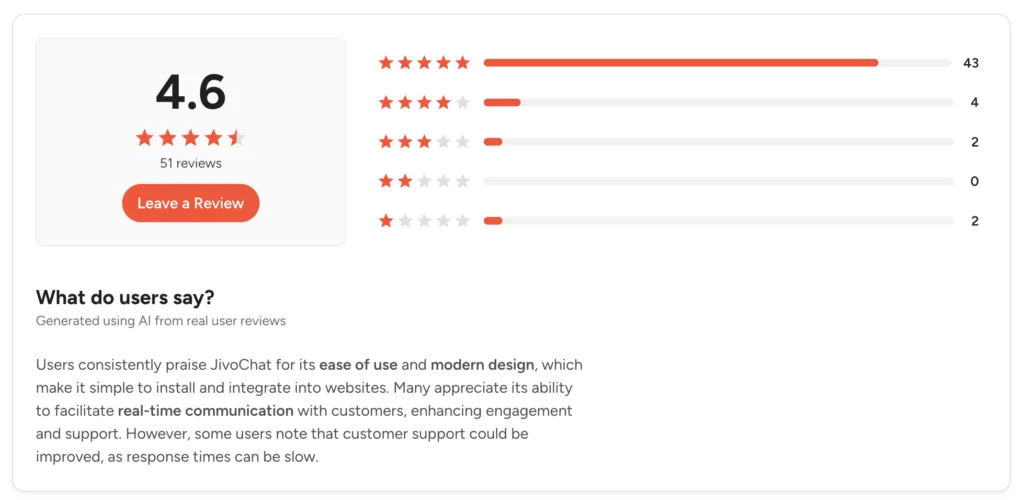
Here is where JivoChat sits across the four platforms as of August 2026.
|
Platform |
Score |
Reviews |
What the audience is |
|---|---|---|---|
|
G2 |
4.6 / 5 |
51 |
Business buyers, heavily weighted to 2019 |
|
Capterra |
4.6 / 5 |
105 |
Business buyers, spread across eight years |
|
Trustpilot |
2.4 / 5 |
34 |
Anyone, unprompted, low volume |
|
|
No score |
Handful of threads |
Mostly affiliates |
Capterra’s sub-scores look healthy, with Ease of Use at 4.7 and Customer Service at 4.5, and Capterra is the only platform of the four carrying real recent volume.
Two things undercut the headline numbers. The first is age. On G2, a large block of the five-star entries was posted between March and July 2019, many from reviewers logged as Consultant at a mid-market company, with strikingly similar structure and phrasing. Every G2 review posted since the start of 2024 sits at 3.5 or below. A 4.6 built that way describes a product as it was seven years ago, not the one you would buy this afternoon.
The second is volume. Trustpilot carries only 34 reviews, so the 2.4 there is directionally interesting rather than statistically strong. Its distribution is stark, with 68% at one star against 23% at five, and reading them explains part of it: some come from consumers who met JivoChat as the chat widget on a site that turned out to be fraudulent, and reviewed the vendor rather than the site.
That last point is worth holding onto, because it cuts both ways. It inflates the negativity on Trustpilot unfairly, and it also tells you something true about who a generous free tier attracts.
That is the last score in this review. Everything after this is written from what people described rather than from what they rated.
What users actually say about JivoChat
Five themes recur, ordered by how often they came up.
It installs in minutes, and non-technical teams take to it immediately
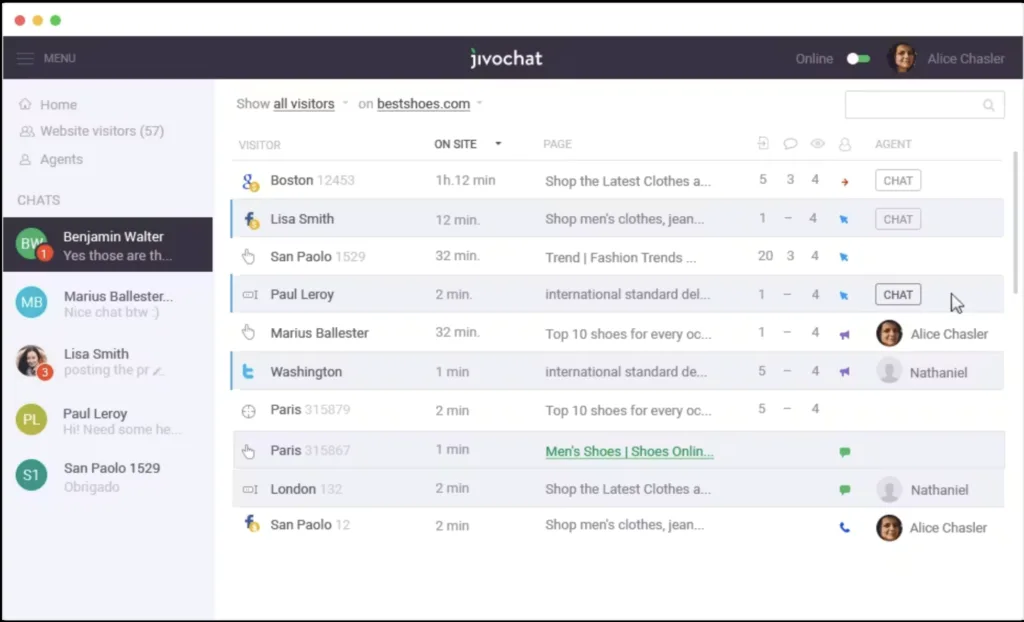
The praise is consistent, and it is about friction. Reviewers describe dropping the script onto a site and being live the same afternoon, comparing setup to adding an analytics tag, and training new agents on the console without much effort. The message preview feature, which shows what a visitor is typing before they send it, comes up repeatedly as the thing people actually love.
Bugs get reported, acknowledged, and then persist
This is the loudest recent theme and the most damaging. Andrey Y., a software company co-founder, described a defect where one customer unsubscribing from offline-message notifications unsubscribed his whole account, so incoming offline messages silently stopped reaching his helpdesk. He reported it repeatedly across two years, was told each time it was fixed, and watched it return. Adnan S. described a telephony setting that had not worked for two years with no reply from support.
Support is slow, and slower if you are not in its timezone
Reviewers in Australia describe waiting the better part of a day for a reply. Others describe writing to support about widget behavior and never hearing back at all. Igor Stevanovic, writing on Trustpilot in March 2026, described a mobile SDK broken on iOS with bug reports going unanswered.
The simplicity is genuinely loved and genuinely limiting
Several reviewers make both points in the same breath. One operations manager who inherited it called it clean, cheap, and free of the usual upsell pressure, then said the same simplicity meant fewer integrations and less customization than modern competitors, and that it would not scale with the team. Others ask for real ticketing, which the product does not have.
Per-seat pricing bites small teams early
The complaint is structural rather than about the headline number. Reviewers describe the per-agent model making it hard to widen coverage, and one described being unable to get staff logged in on time because a seat stays occupied when an agent forgets to log out.
A note on sourcing. Reddit was close to useless here and that itself is the finding. JivoChat runs a widely promoted affiliate program, so most of what surfaces is roundup content linking back to the author’s own blog, tool lists, partner links, and guest-post sellers. The one clearly organic mention I found was a store owner asking what chatbot people actually use, who dismissed JivoChat as outdated in passing while worrying aloud about paid shills in the same thread. Treat any glowing JivoChat recommendation you find on a blog as commission-bearing until proven otherwise.
JivoChat pros and cons
|
Pros |
Cons |
|---|---|
|
Installs and configures in an afternoon |
Long-standing defects that survive repeated reports |
|
Genuinely usable free tier for a tiny team |
Support replies slowly and sometimes not at all |
|
Message preview gives agents a head start |
Every seat, and the AI, is billed per agent |
|
Wide channel coverage on paper |
Key capabilities sit behind the top tier or paid modules |
|
Built-in CRM and telephony without extra vendors |
No real ticketing or case lifecycle |
|
Unlimited sites on one license |
Widget weight can drag page performance |
|
Low entry price against the category |
Ownership and data location take work to establish |
What JivoChat does better than anyone
Getting a small team talking to website visitors, cheaply, today. The free tier is unusually generous, the install is trivial, and the console is simple enough that a two-person shop can run it without training. For a business whose support function is one person answering questions between other jobs, this is a rational purchase and the alternatives are mostly overkill.
What you will be living with
A vendor that fixes things slowly, a pricing structure where every improvement multiplies by headcount, and an escalation path that assumes you can wait. None of that matters much at three agents. All of it matters at fifteen.
Feature by feature, based on the reviews
Pricing and how the bill actually assembles
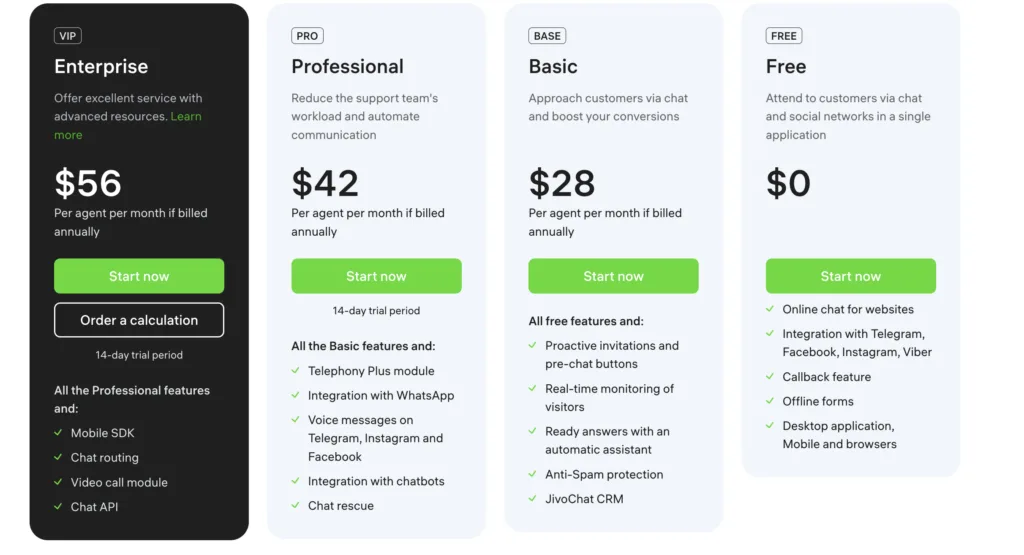
The headline is $28 per agent per month on Basic, $42 on Professional, and $56 on Enterprise, all billed annually per JivoChat’s pricing page. Nothing about that is unusual. The structure underneath it is.
Almost everything interesting is a module bolted on top. WhatsApp is $27 a month, and it also requires the Professional plan, so the channel most small businesses now consider mandatory costs a tier upgrade plus an add-on. The AI Assistant is $13. Video calls are $23 per agent. Telephony Plus is $4. The AI Agent, the thing marketed as resolving up to 80% of conversations automatically, is $69 per agent per month, which is more than double the entry seat price and more than the top-tier seat itself.
That last one deserves attention, because automation billed per human seat is a strange instrument. If the AI works and you keep your team, you pay full price for both. The bill only falls when you cut headcount, so the vendor’s pricing rewards you for the one outcome most support leaders are trying to avoid.
Assemble a realistic five-agent team on Professional with WhatsApp, the AI Assistant, and the AI Agent, and you are at roughly $595 a month against a $42 sticker. That is a fourteen-fold gap between the number on the page and the number on the invoice, and none of it is hidden. It is simply spread across a comparison table most buyers skim.
I would price the modules you need before the seats you want, because the modules are what move the total.
The agent console and the widget
The console is the strongest part of the product. It is fast to learn, canned responses are well handled, and message preview genuinely shortens response time because agents can compose while the customer is still typing. Multi-device access works, and the desktop and mobile apps are stable enough that reviewers mention them as a positive rather than an afterthought.
The widget is where operational costs appear. Reviewers report the script adding weight that shows up in Core Web Vitals, which for an ecommerce site is a marketing problem as much as a support one. Others describe the widget covering too much of the screen on smaller viewports, and proactive triggers firing often enough that customers complain about being interrupted. Triggers are configurable, so that one is a setup issue rather than a defect, though the defaults are aggressive.
Two behavioral faults recur, and neither is cosmetic. Agent status can desynchronize across devices, so agents appear online to customers after signing out and chats route to nobody. And when a visitor abandons a chat that was not picked up in time, some reviewers describe subsequent requests failing to raise a notification at all.
I would test the status behavior on day one with two devices, because a queue that silently routes to an offline agent is worse than no chat at all.
AI capability
There are two separate things here, and conflating them is easy. The AI Assistant is a writing aid built on OpenAI models that helps agents phrase replies. The AI Agent is the autonomous layer that answers customers directly. They are priced separately, and they solve different problems.
The autonomous layer is the newer, less proven half, and there is very little independent evidence about how it behaves in production. Almost everything available is the vendor’s own claim, and the review corpus predates it. That absence is itself informative: a resolution claim with no third-party corroboration is a claim, not a benchmark.
What the review corpus does establish is what surrounds it. There is no knowledge base product to ground answers in, no published resolution reporting, and reporting on the paid tiers is described in the plan matrix as basic or advanced rather than by any defined metric. Without a resolution definition, you cannot compute deflection, and without deflection you cannot justify $69 a seat at renewal.
I would not buy the AI Agent on the strength of the marketing number. Run it against a fixed sample of real conversations and grade the transcripts yourself.
Channels, ticketing and what the inbox does not do
Channel breadth is real. Website chat, WhatsApp, Instagram, Facebook, Telegram, Viber, email, Apple Business Chat and voice all land in one console, which for a small team replaces three or four tools and is the honest core of the value.
What is missing is the layer above conversations. There is no ticket lifecycle, no case status, no SLA engine, and no knowledge base. Several reviewers ask for proper ticketing explicitly. Email handling is thinner than it looks, with reviewers reporting no IMAP integration, and one describing offline messages that never reach the helpdesk they were routed to.
Retention is the quiet one. On the free plan, chat history is kept for two months, and then it is gone. Teams that trial on free, run for a quarter and then upgrade discover the earlier record no longer exists, which matters for disputes, for training material and for anything you would want to feed a model later.
I would treat this as a conversation tool that sits in front of a helpdesk, never as the helpdesk itself.
Vendor support
Support quality is the most consistent criticism across every platform and every year sampled, which is unusual. Most vendors have a bad patch. This reads as a constant.
The failure shapes are specific. Tickets go unanswered rather than being answered badly. Defects are acknowledged, marked fixed, and recur without anyone closing the loop. Coverage is weighted to European and Brazilian hours, so teams in Asia-Pacific describe waiting eighteen to twenty-four hours for a first reply. There is no published SLA on any tier and no priority path listed as a plan benefit.
Set that against the product’s own defect pattern and the compounding problem is obvious. A tool with long-lived bugs and slow support means the mean time to recovery for anything you cannot fix yourself is measured in weeks. For a marketing widget, that is irritating. For the channel your customers use to reach you, it is a business risk that belongs in the decision rather than in the footnotes.
I would ask for a named support contact and a response-time commitment in writing before signing an annual deal.
Scale, access and getting your data out
Seat caps are generous, at up to 100 agents on Basic and Professional and unlimited on Enterprise, so headcount is not the constraint. The gates are.
Chat routing, the Chat API, and the mobile SDK are all Enterprise-only. Read those together, and a real problem appears. Routing is what you need the moment you have more than one queue. The API is what you need to integrate, to report properly, and above all to leave. Putting programmatic access behind the most expensive tier means the cost of exporting your history is an upgrade, and the reviewer reporting a broken iOS SDK was reporting a fault in a feature you can only reach by paying the most.
On compliance, there is a GDPR consent form and anti-spam protection, and unlimited history retention on paid plans. What is absent from the published material is any statement on data residency, SSO or audit logging, which loops back to the ownership question earlier.
I would confirm API access and export format during the trial rather than at renewal, because renewal is the moment your negotiating position disappears.
JivoChat alternatives, by what you are solving for
You want AI resolution priced by outcome rather than by headcount
This is the clearest case for looking elsewhere. Kayako prices AI around resolved conversations rather than per seat, so automation that works reduces cost per resolution instead of sitting as a fixed multiplier on your team size. You give up JivoChat’s very low entry price and its telephony bundling. Test it by taking one month of transcripts and pricing both models against the same volume.
You need an AI agent on top of the helpdesk you already run
If the console is fine and the gap is resolution, Kayako’s AI runs against an existing helpdesk without a migration, grounded in your own help content and reporting on what it actually closed. You give up the single-vendor simplicity of having chat, phone and CRM in one place. Test it by counting how many of last month’s chats were already answered somewhere in your documentation.
You want the same thing but free, permanently
tawk.to is the genuine free alternative, with unlimited agents, a built-in ticketing system and white-labelling for a small monthly fee. You give up polish, telephony and any expectation of fast support. Test it by running both widgets on different site sections for two weeks and comparing pickup rates.
You sell online and need automation that understands carts
Tidio is built around ecommerce, with abandoned-cart flows and an AI layer trained for product questions, and it is where one JivoChat reviewer explicitly moved. You pay more per seat and give up telephony. Test it by tagging a week of chats and counting how many need order or product data to answer.
You want a modern widget and a cleaner design language
Crisp covers similar ground with a lighter, better-looking widget and a more contemporary console, which matters if the chat sits on a brand-led site. You give up the built-in CRM depth and some channel breadth. Test it by measuring widget weight against your current Core Web Vitals scores.
You have outgrown SMB tooling and need SLAs and audit trails
Zendesk or a comparable platform brings ticketing, SLA management, routing, residency options, and audit logging, none of which JivoChat offers. You take on cost and configuration overhead. Test it by asking whether a customer or an auditor has yet asked you for something you could not produce.
Three numbers decide this for any option on the list: cost per resolved conversation at your real volume, the content hours needed before the AI performs, and what the renewal looks like when your team doubles.
Verdict
JivoChat is a good cheap tool that has been coasting on a good reputation. The install is genuinely fast, the console is genuinely pleasant, and for a two- or three-person business that needs to answer website visitors without a project, it remains a sensible choice at a price nothing else in the category matches. The affection in the older reviews was earned.
What has not kept pace is the operating relationship. Defects that survive two years of reports, support that answers slowly or not at all, an autonomous AI priced per human seat with no independent evidence behind its resolution claim, and an ownership structure that takes real work to trace all point the same way. On Monday, I would do two things. Price the modules you would actually switch on and compare that total against the sticker price you have in your head, because the gap is larger than almost anyone expects. Then send JivoChat’s support team a real question and see how long the answer takes, because that response time is the single best predictor of what year two feels like.
JivoChat FAQ
Is JivoChat really free?
There is a permanently free tier covering website chat and several social channels. Note two limits: chat history is kept for only two months, and the pricing page states the free agent allowance inconsistently, showing five agents in one place and up to two in the comparison table. Confirm which applies to your account before planning around it.
Does JivoChat include WhatsApp?
Not in the base price. Direct WhatsApp connection is a $27 monthly module and requires the Professional plan or above, so budget for both.
Can JivoChat replace a helpdesk?
No. There is no ticket lifecycle, no SLA management, no knowledge base, and no case reporting. It is a conversation console, and teams that need those things run it alongside a helpdesk or move off it.
How good is JivoChat’s AI Agent?
Unproven publicly. The resolution figure comes from the vendor, the independent review corpus largely predates the feature, and there is no published resolution definition to measure against. Grade it on your own transcripts before committing at $69 a seat.
Who owns JivoChat?
Corporate databases record the company, founded in Moscow in 2012, as acquired by Sberbank in June 2021, while the current terms of service are issued by a Brazilian entity and public profiles list several different headquarters. If vendor provenance or data residency matters to your buyers, resolve it in writing during the trial.