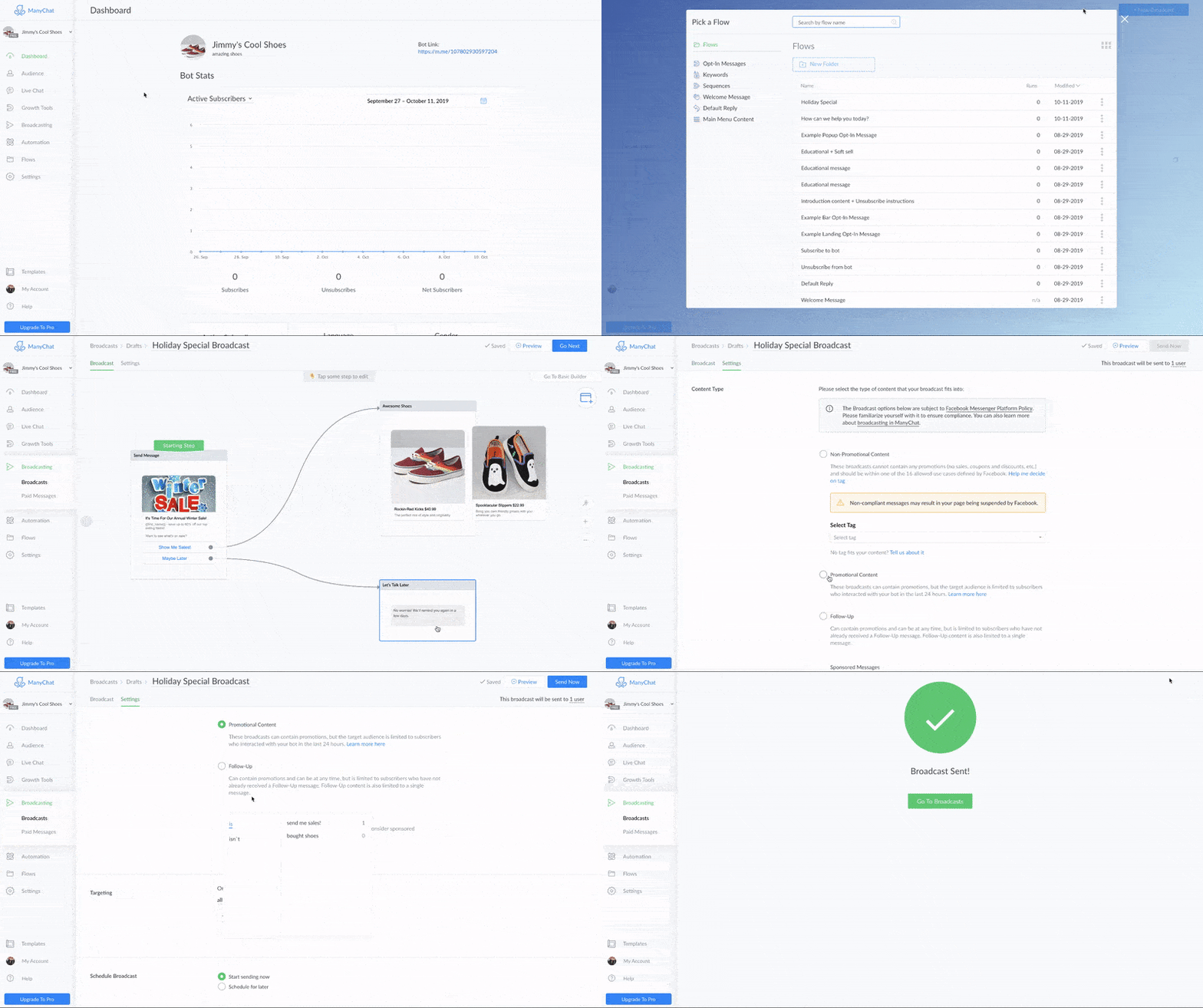
ManyChat is a chat marketing platform built around one mechanic: someone comments a keyword on your Instagram post, and they get a direct message a second later. Around that sits a drag-and-drop flow builder, a unified inbox that pulls Instagram, Facebook Messenger, WhatsApp, TikTok, Telegram, SMS, and email into one screen, broadcast sending, and an AI layer that arrives on the higher tiers. It is sold to creators, direct-to-consumer brands, and small marketing teams rather than to support organizations, and it is priced by Active Contacts per month, from a free tier to $139 a month before overage.
This review is written by Colin Guilfoyle, SVP of Customer Support at Trilogy, who has spent roughly a decade leading support functions and evaluating the software that runs them. He has not run ManyChat against a live production queue, so nothing here is presented as bench testing. What follows is built from the vendor’s own pricing and billing documentation, read firsthand and dated, and from a deep read of what customers describe across four review platforms. Where there is an opinion, it comes from that experience of buying and operating support tooling. Where the evidence disagrees with the opinion, the evidence wins.
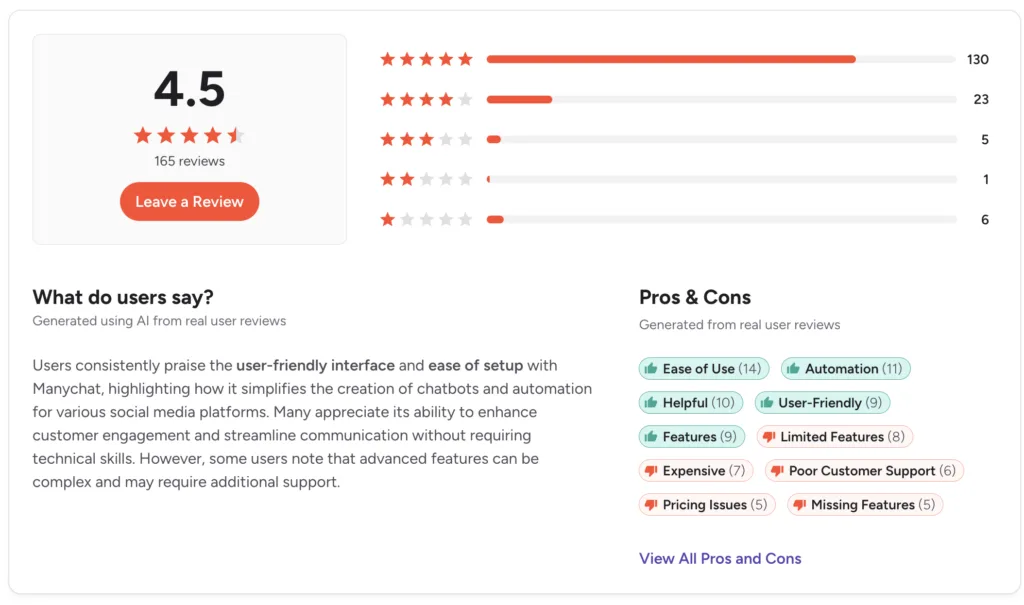
Which brings me to the number that prompted this piece. ManyChat scores 4.5 out of 5 on G2 and 2.2 out of 5 on Trustpilot. Same product, same year, and a gap of more than two full stars. That spread is not noise, and it is the most useful thing on this page, because it maps almost exactly onto the difference between using the product and paying for it. What follows reads all four platforms against each other, prices the thing honestly from the vendor’s own documentation, grades it feature by feature, and names the alternatives worth a look.
How I evaluated ManyChat
Software gets judged on what it does to a team over a year rather than in a demo. Six criteria, in the order they matter.
Hands-on use. I did not run ManyChat against a live queue, and I am not going to pretend otherwise. What I did examine directly is the public pricing page and plan matrix, read on 5 August 2026, including the Active Contact definition, the overage schedule and the feature gates on every tier. Anyone serious should still run the 14-day trial on Essential or Pro before committing.
User reviews, at volume and in depth. G2, Capterra, Trustpilot and Reddit, read for what people describe rather than the score they left. I sampled critical and positive entries on each, and read Reddit threads whole rather than as snippets.
Depth and breadth of features. Whether the product covers a full support surface or three channels and an upsell. ManyChat has one specific and consequential gap here.
Scalability. Multibrand handling, seats, data portability, and behavior when a post goes viral, and volume arrives in an afternoon rather than a quarter.
Pricing and forecastability. The bill you cannot predict, rather than the sticker price. This is where the research got interesting.
Support the vendor gives you. The fairest test any company selling customer communication software can face, and the one ManyChat performs worst on.
Two standing exclusions. Employer-review content from Glassdoor and AmbitionBox is dropped, because it measures the company as a workplace rather than as a vendor. Every Reddit commenter was checked for commercial interest, because the alternatives threads are thick with people selling something.
What you are actually buying in 2026
ManyChat raised a $140 million Series B led by Summit Partners in April 2025, and headcount has roughly followed, moving from the high three hundreds to the mid five hundreds across 2025 and 2026.
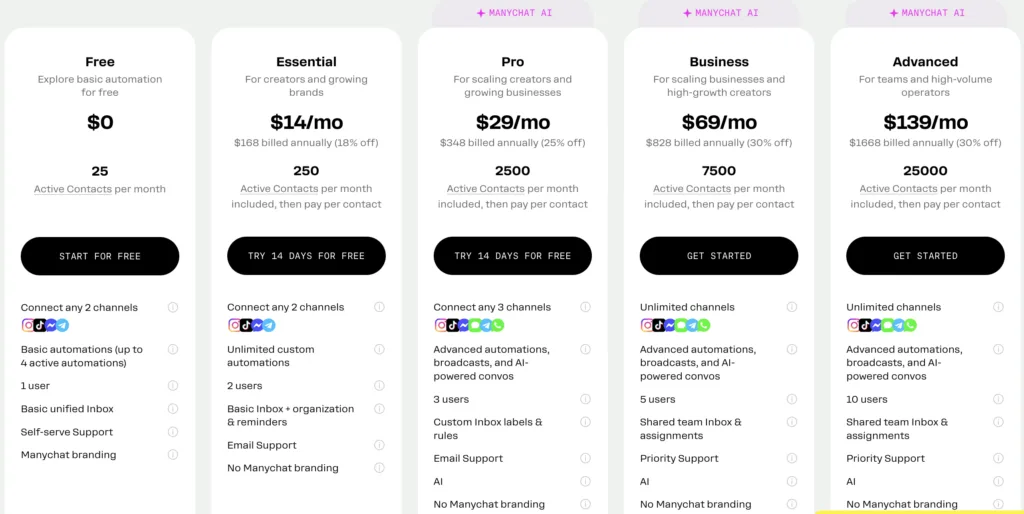
Eleven months after that round closed, on 2 March 2026, ManyChat replaced its pricing. The old two-tier arrangement became five tiers billed by Active Contacts, and the free plan dropped from 1,000 contacts to 25. Those two facts belong next to each other, because they tell you the direction of travel. The company is being run to expand revenue per account, and the mechanism it has chosen is to charge more as your audience grows. That is not a scandal. It is a thing to price into a three-year plan rather than a one-month trial.
The ratings disagree, and that gap is the whole story
Here is where ManyChat sits across the four platforms as of August 2026.
|
Platform |
Score |
Reviews |
What the audience is |
|---|---|---|---|
|
G2 |
4.5 / 5 |
165 |
Business buyers, verified, product-focused |
|
Capterra |
4.6 / 5 |
72 |
Business buyers, some incentivized |
|
Trustpilot |
2.2 / 5 |
295 |
Anyone, unprompted, billing-focused |
|
|
No score |
Dozens of threads |
Practitioners and competing vendors |
G2’s sub-scores tell a consistent internal story. Ease of Setup sits at 8.9 and Ease of Admin at 9.1, while Quality of Support trails everything else at 8.3. Capterra breaks the same way, with Ease of Use at 4.4 and Customer Service at 4.0, its weakest published dimension.
Trustpilot is where it falls apart, and the distribution matters more than the average. Forty-five percent of reviewers give one star and forty percent give five, with few in between. A plain arithmetic mean of that spread would land near 2.9, yet the published TrustScore is 2.2, because Trustpilot weights recent reviews more heavily. Recent sentiment is worse than historical sentiment. The trajectory bears that out: the profile sat at 3.0 across 243 reviews, then 2.8, then 2.4, and now 2.2 as the count passed 295.
I do not read this as one platform lying. G2 and Capterra ask people about a product they chose and configured. Trustpilot catches people at the moment they try to cancel, get charged unexpectedly, or need a human and cannot find one. ManyChat is genuinely good at the first thing and genuinely bad at the second, so both scores are true.
That is the last score in this review. Everything after this is written from what reviewers described rather than from what they rated, because a star tells you how somebody felt when asked, and a description tells you what will happen to your team.
What users actually say about ManyChat
Five themes recur, ordered by how often they came up.
Comment-to-DM works, and it works fast
The praise is specific and consistent. Reviewers describe duplicating an existing automation and having a new campaign live in under five minutes, and setting up a first flow from a template without technical help. One growth marketer reported a click-through rate above 62% on a reel-comment automation. Nobody argues about this part.
The bill moves when your audience moves, not when your usage does
The single loudest complaint, on every platform. Joy H., an independent sales consultant, described paying by subscriber count for people she never messaged, spam and bot accounts included. On Reddit, one operator reported 8,000 contacts accumulated through calls to action and a bill near $100 without a corresponding increase in what they were doing. Another described a plan going from $15 to $95 in the third month because a few reels went viral.
The builder is easy until the funnel gets large
Reviewers who run simple keyword flows call it intuitive. Reviewers running branching funnels describe the same builder becoming hard to maintain and harder to optimize, with advanced configuration needing more technical effort than the onboarding suggests. Several also note that building the same conversation across several channels means rebuilding it per channel.
Support is the thing people write about on their way out
Capterra reviewers describe tickets submitted three times without a response, broken help links, and a blame loop between ManyChat and Meta when contact uploads failed. G2 carries an account of a paying Pro user downgraded to Free after a successful payment, losing live WhatsApp support access for close to three days with no resolution timeframe, and no effective weekend cover.
The Meta dependency is felt as risk, not just as a spec line
This one surprised me. Users describe profiles silently disconnecting so automations stop firing and leads are lost without an alert. Ida, a Trustpilot reviewer, described being Meta Verified and still having her Instagram account flagged for suspicious activity shortly after integrating, with Instagram support finding nothing wrong on her profile. Whether ManyChat caused it is unproven. The fear is real and it recurs.
A note on sourcing. Capterra openly labels some entries as incentivized, so treat its aggregate as the friendliest of the four. Reddit needs the heaviest filter: on the billing thread above, the original post is an organic practitioner complaint, and the substantive replies include a self-identified Meta Tech Partner recommending their own WhatsApp platform. Several highly ranked “ManyChat alternatives” threads are written by founders of competing tools, and I have not treated any of them as user sentiment.
ManyChat pros and cons
|
Pros |
Cons |
|---|---|
|
Fastest comment-to-DM setup in the category |
Billing counts people, not outcomes |
|
Template duplication makes new campaigns near-instant |
Free tier too small to test anything real |
|
Official Meta and TikTok partner status |
No native website chat widget |
|
Seven channels in one inbox |
Support is email-only below $69 a month |
|
Strong lead capture and list building |
Flow maintenance degrades as branches multiply |
|
Large community and template library |
Account connection drops without alerting you |
|
AI included from $29 a month upward |
Contact hygiene tools are effectively absent |
What ManyChat does better than anyone
Turning social engagement into a captured contact, in minutes, without a developer. Nothing else in the category does that as cleanly, and the reason it dominates creator marketing is that the shortest path from a viral reel to an email address genuinely runs through this product. If that is the job, ManyChat is the right tool and the pricing complaints are a cost of doing business rather than a reason to leave.
What you will be living with
A bill that rises with your best months and cannot be trimmed after the fact, an escalation path that runs through email, and a hard dependency on platforms that can restrict your account for reasons neither you nor the vendor will fully explain. I read those as structural rather than as bugs awaiting a fix.
Feature by feature, based on the reviews
Pricing and billing mechanics
The billable unit is the Active Contact, and the definition is the most important sentence in this review. Per ManyChat’s own documentation, a contact counts as active when messages are sent or received through ManyChat, whether by automation, AI, broadcast, or the inbox. Counting happens on contact, not on outcome. There is no notion of a resolved conversation anywhere in the model.
Read that against the unified inbox and a second-order problem appears. Answering an organic DM inside ManyChat creates a billable contact. Answering the identical DM inside Instagram costs nothing. The consolidation being sold to you is also the meter, so the more your team adopts the inbox, the more the platform charges for work it never automated.
The overage schedule compounds it. Beyond the included allowance, Essential charges $0.10 per additional contact, Pro $0.05, Business $0.025, and Advanced $0.004. That is a twenty-five-fold spread, so the smallest account pays twenty-five times more per marginal contact than the largest. A viral post is cheap for an enterprise and expensive for a creator. Annual billing lowers those rates, but overages are still calculated and billed monthly, so committing for a year buys a discount rather than a predictable invoice. Deleting or unsubscribing contacts mid-cycle recovers nothing, because they counted the moment they engaged. Upgrading mid-cycle does forgive accrued overage, which quietly makes a tier bump the rational response to a good day.
I would model your worst month rather than your average one, because that is the month the model was designed around.
User experience and the flow builder
Duplication is the feature that earns the praise. An existing automation clones in seconds, and the clone is editable immediately, which is why campaign velocity is genuinely high. The problems start at scale, and they are structural rather than cosmetic. Branch count is the enemy: multi-path funnels become difficult to trace and difficult to optimize, and there is no strong versioning story when a flow breaks.
Channel handling costs more operationally. Messages are authored per channel, so a genuine seven-channel presence is seven builds and seven maintenance burdens. The word omnichannel is doing heavy lifting here.
Then there is the gap that matters most for anyone in support: there is no native website chat widget. ManyChat lives inside Meta’s messaging surfaces and adjacent apps, and the Messenger embed that approximates a site widget has been described as rendering oddly with buttons that intermittently fail, and a bot that can disappear from a customer’s chat history entirely. Private Instagram profiles cannot be sent an automated DM at all, so a share of the people who comment on your post silently never enter the funnel and nothing tells you.
If your customers expect help on your own website, I do not think this product can be the whole answer.
AI capability
AI arrives at the Pro tier and above. What it does well is structured capture: reading a reply, pulling an intent or a field, and routing accordingly. What it does not do is behave like a support agent. Practitioners describe it as closer to sophisticated keyword matching than to a reasoning system, with no durable memory across a long thread and no way to train it on your own help content the way a knowledge-grounded agent would be trained. One operator running it alongside a competing tool described it as hallucinating frequently while remaining reliable at data capture, which is a fair summary of the ceiling.
The absence that matters operationally is measurement. Because the platform has no concept of resolution, there is no deflection rate to report. You can count conversations started and contacts captured. You cannot answer the question a finance director will ask, which is what percentage of inbound questions were handled without a person and what each one cost. A team that adopts this as its AI support layer will find, twelve months in, that it has no defensible number to renew on.
I would treat this AI as lead capture that occasionally answers a question, and budget for human coverage accordingly.
Inbox, contacts and reporting
The inbox does consolidate seven channels convincingly, with labels and rules from Pro upward and shared assignment from Business upward. Contact management underneath it is the weak layer. Contacts are created from any social touch, and there is no automation-driven way to purge them before they sync onward, so a real estate operator described social followers who were never in the target market flowing through into HubSpot and polluting the CRM.
Put that beside the billing model, and the two dull facts become one expensive one. Contacts are created on any touch, billing counts any touch, and there is no bulk hygiene tool. A messy contact list is therefore a recurring monthly charge and a contaminated CRM at the same time, and cleaning it up is manual work that recovers no money already spent.
Reporting has a similar shape. Analytics are scattered across broadcasts, sequences, and automations rather than presented in one view, and there is no report showing which keywords were typed and got no response, which is precisely the list you would use to improve the thing.
I would assume you export to somewhere else for anything a board would look at.
Vendor support
Support access is a pricing decision before it is a service question. The free tier gets self-serve only. Essential and Pro get email. Priority handling starts at $69 a month. There is no phone path and no published SLA at any tier.
The failure shapes are consistent: tickets acknowledged then unanswered for days, weekends with no effective cover, help center links that lead nowhere, and billing states the product cannot recover from on its own. One ecommerce operator described paid features staying switched off after a lapsed payment was resolved, and kept paying a full subscription for months while they remained disabled, because reactivation was manual and nothing said so.
The sharpest connection in this whole review sits here. ManyChat’s refund policy allows cancellation with a refund within thirty days, and the route to claiming it is to message the support team. The escape hatch is gated behind the function that people most reliably report as unreachable. If I were trialing this, I would put that thirty-day window in the calendar as a hard deadline with an owner’s name against it.
Scale, compliance and platform risk
Everything routes through Meta and TikTok APIs, and ManyChat is an approved partner on both. Approval is not indemnity. Meta’s twenty-four-hour messaging window governs what you can send and when, policy changes land without warning, and reviewers describe connected profiles dropping silently so that automations stop firing while the dashboard still shows them live. Losing leads is bad. Losing leads without an alert is worse, because nobody investigates a queue that looks healthy.
Seat counts cap at ten on the top tier, there is no white-label option, and there is no meaningful multibrand or single sign-on story. Data portability is workable through the API and Zapier, though integrations are described as patchwork rather than native, particularly for CRM behavior data.
I would not put a business-critical support queue behind this. Put a marketing funnel behind it and keep the queue somewhere you control.
ManyChat alternatives, by what you are solving for
You want the DM funnel without a bill that grows with your success
This is the clearest case for looking elsewhere, and it is where Kayako genuinely differs. Pricing built around resolved conversations rather than counted contacts means a viral month raises volume without automatically raising cost per person reached. You give up ManyChat’s creator-native templates and its comment-trigger polish, which are real losses. Test it by taking your three highest-volume months and pricing both models against them rather than pricing your average month.
You need an agent that resolves questions rather than a scripted flow
If the goal is deflection with a number attached, Kayako’s AI is grounded in your existing help content and reports on resolution, and it can run against a helpdesk you already own without a migration. What you give up is the social-first trigger layer, so most teams end up running both rather than swapping. Test it by measuring what share of last month’s inbound questions were already answered somewhere in your documentation.
You want website chat in the same place as social
Tidio covers the gap ManyChat leaves open, pairing a native site widget with social channels and an AI layer aimed at ecommerce. You give up depth on Instagram comment automation, which remains ManyChat’s strongest single feature. Test it by counting how many of your conversations start on your own site rather than in a DM.
Your questions are order-related, and you sell on Shopify
Gorgias pulls order, refund, and shipping data into the conversation, which turns a large share of ecommerce contacts into one-click replies. It costs more per seat, and it is weaker as a marketing funnel builder. Test it by tagging a week of tickets and seeing what proportion need order data to answer.
You want the same comment-to-DM mechanic for less
Chatfuel and similar tools cover Messenger, Instagram and WhatsApp with simpler pricing, and several include website chat. You give up template breadth and community depth. Test it by rebuilding your highest-earning automation and running both in parallel for a fortnight.
You have outgrown SMB tooling and need a real service desk
Zendesk or a comparable platform gives you SLAs, multibrand, residency options and audit trails that none of the above provide. You give up speed, and you take on cost and configuration overhead. Test it by asking whether anyone has asked you for an SLA in writing yet.
Three numbers decide this for any option on the list: cost per resolved conversation at your real volume rather than your average, the hours of content work needed before the AI performs, and what the renewal looks like if your audience doubles.
Verdict
ManyChat is the best tool in the world at one job and a poor foundation for a different one. For turning Instagram engagement into captured leads at speed, without engineering help, nothing else comes close, and the enthusiasm on G2 and Capterra is earned rather than manufactured. For running customer support, it lacks a website widget, a resolution concept, an SLA, and a reachable human, and the Trustpilot collapse is what happens when people discover those absences after the invoice rather than before it.
On Monday, I would do two things. Open your last three months of contact counts and reprice them under the current tier and overage schedule, including the months you would call outliers, because those are the months the model exists to capture. Then decide, deliberately, whether your customer conversations should live in a marketing tool at all. If the answer is that you need capture from social and resolution somewhere accountable, run ManyChat for the first and put something built for support behind the second.
ManyChat FAQ
Is ManyChat safe to connect to my Instagram account?
ManyChat is an official Meta Business Partner and connects through approved APIs, so it is not an unauthorized automation tool. Several users still report account restrictions following integration, and Meta does not explain its enforcement decisions. I would connect a business account you could survive losing.
What exactly counts as an Active Contact?
Any unique person who exchanges a message with you through ManyChat during a billing month, regardless of how many messages pass. It includes people reached through automations and people you simply reply to in the inbox, which is the part most buyers misread.
Is the ManyChat free plan usable for a real business?
No, and it is not meant to be. Twenty-five contacts, two channels, four automations, and ManyChat branding make it a sandbox. Use the fourteen-day trial on Essential or Pro if you want a genuine evaluation.
Can ManyChat replace a customer support helpdesk?
Not on its own. It has no native website chat, no SLA management, no ticket lifecycle, and no resolution reporting. Teams that try usually end up pairing it with a helpdesk within a year.
How do I actually cancel and get refunded?
Cancellation takes effect at the end of the billing period rather than immediately, and refunds are available within thirty days by contacting support. Get confirmation in writing and check the following month’s statement, because charges after cancellation are the most common Trustpilot complaint.