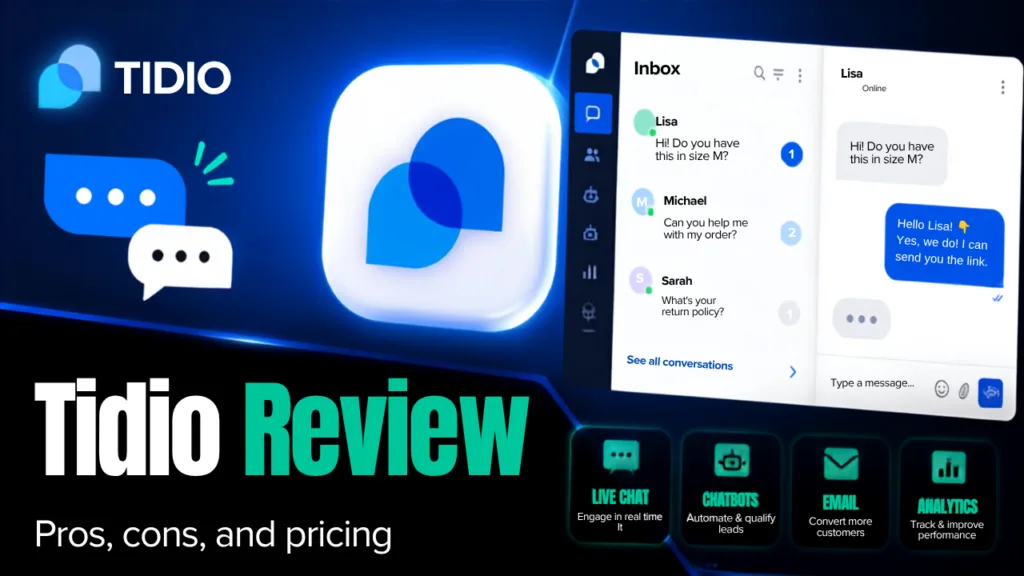
Tidio is a live chat and AI support platform aimed at small businesses, with a heavy concentration among Shopify merchants. A widget goes on your site, conversations from it arrive in one inbox alongside Messenger, Instagram, WhatsApp and email, and around that sit a visual chatbot builder called Flows, a ticketing layer, and Lyro, the AI agent that answers customers directly. It is priced from a free tier through published plans in the tens of dollars a month, with AI and automation billed as separate add-ons on top.
This review is written by Colin Guilfoyle, SVP of Customer Support at Trilogy, who has spent roughly a decade leading support functions and buying the software that runs them. He has not run Tidio against a live production queue, and nothing here is bench testing. What follows is built from published pricing and plan documentation, read first-hand and dated, and from a close read of what customers describe across four review platforms. Where there is an opinion, it comes from that experience of operating support teams. Where the evidence disagrees with the opinion, the evidence wins.
Tidio is the best-liked product I have reviewed in this series on the platforms that measure the product, and it has a pricing structure that almost nobody describes accurately on first reading. Those two facts are related. The software is genuinely good, fast to deploy and pleasant to use, and the commercial model underneath it runs three separate meters that most buyers discover one at a time. What follows reads all four platforms against each other, unpicks the meters properly, grades the product feature by feature, and names the alternatives worth a look.
How I evaluated Tidio
Support software is judged over a renewal cycle, not a trial. Six criteria, in the order they matter.
Hands-on use. I did not run Tidio against a live queue and will not pretend otherwise. What I examined directly is the published plan and add-on structure, read on 13 August 2026, including how the free tier is bounded and where each metered pool sits.
User reviews, at volume and in depth. G2, Capterra, Trustpilot, and Reddit, read for what people describe rather than the score they left, and checked for how many entries are vendor-solicited.
Depth and breadth of features. Whether the product covers a real support surface, and where it stops being a support tool and starts being a sales tool.
Scalability. What happens between the self-serve tiers and the top tier, and whether there is anywhere sensible to land in between.
Pricing and forecastability. The bill you cannot predict. This is where the research concentrated.
Support the vendor gives you. The fairest test a company selling customer service software can face, and Tidio performs well on it.
Two standing exclusions. Employer-review content from Glassdoor and AmbitionBox is dropped because it measures the company as a workplace rather than a vendor. Every source was checked for commercial interest, which matters here because Tidio publishes a great deal of its own comparison content and competitors publish a great deal more.
What you are actually buying in 2026
Tidio’s center of gravity has moved to Lyro, its AI agent, to the point where Lyro is being spun out with its own brand presence. The company positions itself as the AI agent for small businesses and claims a customer base in the hundreds of thousands across its products, weighted heavily toward ecommerce.
Two things about Lyro are worth knowing before the marketing. It runs on Anthropic’s Claude rather than on a model Tidio trains itself, which is a reasonable engineering choice and also means the underlying capability is licensed rather than proprietary. And the resolution figure the company quotes sits around 67%, with a separate company statement putting the average nearer 64% and peaking around 90% on favorable stores. I would treat 64% to 67% as the honest range on an average deployment rather than a single number.
The compliance position improved materially with SOC 2 Type II certification in October 2025, alongside GDPR and CCPA. That matters for anyone who was previously blocked from putting customer conversations through it.
One piece of history belongs in any 2026 evaluation. In December 2024, Tidio changed pricing in a way that substantially increased bills for existing customers, and reviewers were still referencing it well into 2026. The company has continued to evolve its packaging since. I do not read either fact as disqualifying, but both belong in a risk assessment for a multi-year commitment.
The ratings agree on the product and split on the billing
Here is where Tidio sits across the four platforms as of August 2026.
|
Platform |
Score |
Reviews |
What the audience is |
|---|---|---|---|
|
G2 |
4.6 / 5 |
1,900+ |
SMB users, many via seller invite |
|
Capterra |
4.7 / 5 |
450+ |
Small business, some incentivized |
|
Trustpilot |
3.8 / 5 |
223 |
Anyone, mixed, vendor engages |
|
|
No score |
Light |
Shopify merchants, scattered |
Two of these numbers are among the strongest in this series. G2 at 4.6 across more than 1,900 reviews is a large, healthy sample, and support quality specifically scores around 9.3 out of 10, which is unusual for a product at this price. Capterra at 4.7 agrees.
Trustpilot is where the picture changes, and its 3.8 is neither the collapse seen with most vendors nor the endorsement seen on the product platforms. It sits in between, which is itself informative: the commercial relationship generates real friction without generating the wave of one-star billing complaints that characterizes the worst offenders. The vendor also replies to reviews there, including critical ones.
The caveat that matters most is solicitation. A meaningful share of the G2 corpus is marked as collected through seller invite and flagged as incentivized, and Capterra carries incentivized entries too. That does not make the reviews false, and the volume is too large to dismiss. It does mean the gap between the product platforms and Trustpilot is partly a difference in who was asked rather than purely a difference in experience.
That is the last score in this review. Everything after this comes from what people described.
What users actually say about Tidio
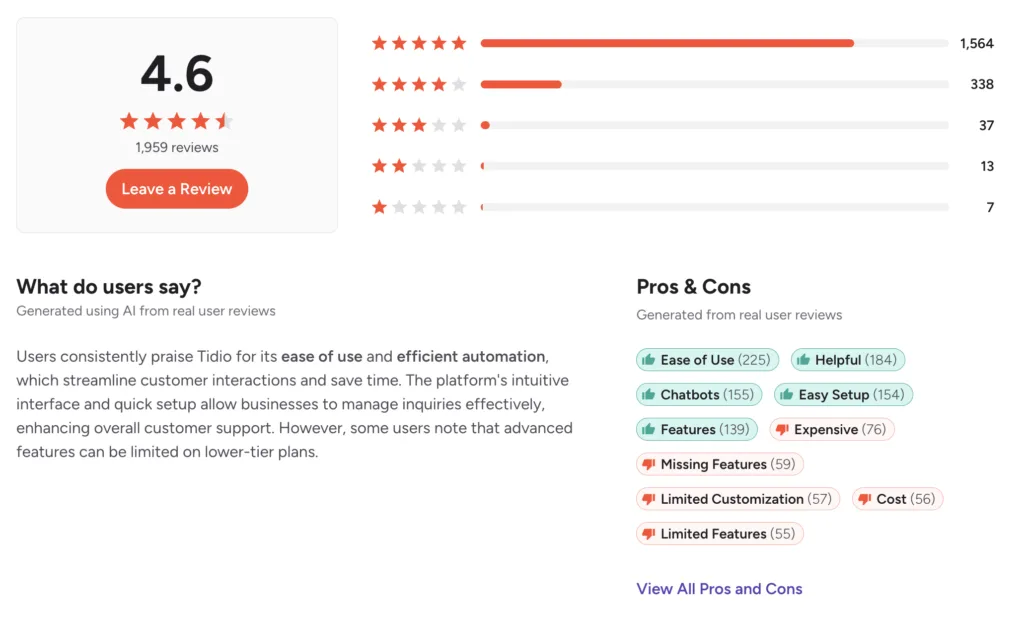
Five themes recur, ordered by how often they came up.
It goes live faster than anything else in the category
The most consistent praise, and it is measured in minutes rather than days. Reviewers describe installing the widget and having live chat plus AI running with minimal effort, several putting the whole setup under fifteen minutes. For a solo merchant or a two-person team, that is the entire value proposition and Tidio delivers it.
Lyro does real work when the content behind it is good
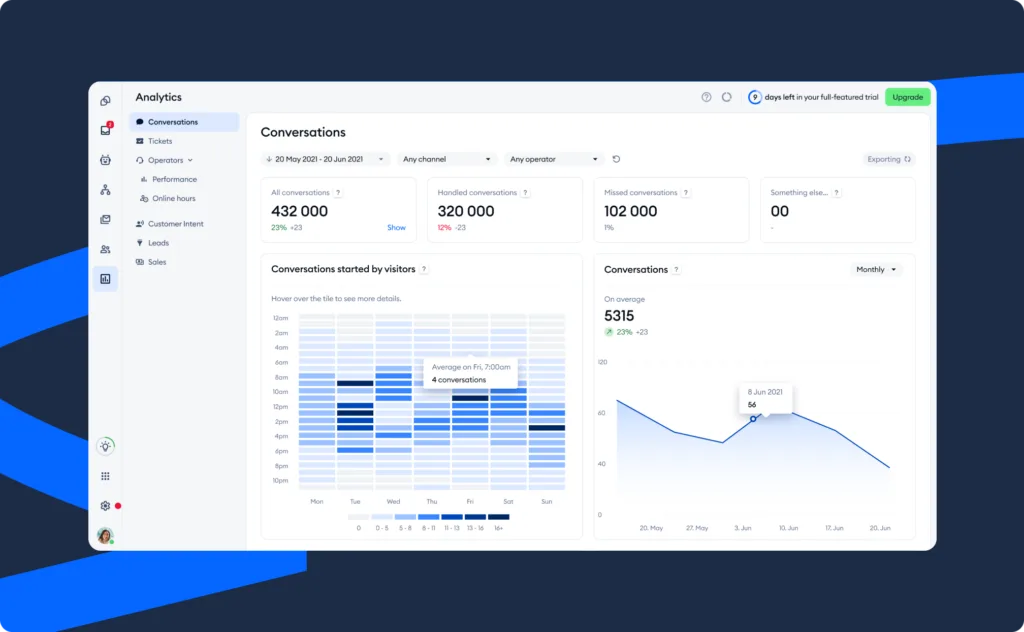
Reviewers describe Lyro handling repetitive questions, keeping context across a conversation, and covering out-of-hours volume that would otherwise go unanswered. The analytics behind it are better than most, showing answer rates, handover frequency, and the questions Lyro could not answer, which is exactly the list you would use to improve it.
The add-on structure is the central frustration
The loudest criticism, and it is structural rather than about any single price. Lyro and Flows are sold separately from the base plan, so a store wanting meaningful automation stacks a plan price, a Lyro price, and a Flows price. Independent analysis puts a realistically automated small store around $80 a month once all three are combined, against headline plan pricing that reads considerably lower.
The jump to the top tier has nothing underneath it
Reviewers and analysts both flag the same gap. The self-serve ladder runs from free through the low tens of dollars, and then the top tier arrives at several hundred dollars a month with nothing sensible in between. Teams that outgrow the mid-tier face a multiple-fold increase rather than a step, and there is no self-serve option to land on.
It leans toward sales rather than deep support
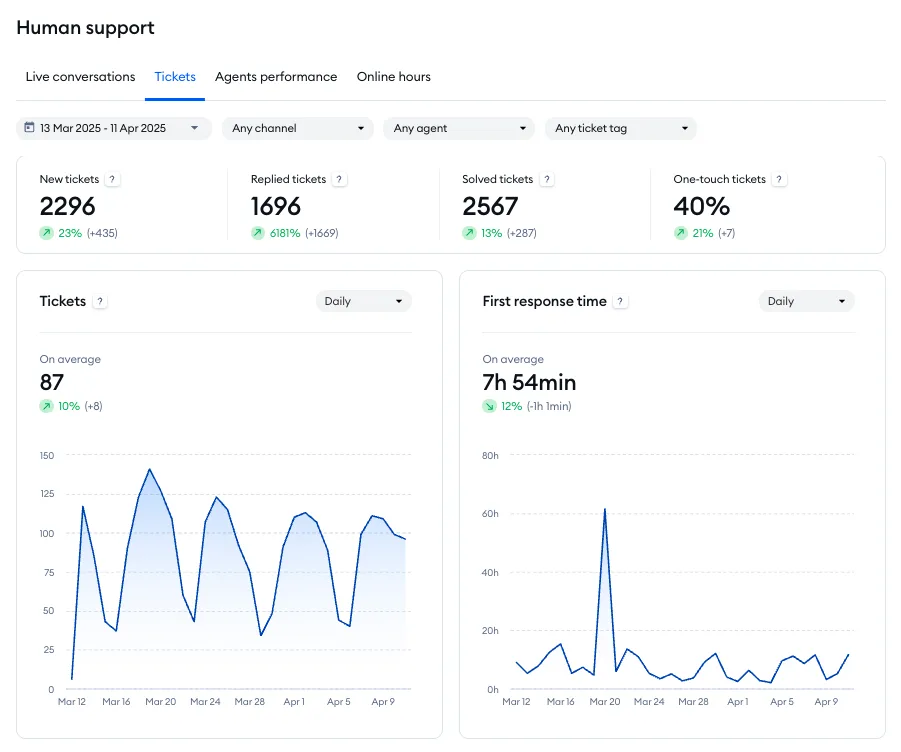
A recurring theme among reviewers who wanted a help desk. There is no full knowledge base product of the kind support teams expect; flow-level analytics showing where visitors drop out of a chatbot sequence are missing, and reporting is adequate rather than deep. One Trustpilot reviewer in March 2026 said plainly that the thing they wanted was a help center and documentation feature they could not find.
A note on sourcing. A large share of the G2 and Capterra corpus is vendor-solicited and incentivized, so weight Trustpilot more heavily than usual when reading sentiment. Tidio also publishes extensive comparison content about competitors, and competitors publish the same about Tidio, so nearly every non-review page ranking for this term has a commercial interest in the answer. I have used none of it as user sentiment.
Tidio pros and cons
|
Pros |
Cons |
|---|---|
|
Live in under fifteen minutes |
Three separate metered pools to track |
|
Lyro resolves a real share of routine questions |
Automation costs more than the plan does |
|
Genuinely useful AI analytics and gap reporting |
Large price cliff to the top tier |
|
Strong Shopify and ecommerce integration |
No true knowledge base product |
|
Free tier that lets you test properly |
Flow-level drop-off analytics missing |
|
Vendor support rated highly by users |
History of a disruptive pricing change |
|
SOC 2 Type II, GDPR and CCPA in place |
Leans sales rather than support depth |
What Tidio does better than anyone
Getting a small ecommerce business from no support automation to working support automation in an afternoon, with an AI agent that resolves a real share of questions rather than deflecting them into a form. Nothing else in this price bracket combines that speed with an AI layer this capable, and the enthusiasm in the reviews reflects something true.
What you will be living with
A bill assembled from a plan plus two add-ons, three usage pools that deplete independently, and a ceiling you hit before you are ready for enterprise pricing. Those are commercial design choices rather than defects, so no release will change them.
Feature by feature, based on the reviews
Pricing and the three meters
This is the section that matters most, and the structure is genuinely harder than the pricing page suggests.
There are three separate quotas running in parallel. Billable conversations count exchanges between a visitor and a human agent. Lyro conversations are counted separately against their own allowance. Flow triggers are counted separately again. Each is bounded, each is topped up differently, and a busy month can exhaust them at different rates. Three pools is more accounting than I think a small merchant expects to do.
The add-on stacking follows from that. The base plan buys the inbox. Lyro is an add-on. Flows is an add-on. A store that wants the automation Tidio is marketed on pays all three, and independent analysis consistently lands that combination around $80 a month at the small end against a headline that reads roughly a third of it.
Two further mechanics deserve attention. Fifty free Lyro conversations are included on every plan, which is a genuine trial rather than a demo and I would use it. And reporting suggests an automatic upgrade triggers when usage approaches the top of a tier, which is convenient if you expected it and unwelcome if you did not.
The cliff is the last piece. The step from the mid self-serve tier to the top tier is a multiple rather than an increment, with no intermediate plan. I would model where your conversation volume lands in twelve months, because the tier above the one you are choosing may be several times the price.
The widget, inbox and Flows
The widget is fast, modern and customizable, and reviewers consistently prefer its look to the older tools in this category. Placement, branding and appearance are all adjustable without code, which matters when it sits on a storefront.
The inbox consolidates website chat, Messenger, Instagram, WhatsApp and email convincingly for a product at this price, and reviewers describe managing all of it without switching tools. Response quality holds up under load according to users, and latency is low because the AI and the inbox are the same platform rather than a bolt-on.
Flows, the visual chatbot builder, is capable and no-code. The gap reviewers name is analytical rather than functional: you cannot easily see how visitors move through a specific flow or where they abandon it, which makes optimization guesswork for the paid feature. For a tool where flows are a paid add-on, not being able to measure their performance properly is the more frustrating half of the problem.
Lyro and AI capability
Lyro is the strongest part of the product and the reason to consider Tidio over a cheaper widget. It answers in natural language, holds context across a conversation, covers 48 languages, and hands off cleanly to humans. Reviewers report it genuinely reducing repetitive load rather than annoying customers, which is not the norm.
Three things temper it. The resolution figures are first-party, and the honest range is around 64% to 67% on an average store rather than the higher peaks quoted in case studies. Performance depends entirely on the content you point it at, so a thin or stale knowledge source produces confident wrong answers, and Tidio does not offer a full knowledge base product to build that content in. And the separate Lyro quota means the better it works, the faster you consume the pool you pay for.
Two adjacent features get confused with Lyro and should not be. Copilot is a free browser extension suggesting replies to agents, and the Reply Assistant polishes agent-written messages. Both help your team, and only Lyro talks to customers.
Support depth, ticketing and reporting
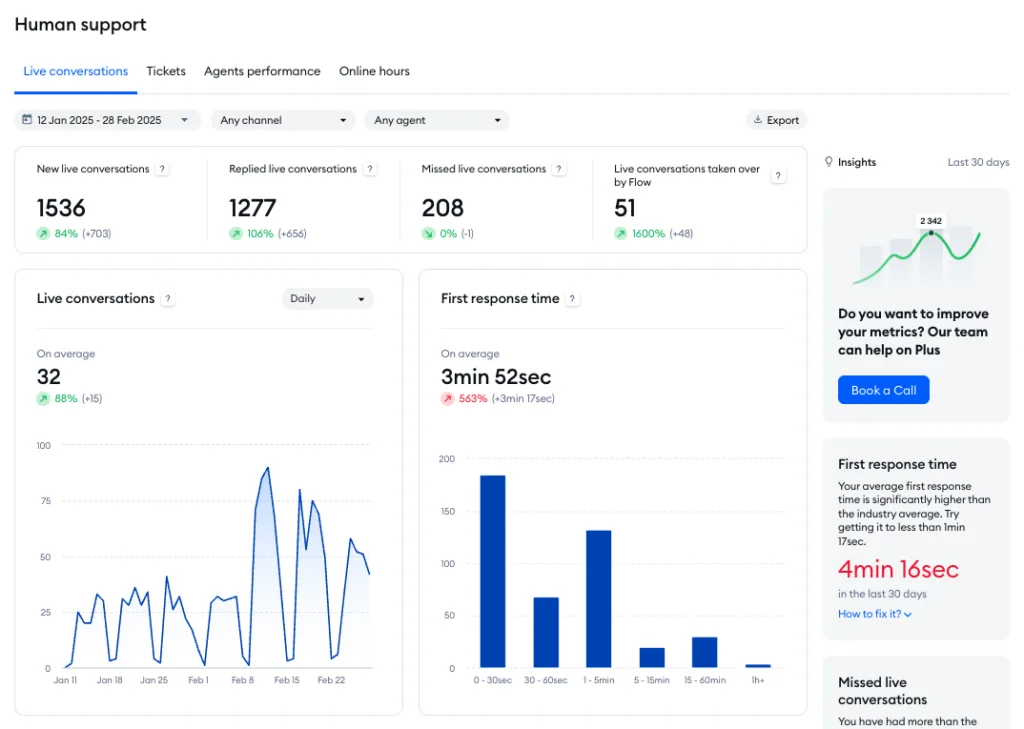
This is where the sales orientation shows. Ticketing exists and works for straightforward queues, but the surrounding machinery a support team expects is thin. There is no full knowledge base or help center product, no SLA engine of substance, and reporting covers conversation volume, response times and agent performance adequately without going deeper.
For a Shopify store answering pre-sales and order questions, I do not think much of that matters. For a team whose customers expect documentation, entitlements or audit trails, it matters immediately, and the mismatch is the single most common reason reviewers describe outgrowing the product.
Ecosystem, compliance and vendor support
Shopify integration is the strongest in the list and includes native actions rather than just data display, which is why the product concentrates among merchants. WordPress, Instagram, Messenger, WhatsApp, and email are all covered. Telegram is not native and needs a third-party automation tool.
Compliance improved with SOC 2 Type II in October 2025 alongside GDPR and CCPA, which clears the bar for most SMB procurement. Teams needing HIPAA or public-sector certification will find the posture insufficient.
Vendor support is a genuine strength and reviewers volunteer it, with support quality scoring above 9 out of 10 on G2 and Trustpilot reviewers describing real help with widget and setup problems. For a product sold to businesses without technical staff, that matters more than a feature.
Tidio alternatives, by what you are solving for
You want AI priced by resolution rather than by three pools
Kayako prices AI around resolved conversations in a single line rather than splitting human conversations, AI conversations, and flow triggers into separate depleting quotas. You give up Tidio’s Shopify-native actions and its speed of setup. Test it by taking a month of transcripts and pricing both models against the same volume.
You need real support depth behind the chat
If the missing knowledge base is your blocker, Kayako brings documentation, ticket lifecycle, and resolution reporting that Tidio does not attempt. You give up the ecommerce focus. Test it by counting how many of last month’s chats should have been answered by an article that does not exist yet.
You are Shopify-first, and order questions dominate
Gorgias pulls order, refund, and shipping data into the conversation and goes deeper on ecommerce workflows than Tidio does. You pay more and give up simplicity. Test it by tagging a week of chats and counting how many need order data to answer.
You want a broader help desk at a similar price
LiveAgent covers email, chat, phone with IVR and a multi-brand knowledge base from a low entry price, though the interface is dated. Test it by listing the channels you actually need and pricing the tier that contains all of them.
Your volume has outgrown SMB tooling
Intercom offers deeper team inbox capability and per-resolution AI pricing for higher-volume operations. You pay materially more per seat. Test it by pricing your current volume at both and comparing cost per resolution.
You want the cheapest workable option
tawk.to is free with unlimited agents and covers basic chat and ticketing without AI. You give up Lyro entirely, which is the main reason to buy Tidio. Test it by running both widgets on different site sections for a fortnight.
Three numbers decide this for any option: total cost at your real volume including every metered pool, what the tier above your chosen one costs, and how many hours of content work stand between you and the AI performing.
Verdict
Tidio is a genuinely good product wrapped in a genuinely confusing commercial model. The widget is modern, the setup is the fastest in the category, Lyro resolves a real share of routine questions rather than deflecting them, and the vendor answers its own support tickets well. For a small ecommerce business that wants working AI support this week rather than after a project, it is a sound choice and the ratings are earned.
The reservations are all about money and depth. Three metered pools run in parallel, the automation that makes the product worth buying is sold as two add-ons on top of the plan, the step to the top tier is a multiple rather than an increment, and there is no real knowledge base underneath the AI that depends on one. On Monday, I would do two things. Take your last three months of conversation volume and price it against all three meters rather than the plan line, including the months you would call outliers. Then spend the fifty free Lyro conversations on your hardest real questions rather than your easiest, because the resolution rate on your average query is not the number that decides whether this works.
Tidio FAQs
How much does Tidio actually cost?
More than the plan price if you want automation. The base plan buys the inbox, while Lyro and Flows are separate add-ons, and independent analysis puts a realistically automated small store around $80 a month once all three are stacked. There is a free tier for testing.
How good is Lyro really?
Better than most AI at this price, with a first-party resolution figure around 67% and a company-stated average nearer 64%. It runs on Anthropic’s Claude and holds context well. Its ceiling is the quality of the content you point it at.
Can Tidio replace a help desk?
For a small ecommerce store answering pre-sales and order questions, largely yes. For a team needing a knowledge base, SLA management, or audit trails, no. The absence of a full documentation product is the most common reason teams outgrow it.
What are the three quotas people mention?
Billable human conversations, Lyro AI conversations, and Flow triggers are each counted separately with their own allowances. A busy month can deplete them at different rates, which is the main reason bills surprise people.
Is Tidio secure enough for regulated data?
It holds SOC 2 Type II as of October 2025 plus GDPR and CCPA, which satisfies most SMB procurement. Teams requiring HIPAA or public-sector certification should look elsewhere.