Zendesk Pricing 2026: Plans, Costs, Features, and Is It Worth It?
Pricing tells you what Zendesk costs. Use cases tell you whether it is worth paying for. This guide covers both.
|
Quick answer. Zendesk pricing in 2026 runs from $19 per agent per month for Support Team up to $115 per agent per month for Suite Professional on annual billing, with Suite Enterprise sold through sales. The published plan price is only the starting number. AI agents are billed separately for every automated resolution, and add-ons for voice, workforce management, and quality add roughly $50 per agent per month each. So the real question behind Zendesk pricing is not which plan is cheapest; it is whether the plan you need is worth the cost for a support operation like yours. Key takeaways
|
Zendesk pricing is not simply a matter of picking the cheapest plan. Your actual cost depends on how many agents you have, which support channels you run, how much automation you need, and which AI or add-on modules you switch on. More importantly, the most expensive Zendesk plan is not automatically the right one for your business.
This guide breaks down what each plan is built for, what really drives your monthly cost, and when Zendesk is worth the money versus when you may be paying for far more support infrastructure than you use. To make that practical, it ends with a decision tree and a scenario table so you can place your own team rather than read another generic price list. First, the published numbers.
1. Zendesk pricing at a glance
Here is the current published structure for Zendesk, on annual billing. Treat it as the entry point to the conversation, not the whole cost.
|
Plan |
Annual price per agent |
Built for |
|---|---|---|
|
Support Team |
$19 / month |
Email and ticketing for teams past a shared inbox |
|
Suite Team |
$55 / month |
Omnichannel support with AI agents |
|
Suite Professional |
$115 / month |
Advanced routing, analytics and AI insights |
|
Suite Enterprise |
Contact sales |
Complex enterprise requirements and governance |
Note. Zendesk has folded its old Support Professional and Support Enterprise plans into the Suite, so the real ladder most buyers climb now runs Support Team, then the three Suite tiers. Monthly billing costs more than the annual figures above.
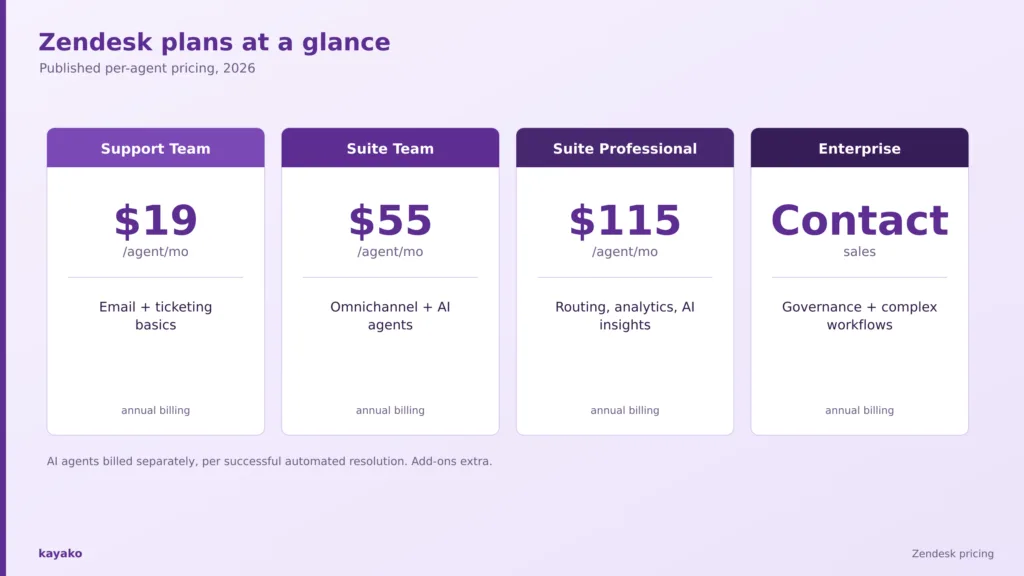
The four published Zendesk tiers. AI resolutions and add-ons sit on top of these numbers.
That table is table stakes, and every competing article already prints it. Before breaking down what moves that number, it helps to hear from the teams already paying it.
2. What people say about Zendesk on G2, Capterra, and Reddit
Zendesk holds strong ratings across review sites, around 4.3 out of 5 on G2 from roughly 6,700 reviews, and 4.4 on Capterra from more than 4,000. The averages look settled, so the standout themes behind them are what actually tell you whether the price is worth it, and they split sharply by team size.
What people praise
- Omnichannel that genuinely unifies. Reviewers describe email, chat, messaging, and voice landing in one agent view as mature and properly joined up, which is the capability larger teams value most.
- Deep workflow automation. Triggers, macros, routing, and SLA tooling let teams encode real process rather than just tag tickets.
- Reporting depth. The Explore dashboards earn praise for how far you can slice ticket volume, CSAT, and SLA data.
- Reliability. Stability rarely comes up as a problem; reviewers treat uptime as enterprise-grade.
What people flag
- Cost is the loudest complaint. On Reddit’s r/Zendesk, a widely shared thread describes a bill reaching around $5,000 a month for only a couple of dozen users, and reviewers repeatedly say the per-agent model punishes growth. The $19 Support Team tier is often seen as too thin, which pushes teams up to Suite Team at $55.
- Add-ons stack quietly. Copilot, quality assurance, and workforce management get switched on one at a time, so the quoted price and the real invoice drift apart. On G2, cost escalation is the single most common criticism, and it hits smaller teams hardest.
- The AI resolution meter drew real pushback. Reviewers describe the per-resolution billing as unpredictable and consistently higher than expected, with reported rates near $1.50 committed or $2.00 pay-as-you-go, plus disputes over what even counts as a resolution.
- Setup takes real work. Ease of setup is Zendesk’s lowest-scoring area on G2, and Reddit users warn that standing it up can take weeks and that the administration never really stops.
- Zendesk’s own support frustrates some buyers. A recurring theme is being pointed to help-center articles instead of a person, and slow responses on complex integration issues.
- Deeper reporting often costs more. Several reviewers note that the most useful analytics sit behind higher tiers or the Explore add-on.
None of these are vague grumbles. They trace directly back to how the Zendesk bill is assembled, which is worth breaking down next.
|
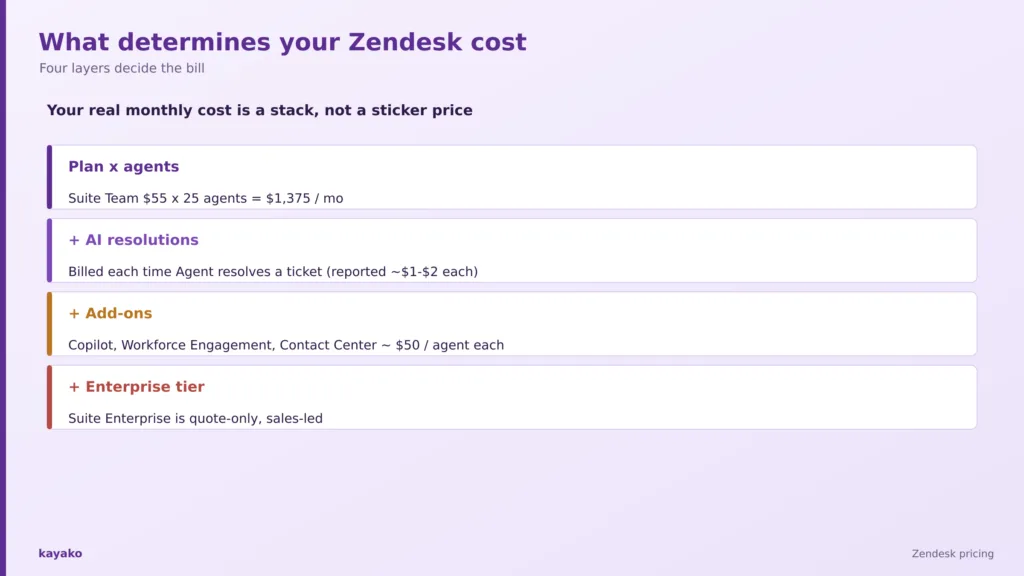
3. What actually determines your Zendesk cost?
Zendesk is billed primarily per agent per month, so the size of your team is the first lever. The clearest way to feel the pricing is to run it against real headcounts on the Suite Team plan.
Number of agents
- 5 agents. $55 times 5 is $275 per month on Suite Team, billed annually.
- 25 agents. $55 times 25 is $1,375 per month.
- 100 agents. $55 times 100 is $5,500 per month, or $66,000 a year before anything else.
That math makes the subscription tangible. The more important question is what those agents are actually doing, because the plan price is only the first of four layers on your bill.
AI resolutions and add-ons
Zendesk now prices its AI agents on outcomes. You pay a fee each time the AI resolves a customer request without handing it to a human. Zendesk does not publish a per-resolution rate, and independent analyses put the effective cost in the region of one to two dollars per automated resolution for mid-market teams, charged on top of your Suite subscription. Separately, modules for voice and contact center, workforce engagement, and quality assurance each add around $50 per agent per month when you need them.
Stack those layers together, and the sticker price understates the real figure. A mid-size team on Suite Professional with voice and AI running can pay well beyond the headline $115. That is why the next question matters more than the price list: which plan does your support operation genuinely need?
Four layers decide the real Zendesk bill: plan, agents, AI resolutions, and add-ons.
|
|
4. Which Zendesk plan makes sense for your support team?
The right plan follows the shape of your support work, not the length of the feature list. Three common patterns cover most teams.
A small team handling email: consider Support Team
Support Team fits when your work is mostly ticket management, email support, basic routing, customer context, simple automations, and basic reporting. If you have five to ten agents and most tickets are straightforward product questions, account issues, and requests arriving by email, you probably do not need the full Suite.
- Scenario. A ten-person team answering product and billing questions that nearly all arrive by email, with no live channels yet.
Omnichannel support: consider Suite Team
Suite Team is built for teams ready to unify channels and automate resolutions with AI agents. It earns its higher price once customers reach you across email, live chat, messaging, voice, and social, because a single customer context across those channels is where the value appears.
- Scenario. A customer opens a chat, follows up by email, then calls. Unified history across all three now saves real handling time.
If live chat is the channel you are weighing, our rundown of the best live chat software compares the options in more depth.
Complex operations: consider Suite Professional
Suite Professional is the tier for teams optimizing larger operations with skills-based routing, advanced reporting, interactive voice response, AI assistance, and more sophisticated workflows. The higher price makes sense once a single general queue starts creating bottlenecks.
- Scenario. Fifty or more agents across billing, technical support, customer success, and account management, where sending every ticket into one queue slows everything down.
Knowing which plan fits is half the decision. The other half is knowing when any of this spend is justified, which is where most pricing articles go quiet.
5. When does Zendesk pricing actually make sense?
Rather than claiming Zendesk is good for large businesses, it helps to name the conditions that make the cost pay back. Zendesk earns its price when several of these are true at once.
- You run multiple support channels. The value comes from consolidating email, chat, voice, and social into one view instead of stitching tools together.
- You have a large support team. Routing, automation, and reporting become more valuable as ticket volume and headcount grow.
- You need sophisticated workflows. Different issue types that route to different teams with their own escalation paths reward a configurable platform.
- You need enterprise controls. Granular permissions, governance, and advanced reporting can justify moving up the ladder.
- You are investing heavily in AI automation. Zendesk includes AI agents across Support and Suite, with pricing tied to successful outcomes.
Put plainly, this section answers when Zendesk is expensive and, more usefully, when it is expensive for a reason. The reverse question is just as important for a buyer, because the same capabilities become dead weight for a simpler operation.
|
|
6. When might Zendesk be more than you need?
A ten-person software company handling two thousand tickets a month does not need the same support infrastructure as a global contact center. The better test is complexity, not company size. Zendesk may be more platform than you need when several of these hold true.
- You primarily need ticketing and email.
- Your support team is small.
- You do not run multiple live channels.
- Your workflows are relatively straightforward.
- You do not need extensive enterprise administration.
- Your biggest goal is resolving more tickets with AI, rather than managing a complex operation.
This is where per-agent pricing can work against you. When most of your volume is repetitive and automatable, you are paying for seats and modules to manage work that a strong AI agent could resolve outright. For that pattern, a platform built around AI agents rather than basic chatbots and priced on resolved tickets changes the math. It also reframes the whole buying question by scenario.
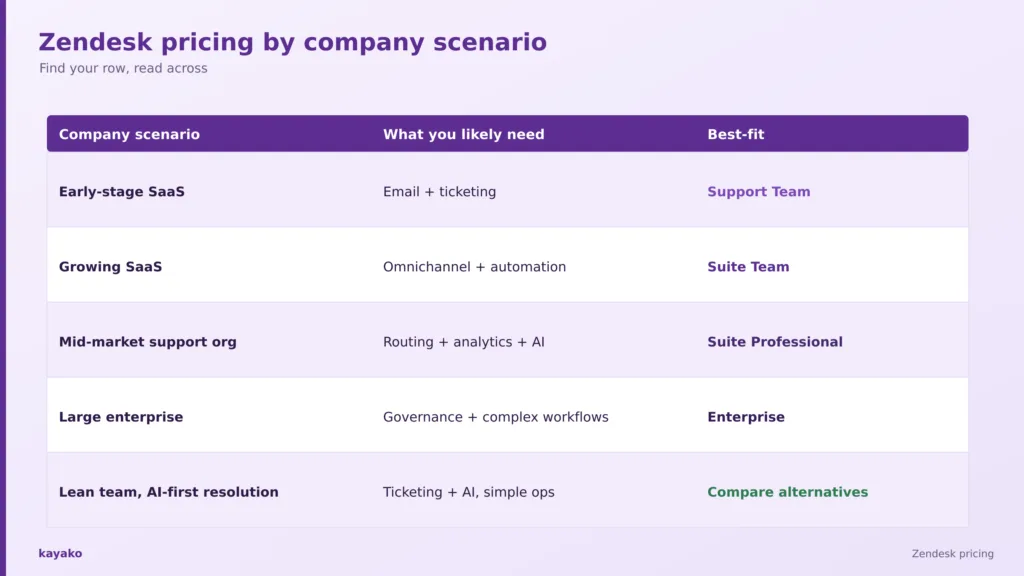
7. Zendesk pricing by company scenario
Find the row that sounds most like your team, then read across to the likely plan. The last row is the one most pricing pages leave out.
|
Company scenario |
What you probably need |
Zendesk fit |
|---|---|---|
|
Early-stage SaaS |
Email and ticketing |
Support Team |
|
Growing SaaS |
Omnichannel and automation |
Suite Team |
|
Mid-market support org |
Routing, analytics, and AI |
Suite Professional |
|
Large enterprise |
Governance and complex workflows |
Enterprise |
|
Lean team focused on AI resolution |
Ticketing, AI, and simple operations |
Compare alternatives |
Match your scenario to the plan. Lean, AI-first teams are the ones who should price alternatives.
Seeing yourself in a row is useful, but a buying decision usually comes down to a direct comparison. For most teams weighing Zendesk, the live question is how it stacks up against a leaner AI-first option.
8. Zendesk vs Kayako
This is not a full feature teardown, just the short version of where each platform fits.
Zendesk
Strengths include broad omnichannel support, a mature and highly configurable platform, advanced routing and reporting, a large app ecosystem, and deep enterprise capabilities. It fits organizations that need a configurable, mature support operation and have the team to run it.
Kayako
Strengths include unified customer conversations through SingleView, AI-powered resolution through the Agent Kay AI agent, strong customer context, automation, and simpler workflows. Rather than per-seat licensing, Kayako is priced at one dollar per resolved ticket with a fixed onboarding fee, so cost tracks outcomes instead of headcount. It fits teams that want to scale support with AI without building an unnecessarily complex operation.
The pricing contrast is the real story. Per-agent licensing rewards adding seats; per-resolution pricing rewards resolving more tickets automatically. If you are actively weighing a move, our guide to the best Zendesk alternatives lays out the options by use case.
A head-to-head helps, but the final call comes down to your own numbers. A short checklist turns the pricing question into a decision.
|
9. What should you actually consider before buying Zendesk?
Swap the question of which plan is cheapest for a short set of questions about your own operation. The answers decide both the plan and whether Zendesk is the right platform at all.
- How many agents actually need seats?
- How many tickets do we handle a month?
- How many channels do customers really use?
- How complex are our workflows and escalations?
- How much of our volume could AI resolve outright?
- How much reporting and administration do we genuinely need?
- What will the platform cost when the team doubles?
That last question is the one that catches teams out. Pricing today is not the same as cost at scale. Per-agent models grow with headcount, so a plan that looks affordable at ten agents can become a major line item at fifty. It is also worth weighing how much of your demand is automatable, since independent research from Gartner found only 14 percent of customer service issues are fully resolved in self-service, which shows how much room modern AI resolution still has to take load off paid seats.
With those answers in hand, the decision becomes straightforward. The tree below turns them into a single recommendation.
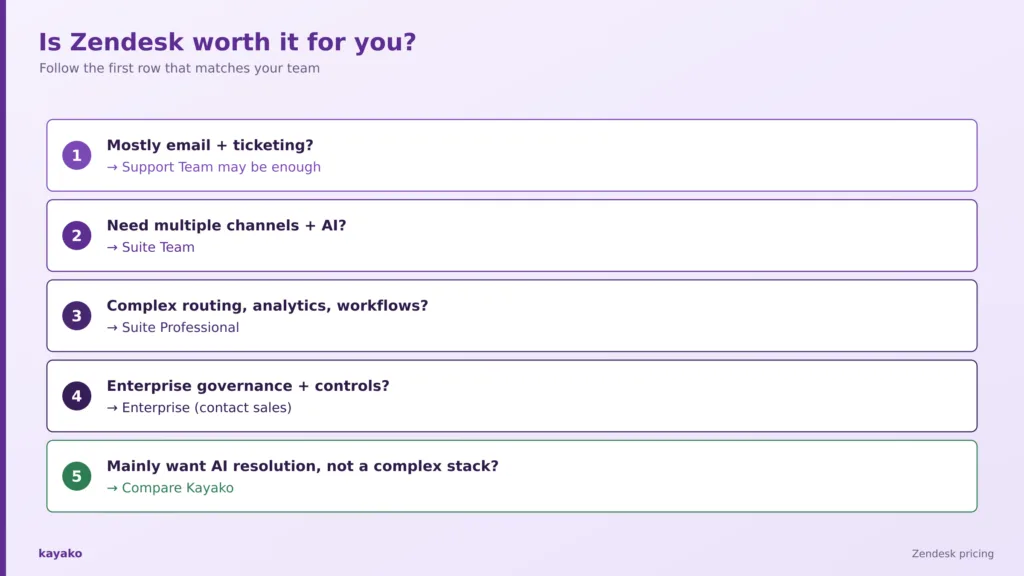
Is Zendesk worth it for you? A quick decision tree
- Do you primarily need email and ticketing? Support Team may be enough.
- Do you need multiple channels and AI? Suite Team.
- Do you have complex routing, analytics, and workflows? Suite Professional.
- Do you need enterprise governance and advanced controls? Enterprise.
- Do you mainly want AI-powered resolution without a complex stack? Compare Kayako.
Follow the first row that matches your team to land on the right plan, or a leaner alternative.
A tree like this is more commercially useful than another long pricing table, because it moves you from what Zendesk costs to whether it is worth paying for. Before the final recommendation, a few quick answers to the questions buyers search most.
How Kayako helps
Kayako is an AI customer support platform built around autonomous resolution. Agent Kay resolves repetitive tickets end to end, and SingleView gives agents the full history of every customer on one screen for the conversations that still need a human. Because pricing is one dollar per resolved ticket rather than per seat, cost rises only when the platform does the work, which suits exactly the lean, AI-first teams that find a full per-agent suite more than they need.
Case study: Trilogy. Trilogy reached 76 percent autonomous resolution with Kayako, cut average ticket age from 17.6 hours to under two minutes, and saved five million dollars within 90 days, the kind of outcome per-resolution pricing is designed to reward.
|
Conclusion
Zendesk pricing in 2026 is clear enough on paper: $19 to $115 per agent per month, with Enterprise sold through sales, plus per-resolution AI fees and add-ons on top. The harder and more valuable question is fit. For a team with real complexity, multiple channels, large volume, and genuine enterprise needs, the cost is justified by what the platform does. For a leaner team whose main goal is resolving more tickets with AI, the same spend buys infrastructure that mostly sits idle.
So read the price list, then read your own operation. Pricing tells you what Zendesk costs. Your use case tells you whether it is worth it, and whether a simpler, outcome-based platform would get you more resolution for less.
Frequently asked questions
How much does Zendesk cost?
Zendesk costs from $19 per agent per month for Support Team up to $115 per agent per month for Suite Professional on annual billing, with Suite Enterprise priced through sales. AI resolutions and add-ons are charged separately on top of the plan.
What is the cheapest Zendesk plan?
Support Team at $19 per agent per month on annual billing is the cheapest plan. It covers email, ticketing, basic routing and reporting, and suits small teams that have outgrown a shared inbox but do not yet need live channels or advanced automation.
Is Zendesk priced per agent?
Yes. Zendesk subscriptions are billed per agent per month, so cost scales directly with team size. AI agent resolutions are billed separately by outcome, and add-ons such as voice and workforce management are also per agent.
Does Zendesk include AI?
Zendesk includes AI agents across its Support and Suite plans, but the automated resolutions they handle are billed separately from the seat price. In practice, heavier AI usage raises your total beyond the published per-agent figure.
How much does Zendesk AI cost?
Zendesk does not publish a per-resolution rate. It charges each time an AI agent resolves a request without a human, and independent analyses estimate roughly one to two dollars per automated resolution for mid-market teams, on top of the subscription.
Is Zendesk worth the cost?
Zendesk is worth the cost for teams with multiple channels, high volume, complex workflows or enterprise governance needs. For small teams that mainly handle email, or whose priority is AI resolution rather than a configurable operation, it can be more platform than the price justifies.
Is Zendesk good for small businesses?
Small businesses can run well on Support Team, but should watch the total cost as channels, AI usage and add-ons grow. Teams whose volume is largely repetitive often get more value from a leaner, resolution-priced platform than from climbing the Suite tiers.
What is the best Zendesk alternative?
The best alternative depends on your use case. For teams focused on AI-first autonomous resolution without per-seat licensing, Kayako is a strong fit; our guide to the best Zendesk alternatives compares options by scenario so you can match one to your needs.
Is Kayako cheaper than Zendesk?
It depends on your volume and headcount. Kayako charges one dollar per resolved ticket plus a fixed onboarding fee rather than per agent, so teams with large or repetitive volume that automates well often pay less than they would across Zendesk seats and add-ons.