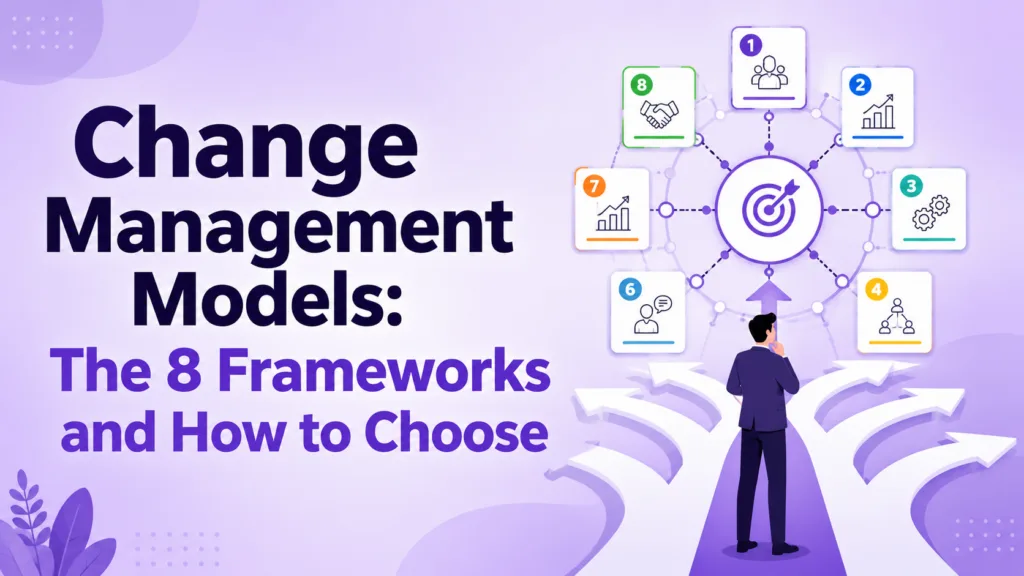
Quick summary: Change management models are frameworks for guiding people and organizations through change. The best known are Lewin’s three stages, Kotter’s eight steps, and Prosci’s ADKAR, alongside McKinsey 7-S, the Bridges Transition Model, and the Kubler-Ross Change Curve. Some work at the organizational level and some at the individual level, and none is universally best. This guide explains each model, compares them, shows how to choose, and applies one to a common modern change: adopting AI in customer support.
Change management models exist because change is hard and mostly fails when it is left to chance. They give leaders a structured way to move an organization, or a single employee, from an old way of working to a new one, and to do it without the confusion and quiet resistance that sink so many well-intentioned initiatives. There are many; they overlap, and choosing between them confuses a lot of teams, so this guide lays them out plainly and helps you match a model to your situation. The good news is that once you see how they group together, the apparent overload turns into a short menu of clear choices. You do not need all eight; you need the one or two that fit the change in front of you.
A word of caution before the frameworks. A widely repeated claim holds that about 70% of change efforts fail, often attributed to McKinsey. It is worth treating carefully: its empirical basis is disputed, and estimates vary widely depending on how failure is defined, as this analysis of the 70% claim lays out. The honest takeaway is not a precise number but a clear pattern: change is genuinely difficult, and structure improves the odds. Whether the true failure rate is fifty percent or seventy, the practical response is the same, which is to manage change with a proven framework rather than improvise. This guide covers eight models, a comparison, how to choose, and a practical application.
What change management models are and why they matter
A change management model is a framework that describes how change happens and what to do at each stage to make it succeed. Some are step-by-step processes, some are diagnostic tools, and some describe the emotions people move through. What they share is a simple premise: managing the human side of change deliberately produces far better results than hoping people adjust on their own. Technology and process can be installed; behavior has to be led, and that is the part these models address.
That premise is well supported by decades of practice and research. Projects with excellent change management meet their objectives far more often than those without, and structured change management makes teams several times more likely to succeed, as the how-to-choose section covers in detail. The models below are the tools that provide that structure, and each one turns the vague instruction to manage change into concrete steps you can actually follow. They fall roughly into two groups: those aimed at the organization, which handle strategy, structure, and momentum, and those aimed at the individual, which handle adoption and emotion. The strongest programs borrow from both, which is easier to see once the models are laid out, starting with the simplest.
Roll out new AI support tools without the resistance, with Kayako
The 8 change management models
Each model below includes what it is, when it works best, and its main limitation. Several pair well together, since organizational and individual models solve different halves of the problem. As you read, notice which half each one addresses, because that is the key to combining them well.
1. Lewin’s Change Management Model
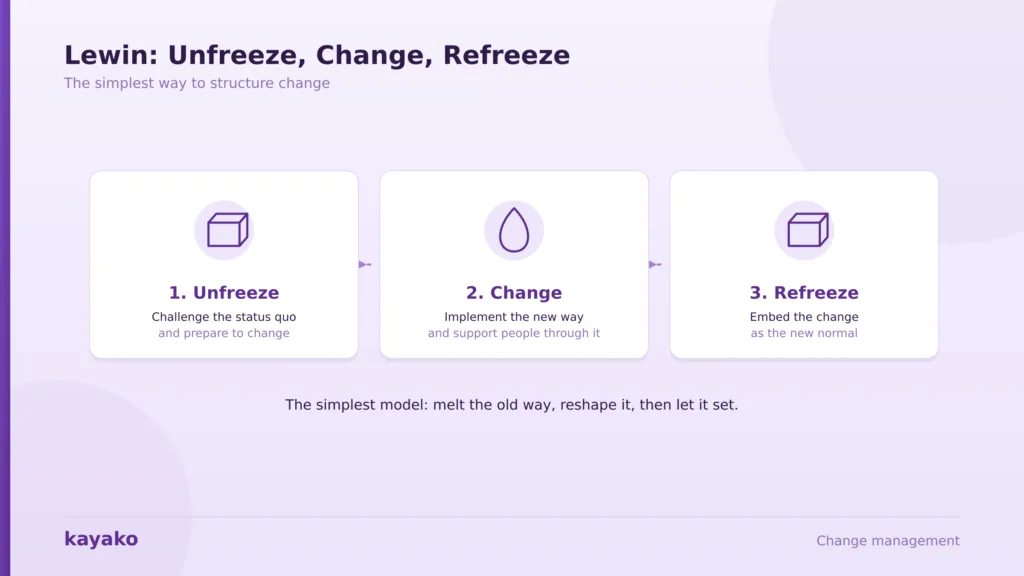
Kurt Lewin’s model is the oldest and simplest, built on three stages: Unfreeze (prepare the organization and challenge the status quo), Change (implement the new way and support people through it), and Refreeze (embed the change so it becomes the new normal). It works best for straightforward, well-defined changes with a clear before and after, such as introducing a new policy or switching a single process. Because it is so easy to grasp, it is often the model teams reach for first, and it remains a solid backbone even when a more detailed framework is layered on top. Its limitation is that same simplicity: it can feel too linear for the continuous, overlapping change most organizations face today. A useful way to picture it is a block of ice reshaped into a new form: you have to melt it before you can reshape it, then let it set again. Lewin sets the pattern that later, more detailed models build on.
2. Kotter’s 8-Step Change Model
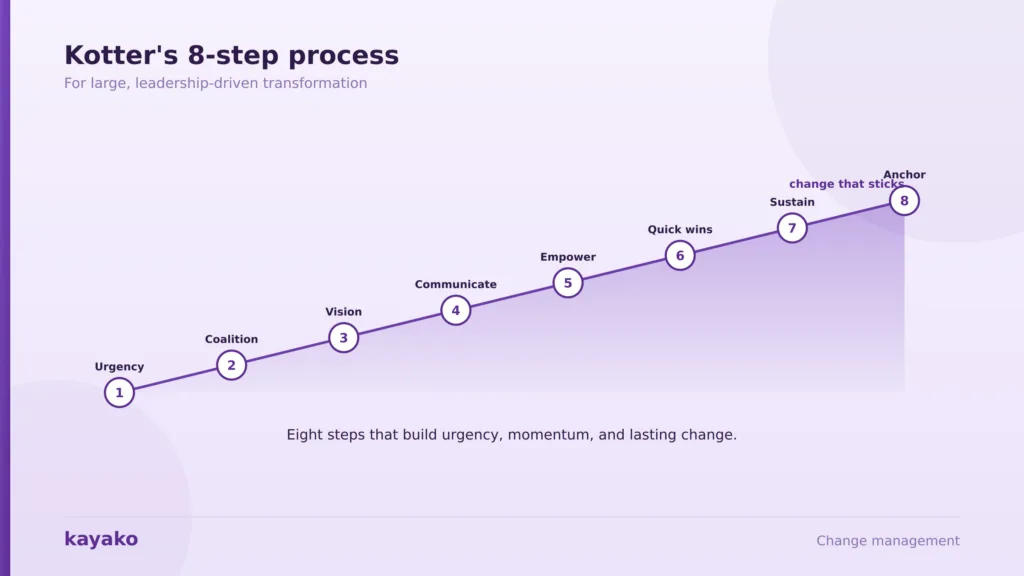
John Kotter’s model is the best known for large-scale organizational change. Its eight steps run from creating urgency and building a guiding coalition, through forming a vision, communicating it, removing barriers, and generating short-term wins, to sustaining momentum and anchoring the change in the culture. It is strong for major, top-down transformation where leadership alignment is essential, such as a merger, a restructuring, or a company-wide strategy change. The eight steps are less a rigid checklist than a reminder of what large change actually requires: a reason to move now, a coalition to drive it, and proof along the way that it is working. Skip the urgency and the effort stalls before it starts; skip the wins, and it runs out of energy halfway. The trade-off is that it is prescriptive and leader-driven, which can feel slow or rigid for smaller or faster changes, and it assumes a level of executive sponsorship that not every initiative has. Its lasting contribution is the insight that early urgency and visible wins, not a memo, are what move people. Where Kotter works at the organizational level, the next model works at the individual level, and the two are frequently run side by side on the same initiative.
3. Prosci ADKAR Model
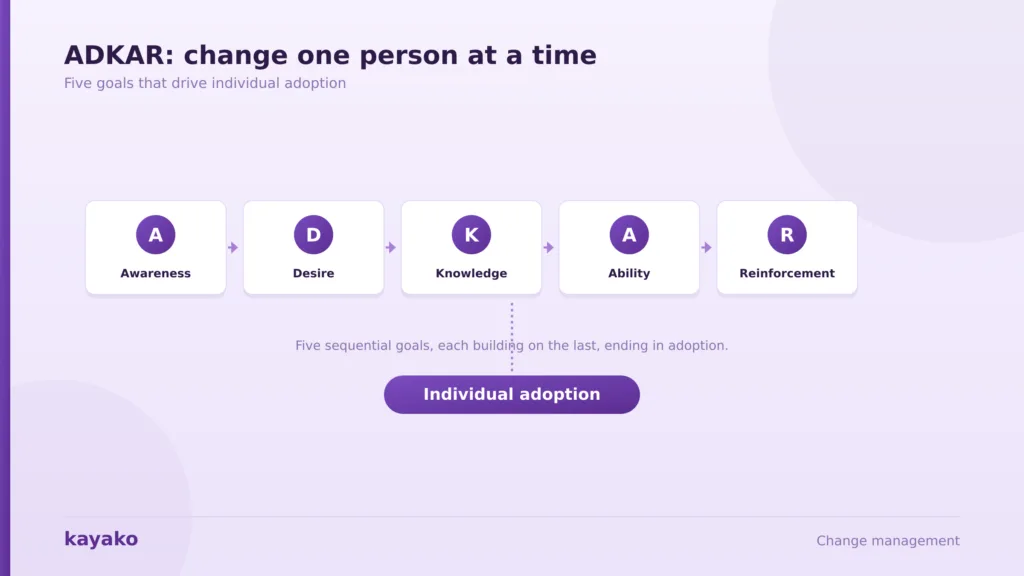
ADKAR, from Prosci, focuses on change one person at a time, through five sequential goals: Awareness of the need to change, Desire to support it, Knowledge of how to change, Ability to implement it, and Reinforcement to make it stick. Its strength is diagnosis: when a change stalls, ADKAR pinpoints which of the five is missing, so instead of a vague sense that adoption is poor, you know whether the gap is desire or ability and can act on it. If people lack awareness, you communicate more; if they lack ability, you train. That precision is why it is so popular for tool rollouts, where a single missing element can quietly sink the whole project. It is less focused on organizational vision and structure, so many teams pair it with Kotter, using Kotter to mobilize the organization and ADKAR to make sure each person actually crosses over. That pairing is one of the most common and effective combinations in practice. You can read Prosci’s own overview of the ADKAR model. ADKAR handles the individual; the next model zooms back out to the whole system.
4. McKinsey 7-S Framework
The McKinsey 7-S framework is a diagnostic tool rather than a step-by-step process. It maps seven interdependent elements that must stay aligned for change to hold: strategy, structure, systems, shared values, skills, style, and staff. Its strength is spotting why a change is stalling, usually because one element is out of step with the others. Its limitation is that it describes alignment rather than prescribing how to get there, so it pairs best with a process model that supplies the steps. In practice, teams use 7-S to find the misalignment and a model like Kotter or Lewin to fix it. Its enduring value is the reminder that you cannot change one part of an organization, like a new system, without the others, like skills and shared values, moving with it. Install new software but leave the old incentives and habits untouched, and the software loses. Where 7-S is analytical, the next models turn to the emotional reality of change.
5. Bridges Transition Model
William Bridges drew a sharp distinction between change, which is external and situational, and transition, which is the internal, psychological process people go through. His model has three phases: Ending, Losing, and Letting Go; the Neutral Zone of uncertainty; and the New Beginning. Its strength is that it takes the human side seriously, which many process models underplay. It is not a full implementation plan on its own, so it complements rather than replaces a model like Kotter. Its core insight is that people need time in the uncomfortable neutral zone, where the old way is gone but the new way is not yet natural, and rushing them through it is what breeds resistance later. Leaders who name that in-between stage out loud help their teams sit with it rather than fight it. It pairs naturally with a model that maps the emotions themselves.
6. Kubler-Ross Change Curve
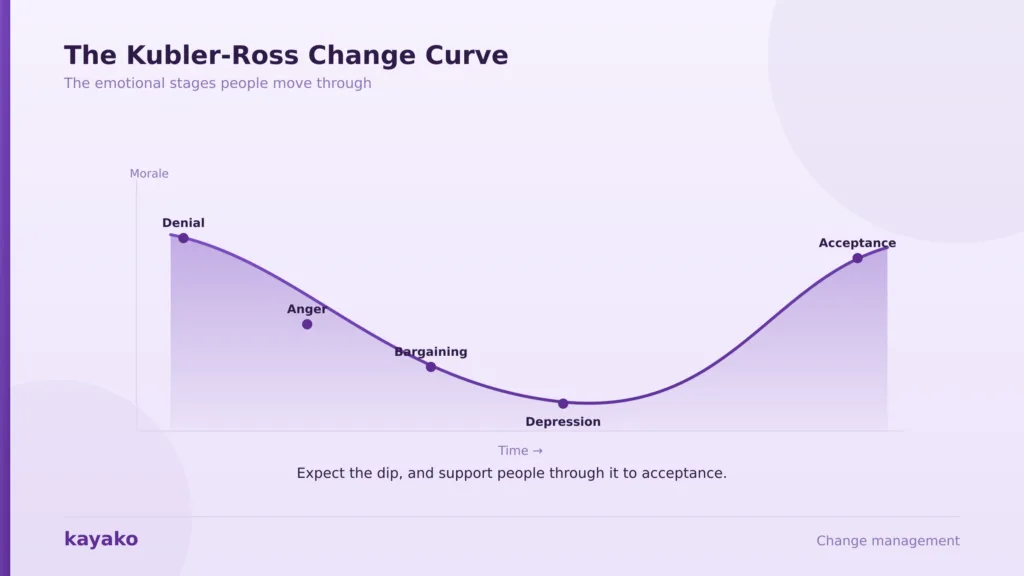
Adapted from the five stages of grief, the Kubler-Ross Change Curve describes the emotional stages people often move through during significant change: denial, anger, bargaining, depression, and acceptance. Its value is anticipatory. It helps leaders expect and support the emotional reactions that derail change when they are ignored. A leader who understands the curve reads a wave of complaints as a normal stage to move through, not as proof that the change was a mistake. Like Bridges, it is descriptive rather than prescriptive, so it guides empathy rather than execution. Knowing the curve exists stops leaders from mistaking a predictable dip in morale for a failing change, and helps them support people through it instead of pushing harder. Two briefer models round out the emotional picture.
7. Satir Change Model and 8. Nudge Theory
The Satir Change Model describes how performance typically dips before it recovers during change, moving through resistance and chaos before reaching a new normal. Its lesson is to expect and plan for the dip rather than panic when productivity falls, since the dip is a sign the change is underway, not that it is failing. Nudge theory takes a different route entirely, influencing behavior by shaping the environment and choices rather than mandating change, which suits voluntary changes in habit. Both are lighter than the full frameworks above and work well as supplements to a heavier process model rather than as standalone plans. Nudge theory, in particular, has grown popular for the small, everyday behavior changes where a mandate would feel heavy-handed. With eight models in view, a side-by-side comparison makes the differences concrete.
Change management models compared
The table below sorts the models by focus and level, so you can see at a glance which solve organizational problems and which solve individual ones.
| Model | Focus | Best for | Level |
|---|---|---|---|
| Lewin | Simple three-stage process | Clear, defined changes | Organization |
| Kotter 8-Step | Leadership-driven process | Large transformation | Organization |
| ADKAR | Individual adoption goals | Driving adoption | Individual |
| McKinsey 7-S | Alignment diagnosis | Finding why change stalls | Organization |
| Bridges | Psychological transition | The human side | Individual |
| Kubler-Ross | Emotional stages | Anticipating reactions | Individual |
| Satir | Performance dip curve | Setting expectations | Both |
| Nudge | Choice architecture | Voluntary behavior change | Individual |
Prosci’s own comparison of ADKAR and Kotter is a useful, in-depth read on how an individual model and an organizational one fit together. Seeing the models side by side makes the real question obvious: which one fits your change?
Adopt AI customer support that your team actually uses, with Kayako
How to choose the right change management model
There is no single best model; there is a best fit for a given change. A few questions point you to it, and the data confirms that using one at all is what matters most. The worst choice is no model, because that is when change is left to hope.
The case for structure is strong. Projects with excellent change management meet their objectives 88% of the time, versus just 13% when change management is poor or absent, and structured change management makes teams roughly 6x more likely to hit their objectives, per Prosci and McKinsey figures compiled by Milestone. Communication is a big part of why: effective communication makes organizations about 3.5x more likely to outperform, even though only around 34% of major change initiatives clearly succeed, per the Change Management Hub.
The pattern in that data is consistent: the specific model matters less than committing to a structured approach and, above all, communicating it well. With that settled, match the model to the change:
- Large, organization-wide transformation? Reach for Kotter or Lewin for the process, and add McKinsey 7-S to check alignment.
- Adoption of a new tool or way of working? Use ADKAR to drive it, person by person, since adoption is where most tool rollouts fail, and add Bridges to ease the emotional transition.
- A change people will resist emotionally? Layer in Bridges or Kubler-Ross to support the human side.
- A voluntary behavior change? Nudge theory often beats a mandate.
Most real change uses more than one model: a process model for the organization and an individual model for adoption. That combination matters most for the change that many teams are running right now, adopting AI. It is worth walking through one applied example in full, because it shows the models working together rather than in the abstract.
Applying a model to AI and support-tool adoption
Rolling out AI in customer support is a textbook change program, and it fails for textbook reasons: not because the technology does not work, but because people do not adopt it. Reasons that AI initiatives stall are covered in this look at why enterprise AI pilots fail, and most of them are change-management problems, not technical ones. A capable tool that no one trusts or uses delivers nothing, which is why the people side deserves as much planning as the technology.
ADKAR maps the rollout cleanly. Build Awareness of why the change is happening and Desire by showing agents that the AI removes drudgery rather than their jobs. Provide the Knowledge and Ability through hands-on training and clear documentation, so agents are not left guessing how the new tools work, and Reinforce the change by celebrating early wins and adjusting based on feedback rather than declaring victory and moving on before the new way has set.
Reinforcement is the step most often skipped, and its absence is why so many changes quietly revert. Kotter’s short-term wins fit here too: a visible early result, like the AI resolving a wave of routine tickets while agents watch their queue shrink, builds the momentum that carries adoption through the harder middle stretch. The same logic applies to an internal IT support desk rollout, where employees have to change how they ask for help. Real examples of AI in customer service show how much smoother adoption is when the change is managed rather than mandated.
This is the one honest place Kayako fits in a guide about change models, and it is worth being clear that Kayako is not a change management tool. Adopting a customer support platform like Kayako is itself a change to manage, and the tools that make adoption easier, clear results, and gradual rollout are the same ones the models prescribe. Kayako’s per-resolution pricing and quick wins give the early Reinforcement ADKAR calls for, and pairing the rollout with helpdesk automation produces the visible short-term results that sustain momentum. Manage the change well, and the technology delivers; skip the change management, and even the best tool stalls on the shelf. The models in this guide are what turn a promising rollout into one that actually changes how the team works.
Change management models are the difference between change that sticks and change that quietly fails. Lewin and Kotter structure organizational change, ADKAR drives adoption at the individual level, McKinsey 7-S diagnoses alignment, and Bridges and Kubler-Ross handle the emotional reality that process models miss. None is universally best, and the strongest programs combine an organizational model with an individual one, using the first to move the system and the second to move the people inside it.
Whatever you are changing, from a company-wide reorganization to adopting AI in your support team, the lesson is the same one the data keeps repeating: managing the human side deliberately beats leaving it to chance. Choose the model that fits your change, communicate relentlessly, and plan for the emotional dip, and you move from the odds that make change so hard to the ones that make it succeed. Change will never be easy, but with the right framework, it becomes something you can lead deliberately rather than survive by luck.
Frequently asked questions
What are the main change management models?
The most widely used models are Lewin’s three-stage model (Unfreeze, Change, Refreeze), Kotter’s 8-Step process, and Prosci’s ADKAR. Others include the McKinsey 7-S framework for diagnosing alignment, the Bridges Transition Model for the psychological side of change, and the Kubler-Ross Change Curve for emotional stages. The Satir model and Nudge theory are lighter supplements. Broadly, some models work at the organizational level and others at the individual level, and they are often combined.
What is the difference between ADKAR and Kotter’s model?
ADKAR works at the individual level, guiding one person through five goals from awareness to reinforcement, and it is strong for diagnosing exactly why a change is stalling. Kotter’s 8-Step model works at the organizational level, driving large-scale transformation through leadership, vision, and momentum. They are complementary rather than competing: Kotter mobilizes the whole organization while ADKAR ensures each individual actually adopts the change. Many teams use both together for major initiatives.
Which change management model is best?
There is no single best model; the right choice depends on the change. Lewin and Kotter suit large organizational transformation, ADKAR suits driving adoption of a new tool or process, McKinsey 7-S suits diagnosing why change stalls, and Bridges or Kubler-Ross suit changes that provoke strong emotional reactions. The strongest programs combine an organizational model with an individual one. What matters most, according to the research, is using a structured model at all rather than leaving change to chance.
Do 70% of change initiatives really fail?
The 70% figure is widely repeated but should be treated with caution. Its empirical basis is disputed, and failure rates vary widely depending on how failure is defined and measured, with credible estimates ranging well below and above that number. The reliable takeaway is not a precise statistic but a clear pattern: organizational change is genuinely difficult, and applying a structured change management approach meaningfully improves the odds of success.
How do you choose a change management model?
Start by identifying the change: is it large and organization-wide, the adoption of a new tool, or something people will resist emotionally? Match accordingly: Kotter or Lewin for transformation, ADKAR for adoption, McKinsey 7-S to diagnose alignment, and Bridges or Kubler-Ross for the emotional side. Most real change benefits from combining a process model with an individual one. Above all, communicate consistently and plan for the temporary dip in performance that almost every change produces.