What customer sentiment analysis is, where the data comes from, how the methods differ, and how to run it on your support queue without drowning in dashboards.
Your survey scores say customers are satisfied. Your churn number disagrees. Both are measuring something real, and the gap between them is usually sitting in text nobody has read: forty thousand ticket replies, chat transcripts, review comments, and the free-text box at the bottom of a CSAT form that everyone skips when compiling the monthly report.
Customer sentiment analysis is how that text becomes usable. Done properly, it tells you not only that satisfaction dropped in March but which feature caused it, which customer segment felt it hardest, and whether the tone was confusion or genuine anger. Done badly, it produces a dashboard of green and red arrows that nobody acts on.
This guide covers what sentiment analysis is, why support teams are usually the right owners of it, the data sources worth pulling in, how the underlying methods differ in accuracy and cost, and a practical sequence for running it against your own queue.
What Customer Sentiment Analysis Is
Customer sentiment analysis is the use of natural language processing to classify the emotional tone of customer language and turn it into structured data you can filter, trend, and act on.
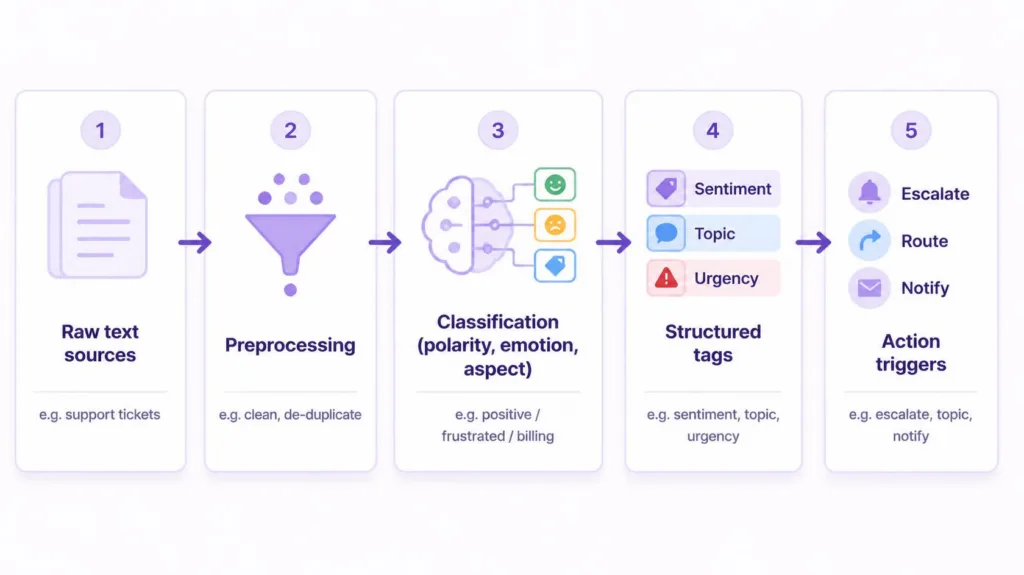
The distinction that matters most is between sentiment analysis and the survey metrics teams already run.
Sentiment analysis is not a survey score
CSAT and NPS ask customers to rate you and depend on someone bothering to respond. Sentiment analysis reads what customers said anyway, in channels they were already using, with no response rate problem. The two are complementary. Survey scores give you a comparable number over time; sentiment gives you the reason behind the number and covers the silent majority who never fill anything in.
Three levels of granularity
Polarity classifies text as positive, negative, or neutral. Easy to implement, and rarely sufficient on its own.
Emotion detection identifies specific states such as frustration, confusion, or relief. More useful operationally, since confusion calls for better documentation while anger calls for an escalation path.
Aspect-based sentiment analysis ties tone to a subject. Rather than recording that a ticket was negative, it records that the customer was negative about billing and positive about the mobile app. This is the level at which sentiment starts driving decisions, because it points at a specific thing to fix.
Most teams start at polarity and stall there. Moving to aspect-based analysis is what converts sentiment work from reporting into operations.
Why Support Teams Are Usually the Right Owners
Sentiment analysis often lands with marketing or a central insights function. That placement makes the output interesting rather than useful, because the people who can act on a negative signal within an hour sit in support.
Three arguments support putting it in support.
Support owns the largest volume of unprompted text. Every ticket, chat, and email reply is a customer describing their experience in their own words without a survey prompting them. No other function generates comparable volume.
Support can act inside the window where it matters. A frustration signal is worth something if it triggers an escalation today. Routed to a quarterly insights deck, it is history.
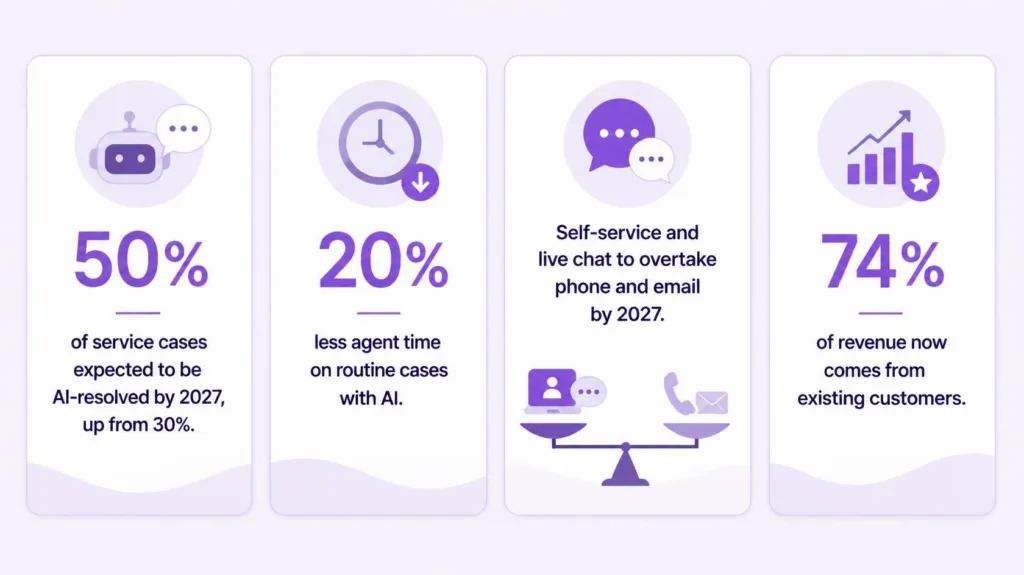
The channel mix is moving toward text. A Gartner survey of 265 customer service and support leaders conducted in April and May 2025 found live chat, self-service portals, and knowledge management consolidating as the essential tools for scalable support, and expected to overtake phone and email in value by 2027. Text-based channels produce exactly the raw material sentiment analysis needs.
There is a commercial argument too. ChurnZero’s 2025 Customer Revenue Leadership Study, surveying 793 senior post-sale leaders, found 74% reporting that most company revenue comes from existing customers. Early detection of dissatisfaction inside the installed base is therefore revenue protection rather than a reporting nicety. The same research found that organizations running a dedicated post-sale platform reported 100% net revenue retention against 94% for those without one.
Where the Data Comes From
Sentiment analysis is only as good as its inputs. Most programs fail because they analyze one channel and generalize from it.
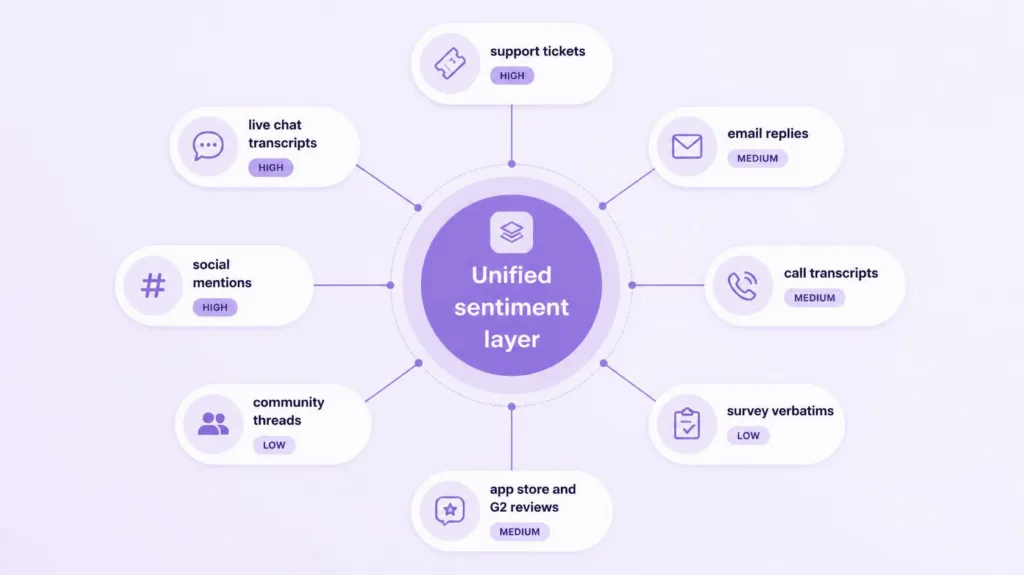
Support tickets are the highest-value source. Long-form, problem-specific, and written by customers who cared enough to contact you.
Live chat transcripts capture tone in real time and show frustration building across a single session rather than after the fact.
Email replies include the informal sign-offs and asides that carry a lot of tonal signal and get stripped out of structured surveys.
Call transcripts require speech-to-text first and introduce transcription error, though they carry emotional signal that text does not.
Survey verbatims are the free-text boxes attached to your CSAT and NPS forms. Small in volume, extremely high in density.
Reviews on G2, Capterra, and app stores tell you what customers say publicly, which frequently differs from what they say to your agents.
Community and forum threads show peer-to-peer language, where customers describe problems without moderating their tone for a support audience.
The practical rule is to start with tickets and survey verbatims, since together they give you volume and density, then add channels once your tagging is stable. Pulling everything in on day one produces noise you cannot interpret. Whatever you connect, keeping it alongside your existing customer support metrics is what lets you tell whether sentiment moved because the product changed or because response times slipped.
How Sentiment Analysis Works
Four approaches, in rough order of sophistication and cost. Knowing which one a vendor uses tells you more about accuracy than any accuracy claim on their pricing page.
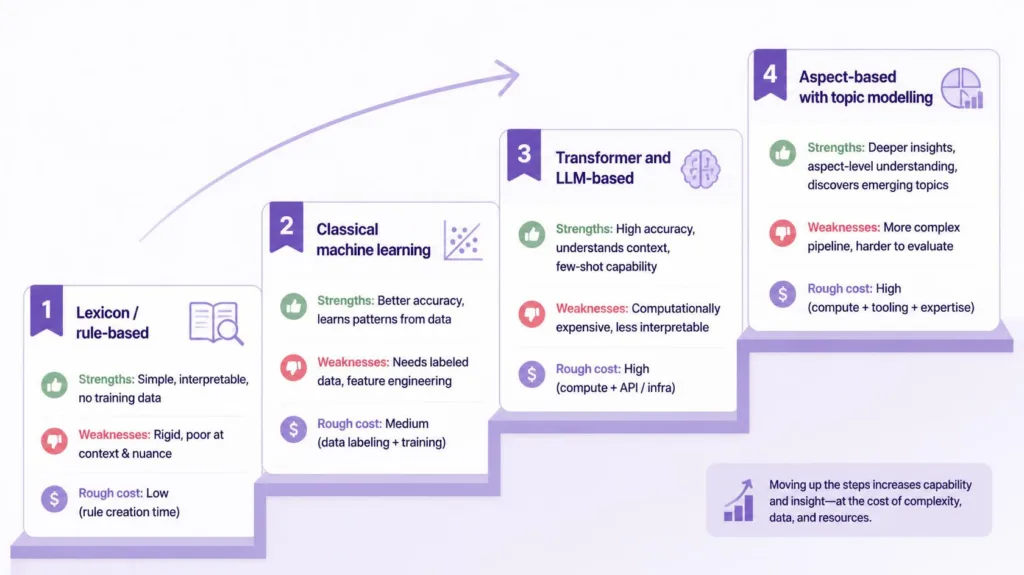
Lexicon and rule-based
A dictionary of words scored for polarity, plus rules for negation and intensifiers. Transparent, cheap, and fast. It fails on sarcasm, domain jargon, and mixed-sentiment messages, which is a serious limitation given how often a single support ticket contains both praise and complaint.
Classical machine learning
Models trained on labeled examples from your own data. Better domain accuracy than a generic lexicon, at the cost of building and maintaining a labeled training set. Still weak on context that spans sentences.
Transformer and LLM-based
Modern language models read context across a whole message and handle negation, sarcasm, and mixed tone considerably better. This is where most current tooling sits. The trade-offs are cost per analysis, latency if you need real-time classification, and reduced explainability when someone asks why a message was scored the way it was. This is the approach covered in more depth in our guide to AI sentiment analysis, including how to choose between social listening tools and support-native platforms.
Aspect-based with topic modeling
Combines sentiment classification with automatic topic extraction so tone attaches to a subject. The most operationally useful and the most work to configure, since your topic taxonomy has to match how your business is organized.
A caveat worth internalizing regardless of method: mixed sentiment is common. A large share of open-ended feedback contains praise and criticism in the same comment, which means any system forcing a single label per message is discarding information. Aspect-based analysis exists precisely to handle this.
Build a sentiment layer your agents can act on
How to Run Sentiment Analysis on Your Support Data
Seven steps. Expect a working first version in four to six weeks, most of it spent on taxonomy rather than technology.
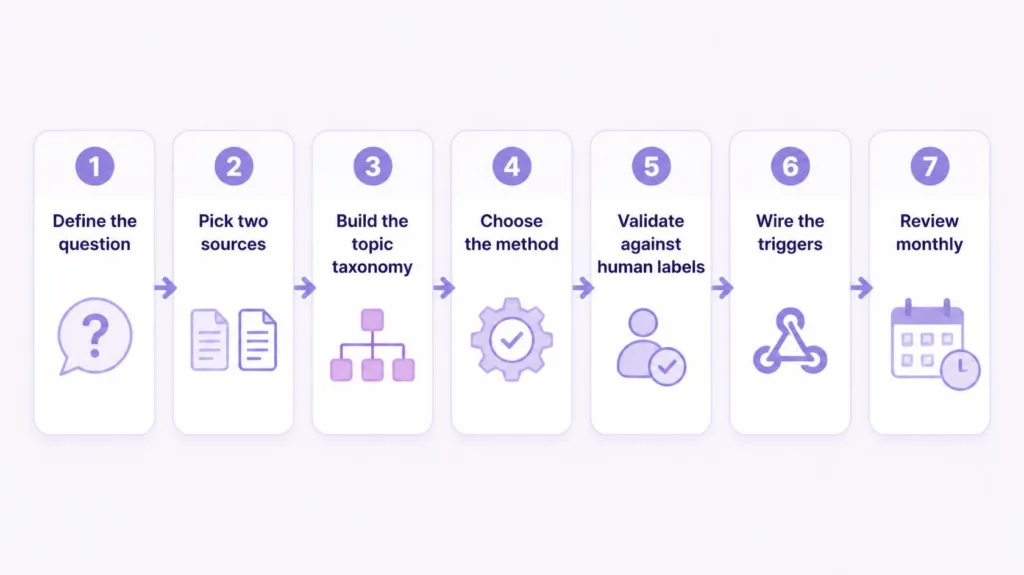
Step 1: Define the decision you want to make
Not “understand our customers.” Something actionable: which product areas drive negative tone, whether sentiment predicts churn in your base, or which ticket types should auto-escalate. The decision determines everything downstream.
Step 2: Start with two sources
Tickets and survey verbatims. Enough volume and density to be meaningful, few enough moving parts to debug.
Step 3: Build the topic taxonomy before the model
List the fifteen to thirty topics your business actually manages: billing, onboarding, specific product modules, integrations, performance, documentation. If your taxonomy does not map to teams who can fix things, the output will not lead anywhere.
Step 4: Choose the method deliberately
Match the approach to your volume and latency needs. Real-time escalation triggers need low latency. Monthly trend reporting does not, which means you can use a more expensive and more accurate method on a batch schedule.
Step 5: Validate against human labels
Have two people hand-label several hundred messages and compare. Vendor accuracy figures are measured on generic benchmarks, not on your customers writing about your product. Expect the gap to be larger than you hope, particularly on jargon.
Step 6: Wire sentiment to actions, not just reports
Negative tone on an enterprise account triggers an escalation. Repeated confusion about one feature opens a documentation task. This is where most value lives and where most implementations stop short. Routing those documentation gaps through your knowledge base best practices review turns sentiment data into deflection. The payoff compounds when agents point customers at the result: Gartner surveyed 5,801 customers in January and February 2025 and found that active promotion of self-service during a conversation roughly doubled the number who said they would use it next time.
Step 7: Review the taxonomy monthly
Products change, so topics drift. A taxonomy nobody maintains degrades within two quarters.
On capacity: acting on sentiment signals requires agents who are not buried. Salesforce’s seventh State of Service report, surveying 6,500 service professionals between April and June 2025, found AI is expected to resolve half of all service cases by 2027, up from roughly 30% today, and that representatives using AI spend about 20% less time on routine cases. Kay, Kayako’s AI support agent, resolves repetitive tickets autonomously, which is what creates room for someone to act on a frustration signal the same day it appears.
What to Measure, and Where Teams Go Wrong
Track four things and resist adding more.
Sentiment distribution over time, segmented by topic. The aggregate line is nearly useless; the per-topic lines are where decisions live.
Sentiment against resolution outcome. Tickets that ended negative despite being resolved indicate a process problem rather than a product one.
Negative sentiment concentration by account. Sudden clustering on one account is a churn signal well ahead of a renewal conversation.
Classification accuracy, rechecked quarterly against fresh human labels.
The recurring mistakes are consistent across teams. Reporting a single company-wide sentiment score, which averages away everything useful. Ignoring neutral messages, which are often where quiet dissatisfaction sits. Treating sentiment as a performance metric for individual agents, which teaches people to avoid difficult tickets. Analyzing only English when a meaningful share of your base writes in other languages. And building dashboards nobody has a mandate to act on, which is the most common failure of all.
One more worth naming: sentiment tells you tone, not effort. A politely worded ticket from a customer who had to try four times is a serious problem that sentiment analysis will score as neutral. Pair it with customer effort score to catch what tone misses.
Making Sentiment Analysis Operational
Sentiment analysis earns its place when it changes what somebody does this week. Everything else is a dashboard.
The path there is narrow but well marked. Define one decision the analysis should inform. Start with tickets and survey verbatims rather than every channel at once. Build a topic taxonomy that maps to teams who can fix things, then choose a method that fits your latency and volume rather than the most sophisticated one available. Validate against your own hand-labeled data instead of trusting benchmark accuracy. Then wire the output to escalations and documentation tasks, and review the taxonomy often enough that it keeps up with your product.
Teams that do this find the gap between their survey scores and their churn numbers closes, because they finally have the reason attached to the number.
Frequently Asked Questions About Customer Sentiment Analysis
How accurate is customer sentiment analysis?
Modern transformer-based models perform well on clear positive and negative language and considerably worse on sarcasm, mixed messages, and domain-specific jargon. Accuracy on your own data is usually below published benchmark figures, which is why hand-labeling a few hundred of your own messages before committing to a tool is worth the afternoon it takes.
What is the difference between sentiment analysis and NPS or CSAT?
Survey metrics ask customers to rate you and only capture people who respond. Sentiment analysis reads language customers produced anyway across every text channel, covering the majority who never complete a survey. Survey scores give you a trackable number; sentiment gives you the reason behind it.
Can sentiment analysis predict churn?
It contributes useful signal rather than a reliable prediction on its own. Negative tone clustering on a single account, particularly across multiple contacts at that account, is a meaningful early warning. Combined with product usage decline and support volume changes it becomes genuinely predictive, though no single input carries that weight alone.
Should we build or buy sentiment analysis?
Buy, in almost all cases. The models are commoditized, and the hard part is the topic taxonomy and the workflow wiring, neither of which building your own model helps with. Building makes sense only with unusual language requirements or data residency constraints that rule out vendors.
How much data do we need to start?
A few thousand messages is enough to see meaningful patterns, and most support teams generate that in weeks. What matters more than volume is coverage across your customer segments, since sentiment differs sharply between self-serve and enterprise customers and an unbalanced sample will mislead you.