An estimated 73% of consumers say a good experience is critical to their brand loyalty, and 84% of companies that work to improve customer experience report higher revenue. The phenomenon only goes to show that over time, customers expect a bond with a company that respects their emotions, along with the services provided. The case studies below sit on both sides of that ledger: the brands that built loyalty through service and the ones that lost it through silence, defensiveness, or speed-without-empathy.
So here are twelve customer service case studies across three categories — famous-brand classics, cautionary tales, and AI-led service in 2026, plus a short section on what SaaS-enabled support teams have done with the tooling available today. Each case is a one-page summary: what happened, what worked or failed, and what to lift from it for your own team.
Companion guides: 25 best customer service books for 2026 · How to say no to customers · Apology letter format
Four Types of Customer Service Case Studies
If you’re building a training program or a leadership briefing, every reading list should pull from all four categories below. Each tells a different story; together they form a complete playbook.
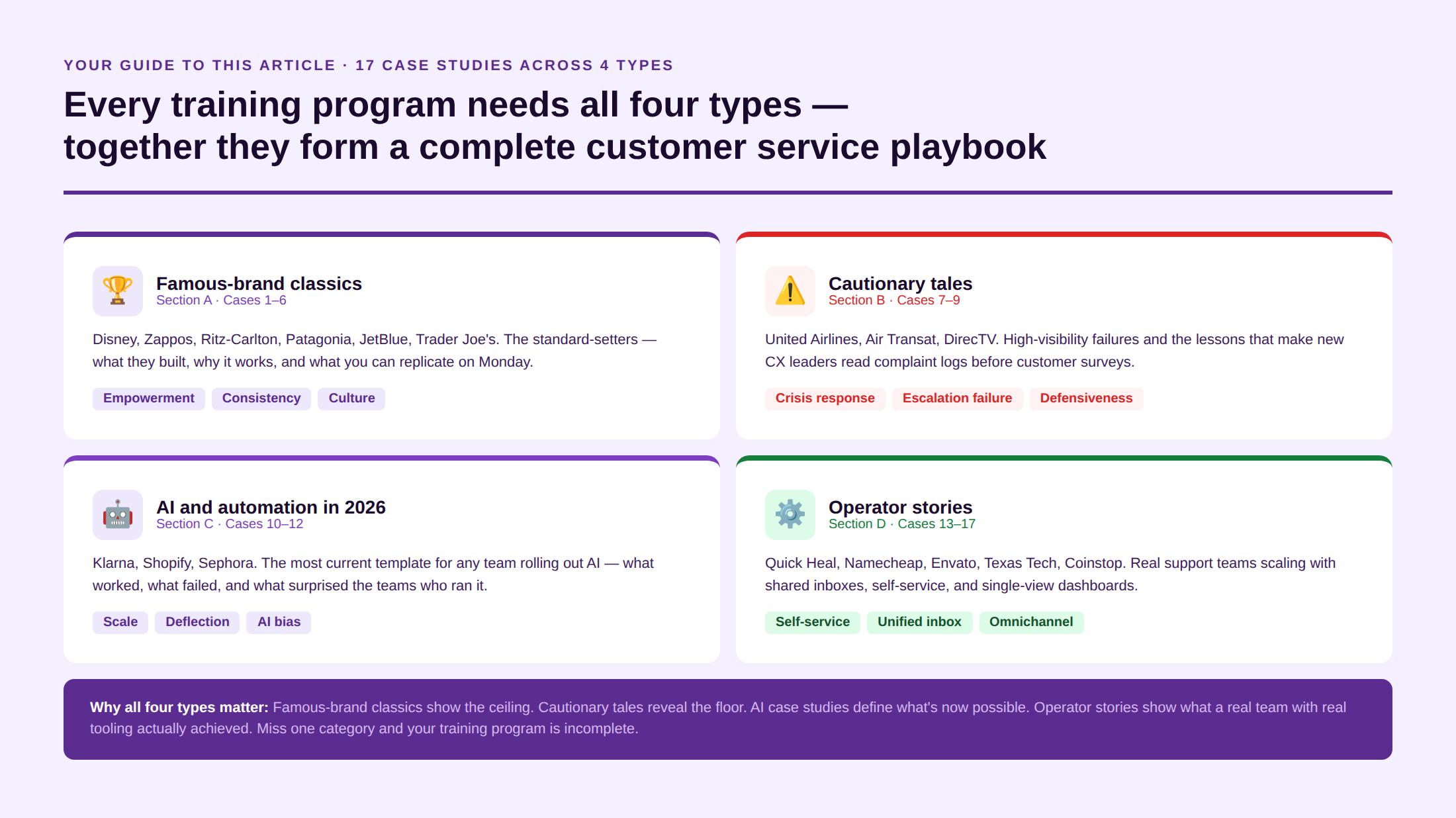
- Famous-brand classics. Disney, Zappos, Ritz-Carlton, Patagonia, JetBlue, Trader Joe’s.
- Cautionary tales. United Airlines, Air Transat, DirecTV.
- AI/automation in 2026. Klarna, Shopify, Sephora.
- Operator stories. Quick Heal, Namecheap, Envato, Texas Tech, Coinstop. Section A: Famous-Brand Classics
Six brands that built reputations on customer service, what each one did, why it worked, and the one piece of behavior your team can take inspiration from.
1. Disney — Everything Speaks
Industry: Theme parks/hospitality.
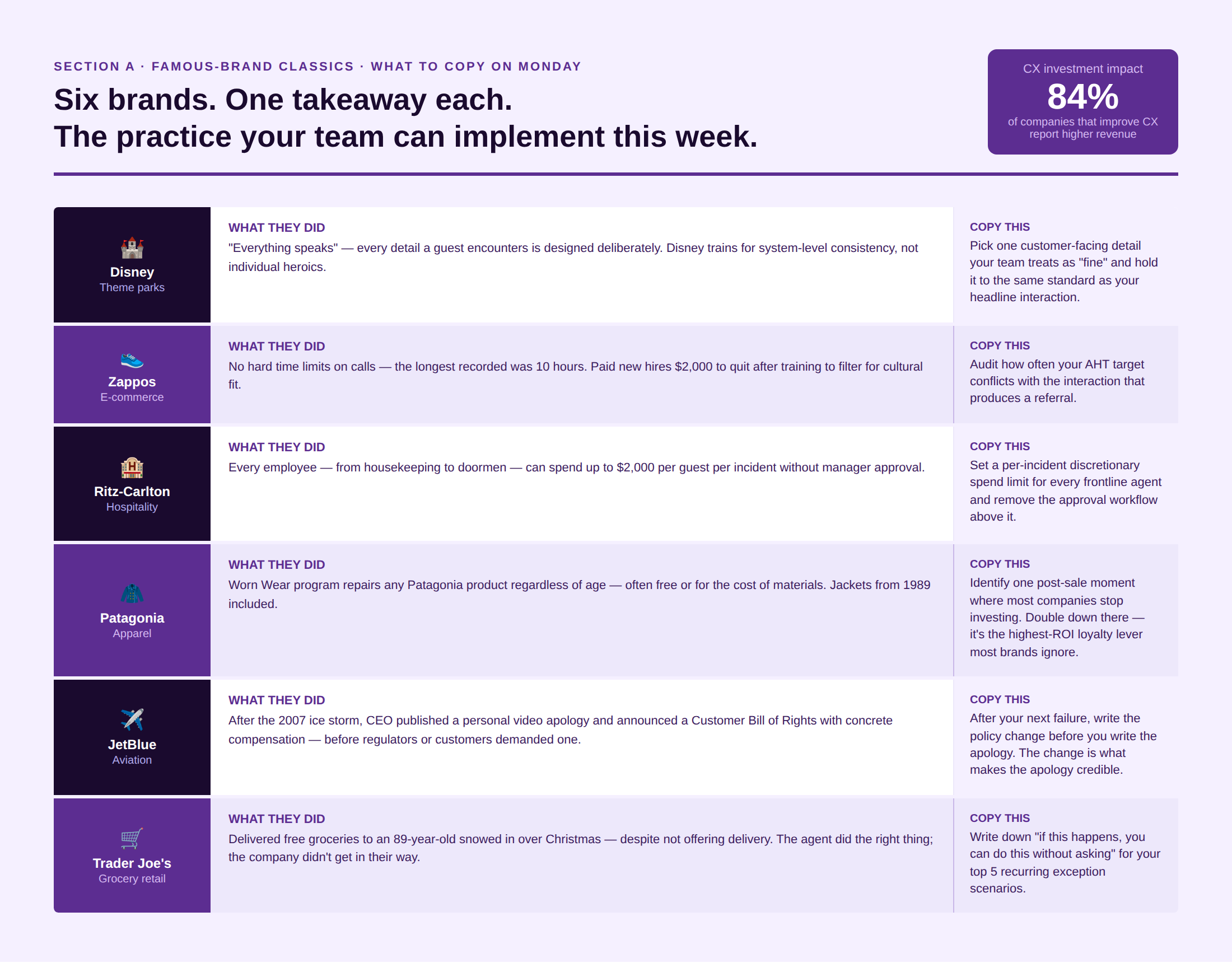
What they do: Disney’s service philosophy is summarized in two words: “Everything speaks.” Every element a guest sees, hears, smells, or touches — from the angle of a paving stone to the script of a custodian’s response — is treated as part of the customer experience and is designed deliberately.
Why it works: Disney trains for the system, not for individual heroics. The Disney Institute teaches operators that consistent, predictable service across thousands of staff requires explicit standards and well-designed processes — not just hiring nice people.
What to copy: Pick one customer-facing detail your team has been treating as “fine” and treat it as “speaking.” Hold it to the same standard as your headline interaction.
“We don’t have unhappy customers because we have unhappy employees. We have unhappy customers because we don’t have well-designed systems.”
2. Zappos — The Ten-Hour Call
Industry: E-commerce (footwear/apparel).
What they do: Zappos famously holds no hard time limit on customer service calls. The longest recorded call was over ten hours. Their service contract center is a cultural center. Agents are encouraged to build relationships, not just resolve tickets, and Zappos pays new hires $2,000 to quit at the end of training to filter for cultural fit.
Why it works: The brand was built on word of mouth. Zappos calculates that the marketing payoff from one viral service story exceeds the cost of a long call by an order of magnitude.
What to copy: Audit how often your average handle time (AHT) target conflicts with the kind of customer interaction that produces a referral.
3. Ritz-Carlton — The $2,000 Rule
Industry: Luxury hospitality.
What they do: Every Ritz-Carlton employee is empowered to spend up to $2,000 per guest per incident to resolve a problem — without needing manager approval. Housekeeping staff, concierges, and doormen all have the same authority.
Why it works: The empowerment isn’t really about the money; it’s about the message. The decision speed creates moments of true delight (a forgotten teddy bear shipped overnight; a damaged shirt replaced before checkout) that no amount of policy could legislate.
What to copy: Set a per-incident discretionary spend limit for every frontline agent and remove the approval workflow above it. Track exceptions for thirty days and adjust.
4. Patagonia — The Lifetime Repair Promise
Industry: Outdoor apparel.
What they do: Patagonia’s Worn Wear program will repair any Patagonia product, regardless of age, often free or for the cost of materials. Customers can mail in jackets they bought in 1989 and get them back stitched and serviceable.
Why it works: The repair promise is also a brand promise: buy once, wear it forever, which turns customers into evangelists. Talkdesk’s CX research repeatedly cites Patagonia as one of the highest-loyalty consumer brands in the world.
What to copy: Identify one moment after the sale where most companies stop investing in the customer and double down there. The post-purchase moment is the highest-ROI loyalty lever most brands ignore.
5. JetBlue — Owning the Failure
Industry: Aviation.
What they do: In February 2007, JetBlue stranded over 1,000 passengers on planes for up to ten hours during an ice storm. CEO David Neeleman published a personal video apology, refused to deflect to “weather,” and announced a Customer Bill of Rights — concrete compensation tied to specific delay thresholds — before regulators or customers demanded one.
Why it works: The apology didn’t just acknowledge the past; it changed the policy. Customers remember the policy; competitors had to match it.
What to copy: After your next failure, write the policy change before you write the apology. The change is what makes the apology credible.
Related: Apology letter format — 15 templates walk through the JetBlue apology letter and what to learn from it.
6. Trader Joe’s — The Snowstorm Delivery
Industry: Grocery retail.
What they do: A famous Reddit story (later widely covered): an 89-year-old man in Pennsylvania, snowed in over Christmas, called every grocery store in his area looking for delivery. Trader Joe’s — which doesn’t normally deliver — said yes, suggested items that fit his diet, sent the groceries free of charge, and called him to wish him a merry Christmas. The story has been retold across consumer behavior textbooks for over a decade.
Why it works: It’s the strongest single illustration of empowerment producing a brand moment that could not have been scripted. The agent who took the call did the right thing; the company didn’t get in the way.
What to copy: Pre-authorize your team to do the right thing in “obvious” cases. Specifically write down, “if this happens, you can do this without asking,” for the top five recurring exception scenarios.
Section B: Cautionary Tales — What CS Failures Teach Us
Three highly visible service failures and the lessons each one made unavoidable. These cases are the reason new CX leaders read complaint logs before they read customer survey results.
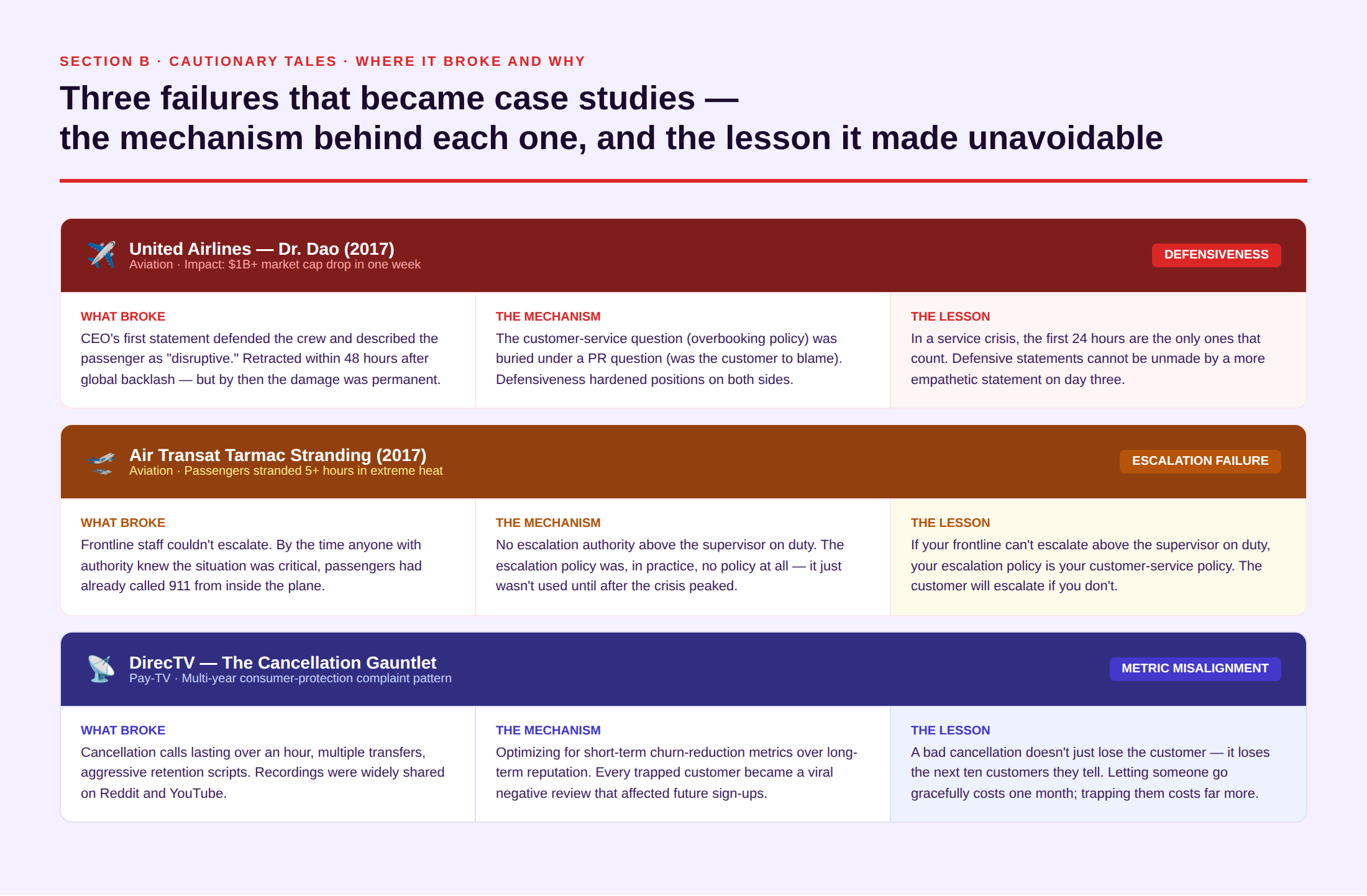
7. United Airlines — Dr. Dao (2017)
Industry: Aviation.
What happened: Dr. David Dao was forcibly removed from an overbooked United flight, bloodied in the process, and the video circulated worldwide within hours. United CEO Oscar Munoz’s first public statement defended the crew and described Dr. Dao as “disruptive and belligerent.” The statement was retracted within 48 hours after public backlash; United’s market cap dropped by an estimated $1B+ that week.
Where it broke: Defensiveness in the first response. The customer-service question (overbooking compensation policy) was buried under a PR question (was the customer to blame).
Lesson: In a service crisis, the first 24 hours are the only ones that count. Defensive statements harden positions on both sides; they cannot be unmade by a more empathetic statement on day three.
8. Air Transat Tarmac Stranding (2017)
Industry: Aviation.
What happened: Two Air Transat flights diverted to Ottawa kept passengers on the tarmac for over five hours in extreme heat with no working air conditioning, no food, and limited water. At least one passenger called 911 from inside the plane after a crew member reportedly told them to. The Canadian Transportation Agency later found the airline breached its tariff.
Where it broke: Frontline staff were not authorized to escalate. By the time anyone with authority knew the situation had become critical, customers had already taken matters into their own hands.
Lesson: If your frontline can’t escalate above the supervisor on duty, your escalation policy is your customer-service policy. The customer will escalate if you don’t.
Related reading on de-escalation: How to say no to customers covers what frontline staff should be empowered to do when policy starts to fail in real time.
9. DirecTV — The Cancellation Gauntlet
Industry: Pay-TV / satellite.
What happened: Across multiple years and consumer-protection complaints, DirecTV (and several similarly modeled providers) became known for cancellation calls that lasted upwards of an hour, involved repeated transfers, and used aggressive retention scripts. Recordings of these calls were widely shared on Reddit, on YouTube, and in consumer-rights filings.
Where it broke: Optimizing for short-term churn-reduction metrics over long-term reputation. Every customer who eventually canceled became a viral negative review.
Lesson: A bad cancellation experience doesn’t just lose the customer, it loses the customers they tell. If the cost of letting someone go gracefully is one month of revenue, the cost of trapping them is the next ten customers who never sign up.
Section C: AI on the Front Line — Three 2026 Case Studies
AI has moved from “sometimes useful” to a primary frontline channel for three specific brands. Their experience — what worked, what didn’t, and what surprised them — is now the most useful template for any team rolling out AI in 2026.
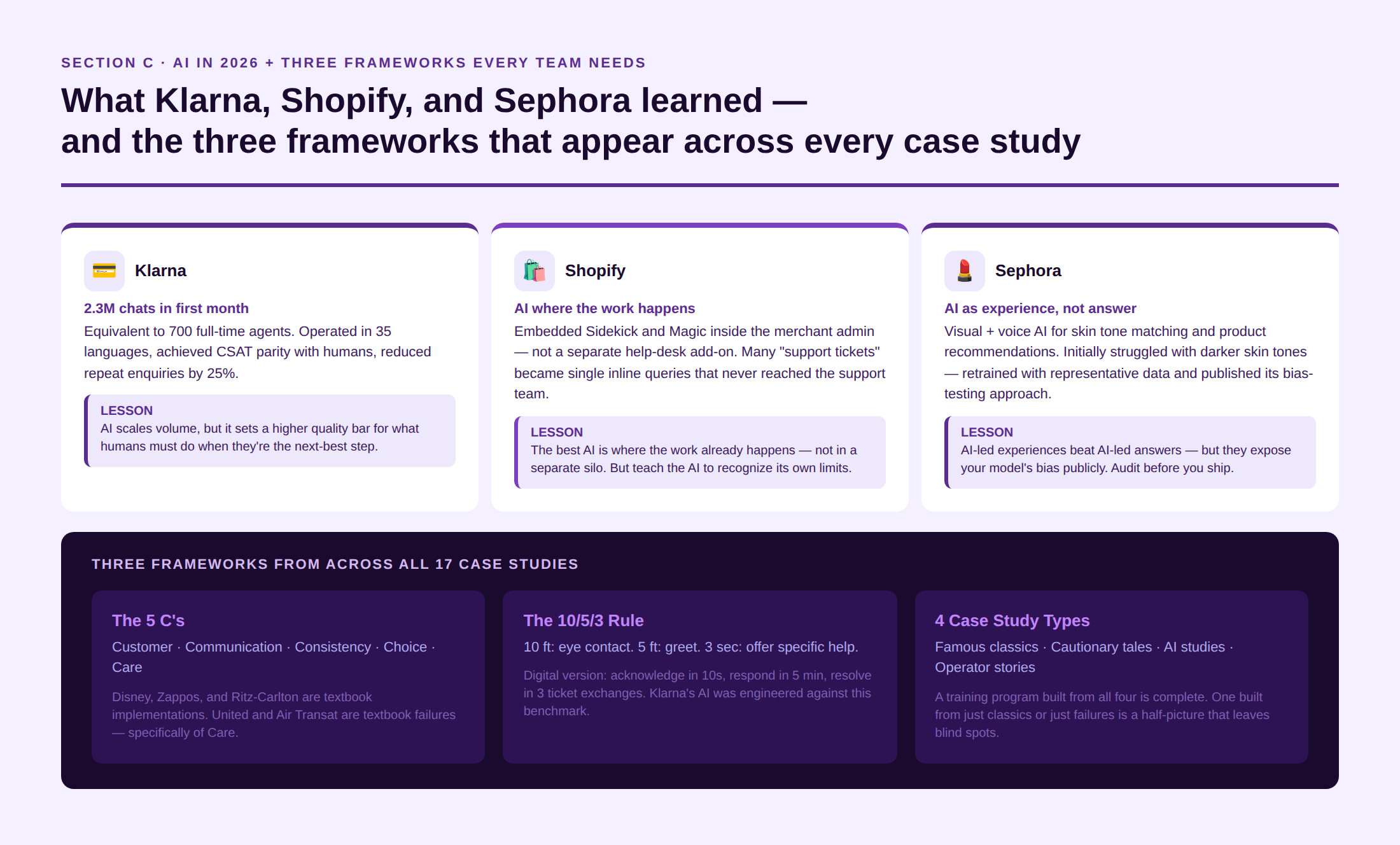
10. Klarna — The 700-Agent AI Assistant
Industry: Buy-now-pay-later / fintech.
What they did: In 2024, Klarna launched an OpenAI-powered customer-service assistant that, in its first month, handled 2.3 million chats — roughly the workload of 700 full-time agents. The bot operated in 35 languages, achieved customer satisfaction parity with human agents, and reduced repeat inquiries by 25%.
What worked: Klarna built a tightly scoped, single-purpose bot — not a general-purpose chatbot. It also retained human agents for high-emotion or high-stakes cases and explicitly routed escalations to them.
What didn’t: Critics noted that the “AI replacing 700 agents” framing oversimplified what happened — many of those agents had been BPO-supplied seasonal staff, and Klarna later emphasized that AI raised the bar for human-agent quality rather than eliminating the role.
Lesson: AI scales volume, but it sets a higher quality bar for what humans must do when they’re the next-best step.
11. Shopify — Sidekick and Magic
Industry: E-commerce platform / SaaS.
What they did: Shopify embedded its AI tooling — Sidekick and Magic — directly inside the merchant admin, not as a separate help-desk add-on. Merchants ask the assistant questions about their store, generate product copy, run analytics, and configure settings, all from the same context they were already working in.
What worked: By placing AI where the work happens, Shopify reduced the friction of asking for help. Many “support tickets” became single inline assistant queries that never reached the support team.
What didn’t: Some merchants reported that AI-generated answers to nuanced questions (especially around platform billing or third-party app behavior) were confidently wrong. Shopify’s response was to add explicit “check with support” fallbacks.
Lesson: The best AI is where the work already happens, not in a separate help-desk silo. But you must teach the AI to recognize its own limits.
12. Sephora — Visual + Voice AI
Industry: Beauty retail.
What they did: Sephora was an early adopter of conversational AI on Facebook Messenger, and by 2026 had layered visual AI (skin and tone analysis) and voice AI on top. A customer can upload a photo, get a foundation match, ask in natural language, and receive a tailored recommendation, all without speaking to a human.
What worked: Sephora treated AI as an experience, not an answer. The point wasn’t to deflect tickets — it was to make the discovery process faster and more confident than browsing alone.
What didn’t: The visual AI initially struggled with darker skin tones, prompting public criticism. Sephora retrained the model with more representative data and published its bias-testing approach.
Lesson: AI-led experiences beat AI-led answers, but they also expose your model’s bias on a public stage. Audit before you ship.
Section D: Operator Stories — How SaaS-Enabled Support Teams Scale
The five case studies below are Kayako customers — useful as concrete operator stories about scaling support with shared inboxes, single-view dashboards, and self-service. We’ve kept them shorter than the famous-brand cases above; they are operator playbooks, not branding stories.
13. Quick Heal — Unified inbox to extend support hours
Problem: No system to track requests across email, social, and chat. Lost tickets, duplicated effort, support hours capped by volume.
Solution: Kayako’s Shared Inbox unified interactions from email, Facebook, X, and live chat in one queue.
Outcome: Reduced response and resolution times; extended support hours; consolidated conversations from multiple sources.
“Without Kayako, we wouldn’t be able to manage all the incoming requests in an organized manner nor provide the quality of support we stand for.”
— Sushant Dashputre, Assistant Manager of Technical Support, Quick Heal
14. Namecheap — Self-service knowledge base for repeat customers
Problem: Repeat-customer-heavy support; no optimized workflow for high request volume; agent stress and low productivity.
Solution: Kayako Self-Service Portal with macro libraries, automated replies, and a knowledge base; SingleView for personalized support at scale. (See knowledge-base style guide and knowledge management is the key to self-service success.)
Outcome: Streamlined ticket management, increased agent productivity, and higher customer satisfaction.
“In all aspects, Kayako provides us with value in buckets.”
— Nata Trusova, Director of Customer Support, Namecheap
15. Envato — Multiple customer bases in one place
Problem: Existing system is not keeping up with the volume of requests; multiple customer databases to coordinate.
Solution: Kayako SingleView dashboard, ticket parsing rules, Smart Routing, and internal collaboration tools.
Outcome: Faster ticket resolution, all customer databases in a single system, and higher productivity.
“Kayako has allowed us to extensively customize our help desk… It has functionality that other support providers haven’t been able to match.”
— Jordan McNamara, Community Manager, Envato
16. Texas Tech University — Internal collaboration on a shared platform
Problem: 36,000+ students and 10,000+ staff served from a shared Outlook account, with no internal collaboration on tickets.
Solution: Kayako Collaborators feature, integrated self-service, and custom LoginShare integrated with campus apps.
Outcome: Reduced ticket volume, improved internal collaboration, and higher CSAT.
“We immediately noticed an increase in the quality of communication and collaboration, especially between our support and development team.”
— Kevin Eyck, Enterprise Server Administrator, Texas Tech University
17. Coinstop — Omnichannel support after rapid growth
Problem: Support handled from a single email account; no way to track progress, standardize responses, or manage volume during rapid growth.
Solution: Kayako helpdesk and live chat with SingleView for full conversation history across channels. (Background reading: What is omnichannel customer service?)
Outcome: Reduced average response time, more tickets handled with the same headcount, and omnichannel support implemented.
“You need one place to browse every single conversation you have had with each customer. Kayako is very well organized.”
— Christopher Pavlesic, Co-Founder, Coinstop
Quick-Reference Frameworks
Three frameworks that show up across almost every case study above. Pin these to the wall.
The 5 C’s of Customer Service
Customer (the centre), Communication, Consistency, Choice, and Care. The Disney, Zappos, and Ritz cases are textbook implementations of all five, particularly Consistency. The United and Air Transat failures are textbook failures of Care.
The 10/5/3 Rule
At 10 feet, make eye contact; at 5 feet, smile and greet; within 3 seconds, offer specific help. Adapted for digital channels: acknowledge in 10 seconds, respond within 5 minutes, resolve in 3 ticket exchanges or fewer. Klarna’s AI assistant was effectively engineered against the digital version.
4 Types of Case Studies
Famous-brand classics, cautionary tales, AI/automation, and operator stories. Build your training program from all four.
So, here they are. Bonafide case studies that cover varied emotions and, most importantly, situations. We hope that you can take a cue from it for your business and improve on your customer service goals to leave a lasting impression.
FAQs — Customer Service Case Studies
1. What is a customer service case study?
A. A customer service case study is a structured account of how a specific company handled a specific service situation, covering the problem, the response, the outcome, and the lesson. The most useful case studies come in four types: famous-brand classics, cautionary tales, AI / automation studies, and operator stories.
2. What are the 5 C’s of customer service?
A. Customer (the center), Communication, Consistency, Choice, and Care. The 5 C’s are a self-grading checklist; every case study above can be read as a story of which of the five were honored and which were skipped.
3. What are the 4 types of case studies?
A. In the customer service context: famous-brand classics, cautionary tales, AI/automation case studies, and operator (SaaS-enabled team) stories. Each tells a different story; together they form a complete training program.
4. What are 5 common customer service problems?
A. (1) Long wait times. (2) Repeat-asking the same questions across channels. (3) Inconsistent answers between agents or channels. (4) No clear escalation path. (5) Closing tickets without confirming resolution. The case studies above touch on all five.
5. What is the 10/5/3 rule in customer service?
A. At 10 feet, make eye contact; at 5 feet, smile and greet; within 3 seconds, offer specific help. Borrowed from hospitality, the digital adaptation is: acknowledge in 10 seconds, respond within 5 minutes, resolve in 3 ticket exchanges or fewer.
6. Where can I find more customer service case studies?
A. Industry-specific collections live on AWS Case Studies, Talkdesk, the Customer Success Association, Cobbai (AI-focused), and academic libraries. The 12 cases in this article cover the highest-leverage stories from each category.
→ See how Kayako’s AI helps support teams put these lessons to work · Read more customer stories