A buyer’s guide to lead generation companies: the categories, how to evaluate them, what pricing models incentivize, and the pipeline leaks agencies cannot solve.
Searching for the best lead generation company usually means one of two things. Either the pipeline is short and someone upstairs wants it fixed this quarter, or an existing vendor is underdelivering, and you are comparing alternatives. Both are reasonable. What neither survives is the assumption underneath most vendor shortlists, which is that lead volume is the constraint.
Frequently it is not. Buyers now form vendor preferences well before anyone fills in a form, which means a supplier can hit every contractual target and still move revenue very little. Understanding that changes what you should be shopping for.
This guide covers what lead generation companies actually do, how the categories differ, how to evaluate one properly, what each pricing model quietly encourages, and the pipeline problems no external supplier can solve on your behalf.
What Lead Generation Companies Actually Do
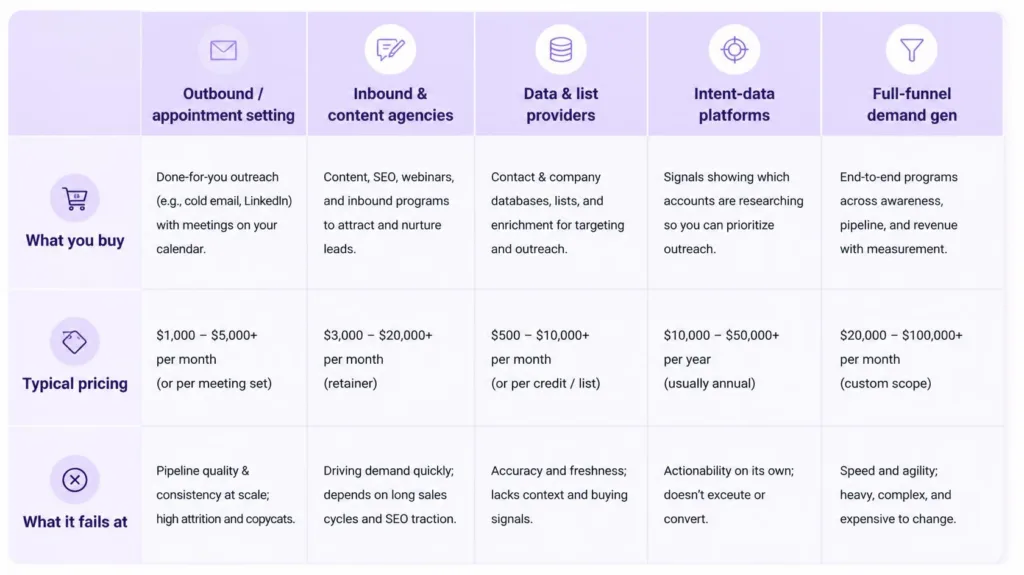
The term covers at least five distinct business models that get sold under one label. Comparing across categories is where most evaluations go wrong, because a list provider and a full-funnel agency are not substitutes for each other.
Outbound and appointment setting
You are buying human or automated prospecting capacity. The deliverable is meetings booked. This works when your ideal customer is identifiable from firmographic data and your offer needs little education. It fails badly when the purchase requires trust built over months.
Inbound and content agencies
You are buying content production and organic acquisition, sometimes with paid media attached. Slower to show results and harder to attribute, but the compounding is real. Judge these on the quality of the work, not the size of the retainer.
Data and list providers
You are buying contact records and enrichment. Useful infrastructure, frequently mis-sold as lead generation. A list is not a lead. Check data provenance and jurisdictional compliance before anything else.
Intent-data platforms
You are buying signals about which accounts are researching your category. Genuinely valuable if you have the sales capacity to act on signals quickly. Wasted if leads sit in a queue for three days.
Full-funnel demand generation
You are buying strategy plus execution across several channels. The most expensive option and the hardest to evaluate, since success depends heavily on how well the supplier understands your market.
Deciding which category you need is a prerequisite, not a detail. Buying an appointment setter when your actual problem is that nobody has heard of you produces expensive meetings with people who will not buy.
Why This Category Is Harder to Buy Than It Used to Be
The market changed in a way that undercuts the standard lead generation pitch, and the data on it is unambiguous.
6sense’s 2025 Buyer Experience Report, based on more than 4,000 buyer responses across North America, EMEA, and APAC, found that 94% of buying groups had ranked a preferred vendor before speaking to any seller, and bought from that early favorite 77% of the time. The same research found buyers report prior personal experience with at least one shortlisted vendor 97% of the time, and recorded average buying cycles compressing from roughly 11.3 months in 2024 to 10.1 months in 2025.
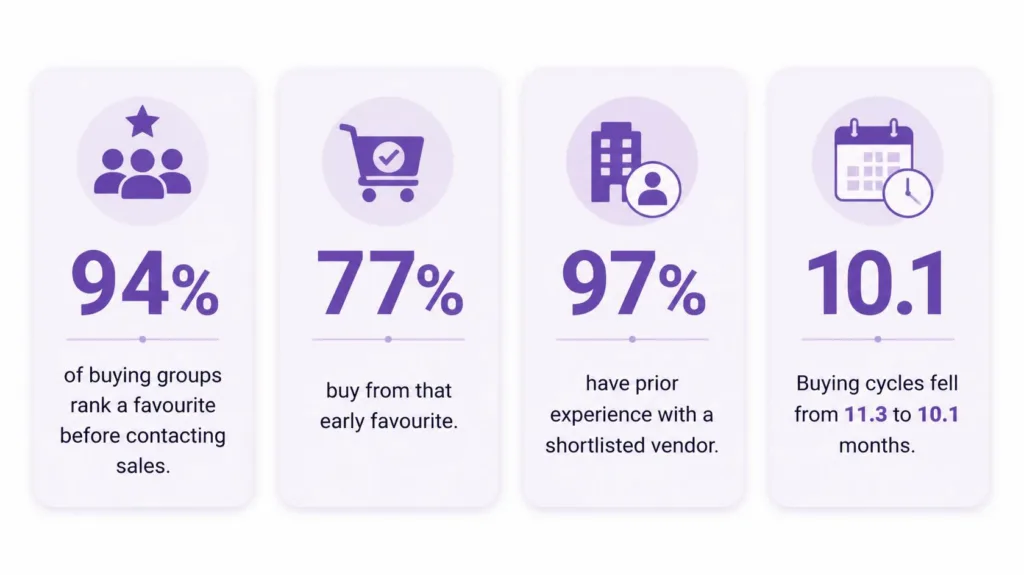
The consequence for anyone buying lead generation is uncomfortable. If preference forms before first contact, then a supplier delivering contacts at the point of first contact is arriving after the decisive moment has passed. The vendor already on the shortlist wins most of the time, and shortlist placement comes from familiarity rather than from outreach volume.
That does not make lead generation companies useless. It reframes what to buy them for: getting known inside your addressable market early, rather than harvesting hand-raisers late.
There is a second reframe worth holding. ChurnZero’s 2025 Customer Revenue Leadership Study, surveying 793 senior post-sale leaders, found 74% reporting that most revenue comes from existing customers, and Pavilion’s 2025 B2B SaaS benchmarks put the installed base at roughly 40% of new annual recurring revenue. Before you spend on external acquisition, check what your existing customers are generating, because that channel is usually cheaper and chronically under-resourced.
How to Evaluate a Lead Generation Company
Six questions separate suppliers worth signing from suppliers worth avoiding. Ask all of them in writing.
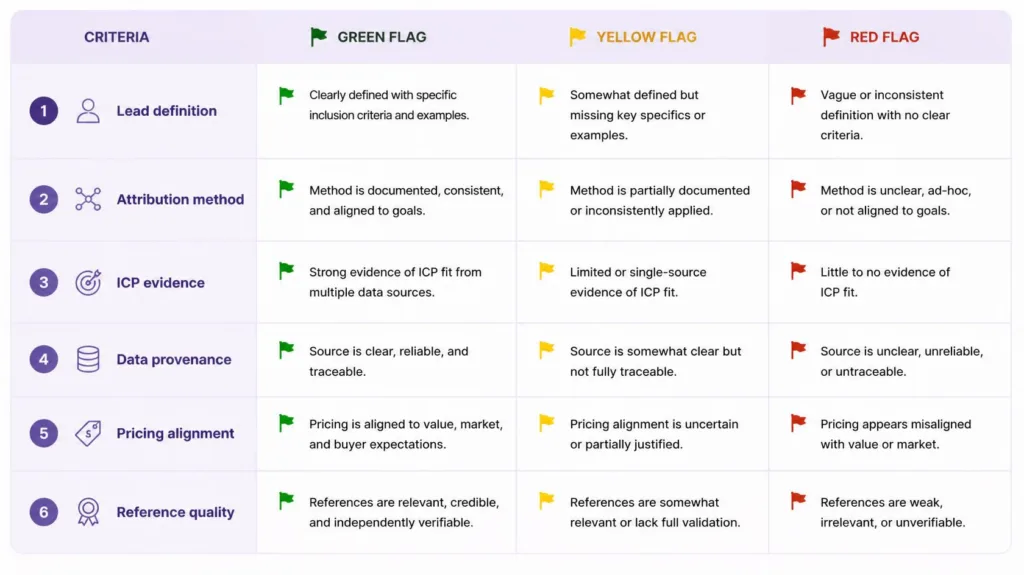
How do you define a qualified lead?
Get this in the contract with acceptance criteria attached. A lead that meets firmographic filters but has expressed no interest is a contact record. Define the qualification bar, define who arbitrates disputes, and define what happens to rejected leads.
How will we attribute results?
Ask what happens when a supplier-sourced contact closes six months later through a different channel. Suppliers who claim clean attribution in a market where most research happens invisibly are overstating what is measurable. Better answers acknowledge the ambiguity and propose a shared method.
What evidence do you have in our segment?
Not logos. Ask for the specific segment, deal size, and sales cycle length of comparable clients, plus what did not work. A supplier who cannot describe a failed engagement has either not had one or will not tell you about it.
Where does your data come from?
Provenance, refresh cadence, and compliance posture across every jurisdiction you sell into. This is a legal exposure question as much as a quality one, and it is the question suppliers most often deflect.
How does your pricing align with our outcomes?
Covered in the next section, since it deserves its own treatment.
Can we speak to a client who left?
The most useful reference call available. Suppliers who refuse are telling you something.
Pricing Models and What They Quietly Incentivize
Every pricing structure encourages a behavior. Pick the one whose incentive matches what you actually want.

Per lead. Encourages volume. Cheap to start, and the model most likely to produce technically compliant leads that no salesperson wants. Only workable with a tight qualification definition and a functioning rejection process.
Per appointment. Encourages booked meetings, which is closer to useful. Watch for meetings booked with people who lack budget authority, and for high no-show rates that fall outside the supplier’s obligations.
Monthly retainer. Encourages activity reporting. Best fit for content and demand generation work where outcomes genuinely take time, worst fit when you need accountability fast. Insist on quarterly review gates.
Performance or revenue share. Encourages closed business, which is the alignment you want. Rare, because suppliers only accept it when they trust your sales team to convert. If a supplier offers this, take the conversation seriously.
A practical note: whichever model you pick, agree the exit terms before signing. Data portability, notice period, and who owns the contact records created during the engagement are all negotiable at the start and immovable later.
Fix the escalation gaps before renewal season finds them first
The Part No Vendor Can Fix: Your Own Pipeline Leaks
Suppliers get blamed for problems that sit inside the buyer’s organization. Four are common, and all four are cheaper to fix than a new contract.

Response speed on inbound
If a demo request waits two days, no supplier can compensate. With buying cycles compressing and 6sense recording the point of first contact moving earlier in the process, the window between interest and a competitor conversation is narrower than it was. Fix routing and response time before buying more volume. The channel mix matters here too: a Gartner survey of 265 customer service and support leaders conducted in April and May 2025 found live chat and self-service portals consolidating as the primary channels for fast support, and expected to overtake phone and email in value by 2027. Those are the same channels prospective buyers use to ask pre-purchase questions.
Support conversations that never reach sales
This is the leak nobody instruments. Your support queue contains expansion signals daily: customers asking whether a feature exists on a higher tier, asking about seat limits, asking whether you integrate with a tool they just bought. Those are buying questions arriving in a support channel. Most organizations answer them accurately and route them nowhere. Connecting your customer support software to your CRM so those signals reach an owner costs nothing close to an agency retainer.
Existing customers who are never asked
Given how much revenue the installed base generates, the absence of a structured referral and expansion motion is the most expensive gap on this list. The customers most likely to recommend you are visible in your support data, which is a better advocate list than anything a supplier will sell you.
Weak presence where shortlists form
If 97% of buyers have prior experience with a shortlisted vendor, then reviews, community presence, and word of mouth are pipeline infrastructure rather than brand nice-to-haves. Support quality drives all three, which is why support metrics belong in pipeline conversations.
Handling this volume of signal requires agent capacity. Salesforce’s seventh State of Service report, surveying 6,500 service professionals between April and June 2025, found AI is expected to resolve half of all service cases by 2027, up from roughly 30% today, with representatives using AI spending about 20% less time on routine cases. Kay, Kayako’s AI support agent, handles repetitive tickets autonomously so the commercially significant conversations reach a person who can act on them.
See how Kay frees your team for the conversations that convert
Red Flags Worth Walking Away From
Guaranteed lead volumes with no qualification definition. Volume without a bar is a metric designed to be met.
Unwillingness to name the data sources. Compliance exposure transfers to you, not the supplier.
Attribution claims that sound certain. Most of the buying process is unobservable. Confidence here signals either naivety or spin.
No named client in your segment. Category experience does not transfer across deal sizes and cycle lengths as smoothly as pitch decks imply.
Pressure to sign before a pilot. Any supplier confident in their delivery will run a paid pilot with defined success criteria.
Reporting that leads with activity. Emails sent and calls made are inputs. If quarterly reviews center on inputs, outcomes are not being measured.
Buying the Right Thing Rather Than the Best-Reviewed Thing
There is no single best lead generation company, and any list claiming otherwise is comparing suppliers that solve different problems. What exists is a right supplier for a specific gap, at a price whose incentives match your goal.
Work in this order. Diagnose whether volume is genuinely your constraint or whether conversion, response speed, and shortlist presence are. Fix the internal leaks first, because they are cheaper and they determine whether purchased leads convert at all. Then pick the category that matches the remaining gap, evaluate on lead definition, attribution honesty, segment evidence, and data provenance, and structure pricing so the supplier wins when you win. Run a paid pilot before a year-long commitment.
Done in that order, a lead generation company becomes a useful addition to a working system. Done in reverse, it becomes an expensive way to discover that the system was the problem.
Frequently Asked Questions About Lead Generation Companies
How much do lead generation companies charge?
Pricing varies enormously by category and market, from per-record fees for data providers through per-appointment rates for outbound suppliers to substantial monthly retainers for full-funnel agencies. Rather than benchmarking headline rates, model your fully loaded cost per closed deal including your own sales time, and compare that against your existing blended acquisition cost.
Is outsourced lead generation better than building in-house?
They serve different situations. Outsourcing buys speed and avoids hiring risk, which suits testing a new segment or covering a temporary capacity gap. Building in-house costs more upfront and produces institutional knowledge that compounds, which suits your core market. Many companies reasonably run both, outsourcing exploration and keeping their primary segment internal.
How long before a lead generation company delivers results?
Outbound and appointment setting can produce meetings within weeks, though meeting quality usually takes a quarter to stabilize as the supplier learns your market. Content and demand generation work realistically needs two to three quarters. Any supplier promising pipeline transformation inside a month is describing volume rather than revenue.
What should be in the contract?
A written qualification definition with acceptance criteria, a documented rejection process, an agreed attribution method, data provenance and compliance warranties, clear ownership of contact records created during the engagement, notice period, and data portability on exit. Agree all of it before signing.
Do we still need lead generation if buyers decide before contacting us?
Yes, though the objective changes. If preference forms before first contact, the job is being known and credible inside your market early, rather than capturing hand-raisers late. That favors suppliers who build presence and reputation over suppliers who deliver contact volume, and it raises the value of reviews, community, and customer advocacy.