Key takeaways
|
Value-based selling is a sales methodology that focuses the entire conversation on the value a buyer will receive, measured in their own business terms, rather than on the features of a product or a race to the lowest price. Instead of listing what a solution does, a value-based seller shows what it will return: time saved, revenue gained, risk reduced, or cost avoided. It reframes the deal from a purchase into an investment with a payback.
This guide explains what value-based selling is, why it has become the default approach for high-performing B2B teams, and the step-by-step process behind it. It covers the core techniques, worked examples, and how the method compares with other frameworks. It also closes on the part sellers too often forget: the value you promise in a deal has to be delivered after it, and that post-sale stretch is where the real return, and the next deal, are decided.
What is value-based selling?
Value-based selling, sometimes called value selling, is an approach where the seller identifies a buyer’s specific goals and challenges, then frames the solution entirely around the measurable value it delivers against them. The unit of the conversation is the outcome, not the feature. A feature-led pitch says the platform has automated reporting. A value-led one says the platform will save your team roughly ten hours a week and cut month-end close from five days to two.
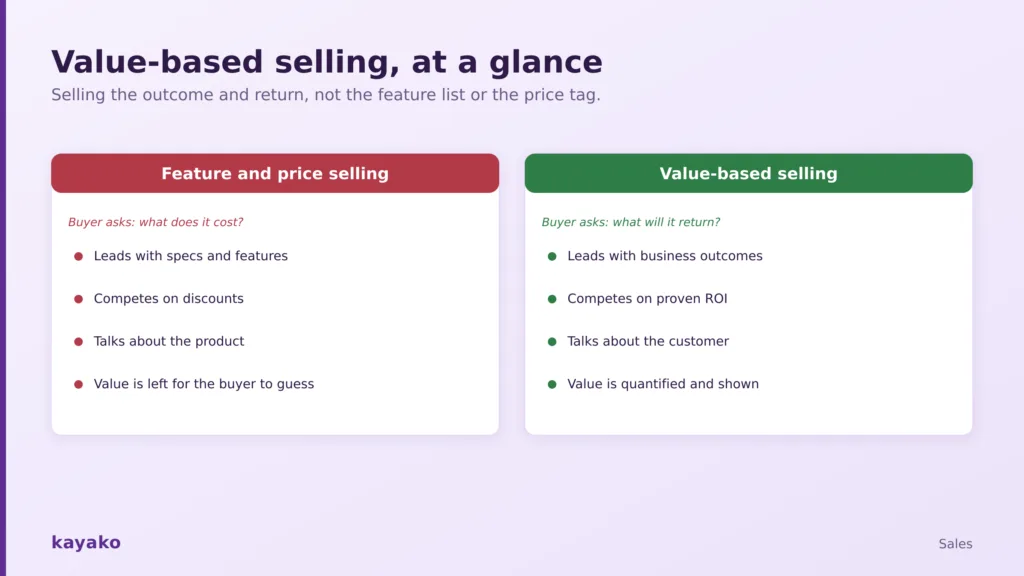
Value selling answers the question the buyer actually cares about: what will this return?
The distinction matters because it changes who does the work of justifying the purchase. In feature selling, the buyer has to translate specifications into business value on their own, and many never do. In value-based selling, the seller does that translation up front and proves it with numbers. It sits close to consultative and solution selling, and strong customer enablement carries the same idea past the sale. To see why it has taken over, look at how buyers behave now.
Why value-based selling works, and matters now
Buyers have changed. They arrive well-researched, they involve more stakeholders, and above all, they demand proof of return quickly. G2’s 2025 research found that 57% of B2B buyers expect ROI within three months of a software purchase, and 11% expect it immediately (via Corporate Visions). A seller who cannot put a credible number on the return is asking a skeptical committee to take it on faith, and most will not.
The cost of getting this wrong is visible in win-loss data. HubSpot’s 2025 State of Sales report found that the top reasons reps lose deals are a presumed lack of product fit at 37% and perceived poor value at 35%. Value selling attacks the second directly. It is also spreading fast: Highspot’s 2025 enablement research found that go-to-market leaders’ focus on improving customer value rose roughly 300% year over year (Highspot). That surge is happening against a hard backdrop, with average B2B win rates hovering near 20% and falling (Ebsta and Pavilion, via Gradient Works). In a tighter market, proving value is what separates the deals that close.
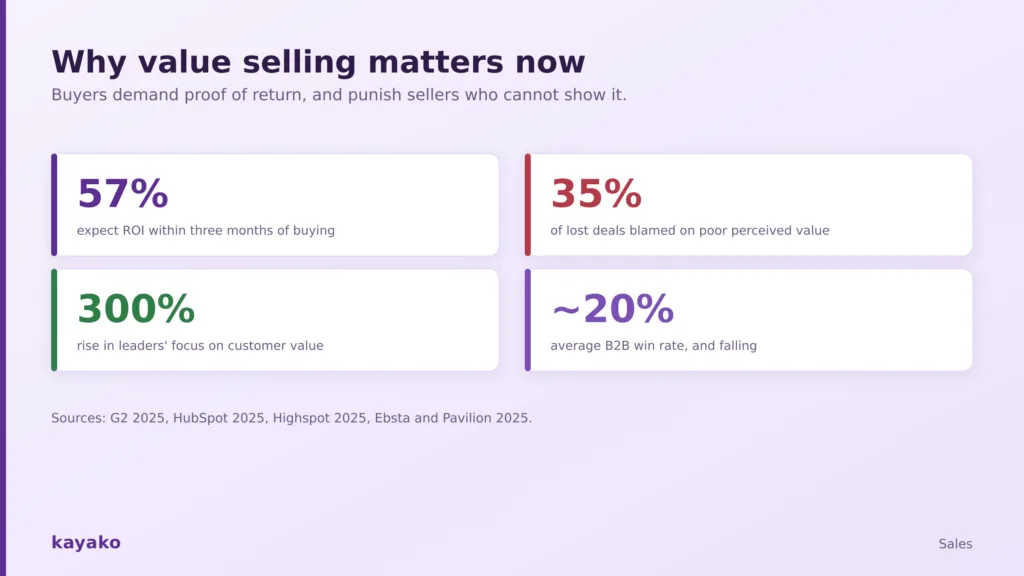
Buyers now demand proof of return, and punish sellers who cannot show it.
|
Understanding why the approach works is one thing. Running it consistently takes a repeatable process.
The value-based selling process
Value selling is not improvisation. The best teams run it as a disciplined sequence, so every rep can build a business case rather than relying on charisma.
1. Research the account
Before any conversation, learn the buyer’s industry, goals, pressures, and the metrics their leadership cares about. Value can only be framed against a target you understand, so this groundwork is where the whole approach starts.
2. Run deep discovery
Ask questions that surface the real problem and its cost. Quantify the pain: how much time, money, or risk the current situation creates. Discovery is where you earn the right to talk about value, and where you gather the numbers you will use later. Mapping the opportunity against the buyer’s sales funnel keeps the effort focused on deals worth the work.
3. Quantify the value
Translate your solution into a specific, credible number in the buyer’s terms. If discovery revealed a five-day month-end close, calculate what cutting it to two days is worth in hours and salary. Conservative, defensible math beats an inflated projection every time.
4. Present the ROI case
Show the return the way a finance stakeholder would want to see it: the cost, the expected gain, and the payback period. Use proof from similar customers to make the numbers believable. This is the moment value selling either lands or collapses.
5. Co-create the plan
Rather than pushing for a signature, build the path to results together. Agree what success looks like, how it will be measured, and who owns each step. A plan the buyer helped write is one they will defend internally.
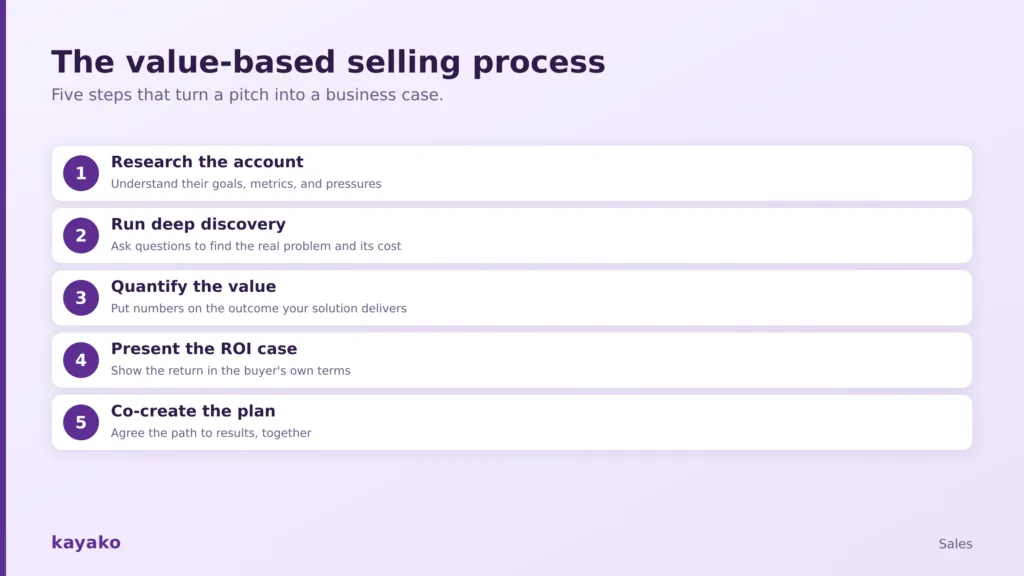
Five steps that turn a pitch into a business case.
The process gives you the structure. A handful of techniques make each step sharper.
Value-based selling techniques
These tactics turn the framework into practice and separate confident value sellers from hopeful ones.
- Speak in the buyer’s metrics. Frame value in the numbers their leadership tracks, whether that is revenue, churn, cost per unit, or cycle time, not in your product’s internal measures.
- Quantify the cost of inaction. Show what staying with the current approach costs each month. A clear price of doing nothing is often more persuasive than the upside of buying.
- Sell to the economic buyer. The person who feels the pain is not always the one who signs. Build a case strong enough to travel up to whoever controls the budget.
- Use proof, not adjectives. Replace words like powerful and seamless with case studies, benchmarks, and references from similar customers. Proof carries the weight that claims cannot.
- Bring an ROI model. A simple, transparent calculator the buyer can adjust builds trust, because it invites scrutiny rather than asking for faith.
Techniques are easier to grasp against real situations, so here is what value selling looks like in practice.
Value-based selling examples
A SaaS platform. Instead of pitching unlimited seats and integrations, the rep discovers that the prospect’s support team spends fifteen hours a week copying data between tools. The pitch becomes: this removes those fifteen hours, worth about $40,000 a year in recovered capacity, and pays for itself in four months.
A professional services firm. Rather than selling hours, the consultant frames the engagement around a target: reducing customer churn by two points, which for this client is worth roughly $1.2 million in retained revenue. The fee becomes a fraction of the return.
A manufacturing supplier. Competing against a cheaper part, the seller quantifies that their component fails half as often, cutting downtime and warranty claims by an amount that dwarfs the price difference over a year.
Each example works because the value is specific and expressed in the buyer’s terms, and each ties back to a metric the buyer already tracks, from churn to net sales. That focus is also what sets value selling apart from adjacent methods.
Value-based selling vs other sales methodologies
Value selling is not the only framework, and it overlaps with several. Knowing the differences helps you combine them well.
- Solution selling diagnoses a problem and prescribes a fix. Value selling goes a step further by quantifying what solving the problem is worth.
- SPIN selling is a questioning technique for uncovering needs. It pairs neatly with value selling, which uses those answers to build the ROI case.
- Consultative selling positions the rep as a trusted advisor. Value selling is the consultative approach with a scoreboard attached, since it insists on measurable return.
- Challenger selling leads with insight that reframes the buyer’s thinking. It works well as the opening move before value selling quantifies the case.
|
|
There is one more stage that most value-selling advice skips, and it is the one that decides whether the value was real.
Value does not stop at the close
A value-based sale makes a promise: this investment will return a specific result. That promise is sold during the deal, but it is only proven afterward, once the customer actually uses what they bought. If the value never materializes, the renewal disappears, and the case study never gets written. This is why the smartest revenue teams treat post-sale delivery as part of the sale, not an afterthought handled by another department.
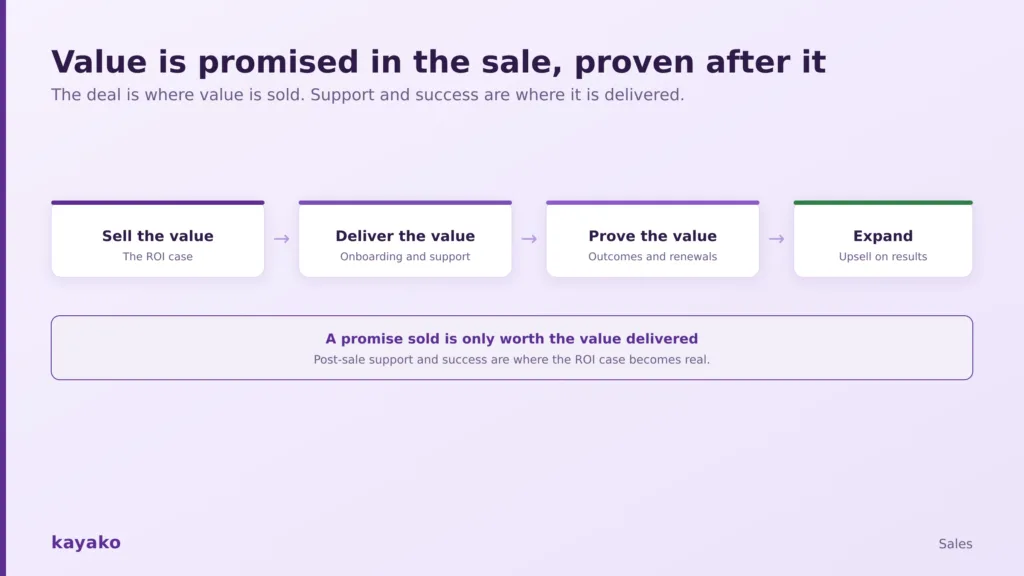
The deal sells the value. Support and success are where it is delivered and proven.
Delivery runs on customer support and success. Fast, capable after-sales service is what turns a signed ROI projection into a realized one, and a deliberate customer retention strategy is what converts that realized value into renewals and expansion. This is where a support platform like Kayako fits the value-selling picture. Kayako gives support teams a unified view of every customer and an AI agent that resolves routine issues fast, so customers reach the outcomes they were sold and keep reaching them. You can see the approach on Kayako’s SaaS customer support page, and our piece on how conversational AI drives revenue connects support directly to the numbers a sales team is measured on, and tracking the right customer experience metrics proves the value was delivered. When the value is delivered, the next value-based conversation, the expansion, almost sells itself.
|
|
Value-based selling wins because it answers the only question a modern buyer truly cares about: what will this return, and how soon? By researching the account, running honest discovery, quantifying the outcome, presenting a credible ROI case, and co-creating the plan, sellers turn a pitch into a business case that a committee can approve. The method pairs with consultative and solution selling and beats feature-dumping in nearly every competitive deal. The final discipline is remembering that value sold is not value delivered. The return you promised is realized after the close, in support and success, so the teams that connect the sale to the outcome are the ones that keep winning.
Frequently asked questions
What is value-based selling?
It is a sales methodology that centers the buyer’s business outcomes and financial return rather than the product’s features or price. The seller identifies the buyer’s goals and challenges, quantifies what solving them is worth, and presents the solution as an investment with a measurable payback. The aim is to make value the basis of the decision instead of cost.
How is value-based selling different from solution selling?
Solution selling diagnoses a customer problem and prescribes a fix. Value-based selling includes that step but goes further by putting a specific number on what solving the problem is worth to the buyer. In short, solution selling identifies the need, and value selling quantifies the return, which is why the two are often used together.
What are the steps in the value-based selling process?
Research the account to understand its goals and metrics, run deep discovery to find the real problem and its cost, quantify the value your solution delivers in the buyer’s terms, present a credible ROI case with proof, and co-create a plan to reach the results. Running these consistently is what makes the approach repeatable across a team.
Why is value-based selling effective?
Because modern buyers demand proof of return and involve more stakeholders, most of whom need a business justification. With 57% of buyers expecting ROI within three months and many deals lost on perceived poor value, an approach built around quantified outcomes fits how people actually buy today. It also differentiates in crowded markets where features look similar.
What is an example of value-based selling?
A software rep learns that a prospect’s team wastes fifteen hours a week moving data between tools. Rather than listing features, the rep frames the product as recovering that time, worth about $40,000 a year, with a four-month payback. The conversation shifts from what the tool costs to what it returns, which is the essence of value selling.
Does value-based selling work for small deals?
Yes, though the depth scales with the deal. Small or transactional sales may need only a quick, credible statement of value rather than a full ROI model. The principle holds at every size: buyers respond better to a clear outcome than to a feature list, so even a light version of the approach tends to outperform feature selling.