Tech sales is the work of selling technology, most often software, to the businesses that run on it. It sits at the meeting point of technology and revenue, and it has become one of the most accessible high-earning careers in the industry, open to people from teaching, hospitality, retail, and plenty of non-technical backgrounds. Demand is steady because every software company needs people who can explain value to a buyer and close the deal.
This guide covers what tech sales actually is, why people move into it, the roles and job titles you will meet, the skills that separate strong sellers from the rest, and a practical path to breaking in. It also looks at the part of the job that job descriptions tend to skip: what happens after the signature, where renewals and expansion decide whether a deal was worth it. The field pays well, yet it is competitive and demanding, so the honest picture matters as much as the highlights.
What is tech sales?
Tech sales, sometimes called technology sales or software sales, is the practice of selling technology-based products and services to other organizations. That includes SaaS platforms, cloud infrastructure, hardware, cybersecurity, and data or AI tools. Most of it is business-to-business, which means you are selling to companies rather than individual consumers, and the deals are usually larger and more considered than a typical retail purchase.
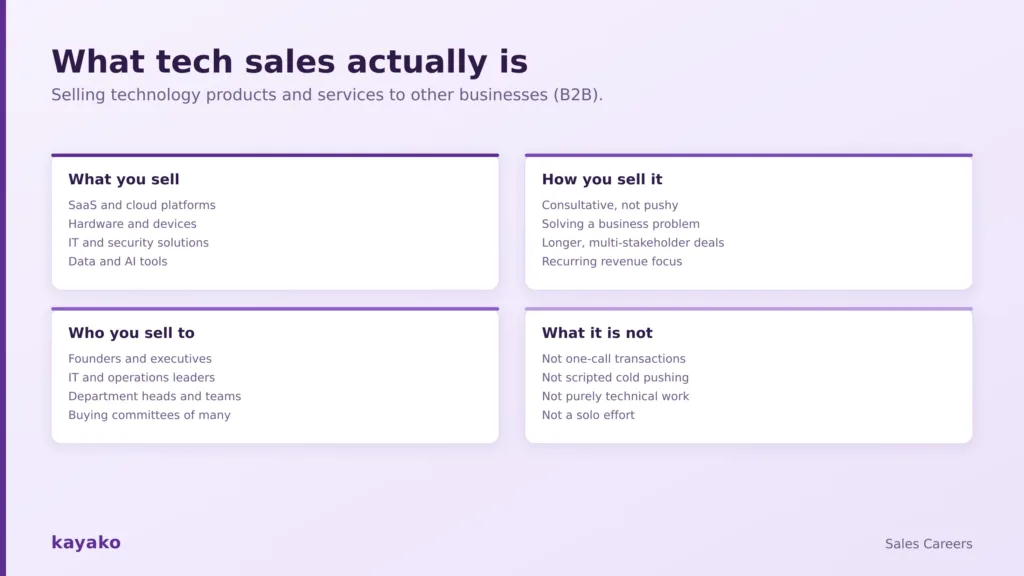
Tech sales in one view: the products, the buyers, and the consultative approach that defines the field.
Two things define the work. First, it is consultative. Good tech sellers diagnose a business problem and show how a product solves it, rather than reciting features. Second, the cycle is long and involves many people. The average business-to-business sales cycle has stretched to about, up from 4.9 months in 2019, and buyers now do roughly of their research on their own before they ever speak to a seller (Kondo). By the time a rep enters the conversation, the buyer already knows a lot, so the seller’s value is judgment and fit, not information.
Because the products are technical and the buyers are businesses, the same customer-facing habits that make great support also make great selling. Our guide to customer experience best practices for B2B sales teams goes deeper on that overlap.
Tech sales vs. IT sales vs. technical sales
These terms get mixed up. Tech sales is the broad category of selling technology, and most of it today is software. IT sales usually refers to selling infrastructure, networking, or managed services to an IT department. Technical sales, or the sales engineer track, is the deeply product-savvy role that supports deals with demos and architecture, often alongside an account executive. If you are starting out, tech sales is the umbrella term worth searching under, and the software side is where most of the entry-level hiring happens.
With the definition settled, the more useful question is why so many people are moving into the field in the first place.
Why pursue a career in tech sales?
The short answer is earning potential combined with a low barrier to entry. Few careers pay this well this fast without requiring a specific degree, and the skills you build transfer across the whole technology industry.
Compensation is the headline. Entry-level sales development reps typically see on-target earnings in the range (Sybill), and the median SaaS account executive on-target earnings reached about in recent benchmark data, with enterprise reps clearing $230,000 to $270,000 or more (Optymyze). On-target earnings combine a base salary with commission, so a strong year can pay well beyond the target. Understanding how that flows into a company’s net sales also helps you speak the language of the business you are selling into.
The honest side matters too. Selling is harder than it was a few years ago. In the first half of 2025 (Ebsta and Pavilion, via Gradient Works), the average B2B win rate now sits around 21%, according to HubSpot data, which means most opportunities do not close. Rejection is constant, targets are aggressive, and the pressure is real. People who thrive tend to treat it as a craft to improve at rather than a daily verdict on their worth.
|
If the trade-off of pressure for pay and growth appeals to you, the next step is understanding the specific roles you could step into.
Common tech sales roles and job titles
Tech sales is a ladder, not a single job. Each rung has a distinct focus, and knowing where you fit helps you target the right first role and plan your growth.
Sales Development Representative (SDR) or BDR
This is the most common entry point. SDRs and business development reps generate and qualify pipeline: researching accounts, sending outreach, booking meetings, and handing warm opportunities to closers. It is high-volume, high-rejection work, and it teaches the fundamentals of prospecting and resilience that everything else builds on.
Account Executive (AE)
The AE owns the deal from qualified opportunity to signed contract, running discovery, demos, negotiation, and close. It is where compensation jumps, and it is the most common promotion from SDR. AEs live in the pipeline, so learning to segment opportunities in the sales funnel is central to the role.
Sales Engineer or Solutions Engineer
Sales engineers are the technical half of a deal. They run detailed demos, answer architecture questions, and prove the product fits. The role suits people who enjoy the product depth without wanting to carry a pure closing quota, and it often pays a higher base with a smaller variable share. Notably, Salesforce research finds reps spend only about 28% of their time actually selling, which is one reason technical specialists exist: they let closers focus on closing.
Account Manager and Customer Success Manager
These post-sale roles keep and grow existing accounts through renewals, upsells, and cross-sells. In recurring-revenue businesses, they matter as much as new-logo closers, because keeping a customer is far cheaper than winning one. Strong customer enablement is the engine here, and many successful sellers move into these roles for the steadier rhythm and the strategic account work.
Sales Manager and VP of Sales
The leadership track moves from carrying your own number to building a team that hits its number. Managers coach reps, run forecasts, and design territory and quota plans. VPs own the whole revenue motion. Compensation is high, and so is accountability for results you no longer fully control yourself.
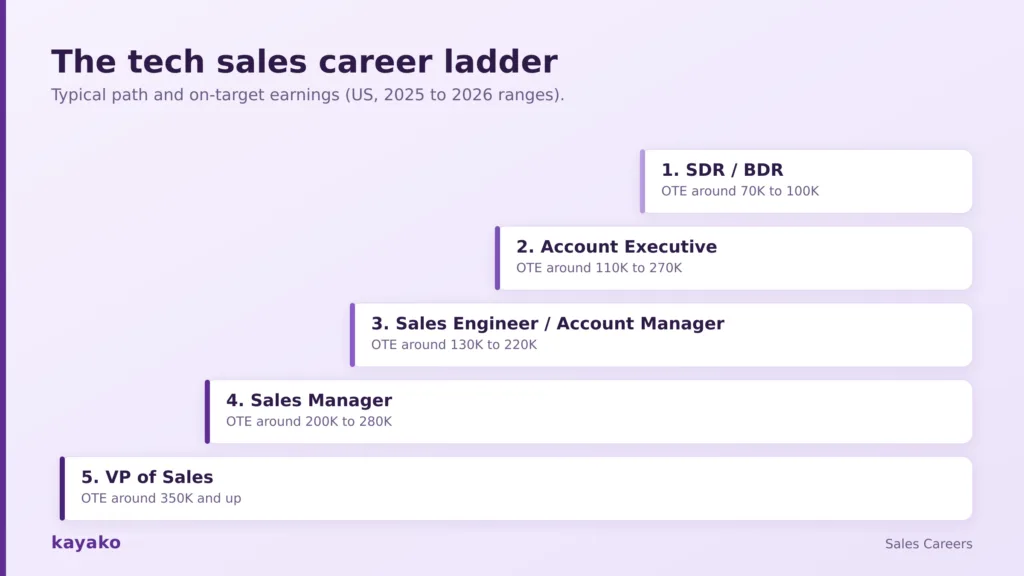
The typical tech sales ladder, with rough on-target earnings at each level.
|
Whichever rung you aim for, the same underlying skills decide who rises and who stalls.
Essential skills for tech sales success
Tech sales rewards a specific mix of soft skills and technical fluency. A technical degree is optional, but the abilities below are not.
- You have to explain value clearly to a junior user and a skeptical executive in the same deal, in writing and out loud.
- The best reps ask sharp questions and actually listen, uncovering the real problem before proposing anything.
- You cannot sell what you do not understand. Deep knowledge of your product and its limits builds the trust that closes deals.
- Most opportunities do not close, and most outreach is ignored. Handling that without losing momentum is the job’s central emotional skill.
- Comfort with Salesforce, HubSpot, and modern AI tools is now table stakes. Already, 81% of sales teams use AI in some form (Hyperbound).
- Solving a problem rather than pushing a product is what separates a trusted advisor from a vendor.
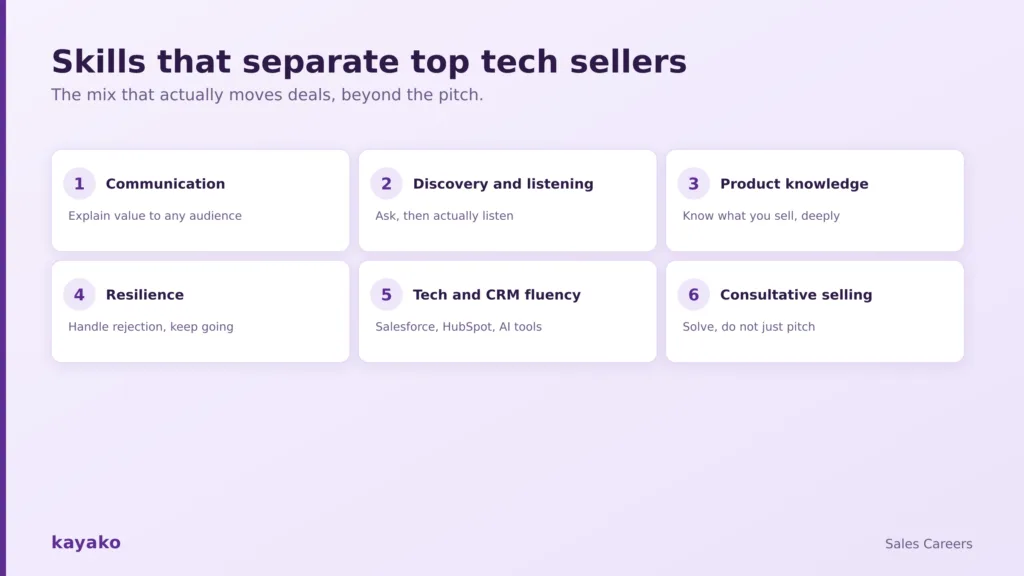
The skill mix that moves deals, beyond the pitch itself.
Relationships sit underneath all of these. Selling to a known contact, such as a former customer or a champion who changed jobs, produces a tech sale (Salesmotion). The reps who invest in trust, and who track it honestly in their customer experience metrics, compound an advantage over time. With the skills mapped, the practical question is how to actually get hired.
How to get into tech sales
You do not need a computer science degree or years of experience. You need a plan, a few weeks of preparation, and the persistence to work a job search the way you would work a pipeline.
- Aim for SDR or BDR openings at software companies. They hire for attitude and coachability more than for a resume full of sales titles.
- Short courses and reputable bootcamps teach prospecting, discovery, objection handling, and CRM basics, and they give you language to use in interviews.
- Get hands-on with a CRM such as Salesforce or HubSpot, plus outreach and sales-intelligence tools. Familiarity signals you can ramp quickly.
- Most roles are won through people. Talk to reps, join sales communities, and treat warm introductions as your highest-value channel.
- Frame past work around results, quotas, targets, revenue, and customer wins, even from non-sales jobs. Numbers travel well.
- Expect a mock cold call or role-play. Use the STAR method for behavioral questions, and practice turning an objection into a next step.
|
Landing the role is the beginning. The part that decides whether a career in tech sales pays off over years is what happens after the deal closes.
Where tech sales meets customer support
Most tech sales content stops at the signature. In a recurring-revenue business, that is exactly the wrong place to stop, because the first contract is often the smallest amount of money a customer will ever pay you. The real return comes from renewals and expansion, and both depend on the experience the customer has after they buy.
The industry has caught up to this (Everstage, via Apollo). That reflects a simple economic truth: keeping and growing a customer is far cheaper and more profitable than replacing one. A rep who understands the post-sale side sells more honestly up front and inherits healthier accounts later.
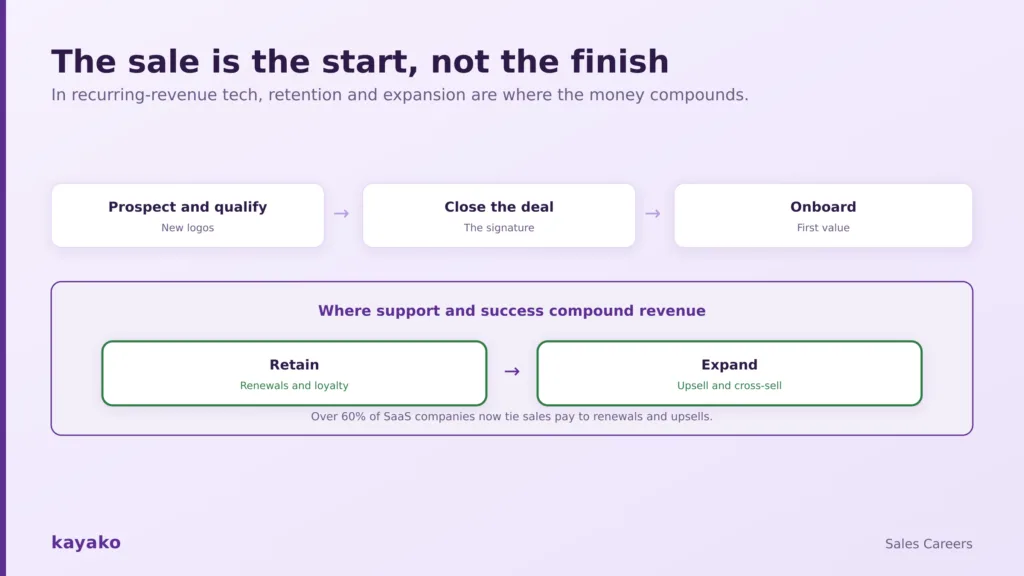
The close is the start. Retention and expansion, which run on support, are where revenue compounds.
Retention and expansion run on customer support. When the businesses that tech sellers sell into can resolve issues fast and keep the full customer context in one place, renewals get easier, and expansion conversations happen naturally. Strong after-sales service and a deliberate customer retention strategy are what turn a signed deal into years of revenue, and they are the difference between a logo that churns and one that grows.
This is where a support platform like Kayako fits into the tech sales picture. Kayako gives support teams a unified view of every customer and an AI agent that resolves routine tickets instantly, so the accounts your sales team works hard to win are easier to keep and grow. You can see the approach on Kayako’s SaaS customer support page, and its AI for customer support is built to handle volume without losing the human context that renewals depend on. For the revenue angle specifically, our piece on how conversational AI for customer service drives revenue and our guide to reducing churn connect support directly to the numbers a sales team cares about.
|
Seen this way, tech sales rewards people who think past the close, because the relationships a good support function sustains are what turn deals into lasting revenue. That is the full arc worth understanding before you commit to the field.
Frequently asked questions
Is tech sales a good career?
For the right person, yes. It offers high earning potential, fast advancement, remote flexibility, and skills that transfer across the technology industry, all without requiring a specific degree. The trade-offs are real pressure, constant rejection, and income that swings with performance. If you enjoy people, problem-solving, and a measurable scoreboard, it is one of the best-paid entry points into tech.
Do you need a degree or technical background for tech sales?
No. Most tech sales roles, especially entry-level SDR positions, hire for communication, coachability, and drive rather than for a technical degree. Plenty of successful reps come from teaching, hospitality, retail, and other people-facing fields. Product and technical knowledge can be learned on the job, and sales engineers are the ones who handle the deepest technical questions.
How much do tech sales reps make?
Entry-level SDRs typically earn $70,000 to $100,000 in on-target earnings. Account executives range widely by segment, from roughly $110,000 at the SMB level to $270,000 or more in enterprise, with a median SaaS AE OTE around $195,000. Sales managers and VPs earn more still. On-target earnings combine base and commission, so top performers with uncapped plans often exceed their targets.
Is tech sales stressful?
It can be. Quota pressure is significant, and in the first half of 2025, about 76% of sellers missed quota. Rejection is a daily feature of the work, and income variability adds its own stress. The people who last build routines for handling rejection, focus on inputs they control, and lean on supportive teams. Managing that pressure is a learnable skill, and it is worth assessing honestly before you commit.
What is the difference between an SDR and an AE?
An SDR generates and qualifies pipeline by prospecting and booking meetings, but does not close deals. An account executive takes those qualified opportunities through discovery, demos, negotiation, and close, and carries a revenue quota. The AE role is the most common promotion from SDR, and it usually comes with a meaningful jump in earnings and responsibility.
Will AI replace tech sales jobs?
AI is changing the work more than replacing it. It already handles research, note-taking, drafting, and parts of prospecting, and 81% of sales teams now use it in some form. What it does not replace is the human judgment, trust, and relationship-building that close complex deals. The reps who pair AI fluency with strong people skills are pulling ahead, rather than being pushed out.
How do I get into tech sales with no experience?
Target SDR roles, build core selling skills through courses or a bootcamp, get hands-on with a CRM, and network your way to warm referrals. Reframe any past work around measurable results, and prepare for role-play interviews using the STAR method. Treat the job search like a sales pipeline: consistent activity, follow-up, and resilience win it.