A step-by-step guide to building a referral program, plus how to use support data to find advocates and time the ask so people say yes.
Most referral programs fail quietly. The landing page goes live, a few dozen customers claim a code, and six months later nobody can say whether the thing paid for itself. The mechanics were never the problem. Codes, rewards, and tracking are solved problems with mature tooling behind them.
What breaks is the ask. Someone has to invite the right customer at the right moment, and in most companies nobody owns that. Marketing sends a launch email to the whole base and hopes. Sales asks whoever they remember. Support, which speaks to more customers in a week than either team does in a quarter and knows exactly who just had a great experience, is left out of the design entirely.
This guide covers how to set up a referral program end to end: the decisions to make before you build anything, the setup sequence itself, and how to wire your support organization into it so the ask lands with people who are actually inclined to say yes.
What a Referral Program Is, and Why Support Owns Half of It
A referral program is a structured system that rewards existing customers for bringing you new ones. Structured is the operative word. Word of mouth happens anyway; a program makes it trackable, repeatable, and attributable to a specific customer and reward.
Three components make a program work, and they map to different teams.
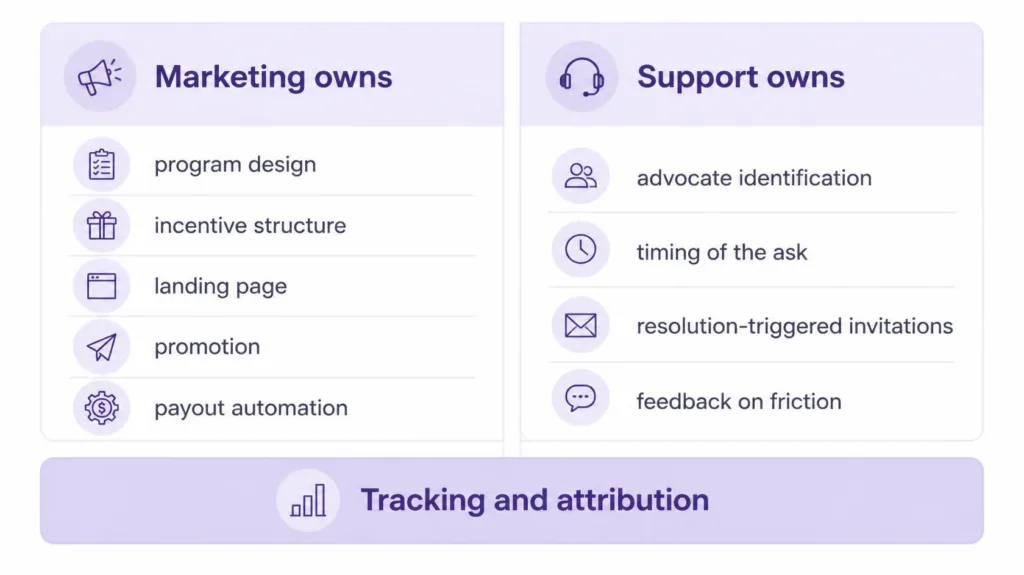
The mechanics
Unique codes or links, reward rules, redemption handling, and attribution. This is infrastructure. You either build it, buy a dedicated referral platform, or use an API-first provider that plugs into your existing stack. Most companies under a few thousand customers should buy rather than build.
The offer
What the referrer gets, what the referred person gets, and what has to happen before either is paid. Getting this wrong is the most common cause of a dead program, usually because the reward is priced against a competitor’s program rather than against your own customer economics.
The ask
Who gets invited, by whom, and when. This is the part almost everyone underinvests in, and it is where support is better positioned than any other function. Your agents can see which customers just had a problem solved well, which ones volunteer praise unprompted, and which ones already recommend you in community threads. That is a live advocate list, refreshed daily, sitting inside your customer support software.
The rest of this guide treats all three as one system rather than as a marketing project with a support afterthought.
Why Referrals Outperform Every Other Acquisition Channel
The case for referrals used to rest on trust arguments. The current evidence is more specific, and it explains why referrals do disproportionate work in B2B.
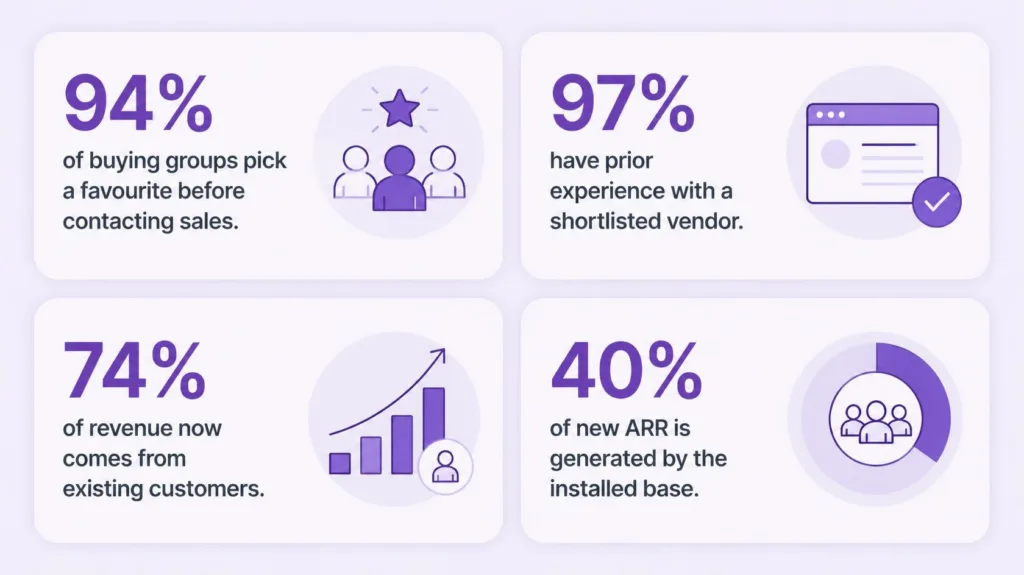
Start with when buying decisions actually get made. 6sense’s 2025 Buyer Experience Report, based on responses from more than 4,000 buyers across North America, EMEA, and APAC, found that 94% of buying groups had ranked a preferred vendor before speaking to any seller, and went on to buy from that early favorite 77% of the time. The same research found buyers report prior personal experience with at least one vendor on their shortlist 97% of the time.
Read those two findings together and the mechanism becomes clear. Shortlists are built from familiarity, and familiarity usually arrives through a person. A referral does not merely generate a lead. It installs you on a shortlist before a competitor knows the deal exists.
The second argument is where growth now comes from. ChurnZero’s 2025 Customer Revenue Leadership Study, which surveyed 793 senior post-sale leaders, found 74% reporting that most company revenue comes from existing customers. Pavilion’s 2025 B2B SaaS benchmarks put the installed base at roughly 40% of new annual recurring revenue, rising past half at companies above $50M. A referral program is one of the few channels that turns retention work directly into acquisition.
Third, cycle length. 6sense recorded average B2B buying cycles compressing from about 11.3 months in 2024 to 10.1 months in 2025. Referred deals sit at the short end of that range because the trust step is already done.
None of this happens without a working program. Which means making some decisions first.
Before You Launch: Five Decisions to Make First
Skipping this section is why programs stall. Each of these locks in something expensive to change later.
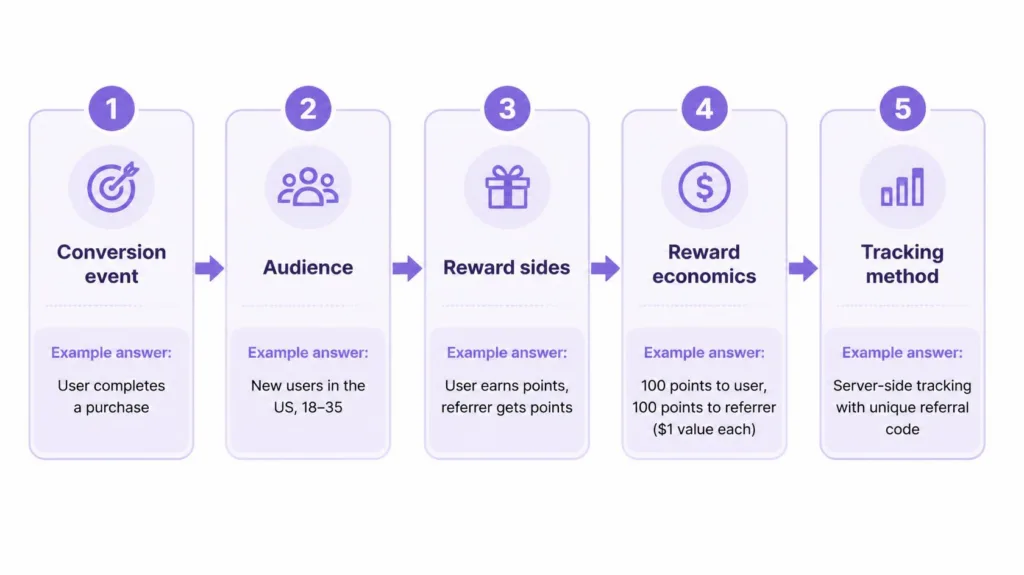
Decision 1: What counts as a successful referral
Pick one conversion event and write it down. A signup, a qualified demo, a first payment, or retention past some threshold. Paying on signup gives you volume and fraud. Paying on first payment gives you quality and slower payouts. Paying after ninety days of retention gives you the best customers and the least participation. For most B2B software, first payment is the right default.
Decision 2: Who you ask
Not everyone. Asking your whole base dilutes the program and irritates customers who have open complaints. Build a list from actual behavior rather than from contract size, which is covered in detail further down.
Decision 3: One side or two
Single-sided rewards the referrer. Double-sided rewards both. Double-sided programs generally outperform, because the referred person needs more convincing than the referrer does. If cost is the objection, split rather than double: a 10% referrer reward becomes 5% each.
Decision 4: What the reward is worth
This is arithmetic, not taste. Take your customer lifetime value, take your current blended acquisition cost, and set the reward comfortably below the latter. Cap referrals per person to protect the budget. Cash is the most motivating and the least strategic, since it leaves your business the moment it is paid. Account credit, upgrades, or extended plan tiers keep the value inside your product.
Decision 5: How you track it
Unique codes are simple and shareable. Unique links attribute better. Whatever you choose, decide now how referral data reaches your CRM and your helpdesk, because an agent who cannot see that a customer has referred three people is an agent who cannot thank them.
Once these are settled, the build is mostly mechanical.
How to Set Up a Referral Program Step by Step
Seven steps, in order. Expect two to four weeks for a first version, less if you buy rather than build.
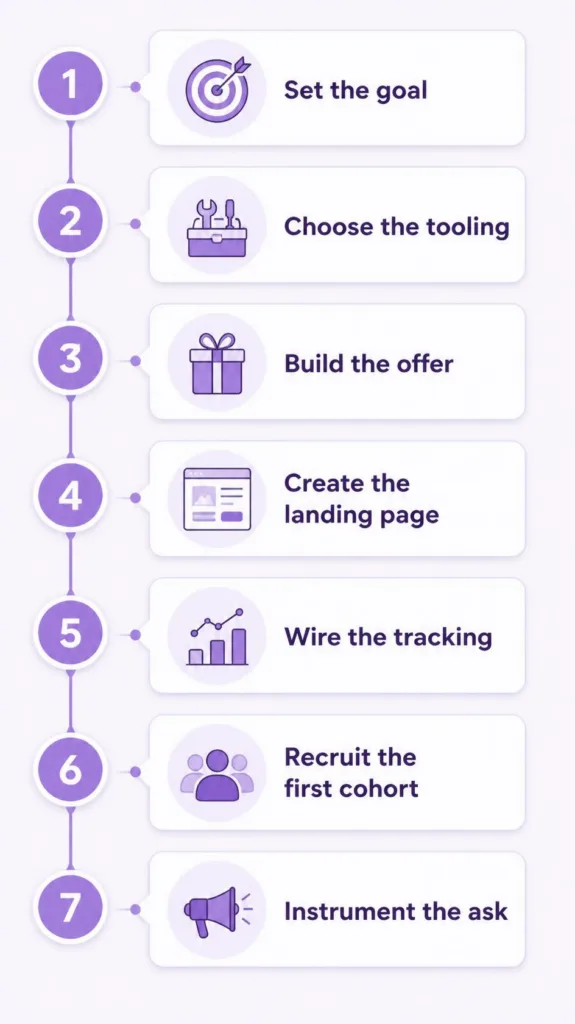
Step 1: Set a numeric goal
Referrals as a percentage of new customers is the cleanest target. Pick a number for the first two quarters, so you have something to judge the program against.
Step 2: Choose your infrastructure
Three routes. Build in-house for full control at high engineering cost. Use a packaged referral platform for the fastest launch with less flexibility. Use an API-first provider when you want your own front end with someone else’s reward logic underneath. Whichever route, confirm it integrates with your CRM and your ticketing system before you sign.
Step 3: Build the offer and the rules
Write the terms in plain language: who qualifies, what triggers payout, how long codes stay valid, referral caps, and what happens if a referred customer churns. Ambiguous terms generate support tickets, which is a cost people forget to model.
Step 4: Create a real landing page
One page that explains the offer, shows the reward on both sides, and answers the obvious questions inline. Every promotion points here. Include a short FAQ, because customers will otherwise ask your agents, and inconsistent answers erode trust in the program.
Step 5: Wire the tracking
Codes generated, codes assigned, redemptions attributed, rewards issued automatically. Manual payout tracking is the single most common reason programs die in month four. Automate it before launch, not after.
Step 6: Recruit a first cohort deliberately
Do not mass-email. Start with fifty to a hundred customers you have strong reason to believe are advocates, invite them individually, and watch what happens. A small cohort tells you whether the offer works before you spend your one launch moment on it.
Step 7: Instrument the ask inside support
Covered next, and it is the step that separates programs that compound from programs that plateau.
Where Support Fits: Finding Advocates and Timing the Ask
Your helpdesk holds a better advocacy signal than your CRM. Here is how to use it.

Find advocates in ticket data
Filter for customers who left high satisfaction scores after a resolved escalation, who volunteer praise without being surveyed, who answer other customers publicly, and who submit feature requests with a described use case attached. These behaviors predict willingness to refer far better than revenue does. Tracking them alongside your existing customer support metrics makes the list maintainable rather than a one-time export.
Time the ask to the resolution
The highest-yield moment is immediately after a problem is solved well, while the customer still feels the relief. That window is short. Waiting for the next quarterly campaign wastes it. Keeping time to resolution low is what creates these moments in the first place.
Let agents make the ask, not just marketing
There is good evidence that a human prompt during a live conversation changes behavior substantially. Gartner surveyed 5,801 customers in January and February 2025 and found that when agents actively promoted self-service during a conversation, roughly twice as many customers said they would use it next time. The same principle applies to referrals: an invitation from the person who just fixed your problem outperforms an invitation from a newsletter.
Never ask over an open complaint
This sounds obvious and gets violated constantly by automated campaigns that do not check ticket status. Suppress referral invitations for any account with an open escalation or a recent negative score. One badly timed ask costs more goodwill than three good ones earn.
Close the loop back to product
Referral conversations surface why people recommend you, which is different from what your positioning claims. Route that back through your customer feedback loop so marketing can use the actual language customers reach for.
Doing all this at scale needs agent capacity, which brings up automation. Salesforce’s seventh State of Service report, surveying 6,500 service professionals between April and June 2025, found AI is expected to handle half of all service cases by 2027, up from roughly 30% today, and that representatives using AI spend about 20% less time on routine cases. Kay, Kayako’s AI support agent, resolves repetitive tickets autonomously, which is what leaves your team room for the conversations where an ask is appropriate.
See how Kay clears the queue that blocks these conversations
Measuring and Optimizing the Program
Track five things. More than that and nobody reads the dashboard.
Participation rate. Invited customers who claim a code. Low numbers mean the offer or the ask is wrong, not the audience.
Referral conversion rate. Claimed codes that reach your conversion event. This tells you whether referred traffic is landing somewhere useful.
Cost per referred customer. Reward cost plus tooling, divided by conversions. Compare against blended acquisition cost, which is the only comparison that matters.
Retention of referred customers. Track them as a distinct cohort. Long-running academic work on referral programs, including a widely cited study of a German retail bank, found referred customers held higher contribution margins and better retention than customers acquired other ways, with the retention advantage persisting even as the margin advantage faded. If your referred cohort is not outperforming, your conversion event is probably too loose.
Fraud rate. Self-referrals, disposable emails, and code sharing at scale. Referral caps, email verification, and paying on first payment rather than signup handle most of it.
On optimization, change one variable at a time. Reward size, reward sides, ask timing, and channel are the four worth testing. Teams running structured post-sale programs see it in retention numbers: ChurnZero found that organizations using a dedicated customer success platform reported 100% net revenue retention compared with 94% for those without one.
Making Referrals a System Rather Than a Campaign
A referral program is not a marketing asset that sits on a landing page. It is a habit distributed across the teams that talk to customers, with support carrying more of it than most org charts admit.
The work divides cleanly. Decide your conversion event and reward economics before you build. Buy tooling rather than building it unless you have a reason not to. Recruit a small first cohort instead of blasting your base. Then wire the ask into the moment right after a good resolution, suppress it for unhappy accounts, and let the people who actually fixed something be the ones who ask. Programs built this way compound, because every well-handled ticket refills the advocate list.
Frequently Asked Questions About Referral Programs
How long does it take to set up a referral program?
With a packaged platform, a functional program can launch in two to three weeks, most of which is spent on offer design and terms rather than implementation. Building in-house realistically takes a quarter or more once tracking, payout automation, and fraud controls are included. The longer timeline is rarely worth it below a few thousand customers.
Should I reward the referrer, the referred customer, or both?
Both, in most cases. The referrer is already convinced; the referred person is the one deciding whether to try you. If budget is the constraint, split a single-sided reward across both parties rather than dropping one side, since a referred customer with no incentive converts noticeably worse.
What is a realistic target for referred customers?
It varies widely by category and audience engagement. Rather than chase a benchmark, measure your own baseline for a quarter and set a target above it. What matters more is whether referred customers retain better than your other cohorts, because that ratio determines whether scaling the program is worth doing.
How do I stop people gaming the program?
Cap referrals per person, verify email addresses, pay on first payment rather than signup, and monitor for clusters of signups sharing IP addresses or disposable domains. Non-monetary rewards reduce fraud incentive considerably, since account credit is far less attractive to abuse than cash.
Can a referral program work if our support experience is weak?
Not reliably. Referrals ask customers to attach their own credibility to you, and people will not do that for a product whose support has burned them. Fixing resolution times and escalation handling usually produces more referrals than any incentive change.