Key takeaways
- Employee engagement activities are structured efforts that build connection, recognition, and growth, the three things people need to feel invested in their work.
- They matter more than ever. Global engagement has fallen to a five-year low, and disengagement now costs the world economy trillions each year.
- The best programs mix categories: team building, remote-friendly options, wellness, recognition, learning, and simple social time.
- Activities work only when managers buy in, participation stays voluntary, and each idea ties back to real purpose rather than forced fun.
- For support and service teams, engagement is a direct customer-experience lever, because engaged agents deliver better service.
Employee engagement activities are the deliberate things a company does to help people feel connected, valued, and motivated at work. They range from a five-minute recognition ritual to a full offsite, and the good ones share a purpose: turning employees who merely show up into people who genuinely care about the outcome. Done well, they build culture. Done as forced fun, they quietly make things worse.
This guide gives you more than thirty activities across six categories, along with the reason engagement is worth the effort right now and a practical framework for running programs that land. It closes with the connection that matters most for service teams: how an engaged workforce shows up directly in the customer experience.
What are employee engagement activities?
Employee engagement activities are organized initiatives designed to strengthen the emotional commitment people feel toward their team, their work, and their organization. Engagement is not the same as satisfaction. A satisfied employee is content to do the job, while an engaged one gives discretionary effort because they care about the result. Activities are one of the main levers for moving people from the first state to the second.
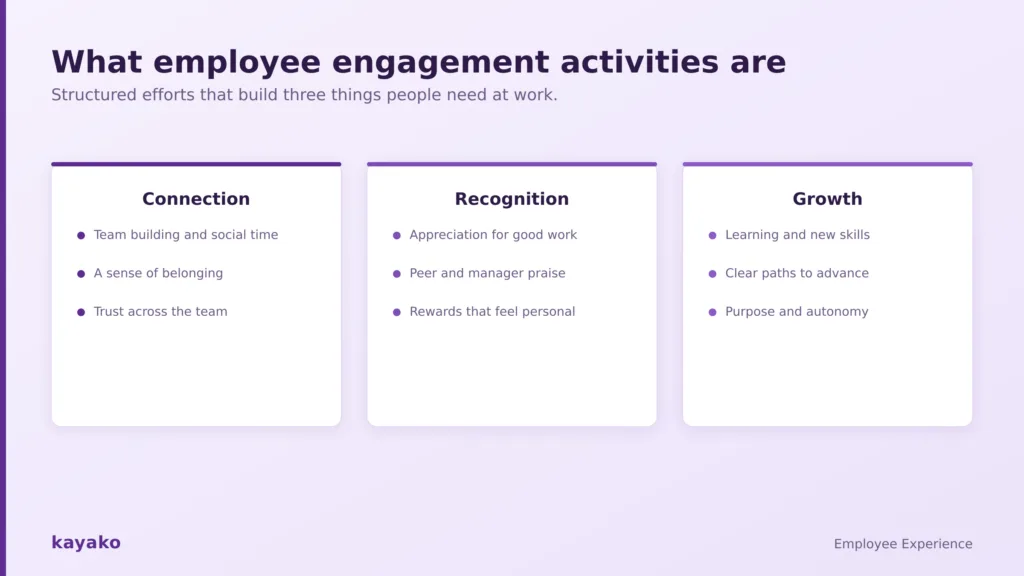
Good activities build three things people need at work: connection, recognition, and growth.
Most effective activities support at least one of three pillars: connection and belonging, recognition and appreciation, or growth and purpose. The strongest programs cover all three over time rather than leaning on a single tactic. A healthy company culture is what emerges when those pillars are reinforced consistently, not with a one-off party. To see why that effort pays back, it helps to look at what disengagement actually costs.
Why employee engagement activities matter
The business case has rarely been stronger, because engagement is in decline. Gallup’s latest research found that only 20% of employees worldwide are engaged, a five-year low, and estimated that low engagement drained roughly $10 trillion from the global economy in a single year (Gallup). The slide has been driven largely by managers, whose own engagement fell first and pulled their teams down with them.
The upside is just as measurable. Gallup’s long-running analysis links highly engaged teams to about 23% higher profitability and 81% lower absenteeism than disengaged ones (HR Cloud), and engaged employees are roughly 87% less likely to leave. Managers account for about 70% of the variance in team engagement, which is why activities alone are never enough without leaders who back them. Retaining good people is a large part of the payoff, and our guide to retaining your support staff goes deeper for service teams specifically.
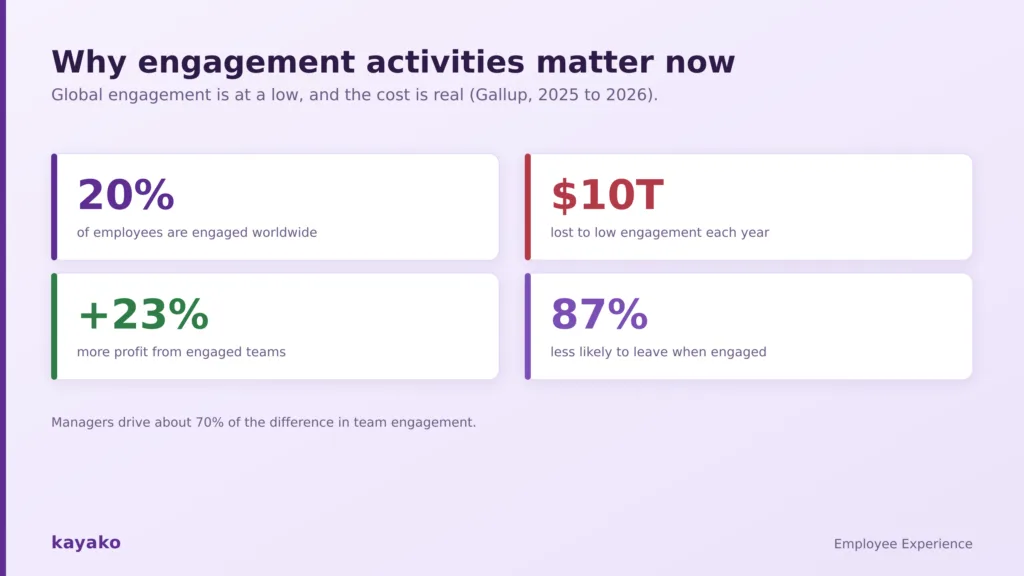
Global engagement is at a low, and the cost of ignoring it is measured in trillions.
|
The activities below are grouped into six categories. Mixing across them is what keeps a program fresh and inclusive, so there is something that fits every person and every working style.
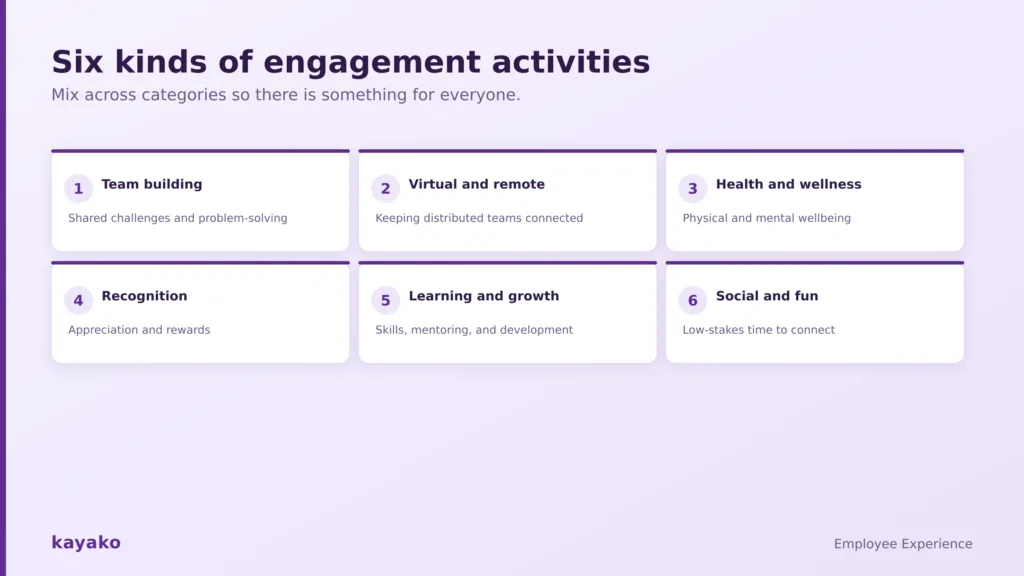
Six categories to draw from, so your program has something for everyone.
Team-building activities
Team building creates shared experiences and trust, which make everyday collaboration easier. The best versions involve a shared challenge rather than forced icebreakers.
- Escape room challenge. In person or virtual, a timed puzzle room forces a team to communicate under mild pressure and reveals how they solve problems together.
- Group volunteering day. A shared cause builds bonds and purpose at once. Teams that give back together report stronger connection than those that only socialize.
- Cross-department shadowing. Pair people from different functions for a half-day so they understand each other’s work and build empathy across silos.
- Office Olympics. Light, friendly competitions, from trivia to desk-chair races, inject energy and give quieter team members a low-stakes way to join in.
- Problem-solving workshops. Give the team a real business challenge and a few hours to prototype answers. It builds skills and signals that their ideas matter.
Support teams in particular benefit from structured connection, and our guide to customer service team building has activities tailored to the service floor. When part of your team works remotely, the format has to change.
Virtual and remote engagement activities
Distributed teams need engagement designed for a screen, because the hallway conversations that build connection in an office simply do not happen. Intentional, remote-first activities fill that gap.
- Virtual coffee pairings. Randomly match two people each week for a casual fifteen-minute chat with no agenda. It recreates the watercooler across distance.
- Online game sessions. Short trivia, Pictionary, or quiz games over video give remote teams a reason to laugh together and reset between heavy stretches of work.
- Show and tell. Invite people to share a hobby, a pet, or a corner of their home. Small windows into real life build the trust that remote work erodes.
- Async recognition channels. A dedicated chat channel for shoutouts lets praise flow across time zones without needing everyone online at once.
- Virtual wellness breaks. Scheduled short breaks for a stretch, a walk, or a guided breather protect against the always-on fatigue of remote work.
Keeping distributed teams connected is a discipline of its own, and our guide to managing remote teams covers the rhythms that make it work. Beyond connection, wellbeing deserves its own focus.
Health and wellness activities
Wellbeing and engagement move together. Employees who feel physically and mentally supported have more to give, and wellness activities signal that the company sees them as people rather than output.
- Step or fitness challenges. A friendly team step count or activity streak encourages movement and a bit of camaraderie, especially for desk-bound roles.
- No-meeting days. Protecting one day a week from meetings gives people uninterrupted focus time, which lowers stress more than most wellness perks.
- Mindfulness sessions. Short guided meditation or breathing sessions, offered rather than required, give people tools to manage pressure.
- Mental health support. Actively promote employee assistance resources and normalize using them. Awareness matters as much as the benefit itself.
- Flexible wellbeing stipends. A small budget people can spend on a gym, a course, or equipment respects that wellbeing looks different for everyone.
Wellness keeps people steady. Recognition is what makes them feel seen, and it is one of the highest-return activities of all.
Recognition and appreciation activities
Recognition is consistently one of the strongest drivers of engagement, and one of the most underused. As of 2025, employees who are recognized at work are about 7x more likely to be highly engaged (Bucketlist), and OC Tanner’s 2025 Global Culture Report found that people who feel appreciated are 156% more likely to report higher engagement (via Chanty).
- Peer-to-peer shoutouts. A simple channel where anyone can praise a colleague spreads recognition beyond managers and reinforces good behavior in real time.
- Milestone celebrations. Mark work anniversaries, project wins, and personal milestones. Consistency signals that the company pays attention.
- Handwritten notes. A specific, personal note from a manager carries more weight than a generic award. Detail is what makes recognition feel real.
- Points-based rewards. Let employees earn and redeem points for rewards they actually want, which keeps recognition frequent rather than annual.
- Public wins at all-hands. Open team meetings with genuine recognition so the whole organization sees what good work looks like.
|
Recognition rewards past effort. Growth activities give people a future to be engaged about.
Learning and growth activities
People stay engaged when they are getting better at something. Development activities are among the most durable, because they connect daily work to a longer sense of progress.
- Lunch and learns. Regular informal sessions where colleagues teach each other a skill, spread knowledge, and give people a stage.
- Mentorship pairings. Match less experienced employees with seasoned ones for regular guidance. Both sides tend to grow more engaged.
- Skill workshops and stipends. Fund courses, certifications, or conference tickets. Investment in growth is a clear signal that the company backs its people.
- Job rotation. Let people spend time in an adjacent role. It builds skills, breaks monotony, and strengthens cross-team understanding.
- Career-path conversations. Regular, honest talks about where someone wants to go turn a job into a path. A strong onboarding experience sets this tone from day one.
Structured growth builds the long game. Sometimes the point is simply to enjoy each other’s company.
Social and fun activities
Not every activity needs a business rationale. Low-stakes social time builds the relationships that make hard work feel lighter, as long as it stays optional and inclusive.
- Interest-based clubs. Running, gaming, cooking, or book clubs connect people around shared passions rather than job titles.
- Team offsites. A day or two away from the usual setting resets relationships and gives people memories that outlast any perk.
- Themed days. Simple themes, from favorite-jersey days to potluck lunches, add lightness without much planning.
- Cultural celebrations. Marking a range of cultural events shows people from different backgrounds that they belong.
- No-agenda hangouts. Sometimes the best activity is unstructured time together with no goal beyond enjoying the company.
A full menu of activities is only half the work. Whether they land depends entirely on how they are run.
How to run engagement activities that actually work
The difference between a program that builds culture and one that breeds eye-rolls is execution. A few principles separate the two.
- Win manager buy-in first. Since managers drive roughly 70% of team engagement, activities without their genuine support fall flat. Start with the leaders.
- Keep participation voluntary. Forced fun backfires. Give people real choice about what and whether they join, and protect those who opt out.
- Tie activities to purpose. Connect each initiative to something real, such as recognition, growth, or wellbeing, rather than running events for their own sake.
- Make everything inclusive. Design for remote workers, different personalities, and different needs so activities pull the whole team in rather than the same few people.
- Measure and adjust. Use pulse surveys and participation data to see what works, and drop what does not. Treat engagement as a program, not a party.
Building this into how a team operates, rather than bolting it on, is the real goal. Our guide to building a customer-oriented culture and the right customer experience metrics helps connect engagement work to outcomes you can track. For service teams, that outcome shows up in a specific and valuable place.
Engaged teams deliver a better customer experience
For any team that touches customers, engagement reaches well beyond internal morale and becomes a direct lever on the customer experience. The service-profit chain, a model developed at Harvard Business School, traces a clear line: better internal support and engagement lead to more capable, motivated employees, who deliver better service, which produces more loyal customers and stronger growth (Harvard Business School). Gallup’s data backs the link, tying engaged teams to roughly 10% higher customer loyalty.
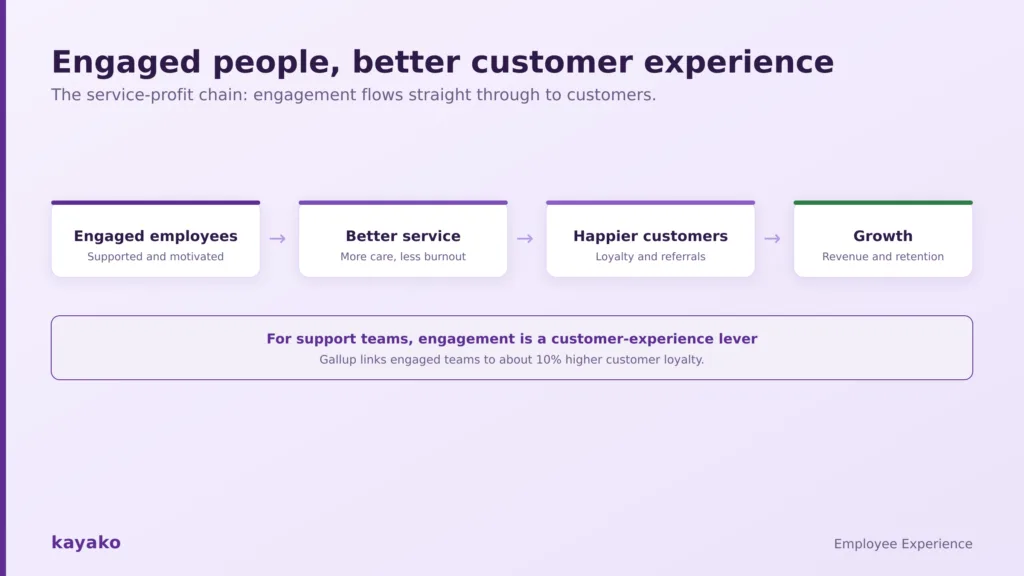
Engagement flows straight through to customers, which makes it a customer-experience lever for support teams.
Support teams face a specific engagement threat: the grind of repetitive tickets. Answering the same handful of questions hundreds of times a day is a fast route to burnout, and burned-out agents disengage. This is where the right tooling supports engagement directly. Kayako’s AI agent, Agent Kay, resolves routine, repetitive questions automatically, which lifts the monotonous load off agents and leaves them the complex, satisfying work that keeps people invested. You can see how in Kayako’s AI for customer support, and our piece on how an AI contact center helps teams escape the repetitive ticket trap goes deeper. A smoother internal helpdesk removes the day-to-day friction that quietly wears people down, and the payoff shows up in the customer experience your team delivers.
|
Employee engagement activities are worth the effort because engagement itself is worth the effort. With global engagement at a low and the cost measured in trillions, the companies that invest thoughtfully in connection, recognition, and growth pull ahead on retention, productivity, and customer loyalty. The activities in this guide give you a full menu to draw from, but the results come from how you run them: with real manager support, genuine choice, a tie to purpose, and a habit of measuring what works. Build that, and engagement stops being an event on the calendar and becomes part of how your team operates every day.
Frequently asked questions
What are employee engagement activities?
They are structured initiatives that strengthen the emotional commitment employees feel toward their work and organization. They span team building, remote-friendly options, wellness, recognition, learning, and social time. The goal is to move people from simply being satisfied to being genuinely invested in outcomes, which shows up in effort, retention, and performance.
Why are employee engagement activities important?
Because engagement drives real business results and is currently in decline. Gallup found only about 20% of employees worldwide are engaged, at an estimated cost of $10 trillion a year in lost productivity, while highly engaged teams see roughly 23% higher profitability and far lower turnover. Activities are one of the most practical levers for closing that gap.
What are good employee engagement activities for remote teams?
Remote-first options work best: virtual coffee pairings that recreate watercooler chats, short online game or trivia sessions, show-and-tell shares, async recognition channels, and scheduled wellness breaks. The key is designing for a screen and different time zones rather than moving in-office activities online without adapting them.
How do you measure the success of engagement activities?
Use a mix of pulse surveys, participation rates, and outcome metrics such as retention, absenteeism, and customer satisfaction. Track engagement over time rather than after a single event, and be willing to drop activities that do not move the numbers. Treating engagement as an ongoing program, not a one-off, is what makes measurement useful.
Do employee engagement activities actually work?
Yes, when they are run well. Voluntary, purposeful activities backed by managers reliably improve connection, recognition, and growth. Forced or tokenistic events can backfire and increase cynicism. Since managers account for about 70% of the variance in team engagement, leadership support is the single biggest factor in whether activities succeed.
How often should you run engagement activities?
A steady rhythm beats occasional big events. Small, frequent touches, such as weekly recognition and regular check-ins, matter more than an annual party. Aim for a consistent cadence that mixes categories over a quarter, so people experience connection, recognition, growth, and wellbeing on a repeating basis rather than all at once.
How do engagement activities affect customer experience?
Directly, especially for service teams. The service-profit chain shows that engaged, well-supported employees deliver better service, which produces more loyal customers. Gallup links engaged teams to about 10% higher customer loyalty. For support teams, reducing burnout from repetitive work, including with AI that handles routine tickets, protects engagement and the customer experience at once.