I have sent a few thousand refusals in my time on support and CX teams: refunds outside the window, discounts I could not give, features that were never coming. The ones that kept the customer had almost nothing to do with the answer and everything to do with how it was delivered. This is the framework, the scripts, and the 13+ templates I wish I had on day one.
Early in my support career, I thought a good agent was one who found a way to say yes. Then I watched our best yes-sayer quietly train an entire book of customers to escalate, because they had learned that pushing hard enough always produced an exception. Saying no to customers is a skill, not a service failure, and it is one of the most valuable a support team can build. Done well, a clear no protects fairness and capacity while leaving the relationship intact. Done badly, it is the fastest way to lose a customer you could have kept.
This guide is the practical version I give new agents. It covers what saying no actually means, the Acknowledge, Explain, Offer framework that structures every good refusal, how to adapt it by channel, and more than thirteen ready-to-use templates for the situations you will hit most. There is a dedicated section on refusing B2B clients, where the stakes per conversation are higher, and an honest look at what frontline agents themselves say works. Use it as a reference, not a script to read robotically.
What saying no to customers really means
Saying no to a customer means declining a specific request, for a refund, a discount, a feature, a policy exception, faster service, or anything outside your standard offering, without losing the relationship. It is not refusing to help. It is declining the exact path the customer asked for while making sure they leave with somewhere productive to go next.
The phrase has two halves that matter equally: the no, and the customer. A clear no protects fairness, capacity, and policy. A respectful experience protects the relationship and the brand. Most teams over-protect one half at the expense of the other, producing either rigid, scripted refusals or vague half-yeses that create false hope. The whole skill is holding both at once.
In one sentence: saying no to a customer means giving them an honest answer plus a workable next step, not a softened maybe, and not a closed door.
When you will need it:
- A refund or return outside the policy window.
- A custom discount or pricing exception.
- Feature requests outside the roadmap.
- Priority service or queue-jumping requests.
- Out-of-scope work for B2B clients.
- Requests for confidential information.
- Unrealistic timelines or warranty extensions.
Once you can spot these moments coming, the next step is accepting that turning them down is part of good service, not a departure from it.
Why saying no is a customer service skill, not a failure
There is a stubborn myth in customer service that the customer is always right, so you should always find a way to say yes. In practice, saying yes to everything erodes service quality, sets precedents you cannot sustain, and burns out the team. Honesty is what customers actually reward. Research from PwC found that 59% of customers feel companies have lost touch with the human element of customer experience, and hollow yes responses are a large part of why (PwC).
The data on transparency points the same way. Roughly 94% of consumers say they are more likely to stay loyal to a brand that commits to full transparency (NayaOne), and expectations for these interactions keep climbing, with 56% of marketing leaders reporting a rise in what customers expect from service (CMSWire). A confident, empathetic no protects CSAT, which shows up directly in your customer experience metrics, because a vague answer frustrates people more than a clear decline. It builds trust, because honesty signals you will be straight with them when it counts. And it preserves your capacity to serve the customers who need exactly what you offer. Knowing the difference between a request to accommodate and one to decline is where it starts.
When to say yes versus when to say no
| Say yes when | Say no when |
|---|---|
| The request is reasonable and within policy. | It would set an unsustainable exception precedent. |
| A small flex keeps a high-value customer. | It would be unfair to other customers. |
| No workable alternative is available. | It sits outside your product or service scope. |
| The cost of the yes is genuinely low. | It would compromise service quality for others. |
What not to say, and what to say instead
| Avoid | Use instead |
|---|---|
| “I can’t do that.” | “Here is what I can do for you.” |
| “That’s not our policy.” | “Our policy keeps things fair for every customer. Here is how it applies.” |
| “No.” alone, after a long conversation | Lead with the alternative, then the no. |
| “I don’t know.” | “Let me find out and get back to you by [time].” |
| “That’s impossible.” | “That is not something we offer today, but here is a closer alternative.” |
| “You should have read the terms.” | “I understand this is frustrating. Let me explain the options we have.” |
The way your team says no is a brand moment. Kayako keeps every refusal consistent, on-brand, and fast, even at volume. Worth 30 minutes to see how.
The Acknowledge, Explain, Offer framework
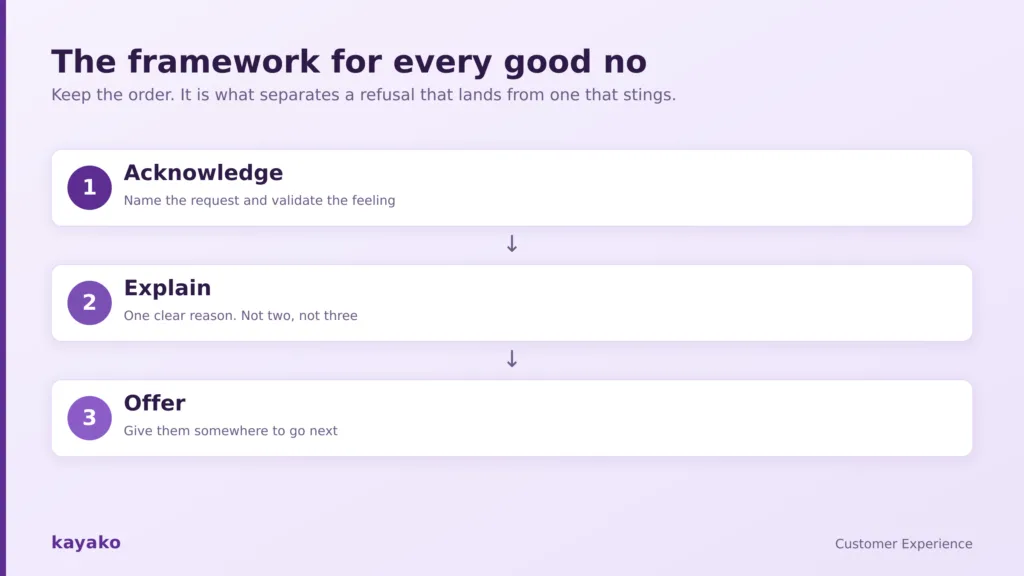
The Acknowledge, Explain, Offer framework: keep the order, every time.
To decline any request over email, chat, or phone, use this three-step structure, and keep it in this order. The order is what separates a refusal that lands from one that stings.
- Acknowledge. Name the request and validate the feeling behind it. Customers who feel unheard escalate.
- Explain. State clearly and briefly why the request cannot be met. One reason is enough. Two sounds like justification. Three sounds like excuses.
- Offer. Give them somewhere to go: an alternative, a partial solution, a workaround, or a future option.
The positive language flip
The words you pick change how the same decision lands. Run any refusal through this swap before you send it.
| Instead of | Say |
|---|---|
| “We can’t refund you.” | “What I can offer is store credit or a discount on your next order.” |
| “We don’t have that feature.” | “Here is the closest feature we have that might solve this.” |
| “I’m unable to help with that.” | “That is outside what I can action, but here is who can help.” |
| “That’s not something we offer.” | “We focus on [X]. Here is what we recommend for your use case.” |
| “We won’t make an exception.” | “Our policy applies consistently to everyone, which keeps things fair.” |
| “That’s not possible.” | “We are not set up to do that yet. Here is the closest alternative.” |
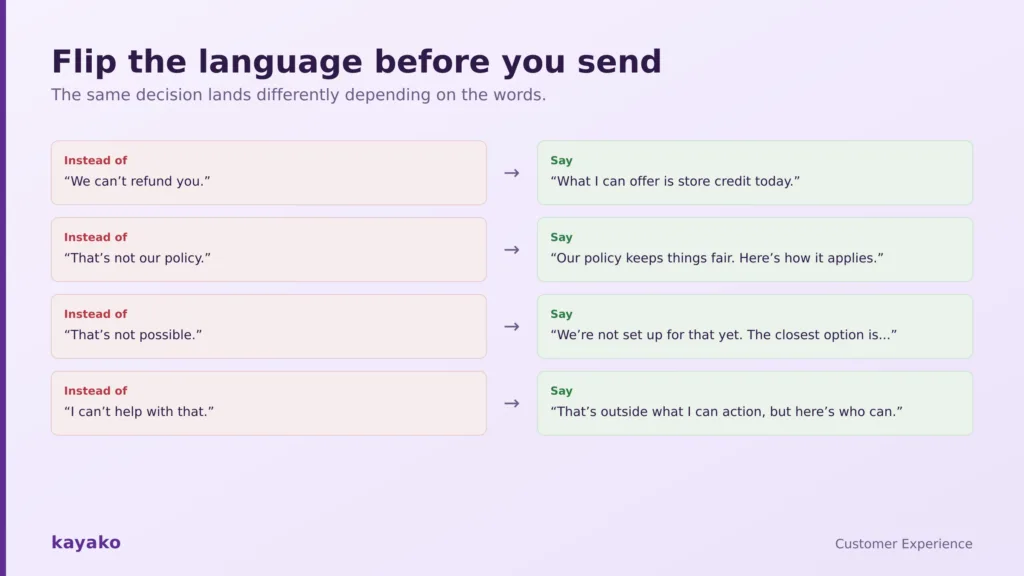
Flip the language before you send: the same decision, received very differently.
With the structure in place, the delivery changes depending on where the conversation happens.
How to say no by channel: email, live chat, and phone
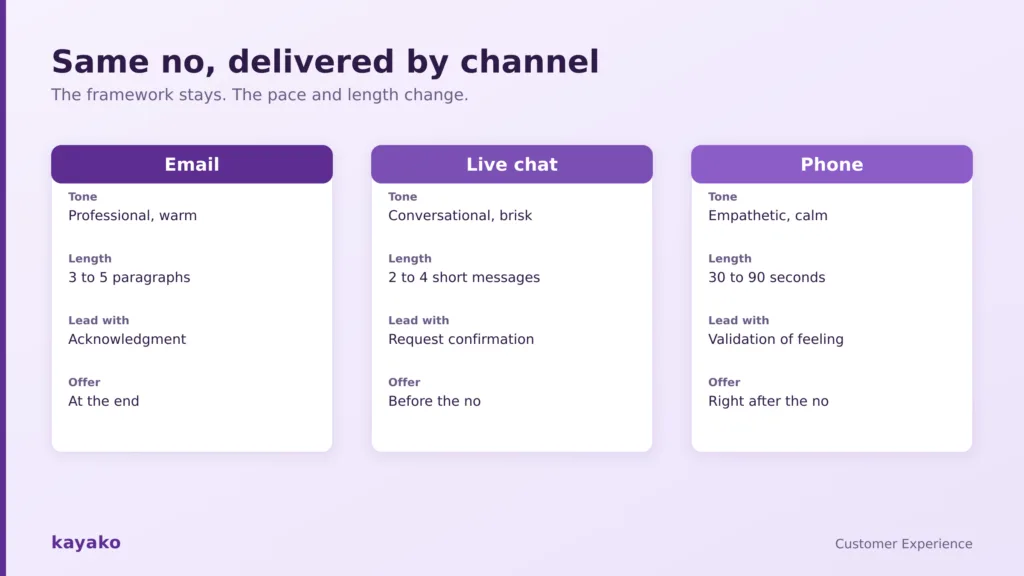
The same no, paced and structured differently for email, chat, and phone.
The framework stays the same across channels, but the pacing and length change. The same no needs to be delivered differently on live chat than in an email or on a call.
How to reject a request in an email
- Lead with acknowledgment, not the refusal.
- Keep the explanation to two or three sentences at most.
- Always close with a clear next step or alternative.
- Use a calm, neutral subject line, never “Re: Your Complaint.”
How to say no on live chat
- Do not make them wait for the no. Acknowledge in your first message.
- One idea per message. No walls of text.
- Use canned responses as starting points, not copy-paste answers.
- Offer the alternative before you land the refusal.
How to politely decline on the phone
- Slow down. Rushed responses sound dismissive.
- Mirror the customer’s energy, not their frustration.
- Never say “no” as a standalone sentence.
- Offer a pause if things escalate, and if the customer is already angry, our guide to dealing with an angry customer goes deeper: “Can I put you on hold while I check the options?”
Channel comparison
| Live chat | Phone | ||
|---|---|---|---|
| Tone | Professional, warm | Conversational, brisk | Empathetic, calm |
| Length | 3 to 5 paragraphs | 2 to 4 short messages | 30 to 90 seconds |
| Lead with | Acknowledgment | Request confirmation | Validation of feeling |
| Offer position | End of email | Before the no | Immediately after the no |
The single most-searched refusal of all is the discount request, so it is worth handling on its own.
How to refuse a discount request politely
Discount requests are the most common refusal in this whole category, and the worst one to fumble, because it is really a relationship question wearing a pricing costume. Treat it as a moment to reinforce trust, not a transaction to shut down.
Standard discount refusal (email)
|
Discount refusal for a high-value B2B customer
|
Discount refusal on live chat (short)
|
What to avoid when refusing a discount:
- Do not quote “policy” without the why. Fairness and consistency are credible reasons; the word policy on its own is not.
- Do not offer the discount on the second email after refusing on the first. It teaches customers that pushing back works.
- Do not apologize for the price. You are not sorry it costs what it costs.
- Do not end on the refusal. End on the alternative or the next step.
Consistent discount answers across a whole team are hard to hold by hand. Kayako makes the right response the default one. Let me show you.
Easy, moderate, and difficult denials
Not every no carries the same weight. These three templates scale the tone to the difficulty of the decline.
Easy denials, clearly outside scope
|
Moderate denials, possible but not advisable
|
Difficult denials, reasonable but not possible
|
From here, the fastest way to help is a ready template for each of the situations you will meet most often.
13 common situations: reject customer requests politely
The 13 refusals you will send most, each with a ready template below.
Each template below follows the Acknowledge, Explain, Offer structure. Adapt the bracketed fields and keep the tone your own.
1. Refund request outside policy
|
2. Feature request decline
|
3. Priority service request
|
4. Confidential information request
|
5. A service we do not offer
|
6. Policy exception
|
7. Immediate fix request
|
8. Product or service change request
|
9. Warranty extension
|
10. Unreasonable demands
|
11. Unrealistic timeline
|
12. Out-of-scope client request (B2B)
|
13. Catch-all general refusal
|
Consumer refusals are one thing. Turning down a B2B client, where a contract and a renewal are on the line, is a different discipline.
Thirteen scenarios, one consistent voice. Kayako turns your best refusals into shared canned responses the whole team can reuse. See it in action.
Saying no to clients (B2B, consultancy, and agency)
Saying no in a B2B or client context is structurally different from declining a consumer request. The relationship is longer, the stakes per conversation are higher, and the no usually has a contract behind it. If you are newer to this, our guide to B2B customer service covers the relationship and channel patterns that make these refusals harder than business-to-consumer ones. Get the framing wrong, and you risk the renewal. Get it right, and you reinforce the trust the whole account runs on, which is the heart of the best B2B customer service practices.
Three rules for saying no to a client
- Anchor on the contract, not the relationship. “This is outside our SOW” sounds better than “we cannot help.” The contract is impersonal, so push the no to the document.
- Offer a paid path. If they want it badly enough, they will pay for it. Quote the scope and price for the work that would cover the request.
- Protect the existing project. Tell them what you will keep doing while the scope conversation continues. Silence is what makes clients escalate.
Template: out-of-scope work request
|
Template: a guarantee you cannot give
|
Template: declining a partnership or vendor request
|
Client refusals carry a contract and a renewal. Kayako keeps the full account history in view so every no is informed. See how.
Templates give you the words. The frontline agents who send these all day give you the judgment, and they are refreshingly blunt about what works.
What real support agents say about saying no
Search for saying no to customers in communities like r/customerservice, r/talesfromcallcenters, and r/smallbusiness, and you will find more than a decade of frontline discussion. Read enough of it and the same patterns surface again and again. Three come up most often, and all three match what I have seen on the floor.
Pattern 1: the slow no is worse than the fast no
The most common complaint agents raise in these threads is being told to stall, to escalate to keep the customer happy, when the answer was always going to be no. The result is a customer who waits days to hear something that could have been said in two minutes, and who is angrier for the wait. The recurring consensus is that a clear, kind no on first contact lands far better than a delayed maybe. A stalled no does not soften the decision; it just adds a broken expectation on top of it. You can read the ongoing discussion on r/customerservice.
Pattern 2: naming the policy is fine, hiding behind it is not
A pattern that surfaces repeatedly in call-center communities is the difference between an agent who recites a rule and one who can explain why it exists. “Our policy is X, the reason it exists is Y, and here is the alternative I can offer” de-escalates far more reliably than “that is our policy.” Customers can tell whether an agent has simply been handed the rules or actually understands them, and the second group defuses tension the first cannot.
Pattern 3: the one-time human exception, framed explicitly
Small business owners in these communities often describe breaking their own rules on rare occasions, a one-time refund or discount, but only with explicit framing: I am doing this once because I think you were treated unfairly, and the policy stands going forward. The framing is the whole trick. Without it, the exception quietly becomes the new baseline, and you have trained the customer to expect it next time. With it, you get the goodwill without the precedent. For related context, strong customer self-service deflects many of the requests that would otherwise need a no at all.
25 professional phrases for saying no politely
A phrase bank you can adapt on the fly, grouped by the stage of the conversation.
Acknowledging the request
- “Thank you for bringing this to our attention. I want to make sure we handle it properly.”
- “I can see why this is important to you, and I appreciate you taking the time to reach out.”
- “I hear you. This clearly matters, and I want to give you an honest answer.”
- “Thank you for your patience while I looked into this.”
- “I completely understand where you are coming from on this.”
Explaining the reason
- “Unfortunately, this falls outside our current policy: [one-sentence reason].”
- “We are not set up to offer that at this stage, and I want to be straight with you about that.”
- “Our policy is designed to keep things consistent for all customers.”
- “I have reviewed this, and there is not a way for me to action it within our current guidelines.”
- “This is not something we are able to accommodate right now: [brief honest reason].”
- “After looking into this carefully, the answer has to be no on this occasion.”
- “We cannot make an exception here, because it would not be fair to other customers in the same position.”
Offering an alternative
- “Here is what I can do instead: [specific alternative].”
- “What I am able to offer is [X]. I hope that goes some way to helping.”
- “The closest thing we have that might work for you is [X].”
- “While I cannot do [X], I can [Y]. Would that be helpful?”
- “I would like to suggest [alternative] as a next step.”
- “If [future condition], we would be glad to revisit this.”
- “I will flag this for the team as feedback. In the meantime, [workaround].”
Closing positively
- “Thank you for your understanding. I genuinely appreciate it.”
- “I am sorry I could not give you the answer you were hoping for, but I am glad we could talk it through.”
- “Please do not hesitate to reach back out. We are always here.”
- “I hope [alternative offered] works out for you.”
- “Thank you for being a valued customer.”
- “I am sorry this was not possible this time. We will keep your feedback in mind.”
Psychological frameworks that make a no land well
A refusal is as much emotional as logical. These frameworks explain why the techniques above work, and give you levers when a standard no is not enough.
Empathy and validation
Validate the emotion before you address the request. Drawing on Daniel Goleman’s work on emotional intelligence, the principle is simple: customers who feel unheard escalate, and customers who feel heard negotiate. Name the feeling first.
Loss-aversion reframing
Kahneman and Tversky showed that people respond more strongly to avoiding a loss than to an equivalent gain. Where it is honest, frame the no as protecting the customer from a worse outcome rather than withholding a better one.
The reciprocity principle
Robert Cialdini’s research on reciprocity finds that giving something small first changes how the next message is received. Offer a resource or a genuinely useful piece of information before the decline, and the refusal lands on warmer ground.
The positive sandwich
Yes, then no, then yes. Open with what you can do, deliver the no in the middle, and close with another positive. Memory anchors on the first and last thing, not the middle, so the customer leaves remembering the help.
Feel, felt, found
A classic empathy script: I understand how you feel, others have felt the same, and what they have found is that [alternative] works well. It acknowledges the emotion and redirects to a solution in one move, and when a genuine apology is warranted, our apology letter format guide covers how to word it.
Mirror and match
Match the customer’s formality and pace. A short, direct customer does not want a five-paragraph email, and a customer who wrote a detailed, emotional message deserves an equally considered reply. Getting these frameworks right in the moment is easier when you avoid the mistakes that undo them.
Common mistakes when saying no
| Mistake | Why it backfires | Do this instead |
|---|---|---|
| Saying no at the end of a long conversation | The customer feels their time was wasted | Signal the no early, then explore alternatives |
| Vague language such as “we’ll look into it” | Creates false hope and follow-up frustration | Be clear: “This is not on our roadmap” |
| No alternative offered | The customer has nowhere to go, so churn risk spikes | Always close with an alternative |
| Over-apologizing | Sounds uncertain and invites pushback | One sincere apology, then move to solutions |
| A robotic, templated tone | Customers feel processed, not helped | Personalize the acknowledgment |
| Making promises you cannot keep | Destroys trust faster than the original no | Only commit to what you can deliver |
Every interaction is a chance to show what your brand stands for. When you cannot say yes, the way you say no becomes the message. A clear, empathetic, solution-forward refusal tells the customer you respect them enough to be honest. Whether or not they like the final decision, they will remember how you framed it. Holding that standard across a whole team, on every channel, all day, is where the right tooling earns its place.
How Kayako helps your team say no consistently
The hardest part of saying no is not writing one good refusal. It is delivering that same quality on the hundredth ticket of the day, across a team of agents with different instincts, without it drifting into either coldness or false hope. That consistency is a tooling problem as much as a training one.
This is where a support platform earns its place. In Kayako, your best refusals become shared canned responses, so the strongest version of each no in this guide is one click away for every agent, ready to personalize rather than write from scratch. SingleView puts the customer’s full history and past conversations on one record, so an agent knows whether this is a first request or the third time someone has pushed on the same exception, and can frame the no accordingly.
Its AI agent, Agent Kay, which is a genuine AI agent rather than a scripted chatbot, can handle the clear-cut declines instantly and consistently, while routing the sensitive ones to a person with the context already attached. The result is not a colder no; it is a faster, better-informed, more human one, delivered the same way every time. You can see where this is heading in Kayako’s view of the future of AI in customer service.
Turn your best refusals into your team’s default response. Kayako keeps every no fast, consistent, and human at scale. Let me show you how in 30 minutes.
Saying no to customers well is a craft, and it is learnable. Structure every refusal as Acknowledge, Explain, Offer. Choose positive language over blunt negatives. Adapt the pacing to the channel. Anchor B2B refusals on the contract and offer a paid path. And never end on the no, because the alternative is what the customer remembers. The templates and phrases here give you a running start, but the judgment comes from doing it with genuine respect for the person on the other end. A good no protects your business and your customer at the same time, and customers can always feel the difference between being processed and being helped.
Frequently asked questions
How do I say no to customers politely?
Use the Acknowledge, Explain, Offer framework: validate the request, give one honest reason it cannot be met, and offer a workable alternative or next step. Avoid “no” as a standalone sentence, and never end the conversation on a refusal. Leading with the alternative and keeping the explanation to a single clear reason is what keeps the customer from feeling shut out.
How do you say no to customers in a positive way?
Reframe the decline around what you can do. For example: “Thanks for reaching out about this. A direct refund is not possible because the order falls outside our 30-day return window, but what I can do is apply a credit to your account today. Would that work?” That single message acknowledges, explains, and offers in under thirty words, and it leaves the customer with a path forward rather than a closed door.
What are some phrases for politely declining a request?
Useful ones include “What I can offer is…”, “Here is what is possible within our current policy…”, “The closest thing we have is…”, and “I would like to suggest [alternative] as a next step.” The full bank of 25 phrases, grouped by conversation stage, is in the phrases section above.
How do you refuse service to a customer?
Be direct, brief, and respectful. Name the specific behavior or condition that triggered the refusal, such as abuse, threats, or a policy violation; state that service is being declined, and where appropriate offer a future path such as a refund, account closure, or escalation. Document the interaction, and never refuse service in vague or accusatory terms.
How do you reject a customer request politely by email?
A reliable structure is: “Hi [Name], thanks for getting in touch. I have looked into your request, and unfortunately it falls outside [reason]. What I can do instead is [alternative]. Let me know if that works.” The 13 templates above cover the most common scenarios in ready-to-use form, each built on the Acknowledge, Explain, Offer structure.
How do you turn down a client politely in B2B?
Anchor on the contract or scope of work rather than the relationship, be specific about why the request falls outside scope, and offer a paid path if one exists. Keeping the existing project moving while you discuss the new request is what stops clients from escalating. The B2B section above has templates for out-of-scope work, outcome guarantees, and partnership declines.
Is it okay to say no to a customer?
Yes, and it is often necessary. Saying yes to every request sets unsustainable precedents, creates unfairness for other customers, and depletes your team. The goal is not to avoid the no; it is to make every no leave the customer feeling valued and respected, with a clear sense of what you can do for them instead.