Freshdesk is the customer service product from Freshworks. Tickets arrive from email, a portal, chat, phone and social, land in a workspace that reviewers consistently describe as one of the easiest to learn in the category, and move through automation rules, SLAs, routing and canned responses. Around that sit a knowledge base, dashboards, agent gamification, roughly sixty native integrations and Freddy, the AI layer covering both an agent-side copilot and a customer-facing agent. It is sold to small and mid-sized teams and scales into enterprise, and core ticketing is priced per agent per month from $19 to $89.
This review is written by Colin Guilfoyle, SVP of Customer Support at Trilogy, who has spent roughly a decade leading support functions and buying the software that runs them. He has not run Freshdesk against a live production queue, and nothing here is bench testing. What follows is built from published pricing and plan documentation, read first-hand and dated, and from a close read of what customers describe across four review platforms. Where there is an opinion, it comes from that experience of operating support teams. Where the evidence disagrees with the opinion, the evidence wins.
The gap that prompted this piece is the familiar one, with an unfamiliar cause. Freshdesk scores 4.4 on G2 across nearly 3,800 reviews and 1.6 on Trustpilot. What makes it worth writing about is how cleanly the two populations divide. The people using the product like it, consistently and in volume. The people dealing with the contract do not, and their complaints converge on one specific thing that also appears in the G2 corpus. That convergence is the most useful finding on this page. What follows reads all four platforms against each other, prices the product properly including the parts that are not on the headline tier, grades it feature by feature, and names the alternatives worth a look.
How I evaluated Freshdesk
Support software is judged over a renewal cycle, not a trial. Six criteria, in the order they matter.
Hands-on use. I did not run Freshdesk against a live queue and will not pretend otherwise. What I examined directly are the published plan and pricing listings, read on 12 August 2026, including the separation between the ticketing product and the omnichannel product and the structure of the AI add-ons.
User reviews, at volume and in depth. G2, Capterra, Trustpilot and Reddit, read for what people describe rather than the score they left. With nearly 3,800 G2 entries, the theme counts are statistically meaningful here in a way they are not for smaller products. Reddit carries no concentrated corpus, only scattered mentions in IT threads.
Depth and breadth of features. Whether the product covers a real support surface, and which parts of it sit behind which purchase.
Scalability. Performance under load, reporting depth, seat administration, and behavior as ticket volume grows.
Pricing and forecastability. The bill you cannot predict. This became the center of the research.
Support the vendor gives you. The fairest test a company selling customer service software can face.
Two standing exclusions. Employer-review content from Glassdoor and AmbitionBox is dropped because it measures the company as a workplace rather than a vendor. Every source was checked for commercial interest, which matters unusually here because most published Freshdesk pricing analysis is written by companies selling replacements.
What you are actually buying in 2026
The single most important thing to understand about Freshdesk is that it is not one product. Freshworks sells Freshdesk for email and ticketing, Freshdesk Omni for multichannel, and Freshchat and Freshcaller as separate products again. Each carries its own price ladder.
That structure is where most budgeting goes wrong. The $19 figure people quote is the entry tier of the ticketing product, and it buys email and a portal. A team whose customers expect live chat, WhatsApp, or social is buying Omni, which starts at $29 per agent per month rather than $19. For ten agents, that is $100 a month more than the number in the business case, and the mismatch is discovered after the comparison spreadsheet is finished rather than during it.
Freddy, the AI layer, is separate again and splits in two. The Copilot that helps agents draft and summarize is an add-on at roughly $29 per agent per month, available only on Pro and Enterprise. The customer-facing AI Agent is billed by session, with a one-time allowance included on higher tiers and additional sessions sold in packs afterward. Both are widely documented at those rates across independent pricing analyses.
The practical consequence is that Freshdesk’s advertised price and Freshdesk’s actual price are different questions, and the pricing page answers the first one.
The ratings disagree, and the split is unusually clean
Here is where Freshdesk sits across the four platforms as of August 2026.
|
Platform |
Score |
Reviews |
What the audience is |
|---|---|---|---|
|
G2 |
4.4 / 5 |
3,759 |
Agents and admins using the product daily |
|
Capterra |
4.5 / 5 |
3,500+ |
Business buyers, some incentivized |
|
Trustpilot |
1.6 / 5 |
406 |
Anyone, mostly billing and contract experiences |
|
|
No score |
Scattered |
Practitioners, no concentrated corpus |
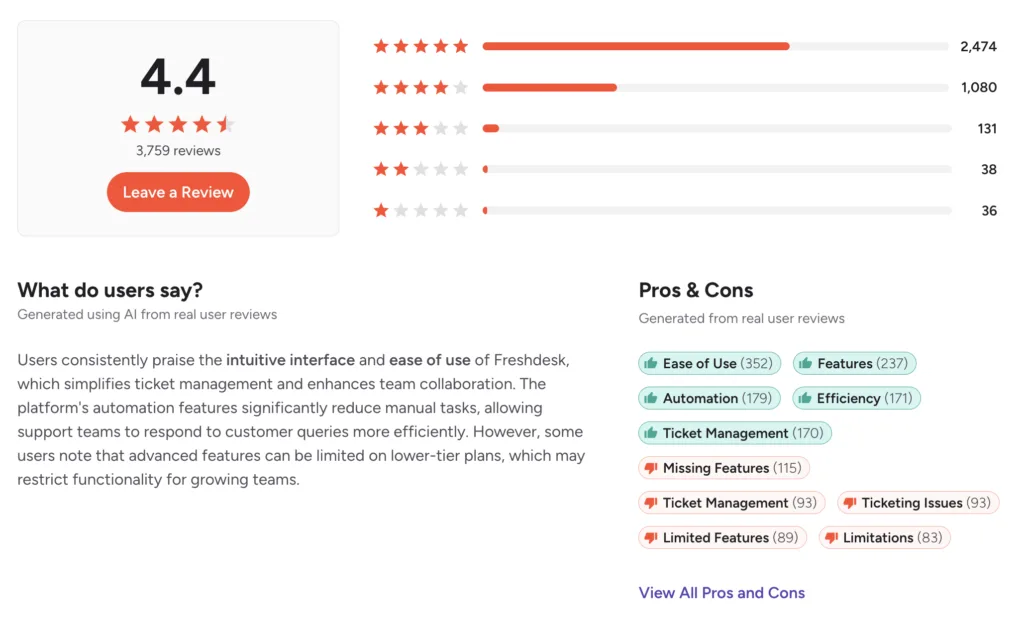
The G2 sample is large enough that its theme counts mean something. Ease of use draws 352 mentions and again at 237, automation 179, efficiency 171. On the other side, the top complaint is a missing asset management feature relative to the sister product Freshservice at 115 mentions, followed by duplicate tickets and slow performance at high volume at 93, then limited features at 89 and limited customization at 80. Poor reporting sits at 69.
Read that list and a picture forms. These are the complaints of people who use the product a lot and want more from it, not the complaints of people who regret buying it.
Trustpilot inverts completely, and its distribution is a barbell: 39% at one star against 38% at five, with almost nobody in between. Reading the one-star entries, they are overwhelmingly about billing rather than software. Marcus Dyson, writing on Trustpilot in November 2025, described being renewed on an annual plan and billed for two seats his team had already deactivated and had not used for months.
That is where the two populations connect. Patrick O., a head of technology writing on G2, gave the product three stars while calling the core ticketing solid and reliable, then described seat management and subscription changes as rigid and process-heavy, particularly for a business needing to scale down rather than up. He reported that a straightforward seat reduction request involved long delays and reliance on cancellation-style clauses that could not be pointed to in writing when he asked.
Two independent platforms, two different reviewers, the same specific mechanic. That is the finding.
That is the last score in this review. Everything after this comes from what people described.
What users actually say about Freshdesk
Five themes recur, ordered by how often they came up.
Teams become productive on it faster than on anything comparable
This is the strongest and most repeated praise, and it shows up as a business outcome rather than an opinion. Reviewers describe entire teams working without formal training within days, and one described migrating from shared inboxes and scattered chats and immediately being able to see who replied to what. For anyone hiring seasonally or running a lean team, that adoption speed is worth real money.
Automation does the work people expect it to do
Ticket routing, categorization, canned responses and SLA rules come up constantly as time savers that keep working. One multi-brand operator described managing 15 brands and over 170,000 tickets a year with a lean team, reporting a 37% reduction in first response time. Another described resolution time falling by three quarters after rolling it out across a franchise network.
Performance degrades when ticket volume is high
The most consistent product criticism, and it is specific rather than vague. Reviewers describe slow loading when switching between tickets, lag when several reports are open, duplicate ticket creation during busy periods, and search becoming inconsistent as the database grows. One reviewer reported hitting an error message telling them they were doing too much. These are not edge cases in the corpus.
Reporting is usable but rigid, and the good parts cost more
Reviewers describe standard dashboards as fine and custom reporting as effortful. Sunil K., a head of customer support, described the advanced analytics as rigid, with complex reports taking more work than they should. Others report needing higher tiers for deeper analysis, and one described a consolidated performance report being retired when new insights shipped.
Billing and seat administration is where goodwill is lost
Covered above, and worth restating because it is the theme that spans platforms. Reduction is harder than addition, responses on contractual questions are described as slow and policy-driven, and escalation adds more people to the thread without resolving anything faster.
A note on sourcing. Capterra carries incentivized entries, so treat that aggregate as the friendliest of the four. G2’s own community carries a discussion thread whose title accuses Freshworks of deceptive business practices, which I mention as an indication of where feeling runs rather than as a substantiated claim. Almost every detailed Freshdesk pricing breakdown online is published by a competitor, so I have relied on the figures where several independent analyses agree with the vendor-supplied listings.
Freshdesk pros and cons
|
Pros |
Cons |
|---|---|
|
Fastest team adoption in the category |
Advertised price excludes most real setups |
|
Automation that genuinely reduces workload |
Slow performance at high ticket volume |
|
Large, mature integration ecosystem |
Duplicate tickets during busy periods |
|
Strong SLA and routing on mid tiers |
Seat reduction is rigid and slow |
|
Multi-brand handling at scale |
Custom reporting takes real effort |
|
Free tier and 14-day full-feature trial |
AI sold as two separate paid add-ons |
|
Deep documentation and training resources |
Mobile app trails the desktop product |
What Freshdesk does better than anyone
Getting a support team from chaos to structure quickly, and keeping it there as volume grows. The combination of a workspace people learn without training and automation that does real work is why teams handling six-figure annual ticket volumes run it with small headcounts. On product merit at mid-market scale, this is a genuinely strong help desk.
What you will be living with
A bill assembled from more parts than you costed, performance that sags exactly when you are busiest, and a contract that is easier to grow than to shrink. The first and third are commercial decisions rather than defects, which means no release will change them.
Feature by feature, based on the reviews
Pricing, products and add-ons
Core ticketing runs $19, $55, and $89 per agent per month on annual billing for Growth, Pro, and Enterprise, with a free tier for a very small team. Those are the numbers on the page.
The rest is assembled from three directions. Omni, if you need channels beyond email, starts at $29 rather than $19. Freddy AI Copilot adds roughly $29 per agent per month and only on Pro or above. The customer-facing AI Agent is session-based, with an included one-time allowance on higher tiers and packs sold afterward at roughly $49 per hundred sessions, and reporting across independent analyses is consistent that unused sessions do not roll over.
Work a realistic example, and the gap is stark. Fifteen agents on Pro is $825 a month. Add Copilot for ten of them, and it is $1,115 before a single AI session is bought. At 2,000 AI conversations a month, session costs alone can approach or exceed the human seat bill.
The tier jumps compound it. One reviewer described the step between plans as four or five times the previous rate and hard to justify. Round-robin routing, CSAT surveys, and custom dashboards sit at Pro. Skills-based routing, audit logs, and IP allowlisting sit at Enterprise. So the upgrade is rarely a choice about value and usually a single feature you cannot work around.
Model the tier that contains your must-have features, then add the AI line separately, because that is the number that moves.
The agent workspace and ticketing
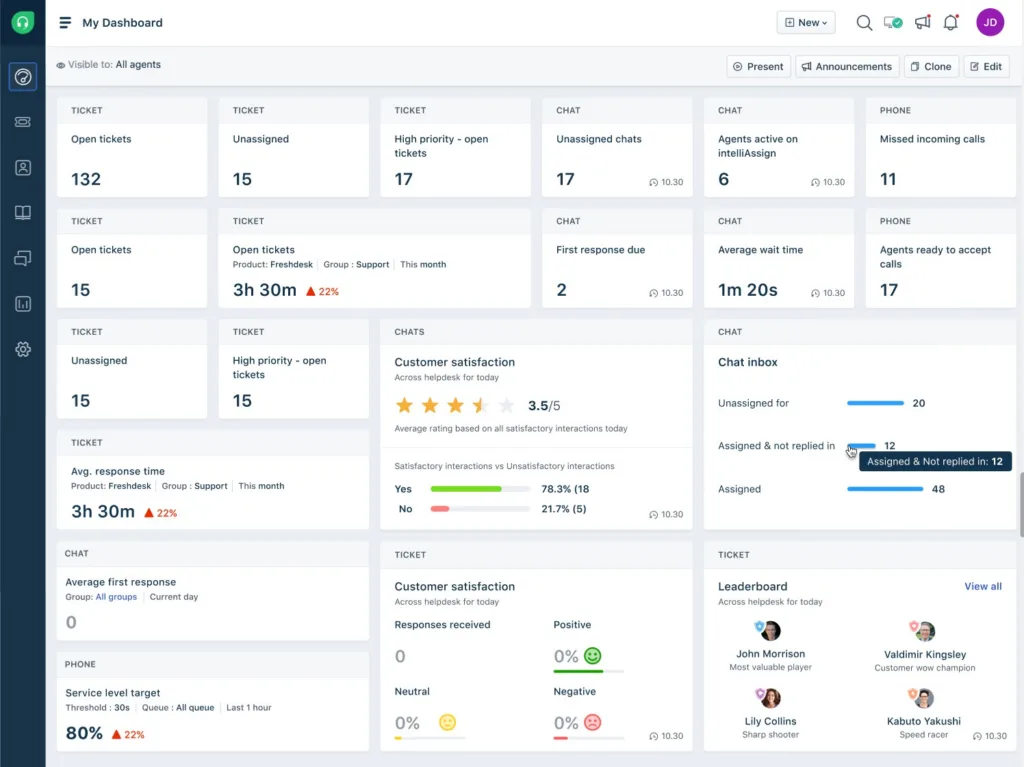
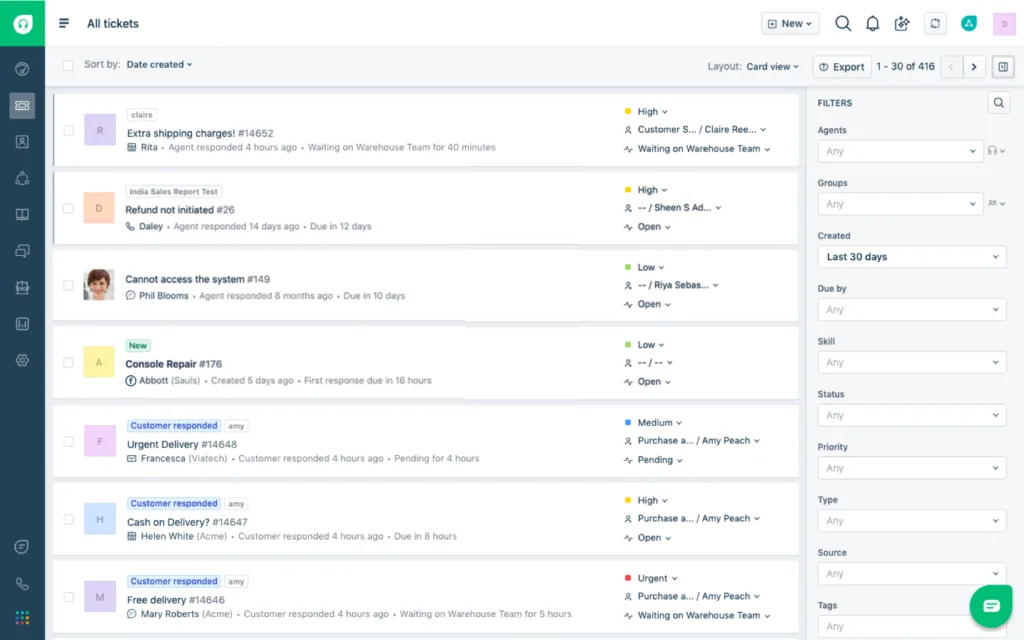
The workspace is the reason for the scores. Ticket views, filters, and agent workflows are quick to learn; internal notes keep team discussion away from customers, and merging and collaboration work as expected. Reviewers describe onboarding new agents in days rather than weeks, which is the single most valuable property a help desk can have for a growing team.
The performance complaints are the counterweight, and they are credible because they are so specific. Switching between tickets is slowing down. Reports lag when several are open. Search returning inconsistent results as history accumulates. Duplicate tickets appearing during volume spikes. A support operation feels these precisely when it can least afford to.
Two structural gaps recur. Child tickets display as separate items rather than nesting under a parent, which complicates any workflow with sub-tasks. And one solutions engineer reported being unable to export all tickets from a timeframe with their full content, which matters both for analysis and for the day you decide to leave.
Freddy and AI capability
Two products under one name, doing different jobs. Copilot assists agents with drafting, summarization and translation. The AI Agent answers customers directly.
The review corpus is thinner here than on ticketing, which is itself informative: many reviewers mention AI as something they have not adopted because it costs extra. One IT engineer said plainly that the team could not use it because it required additional payment, and asked for it to be included across licenses. Others describe wanting ticket-level AI summaries for long threads and not having them.
Where people have used it, reports are moderate rather than enthusiastic, and one reviewer described the AI features as not strong. Set against Freshworks marketing that cites up to 80% resolution with AI agents, the gap between claim and reported experience is wide enough that I would treat the marketing number as a ceiling under ideal conditions rather than a planning assumption.
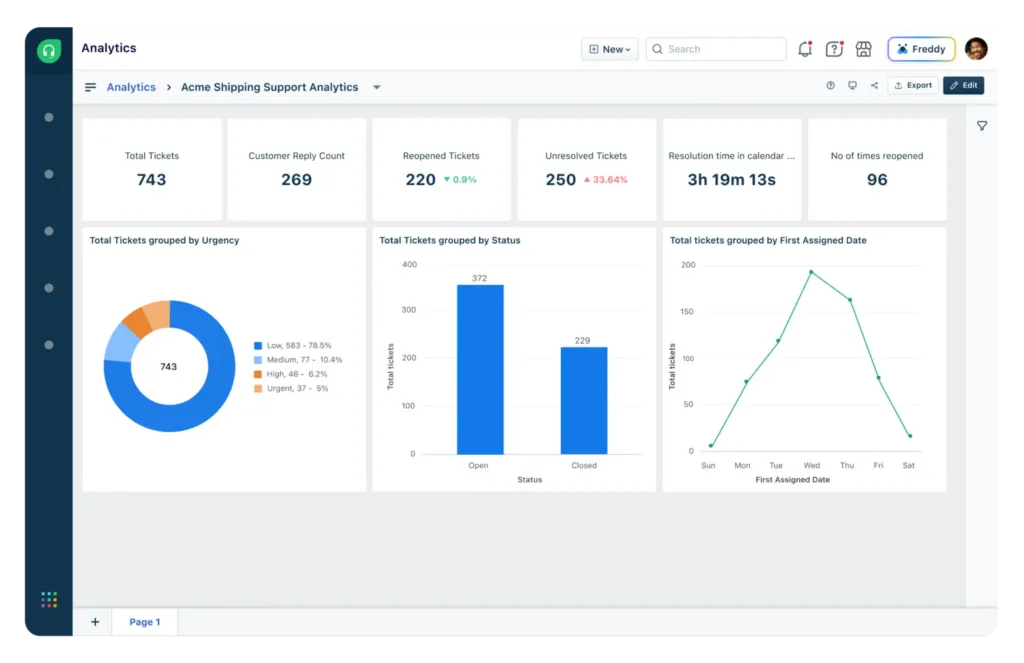
The 14-day trial includes full enterprise-tier access, so grade the AI on your own historical tickets before you buy sessions.
Knowledge base, self-service and channels
The knowledge base does the core job and reviewers credit it with reducing repetitive tickets. The limits are about shape rather than function. One product manager described it behaving more like an FAQ than documentation, with no way to structure it in a documentation-style format, and separately found white-labelling too limited to make the help center feel like part of their product.
Channel coverage is genuinely broad once you are on the right product, and the integration list is one of the deepest in the category at around sixty native connectors plus the wider Freshworks suite. Reviewers running contact centers describe integrating with Genesys and Teams successfully. One noted that Freshdesk does not follow a traditional queue-based structure, which makes precise first-response and handling-time measurement harder when tickets are reassigned across teams.
Reporting and analytics
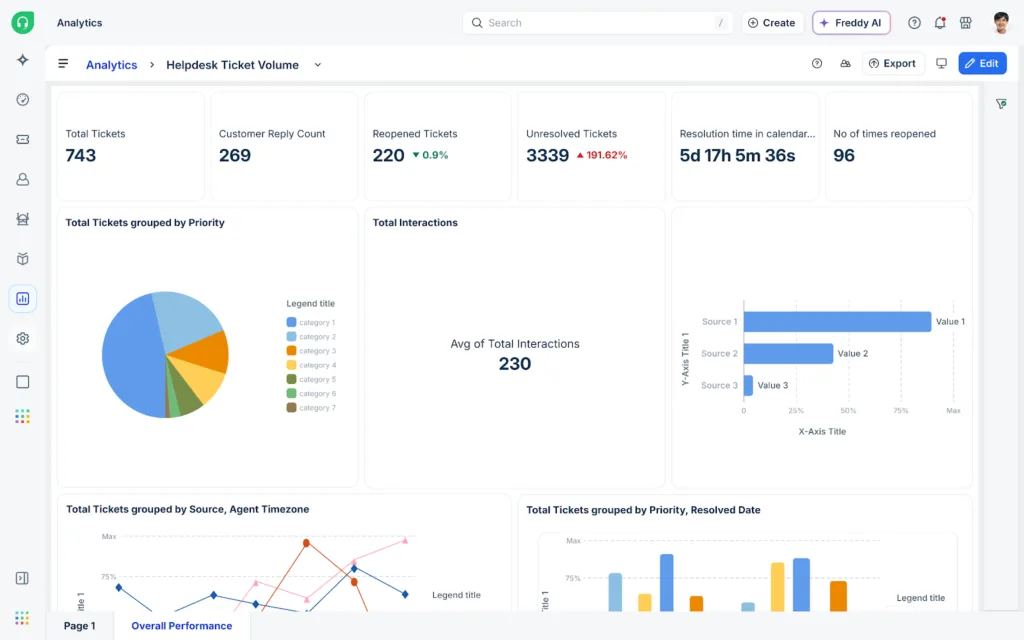
Standard reporting is adequate and widely used. Custom reporting is where the friction sits, and it appears in 69 mentions on G2 as poor reporting, plus repeated individual descriptions of rigidity and effort.
The pattern in the complaints is consistent: people can get the numbers, but not in the shape their leadership asked for, and getting closer requires either configuration time or a higher tier. For a support leader whose budget depends on demonstrating deflection and response performance, that is the constraint that matters most, and it is worth testing with a real named report during the trial rather than a demo dashboard.
Vendor support and commercial terms
Support experiences split sharply. Several reviewers describe responsive, helpful service with good documentation, and one head of customer service called the turnaround fast. Others report slow responses and describe the mobile experience and support quality as the weakest parts of the package.
The consistent negative is not technical support but commercial support. Billing and contract queries draw the slowest responses; answers are described as policy-driven rather than pointing to written terms, and seat reduction in particular is reported as difficult across both G2 and Trustpilot. One customer described deactivating seats and still being billed for them through a renewal.
Get your seat-reduction terms, notice period, and renewal date in writing before signing an annual deal, because that is the specific mechanic customers report being unable to pin down afterward.
Freshdesk alternatives, by what you are solving for
You want AI priced by outcome rather than by session pack
Kayako prices AI around resolved conversations rather than sessions that expire unused, so a quiet month does not waste budget, and a busy one does not trigger a pack purchase. You give up Freshdesk’s integration breadth and its ecosystem. Test it by pricing your three busiest months under both models.
You need resolution reporting you can take to a board
If the gap is proving what automation actually closed, Kayako’s AI reports on resolution directly rather than requiring you to assemble it. You give up the Freshworks suite integration. Test it by writing down the exact report your CFO asked for and building it in each.
You want the same simplicity without the add-on stack
Zoho Desk covers comparable ground with more included in the base tiers, particularly if you already run other Zoho products. You give up some polish and integration depth. Test it by listing every add-on in your Freshdesk quote and checking which are standard elsewhere.
Your team is small, and the tier jumps hurt
LiveAgent and Help Scout both avoid the four-times step between plans, with more channels included lower down. You give up reporting depth and enterprise governance. Test them by pricing three years at your expected headcount rather than today’s.
You need enterprise governance and audit trails
Zendesk brings deeper multibrand, entitlement, and audit capability, at a materially higher entry price. Test it by asking whether anyone has requested something Freshdesk could not produce.
Support is part of your product experience
Intercom is built around in-product messaging with per-resolution AI pricing. You give up telephony and the ticketing depth Freshdesk has matured over a decade. Test it by checking what share of conversations start inside your product.
Three numbers decide this for any option: cost per resolved conversation at your real volume including AI, the fully loaded price of the tier that contains your must-have features, and what happens to the bill when your team shrinks.
Verdict
Freshdesk is a very good help desk with a commercial model that works against it. The product deserves its G2 standing: teams learn it fast, the automation genuinely reduces workload, and operators running multiple brands and six-figure ticket volumes report real gains rather than vague satisfaction. If you are choosing on product merit for a mid-market support operation, it belongs on the shortlist and often wins.
The reservations are about money and contracts rather than software. The advertised $19 covers email ticketing only, the omnichannel product starts higher, both halves of the AI layer are separately paid, the jump between tiers is several times the previous rate, and customers on two independent platforms report that reducing seats is materially harder than adding them. On Monday, I would do two things. Build the quote from your must-have feature list rather than the headline tier, adding the AI line as its own row, because that total is routinely two to three times the number people carry into the meeting. Then ask your rep, in writing, exactly what happens if you need to reduce seat count mid-term, and keep the answer.
Freshdesk FAQs
How much does Freshdesk actually cost?
Core ticketing is $19, $55, and $89 per agent per month on annual billing. Freshdesk Omni, needed for chat and social channels, starts at $29. Freddy AI Copilot adds roughly $29 per agent on Pro and above, and the customer-facing AI Agent is billed in session packs. Budget all four lines.
Is Freshdesk cheaper than Zendesk?
At the entry tier, clearly yes. The gap narrows once you add omnichannel and AI, because Zendesk includes more in its base price. Compare like for like on the channels and AI you will actually switch on.
Does Freshdesk slow down at high ticket volume?
Reviewers report it does, consistently. Slow ticket switching, lagging reports, inconsistent search on large histories, and occasional duplicate tickets during spikes are the recurring descriptions. Load-test during the 14-day trial rather than feature-testing.
Can I reduce my Freshdesk seat count mid-contract?
This is the most reported commercial friction, appearing on both G2 and Trustpilot. Customers describe long delays and reliance on cancellation-style clauses. Get the reduction terms in writing before you sign.
Is Freddy AI worth the add-on cost?
The evidence is mixed and thinner than for the core product, partly because many teams decline it on price. Freshworks markets up to 80% resolution; reported experience is more modest. Grade it against your own historical tickets during the enterprise-access trial.