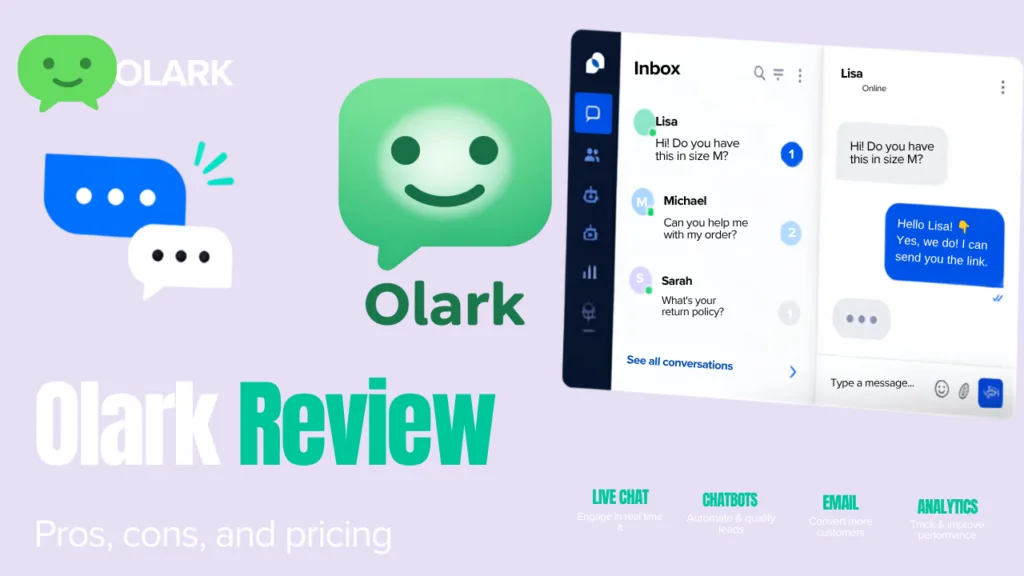
Olark is a live chat product that has been running since 2009 and serves around 12,000 businesses. A widget goes on your site, visitors chat, agents answer from a simple console, and around that sit real-time visitor monitoring, proactive triggers, pre-chat surveys, canned responses, transcripts, and integrations into most CRMs and help desks. For most of its life, it was one of the cheapest and simplest live chat tools you could buy, and that is what almost every review page still says about it. As of 2026, it is something different, and the gap between those two descriptions is the reason this review exists.
This review is written by Colin Guilfoyle, SVP of Customer Support at Trilogy, who has spent roughly a decade leading support functions and buying the software that runs them. He has not run Olark against a live production queue, and nothing here is bench testing. What follows is built from Olark’s current pricing page, read first-hand and dated, and from a close read of what customers describe across four review platforms. Where there is an opinion, it comes from that experience of operating support teams. Where the evidence disagrees with the opinion, the evidence wins.
Here is the finding that should shape your evaluation. G2 currently lists Olark’s entry price at $17 a month. Capterra says it starts at $29. Comparison articles published this year repeat both figures. Olark’s own pricing page, read today, leads with a product called the Standard AI Website Agent at $400 a month billed annually. That is not a rounding error or a tier difference. It is a different company selling a different product to a different buyer, and the review ecosystem has not caught up. What follows explains the repositioning, reads the ratings honestly given that they describe the old product, grades what is actually on sale, and names the alternatives.
How I evaluated Olark
Software is judged over a renewal cycle, not a trial. Six criteria, in the order they matter.
Hands-on use. I did not run Olark and will not claim otherwise. What I examined directly is Olark’s current pricing page, read on 13 August 2026, including the AI agent tier, the surviving live-chat plan, and the seat structure.
User reviews, at volume and in depth. G2, Capterra, Trustpilot and Reddit, read for what people describe and, critically here, for when they wrote it and which product they were describing.
Depth and breadth of features. Whether the product covers a real support surface. Olark deliberately never tried to, and that focus is the point.
Scalability. Seat model, routing, multi-site handling, and what the top tier actually contains.
Pricing and forecastability. The bill you cannot predict. Here the problem is that the published bill and the researched bill are different by an order of magnitude.
Support the vendor gives you. The fairest test any company selling customer communication software can face, and one Olark has historically passed well.
Two standing exclusions. Employer-review content from Glassdoor and AmbitionBox is dropped because it measures the company as a workplace rather than a vendor. Every source was checked for commercial interest, which matters here because most Olark commentary now sits on competitor blogs or affiliate review sites.
What you are actually buying in 2026
Olark has repositioned from a cheap live chat widget into an AI website agent product, and the pricing page is explicit about it.
The headline offer is the Standard AI Website Agent, powered by an engine Olark calls Aiden, at $400 a month billed annually, which is $4,800 a year. That buys unlimited AI conversations, automatic knowledge updates, lead capture and qualification, proactive engagement, account management, and one human agent seat. Additional human seats are $29 each per month. Above that sits a custom enterprise package covering regional routing, SSO, custom SLAs, and legal review.
The old product has not disappeared. Olark’s page states that a classic live-chat-only plan remains available at $29 per agent per month for teams that want humans without AI. It is mentioned in a single line of body copy below the main pricing cards rather than presented as a tier, which tells you where the company’s attention now sits.
The pricing philosophy is worth crediting, because it directly opposes where most of this category has gone. Olark argues that token and usage pricing creates a bad incentive, since the more your agent helps, the more you pay, so teams start rationing their own success. Their answer is a flat price with unlimited AI conversations and no overages, where cost rises only when you add humans. Having spent several of these reviews documenting exactly the trap Olark is describing, I think the critique is correct even if the price is high.
The ratings describe a product that is no longer the main offer
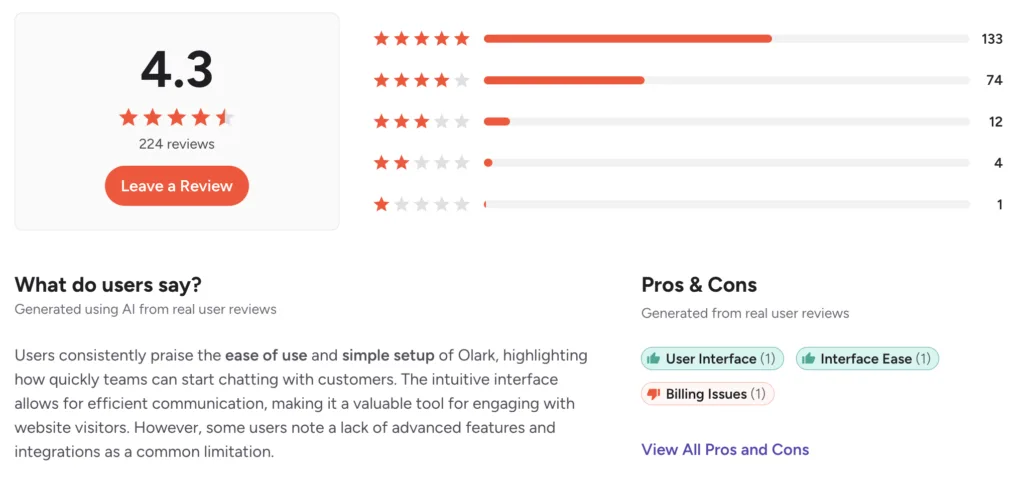
Here is where Olark sits across the four platforms as of August 2026.
|
Platform |
Score |
Reviews |
What the audience is |
|---|---|---|---|
|
G2 |
4.3 / 5 |
224 |
Small business, describing the chat tool |
|
Capterra |
4.5 / 5 |
450+ |
80% small business, mostly pre-2024 |
|
Trustpilot |
No usable corpus |
Minimal |
Too few entries to read |
|
|
No score |
Almost none |
No meaningful discussion |
The G2 sub-scores are genuinely strong and worth reading, because they describe what Olark has always been good at. Ease of use sits at 9.3, ease of setup at 9.0, ease of admin at 9.0, and quality of support at 8.8. Those are high numbers, and they are consistent with a product whose entire design goal was simplicity.
The problem is what the aggregate is measuring. The corpus overwhelmingly describes a low-cost live chat widget bought by small businesses, and Capterra’s own breakdown confirms 80% of reviewers are small businesses. Almost none of it describes an AI website agent at $4,800 a year, because that product is new. A buyer arriving from a comparison list sees 4.3 stars, a $17 entry price, and glowing ease-of-use scores, then discovers a product costing more than twenty times that.
Sample size compounds it. At 224 G2 reviews, Olark has one of the smallest corpora in this series, and Trustpilot and Reddit offer nothing usable at all. There is no independent forum where the new product is being discussed, so the evidence base for what Aiden actually does is currently the vendor’s own page.
That is the last score in this review. Everything after this comes from what people described, with the caveat that they were mostly describing the older product.
What users actually say about Olark
Five themes recur, ordered by how often they came up.
Simplicity is the whole product, and it works
The most consistent praise across every year of the corpus. Reviewers describe installing it in minutes, training agents without documentation, and running multiple concurrent chats without confusion. The interface is clean, the learning curve is minimal, and nothing gets in the way. For teams who wanted chat and nothing else, this was the right answer.
Visitor monitoring and triggers punch above the price
Reviewers value seeing who is on the site, which pages they viewed, and how long they stayed, then triggering a proactive message based on that behavior. Combined with pre-chat surveys that qualify before an agent engages, it gave small sales teams capability that normally costs much more.
The design has aged, and customization is thin
The most common criticism, and it is blunt. One Capterra reviewer said the product looks outdated and that auto-responses cannot be customized well, adding that you cannot build a chatbot in it. Others describe customization as limited compared to competitors, particularly for teams with real branding requirements.
PowerUps turn a cheap tool into an expensive one
The add-on structure was the historical pricing complaint. Capabilities sold as PowerUps carried substantial monthly fees on top of the seat price, with co-browsing and removing Olark branding both reported at high recurring cost. A tool advertised as one simple price often was not.
Support from Olark is genuinely good
Reviewers consistently rate it well, and G2’s quality-of-support score of 8.8 backs that up. In a category where vendor support is usually the loudest complaint, Olark answering its own chats properly is a real and repeated positive.
A note on sourcing. The Olark review corpus is small, old, and concentrated on the pre-AI product, so I have treated it as evidence about the live chat tool rather than about the current offer. There is essentially no independent commentary about Aiden. Most non-review web content ranking for Olark now belongs to competitors or affiliate sites carrying disclosed commissions, and none of it is used here as user sentiment.
Olark pros and cons
|
Pros |
Cons |
|---|---|
|
Simplest setup and admin in the category |
Entry price on review sites is badly out of date |
|
Visitor monitoring and triggers included |
AI agent tier is $4,800 a year, annual only |
|
Flat AI pricing with no usage metering |
No independent evidence about the AI engine yet |
|
Vendor support rated highly by users |
Interface design is visibly dated |
|
Classic $29 per agent chat plan survives |
Limited customization and branding control |
|
Wide integration list into CRMs and help desks |
Historical PowerUp add-ons inflated the real bill |
|
Nearly two decades of continuous operation |
No ticketing, so it is not a help desk |
What Olark does better than anyone
Being uncomplicated. Every product in this category has spent five years adding surface area, and Olark spent them keeping a chat widget that installs in minutes and that a new agent understands without training. The ease-of-use and ease-of-admin scores are not marketing; they are the highest in this series, and for a team that wants chat and only chat, the classic plan is still a defensible purchase.
What you will be living with
If you buy the AI tier, a four-figure annual commitment to a product with no independent track record, from a vendor whose public evidence base describes something else. If you buy the classic plan, a dated interface, no chatbot, no ticketing, and a roadmap whose attention is clearly elsewhere.
Feature by feature, based on the reviews
Pricing, and why every comparison table is wrong
The current structure has two real options. The Standard AI Website Agent is $400 a month billed annually, including unlimited AI conversations, automatic FAQ and knowledge updates, lead capture, proactive engagement, account management, and one human seat, with extra seats at $29 each. Enterprise is quote-only and adds regional routing, multiple teams, custom workflows, SLAs, and SSO. Below that, a classic live-chat-only plan continues at $29 per agent per month.
Three things follow. First, any comparison table showing Olark at $17 or $29 is describing the classic plan while the vendor is selling the AI one, so check which product a recommendation refers to before acting on it. Second, the AI tier is annual billing only at nearly five thousand dollars, which is a procurement decision rather than a credit card signup, and that alone rules it out for the small businesses who make up 80% of its review base. Third, the seat economics invert the usual model: AI is the fixed cost, and humans are the variable one, so the bill grows only when you hire.
I would price the classic plan against a modern competitor before considering the AI tier, because at $4,800 a year Olark is competing with products that have far deeper evidence behind them.
The chat widget and agent console
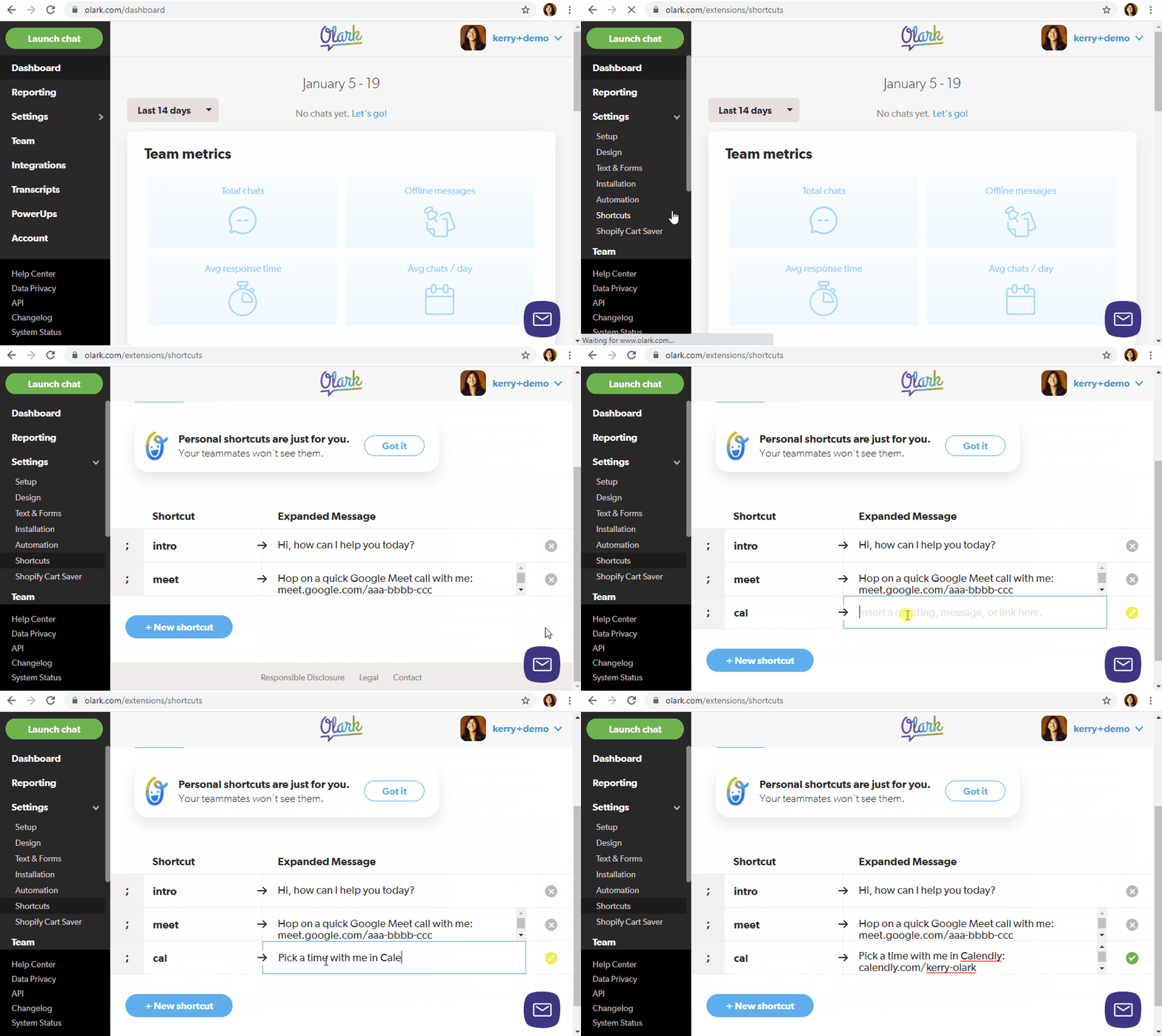
The widget is the part with two decades of refinement behind it. It installs with a script, deploys across multiple sites on one account, handles concurrent conversations cleanly, and supports offline forms when nobody is available. Agents work from a console reviewers describe as clean and immediately understandable.
The costs are cosmetic, and they matter more than they used to. Reviewers describe the design as dated against newer widgets, customization as limited for teams with strict brand guidelines, and auto-response configuration as inflexible. On a marketing site where the chat bubble sits next to a carefully designed page, that gap is visible to customers rather than just to agents.
Two functional absences define the product. There is no ticketing, so anything needing follow-up after the visitor leaves has to live somewhere else. And in the classic plan there is no chatbot, so out-of-hours coverage means an offline form rather than an answer.
Aiden and the AI proposition
Aiden is the AI engine behind the new tier, and the honest position is that there is very little independent evidence about it. The review corpus predates it; there is no Reddit discussion, and Trustpilot has nothing usable. What can be said comes from the vendor: unlimited conversations with no token metering, automatic FAQ and knowledge updates, lead capture and qualification, and proactive engagement, with white-glove support and account management included.
The commercial design is the interesting part, and I think it is right in principle. Olark’s argument is that usage-based AI pricing punishes success, so teams under-deploy their own agent to control spend. Every consumption-priced product I have reviewed in this series demonstrates exactly that dynamic, and a flat fee with unlimited conversations removes it. Whether the agent is good enough to justify $4,800 a year is a separate question that the public evidence cannot currently answer.
If you are seriously considering it, I would ask for reference customers running it in production and a written resolution definition, because you are buying on the vendor’s description rather than on a market track record.
Integrations, reporting and scale
The integration list is one of Olark’s quiet strengths, covering the CRMs and help desks most small teams already run, which is what lets it work as the chat layer in front of someone else’s ticketing.
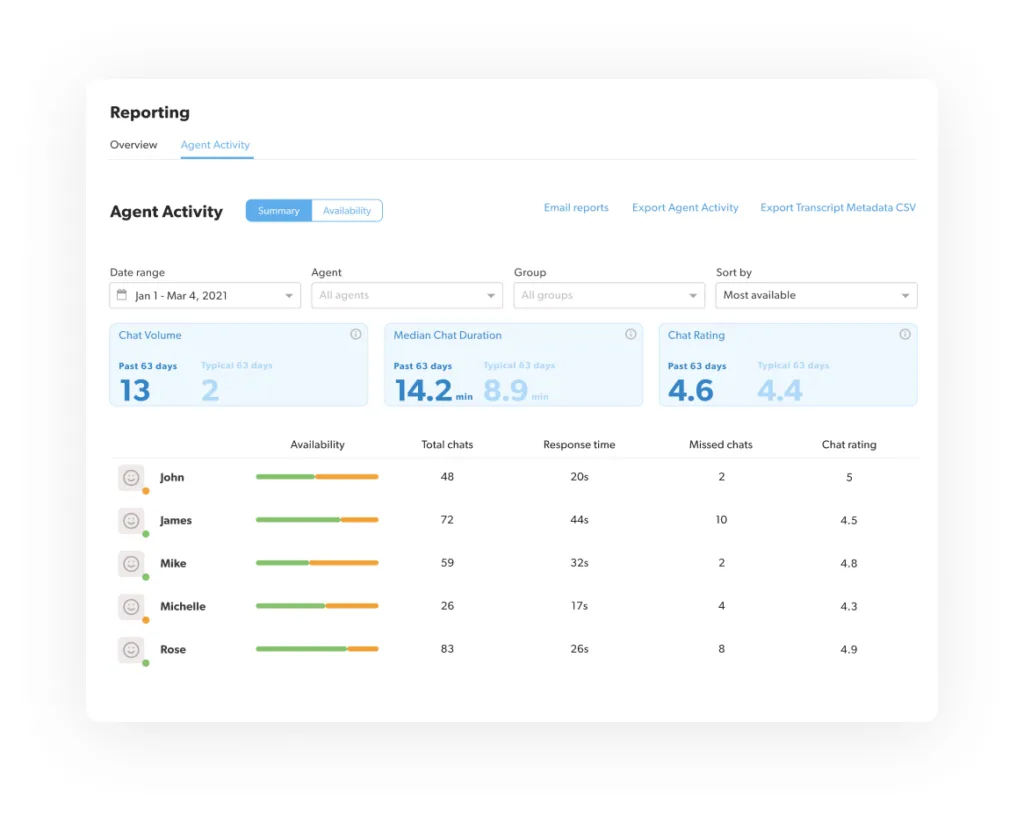
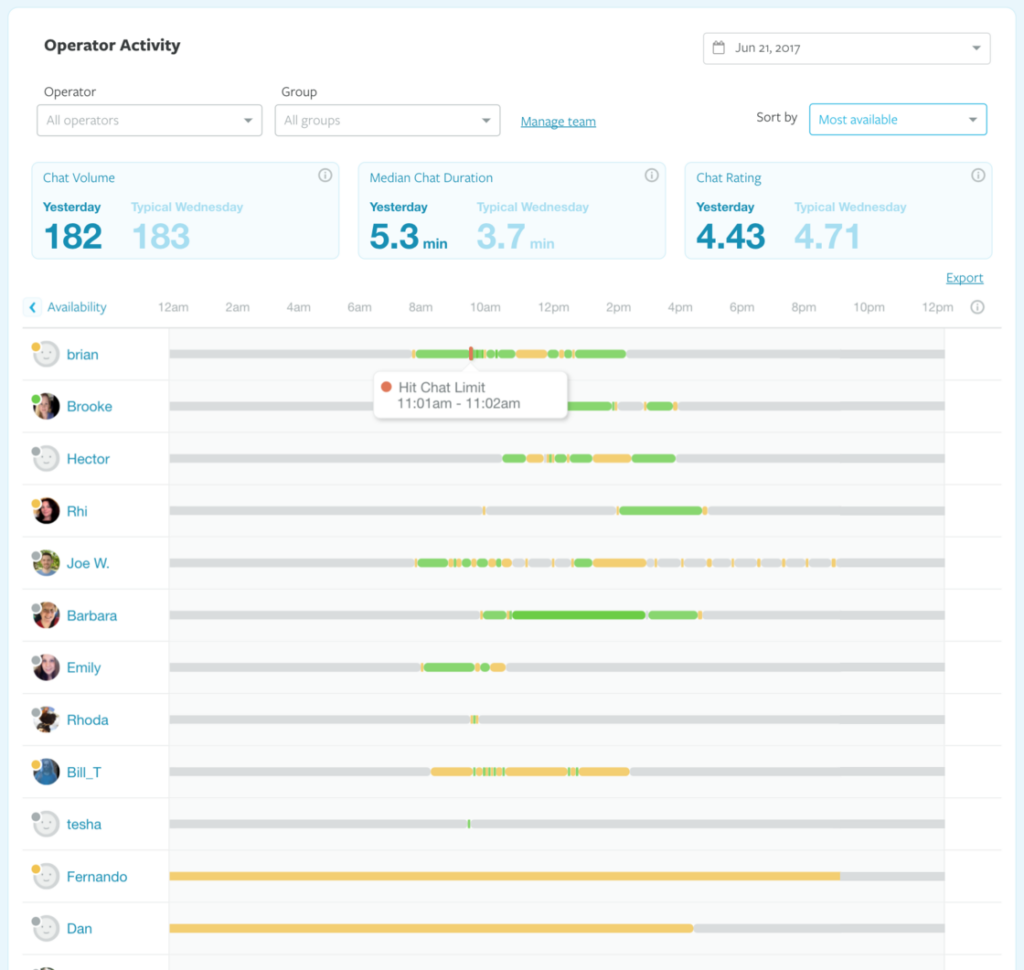
Reporting covers chat volume, response times, satisfaction ratings, and agent activity, and reviewers describe it as adequate and occasionally better than expected for the price. It is not analytical depth, and teams wanting cohort or funnel analysis will export.
Scale constraints are structural rather than technical. Per-operator billing on the classic plan makes large teams expensive, routing sophistication and SSO sit behind the quote-only tier, and there is no multibrand story of the kind larger organizations need. Olark was built for small teams and still shows it.
Vendor support and company stability
Support is a genuine strength, rated 8.8 on G2 and repeatedly praised in reviews, and the AI tier includes named account management rather than a queue.
Stability deserves credit too. Olark has operated continuously since 2009 under the same product name, without the acquisitions, sunsets, or private equity recapitalizations that have disrupted several competitors covered in this series. A buyer choosing the classic plan is choosing a product that has been quietly maintained for seventeen years, which counts for something when the alternative is a startup with two years of runway.
Olark alternatives, by what you are solving for
You want AI resolution with evidence behind it
Kayako prices AI around resolved conversations and reports on what actually closed, with a public track record you can check. You give up Olark’s flat unlimited model, which is genuinely attractive if your volume is high. Test both by pricing your real annual conversation volume against each.
You want chat and ticketing in one place
Olark has no ticketing, so anything requiring follow-up leaves the tool. Kayako keeps the conversation and the case together, with resolution reporting behind both. You give up Olark’s simplicity. Test it by counting how many chats last month needed a follow-up email.
You want a modern widget at a small-business price
Tidio offers a contemporary widget with an AI agent from a much lower entry point, though it runs several metered pools. Test it by pricing your conversation volume against Olark’s flat fee, because above a certain volume, flat pricing wins.
You need a full help desk for the same money
LiveAgent gives you chat, email, phone with IVR, and a knowledge base for a fraction of Olark’s AI tier. You give up polish. Test it by listing every channel your customers actually use.
You are ecommerce, and orders drive the questions
Gorgias pulls order and shipping data into the conversation, which Olark cannot do. Test it by tagging a week of chats and counting how many need order data.
You want the simplest possible free option
tawk.to is free with unlimited agents and matches Olark’s classic plan on most core chat functions. You give up polish, support quality, and visitor monitoring depth. Test it by running both widgets on different site sections for a fortnight.
Three numbers decide this for any option: cost per resolved conversation at your real annual volume, whether the price rises when volume rises, and how much independent evidence exists about the AI you are buying.
Try Kayako customer support software
Verdict
Olark spent seventeen years being the simplest live chat tool on the market, and it was genuinely good at it. The ease-of-use, setup, and admin scores are the highest I have recorded in this series; support is rated well, and the company has been quietly stable while competitors were acquired, sunset, or repriced. The classic plan at $29 per agent remains a reasonable purchase for a team that wants chat, has somewhere else for tickets, and does not mind a dated interface.
The thing to be careful about is that this is no longer the product Olark is selling. The main offer is now an AI website agent at $4,800 a year on annual billing, and there is almost no independent evidence about it, because the entire review corpus describes the older, cheaper tool. On Monday, I would do two things. Check which product any comparison table, article, or recommendation is actually pricing, because the widely published $17 and $29 figures do not describe the headline offer. Then, if the AI tier interests you, ask for production reference customers and a written definition of what the agent counts as resolved, because at that price you are buying on the vendor’s description rather than on a market track record.
Olark FAQs
How much does Olark cost in 2026?
The headline product is the Standard AI Website Agent at $400 a month billed annually, including unlimited AI conversations and one human seat, with extra seats at $29 each. A classic live-chat-only plan remains available at $29 per agent per month. Review sites still list much lower figures.
Why do review sites show Olark at $17 or $29?
Because they describe the older live chat product. The corpus on G2 and Capterra predates the AI repositioning, so the aggregate scores and the entry prices refer to a tool that is no longer the main offer.
Does Olark have a chatbot?
Not on the classic live chat plan. Automated answering comes with the AI Website Agent tier, powered by Olark’s Aiden engine, which is where the current pricing and roadmap attention sit.
Can Olark replace a help desk?
No, and it never tried to. There is no ticketing, no SLA management, and no case lifecycle. It is a chat layer designed to sit in front of a help desk you run elsewhere.
Is the flat AI pricing actually better?
If your volume is high, mathematically yes, because unlimited conversations at a fixed fee beats per-resolution billing above a certain point. The open question is quality, since there is no independent evidence yet about how well the agent resolves.