Customer Satisfaction Score (CSAT): Formula, Benchmarks & How to Improve It (2026)
| Customer Satisfaction Score (CSAT) measures how satisfied a customer was with a specific interaction, product, or service. You ask “How satisfied were you?” on a 1-to-5 scale, then report the percentage who answered 4 or 5. The formula is CSAT (%) = (satisfied responses ÷ total responses) × 100. A good CSAT is 75% to 85% in most industries. |
Key takeaways
|
Customer Satisfaction Score is the most direct customer experience metric there is: you ask customers how satisfied they were immediately after an experience and report the share who were happy. It is also under pressure. The American Customer Satisfaction Index fell to about 76 out of 100 in early 2026, and customer complaints rose sharply in the same period (ACSI, via HelloCustomer). That makes measuring and improving CSAT a genuine competitive edge. This guide covers the definition, the formula, 2026 benchmarks by industry, how CSAT compares with NPS and CES, and how to improve your score.
What is CSAT (customer satisfaction score)?
CSAT stands for Customer Satisfaction Score. It is a transactional customer experience metric that measures how satisfied a customer was with a specific interaction, product, or service, captured through a short one-question survey rated on a 1-to-5 scale (sometimes 1-to-10) right after the experience. The standard question is: “How satisfied were you with your experience today?”, and the top ratings (4 and 5 on a 1-to-5 scale) count as satisfied responses.
CSAT sits at the fast-feedback end of the metrics spectrum. Because it is tied to a single touchpoint, it localizes problems precisely: it tells you exactly which interaction, agent, or step left a customer unhappy. It is most valuable at high-frequency moments where satisfaction varies, such as after a purchase, a support ticket, or onboarding.
How to calculate CSAT?
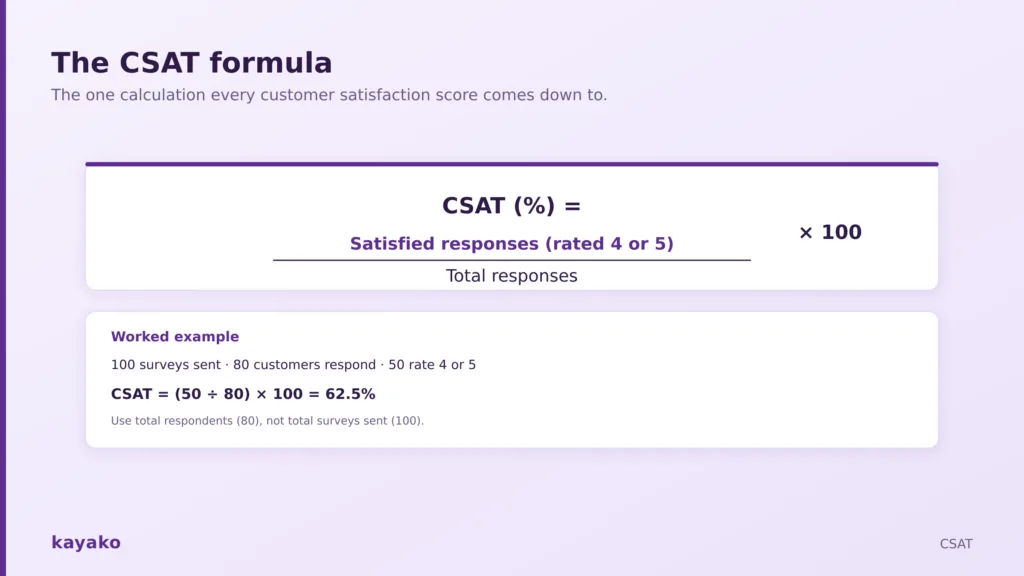
To calculate CSAT, divide the number of satisfied responses (ratings of 4 or 5 on a 1-to-5 scale) by the total number of responses, then multiply by 100. For example, 50 satisfied responses out of 80 total gives a CSAT of 62.5%. Always use total respondents, not total surveys sent.
The one calculation every customer satisfaction score comes down to.
On a 1-to-5 scale, satisfied responses are 4s and 5s. On a 1-to-10 scale, satisfied responses are typically 7 to 10; the formula is identical. Some teams instead report a composite average of all ratings (for example, 4.2 out of 5), but the percentage method is the one that maps to industry benchmarks. Whichever you pick, use it everywhere so your trend data stays comparable. For a quick result from raw data, use Kayako’s CSAT calculator.
What is a good CSAT score? Benchmarks by industry
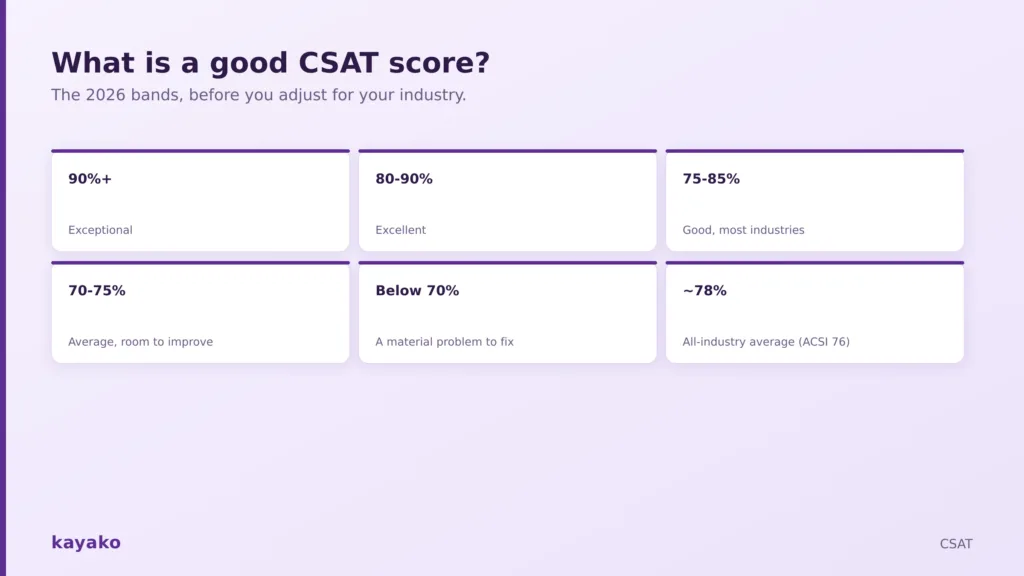
A good CSAT score in 2026 is generally 75% to 85%, with 80% and above considered excellent and 90% and above exceptional. Below 70% signals real dissatisfaction. The all-industry average is around 78%, but a good score depends heavily on your sector: consulting averages about 84% while telecom and cable run as low as 62%.
The 2026 bands, before you adjust for your industry.
The table below shows approximate 2026 CSAT by industry. One important caveat: the ACSI publishes a 0-to-100 weighted index, which is not the same as a transactional CSAT percentage, so confirm which method a benchmark uses before comparing yourself to it.
| Industry | Approx. 2026 CSAT |
|---|---|
| Consulting | 84% |
| Financial services and banking | 83% |
| Full-service restaurants | 82% |
| E-commerce and retail | 80 to 82% |
| Software and SaaS | 80% |
| Insurance | 78 to 81% |
| All-industry average | About 78% (ACSI index 76) |
| Internet service providers | 73% |
| Airlines | 72 to 76% |
| Telecom and cable | 62 to 68% |
Channel matters as much as industry. Aggregated 2026 data puts live chat highest at about 85%, followed by phone at 83%, email at 74%, and social at 68%. And the single strongest predictor of CSAT is speed: responses within an hour score meaningfully higher than those that take a day or more (2026 CSAT benchmarks, via MavenAGI). Always benchmark against your own sector and channel, not the overall average.
|
CSAT vs NPS vs CES: when to use which
CSAT is one of three core experience metrics, and they answer different questions. Using them together gives you interaction detail, loyalty context, and effort insight at once.
Three metrics, three different questions.
| CSAT | NPS | CES | |
|---|---|---|---|
| Measures | Satisfaction with one interaction | Overall loyalty and referral | How easy it was to get help |
| Question | How satisfied were you? | How likely to recommend us? | How easy was it to resolve? |
| Best used | After specific touchpoints | Periodic relationship check-in | After support or task completion |
| Frequency | High, every interaction | Low, quarterly or annual | Medium, post-service |
Use CSAT when you need to know whether a specific experience landed well, NPS when you need overall brand loyalty, and CES when you want to know how much effort a customer had to exert, which is often the clearest predictor of effort and churn risk.
How to collect CSAT data
The closer a survey sits to the experience, the more accurate the response. The main collection methods, by channel:
- Post-ticket surveys. Triggered automatically when a support ticket or chat closes, so the response links to the agent, issue, and ticket. The most common method in customer service.
- Transactional email. Sent within minutes of a purchase, shipment, or account change. Keep it to one question in the email body, since click-through forms cut response rates.
- In-app prompts. Triggered after a feature is used or a milestone is reached, best for SaaS, timed to avoid interrupting a task.
- SMS and IVR. High open rates on SMS suit mobile-first and field service; post-call IVR reaches phone-first customers who are underrepresented in digital surveys.
- In-store and QR. Tablet or receipt prompts capture immediate sentiment in retail and hospitality, though scores skew high when staff is visible.
How to improve your CSAT score
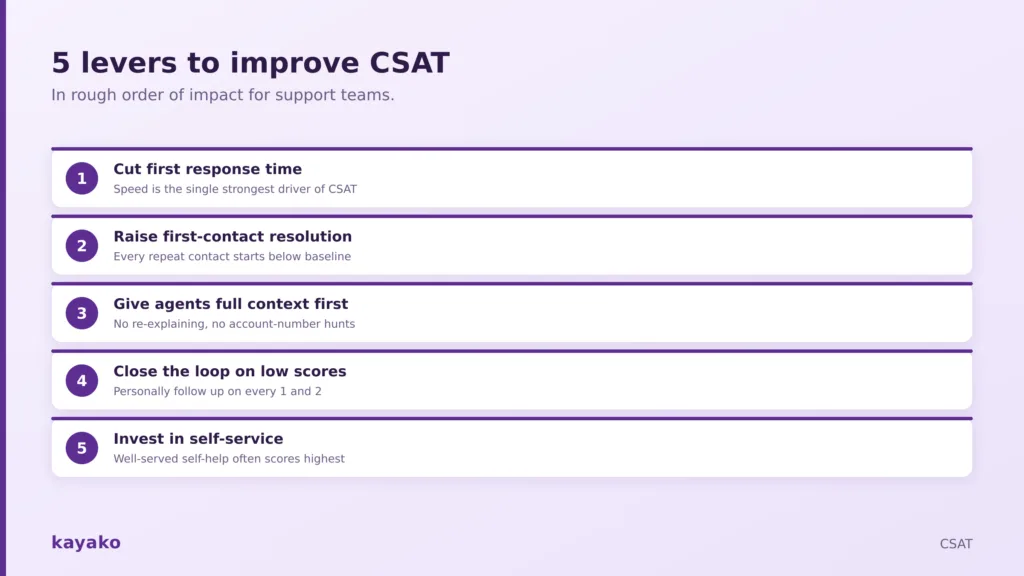
A low CSAT is fixable, and the levers are consistent across support teams. In rough order of effect:
In rough order of effect for support teams.
- Cut first response time. Speed is the most consistent driver of CSAT across every channel. Setting and hitting response-time SLAs lifts CSAT faster than anything else, even before resolution quality changes. Our guide to SLAs and satisfaction shows how.
- Raise first-contact resolution. Every repeat contact for the same issue starts below baseline. Better routing, training, and knowledge access lift first-contact resolution and remove the main source of repeat frustration.
- Give agents full context first. An agent who has to ask for an account number or what the customer already tried starts with negative momentum. Unified customer history before the first reply turns friction into trust.
- Close the loop on low scores. A customer who scores 1 or 2 and hears nothing usually churns. A personal follow-up that acknowledges the failure often saves the relationship, and they remember the recovery.
- Invest in self-service. Customers who resolve an issue through a well-built knowledge base often report higher satisfaction than those who needed an agent, because they did it faster and on their own schedule.
|
Benefits and limitations of CSAT
The benefits. CSAT is a fast feedback signal that surfaces problems before they compound, a precise agent-coaching input when tied to individual tickets, a churn predictor since low scorers are far more likely to leave, and a product feedback loop when you categorize the open-ended follow-up. McKinsey’s research points to consistency, across channels and over time, as the primary driver of satisfaction, and CSAT is the metric that surfaces inconsistency fastest.
The limitations. CSAT has real blind spots. Survey fatigue lowers response quality, so cap surveys per customer. Response bias pulls answers toward the very happy and very angry, understating the quiet middle. Recency bias means a customer rates the last moment, not the whole relationship. And cultural differences move scores by region, so global teams need region-specific benchmarks. Above all, CSAT measures satisfaction, not loyalty: a happy interaction does not guarantee a customer stays, which is why it pairs best with NPS and CES.
How Kayako helps you track and improve CSAT
Measuring CSAT is easy; acting on it is where most teams stall, because the score sits in a survey tool disconnected from the tickets and agents that produced it. Kayako closes that gap. It connects post-ticket CSAT directly to individual agent records, the specific issue, and the customer’s full history, so coaching happens on real interactions rather than averages, and low scores route automatically to a team lead for personal follow-up.
Because the biggest CSAT lever is speed, Kayako’s AI agent, Agent Kay, resolves routine tickets instantly and gives human agents the full customer context before they reply, cutting the wait times that depress scores. After moving to Kayako, Trilogy resolved 76% of tickets autonomously, cut ticket age from 17.6 hours to under 2 minutes, and raised CSAT from 76% to 90%. You can see the approach on Kayako’s AI customer support page, and track it alongside your other support metrics.
|
|
Frequently asked questions
What is the full form of CSAT?
CSAT stands for Customer Satisfaction Score. It is a transactional customer experience metric that measures how satisfied a customer was with a specific interaction, product, or service, captured immediately after the experience through a brief one-question survey rated on a 1-to-5 or 1-to-10 scale.
How do you calculate CSAT out of 5?
Divide the number of satisfied responses by the total number of responses, then multiply by 100. On a 1-to-5 scale, satisfied responses are ratings of 4 or 5. For example, 50 satisfied responses out of 80 total respondents give a CSAT of 62.5%. Use total respondents, not total surveys sent, since your response rate affects representativeness rather than the formula.
What is a good CSAT score?
A good CSAT score in 2026 is generally 75% to 85%, with 80% and above excellent and 90% and above exceptional. Below 70% signals real dissatisfaction. The right benchmark depends on your industry: consulting averages about 84% and e-commerce 80 to 82%, while telecom and cable run as low as 62 to 68%. Always benchmark against your own sector.
What is the difference between CSAT and NPS?
CSAT measures satisfaction with a specific interaction and is best used at high-frequency touchpoints, right after an experience. NPS measures overall loyalty and referral likelihood and is best used as a periodic relationship check-in. Neither is universally better; teams that use both get interaction-level detail from CSAT and relationship-level context from NPS.
How do I improve a low CSAT score?
In order of typical effect: reduce first response time by setting and hitting SLA targets; improve first-contact resolution through better routing, training, and knowledge access; give agents customer context before they reply; personally close the loop on every score of 1 or 2; and invest in self-service so customers can resolve routine issues without waiting. Speed is the fastest lever of the five.
What is the CSAT survey question?
The standard CSAT question is “How satisfied were you with your experience today?”, answered on a 1-to-5 scale from very dissatisfied to very satisfied. Keep it specific to what you want to measure, such as “How satisfied were you with the support you received?”, and add at most one open follow-up like “What could we have done better?” for context without hurting completion.