Key takeaways
- The customer is always right is a service slogan popularized by retail pioneers around 1905, not the invention of any single person.
- The useful core of the idea is to take complaints seriously and treat customers with respect, which was a genuinely new stance a century ago.
- Taken literally, the motto harms employee morale, rewards bad behavior, and ignores that customers are sometimes simply wrong.
- The modern approach keeps the respect and drops the absolutism: empathy with clear boundaries, backed by tools that make good service consistent.
The customer is always right may be the most repeated phrase in the history of retail. It has been printed on staff handbooks, quoted in boardrooms, and thrown across countless service counters by shoppers who wanted the last word. More than a century after it entered the language, it still shapes how businesses think about service, and it still starts arguments about whether it is wise or wrong.
This guide separates the slogan from the myth. It covers what the phrase actually means, where it came from, why the literal version causes real harm to staff and businesses, the kernel of truth worth keeping, and how modern support teams apply the respect without the absolutism. The short version is that customers deserve to be heard and treated well, yet no healthy business lets one person’s demand override fairness, facts, or the wellbeing of its own people.
What does “the customer is always right” mean?
At its simplest, the phrase tells service staff to give a high priority to customer satisfaction: take complaints seriously, assume the customer has a real problem, and treat every shopper with respect. When it appeared, that was a meaningful stance. In an era when caveat emptor, or “let the buyer beware,” was the norm and misrepresentation was common, promising to side with the customer set a store apart and built trust.
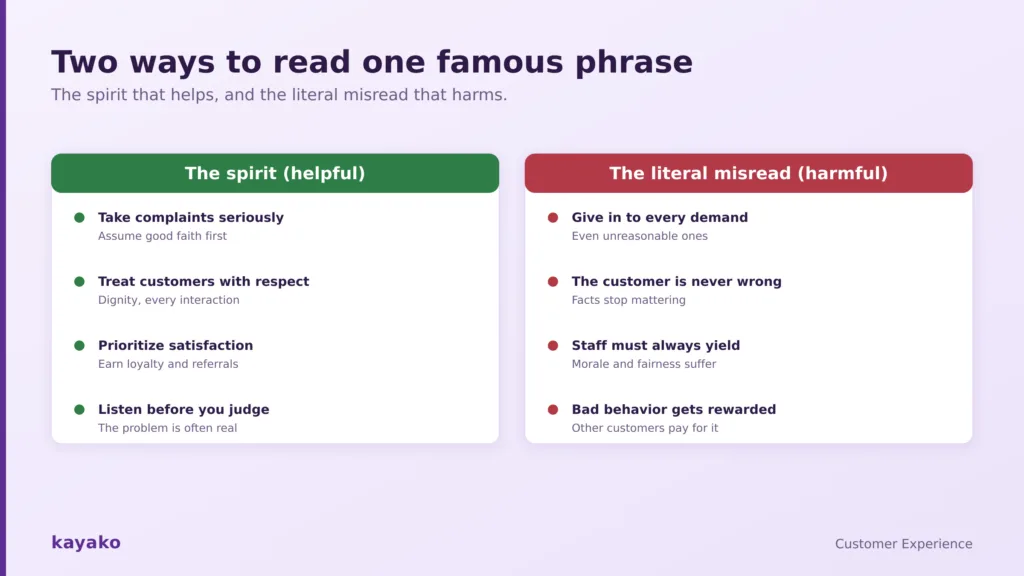
The phrase has a helpful spirit and a harmful literal reading. Most disputes come from confusing the two.
The trouble is that the slogan gets read two ways. The spirit of it, respect and genuine attention to complaints, is sound and still worth following. The literal reading, that the customer is never wrong and staff must always yield, is where the damage starts. Even the National Customer Service Association lists “the customer is always right” among its myths of customer service, noting that customers are sometimes wrong and that offering tactful options is the real job. Getting the importance of customer experience right depends on keeping the spirit and dropping the absolutism.
|
To understand why the phrase carries so much weight, it helps to know where it came from, because the history is often told wrong.
The origin and history of the phrase
No single person coined the phrase ” the customer is always right. It was popularized by several retail pioneers in the early 1900s, chiefly Marshall Field of Chicago, his one-time employee Harry Gordon Selfridge, and the Philadelphia merchant John Wanamaker. The earliest verified appearance in print that fact-checkers have traced is a September 1905 article in the Boston Globe describing Marshall Field’s approach (Snopes). Selfridge carried the idea to London, where he opened Selfridges in 1909 and used it to train staff to take shoppers seriously.
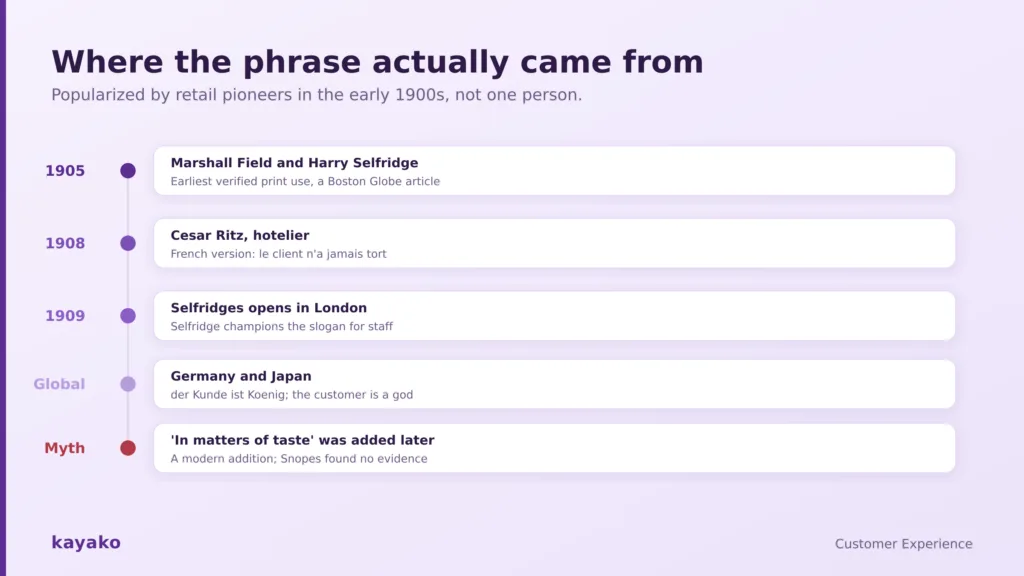
The phrase spread through several retailers in the early 1900s, and the popular ending is a later addition.
The sentiment traveled. In 1908, the hotelier César Ritz was credited with the French version, le client n’a jamais tort, meaning “the customer is never wrong.” Germany adopted der Kunde ist Koenig, “the customer is king,” and Japan uses okyakusama wa kamisama desu, “the customer is a god.” Different words, the same instinct to put the buyer first (phrases.org.uk).
The “in matters of taste” myth
A popular claim online says the original phrase was longer, “the customer is always right in matters of taste,” and that the qualifier was lost over time. It is a tidy story, because the longer version limits the idea to personal preference, such as which hat a shopper likes, rather than every demand. The problem is that it appears to be untrue. Snopes investigated and found no evidence that Selfridge or anyone else used the “in matters of taste” ending, including in Selfridge’s own 1918 book. The qualifier is a 21st-century addition spread largely through social media, so it is best treated as a useful idea rather than a historical fact.
With the history straight, the practical question is the one every manager eventually asks: is the phrase actually true?
Is the customer always right?
The honest answer is no, at least not literally. Customers deserve respect, attention, and a fair hearing, and they are often right that something has gone wrong. They are not, however, always correct about the facts, always reasonable in their demands, or always acting in good faith. Treating a slogan as an absolute rule is where sensible service turns into a liability. Knowing when to agree and when to hold a line, which our guide to saying no to customers covers in depth, is a core service skill rather than a failure of it.
The case against the literal reading is strong, and it is worth walking through, because each weakness points to a better practice.
Why the customer is not always right
Four problems show up wherever the phrase is applied literally. Each one has a real cost, and each has a healthier alternative.
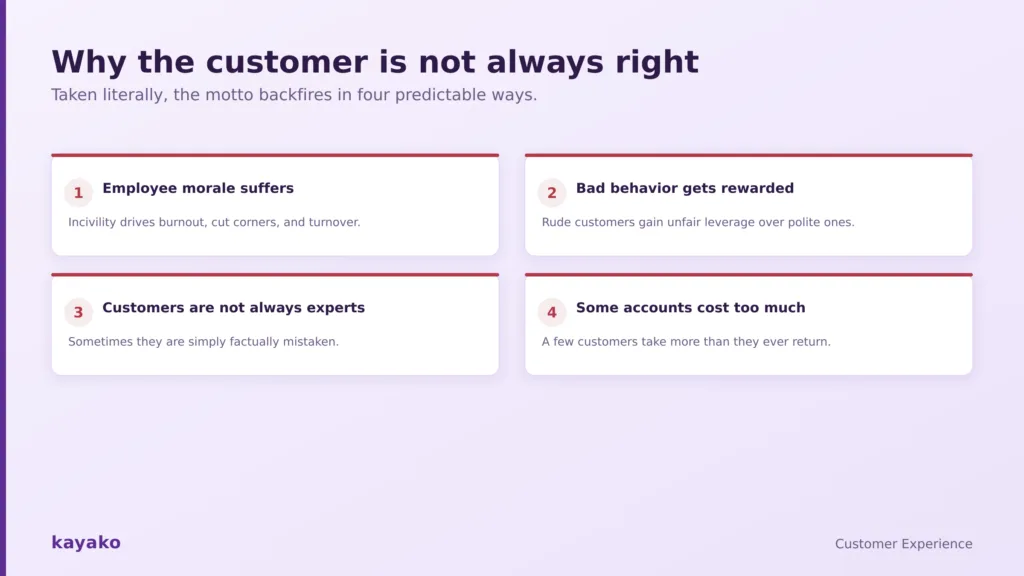
Taken literally, the motto backfires in four predictable ways.
It harms employee morale and drives turnover
The clearest cost falls on staff. A 2026 study from the University of Mississippi and the University of Tampa, published in Services Marketing Quarterly, found that frontline employees who face rude or uncivil customers are more likely to burn out, cut corners, and quit (University of Mississippi). When a business signals that the customer is always right, it tells employees their dignity comes second, and frontline service roles already see turnover as high as 45%, according to industry data from QATC. Protecting staff is not a soft nicety, because morale and retention feed directly into service quality. Our guide to dealing with rude customers has practical scripts for these moments.
It rewards bad behavior
A literal rule teaches customers that pressure works. The ones who shout, threaten, or exaggerate get more than the ones who stay polite, which is both unfair and expensive. It also rises with the general temperature of complaints. The 2025 National Customer Rage Survey found that 77% of Americans had a product or service problem in the past year, and customer rage has been climbing for years (via 19pine). Rewarding the angriest voices only trains more of them. Handling those situations well is a learnable skill, and our guide to handling angry customers breaks it down.
Customers are not always experts
Sometimes the customer is simply mistaken about how a product works, what a policy says, or what they actually need. A good agent corrects the record with tact rather than agreeing with something false. Blind agreement can send a customer toward the wrong solution, which creates a second complaint later and erodes the trust the phrase was meant to build.
Some accounts cost more than they return
A small number of customers demand endless discounts, refunds, and attention while generating little revenue and much stress. Occasionally the right business decision is to part ways respectfully. Keeping every customer at any cost is not loyalty; it is a slow drain on the resources you owe to the customers who are a good fit.
|
None of this means the phrase should be thrown out entirely, because underneath the absolutism sits an idea worth keeping.
The case for taking the idea seriously
Strip away the literal reading and a durable truth remains: customers who feel heard and respected stay, spend, and recommend, while those who feel dismissed leave and warn others. The financial stakes are large. Qualtrics research in 2025 estimated that poor customer experiences put roughly $3 trillion at risk globally, as consumers cut back or stop spending after bad interactions (Forbes).
Expectations keep rising too. Salesforce reports that 76% of customers now expect companies to know and value them, and Zendesk finds that more than half will switch to a competitor after a single bad experience.
Respect also builds durable trust. PwC found that 59% of customers feel companies have lost touch with the human element of service (PwC), which is exactly the gap the original slogan tried to close. The goal is to keep that human, complaint-respecting instinct while measuring whether it works. Tracking the right customer experience metrics is how you tell genuine service from mere appeasement, and strong customer loyalty is the payoff when you get the balance right.
|
The practical challenge, then, is holding both ideas at once: real respect for the customer and real boundaries for the business. That balance is what modern service teams are built around.
How to apply the philosophy in modern customer service
The healthiest version of the phrase is not “the customer is always right.” It is closer to “the customer always deserves respect, a fair hearing, and an honest answer.” The steps below turn that into daily practice.
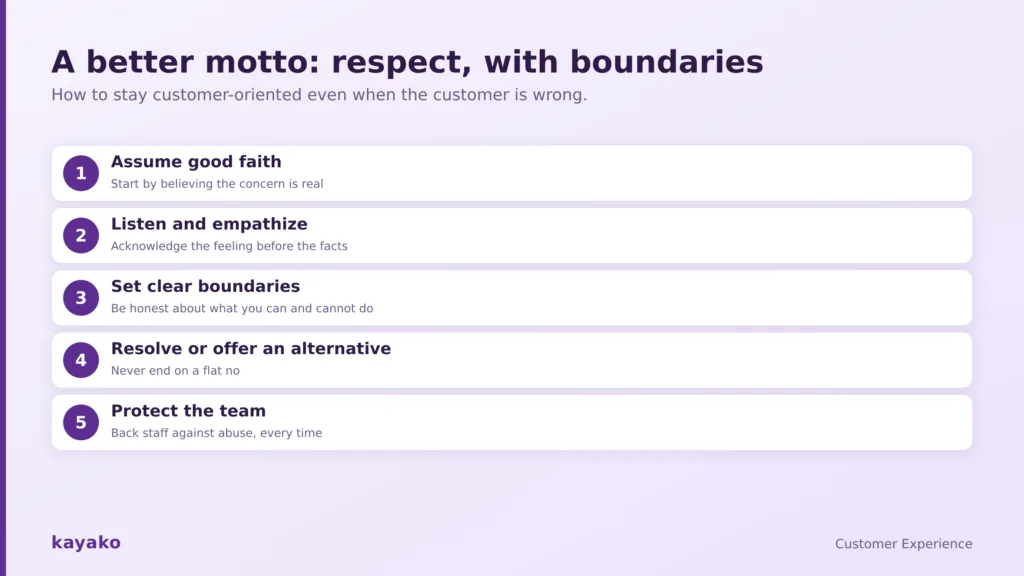
A better motto: respect with boundaries, in five practical steps.
- Assume good faith first. Start by believing the concern is real. Most complaints come from a genuine problem, and leading with suspicion poisons the interaction.
- Listen and empathize before facts. Acknowledge the feeling before you correct the detail. A customer who feels heard becomes far easier to help.
- Set clear, honest boundaries. Be direct about what you can and cannot do. Vague answers create false hope, and false hope creates the next complaint.
- Resolve or offer an alternative. Never end on a flat refusal. Where a sincere apology is due, our guide to the apology letter format helps you word it, and there is always a next step to offer.
- Protect your team. Back staff against abuse every time. Empowered, supported agents deliver better service than fearful ones, and they stay longer.
Making this consistent across a whole team, on every channel, is the hard part. It depends on giving agents the context and the tools to respond well under pressure, which is where the right customer support metrics and the right platform come in.
|
How Kayako helps you deliver respectful service with boundaries
A good service philosophy needs support from good tooling, because consistency is hard to hold by hand across hundreds of conversations a day. Kayako is built to make respectful, well-informed service the default rather than the exception.
Three things matter here. First, Kayako’s SingleView puts each customer’s full history and past conversations on one screen, so an agent knows whether this is a first issue or a repeated demand and can respond fairly and in context.
Second, shared canned responses let a team reuse its best replies, including graceful ways to say no, so quality holds steady even on the hundredth ticket.
Third, its AI agent, Agent Kay, resolves routine questions instantly and routes the sensitive ones to a person with the context already attached, which lifts the repetitive load that burns agents out.
You can see the platform on Kayako’s customer support software page, and its AI for customer support, and our view of the future of AI in customer service explains where this is heading. The result is service that stays respectful and consistent while protecting the people who deliver it, which is the balance the original phrase was always reaching for.
| Deliver fast, consistent, respectful support at scale with Kayako |
The customer is always right endures because its spirit is sound: take people seriously, treat them with respect, and honor genuine complaints. Its literal reading fails because it ignores facts, rewards bad behavior, and wears down the staff who carry it out. The modern answer keeps the respect and adds boundaries, empathy paired with honesty, and it backs frontline teams instead of sacrificing them. Handled that way, a century-old slogan still points somewhere useful, toward service that earns loyalty without costing a business its fairness or its people.
Frequently asked questions
What does “the customer is always right” mean?
It is a service slogan urging businesses to prioritize customer satisfaction: take complaints seriously, treat customers with respect, and assume there is a real problem behind a concern. It was never meant as a literal rule that customers are correct about everything or entitled to any demand. The useful reading is about respect and attention, not blind agreement.
Who said, “the customer is always right”?
No single person coined it. It was popularized in the early 1900s by retail pioneers including Marshall Field, Harry Gordon Selfridge, and John Wanamaker. The hotelier César Ritz is credited with a French version, “le client n’a jamais tort,” around 1908. The earliest verified print use fact-checkers have found is a 1905 Boston Globe article about Marshall Field.
Is the full quote “the customer is always right in matters of taste”?
Almost certainly not. The “in matters of taste” ending is a modern addition, and Snopes found no evidence that Selfridge or the other originators ever used it, including in Selfridge’s own 1918 book. It is a popular online claim rather than a documented historical quote, though the idea it expresses, that customers get to decide their own preferences, is reasonable.
Is the customer always right?
No, not literally. Customers deserve respect and a fair hearing, and they are often right that something went wrong, but they are not always factually correct, reasonable, or acting in good faith. The better approach is to treat every customer with respect while keeping honest boundaries, correcting mistakes tactfully, and protecting staff from abuse.
Why is “the customer is always right” considered wrong or harmful?
Taken literally, it harms employee morale and drives turnover, rewards aggressive or dishonest customers at the expense of polite ones, ignores that customers are sometimes mistaken, and pushes businesses to keep accounts that cost more than they return. Research links customer incivility to employee burnout and higher turnover, which ultimately lowers service quality for everyone.
What should replace “the customer is always right”?
A more accurate motto is that the customer always deserves respect, a fair hearing, and an honest answer. Some teams use “the customer is not always right, but they are always the customer.” The point is to keep the respect and attention while adding boundaries, so staff are supported, and facts still matter.
How do you handle a customer who is wrong?
Acknowledge the feeling first, then correct the facts with tact. Explain the situation clearly, offer the best alternative you can, and avoid ending on a flat refusal. Stay calm, keep the customer’s dignity intact, and lean on agreed policies so the decision is consistent and defensible rather than personal.