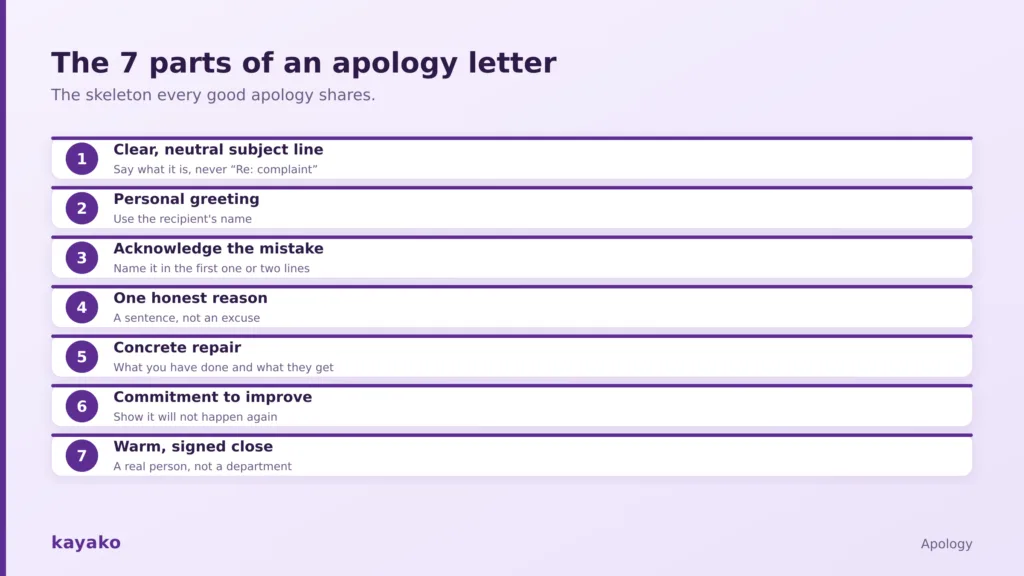
| A good apology letter follows seven parts: a clear subject line, a personal greeting, an acknowledgment of the mistake, one honest reason, a concrete repair, a commitment to improve, and a warm signed close. Put the apology in the first one or two lines, keep the reason to a single sentence, and end with a real name, not a department. |
Key takeaways
|
A good apology letter follows a specific format, whether you are writing to a customer, your boss, a teacher, or someone you have hurt. Get the structure right, and even a serious mistake reads as considered and sincere; get it wrong, and it hardens an already-frustrated reader. This guide covers the correct apology letter format, how to write one step by step, the 5 R’s framework, formal versus informal versions, ready-to-use templates by context, and real examples worth studying.
What is the correct apology letter format?
The correct apology letter format has seven parts, in order: a clear, neutral subject line; a personal greeting using the recipient’s name; an acknowledgment of the mistake in the first one or two lines; one brief, honest reason; a concrete repair; a commitment to improvement; and a warm, professional close signed by a named person.
The skeleton every good apology shares.
- Subject line. Tell the reader what the message is about. Never use “Re: complaint.”
- Personal greeting. Use the recipient’s name. “Dear Sir or Madam” signals a template.
- Acknowledgment. Name what happened in the first one or two lines. Do not bury it.
- Honest reason. One sentence is enough. Two starts to sound like justification.
- Concrete repair. State what you have done and what the recipient gets. Specifics build trust.
- Commitment to improve. Show it will not happen again. The verb matters more than the promise.
- Warm close. Sign off as a real person with name, role, and contact, not as a department.
How to write an apology letter (step by step)
To write an apology letter, open with the recipient’s name, acknowledge the mistake in the first one or two lines, give one honest reason, offer a concrete repair, state what you are changing so it will not happen again, and sign off with your name and contact. Read it aloud before sending; if it sounds like a template, rewrite it.
- 1. Open with the recipient’s name and a neutral subject line.
- 2. Acknowledge the mistake plainly in the first sentence or two.
- 3. Give one honest reason for what happened, without making excuses.
- 4. Offer a concrete repair: what you have done and what they get.
- 5. State the specific change that stops it from recurring.
- 6. Close warmly, signed by a named person, and read it aloud before sending.
The 5 R’s of an apology
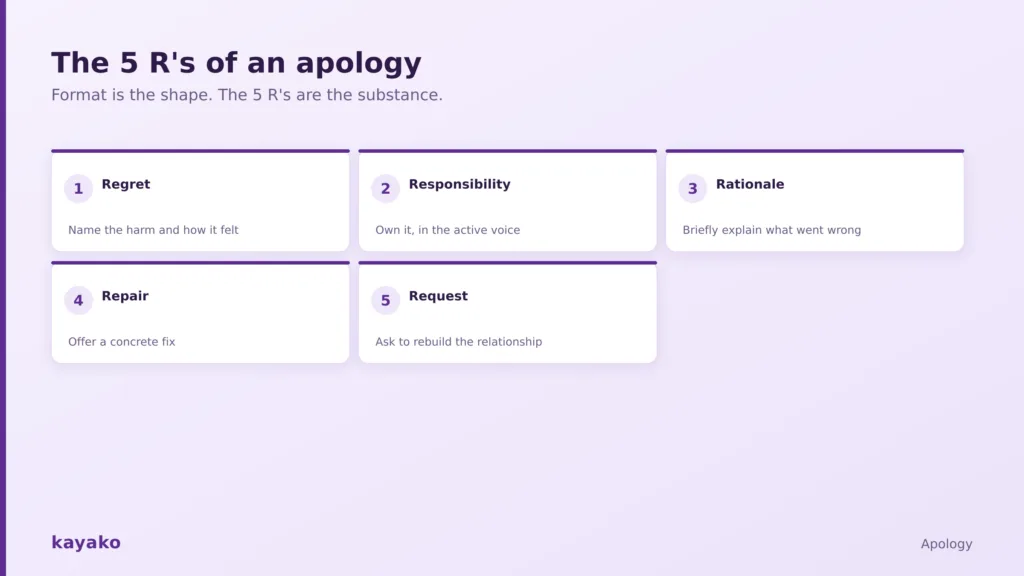
Format gives an apology its shape. The 5 R’s give it substance. Run any apology through this checklist before you send it.
Format is the shape. The 5 R’s are the substance.
- Regret. Acknowledge the harm and how it likely felt. “I’m sorry” without naming the harm reads as boilerplate.
- Responsibility. Own what happened in the active voice: “I made a mistake,” not “a mistake was made.”
- Rationale. Briefly explain what went wrong, not why it was justified. One sentence.
- Repair. Offer a concrete fix: a refund, replacement, redo, or action plan. The repair carries the real weight.
- Request. Ask to rebuild the relationship: “I hope we can move forward.”
Some leadership and HR programs teach a shorter four-part version, the 4 R’s: Recognize, Responsibility, Remorse, and Repair, with Request folded into Repair. Both work; use the one your team will remember.
Formal vs informal apology format: when to use each
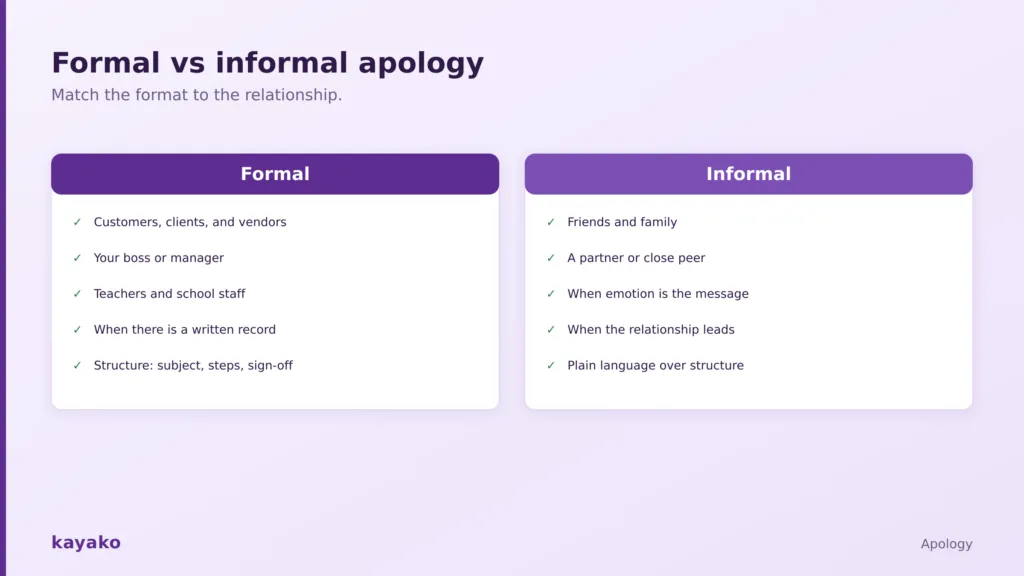
The single biggest mistake in apology writing is using the wrong register. A formal, customer-service apology to a friend reads cold; an informal “my bad” to a senior manager reads disrespectful. Match the format to the relationship.
Match the format to the relationship.
Use a formal apology when writing to a customer, client, boss, vendor, or school staff member, when the mistake has a business or compliance consequence, or when there may be a written record. Use a subject line, a structured sequence, and a professional sign-off.
Use an informal apology when writing to a friend, partner, family member, or close peer, where the relationship matters more than the structure and emotion is the substance. Plain language beats a stiff template.
Short one-paragraph apology format
When the situation is small, or the channel is short, such as a chat message or a text, a single paragraph with four moves works: name what happened, own it, state the fix, and thank them.
| Short apology example
“Hi Sara, quick note to apologize for missing the deadline on the deck. That was on me. I’ve sent the updated version this morning, and I’ve blocked tomorrow to walk you through it. Thanks for your patience.” |
Apology letter templates by context
Use these as starting points, and always personalize the name, the situation, and the repair. Copy-pasting is what makes a templated apology read as templated.
1. Apology for a mistake at work
| Subject: Apology, [project or task] error
Hi [Manager’s name], I’m writing to apologize for [the specific mistake] on [date or project]. I take full responsibility; I should have [what you should have done], and I didn’t. Here’s what I’ve done to fix it: [concrete action]. Going forward, I’ve added [specific safeguard] so this doesn’t happen again. Thank you for your patience. Let me know if you’d like to discuss in person. Best, [Your name] |
2. Apology to your boss or manager
| Subject: Apology
Hi [Manager’s name], I want to apologize for [behavior or outcome] in [meeting or situation]. That wasn’t the standard I want to bring, and I understand why it landed badly. I’ve already [concrete corrective action], and I’d like a few minutes this week to walk through what I’ll do differently. Thank you for the trust; I won’t take it lightly. Best, [Your name] |
3. Apology to a teacher
| Subject: Apology, [class], [your name]
Dear [Teacher’s name], I’m writing to apologize for [missing the assignment / being late/disrupting class]. I understand it was disrespectful of your time and the class, and I’m sorry. I’ve already [submitted the work / reviewed the material], and I’d like to ask whether I can [make up the work / discuss in office hours]. Thank you for your understanding. Sincerely, [Your name], [class period] |
4. Personal apology to someone you hurt
| No subject line, plain and personal
Hi [Name], I’ve been thinking about what I said, and I owe you a real apology. What I did was [specific thing], and the way it landed was [the harm]. That wasn’t fair to you, and I’m genuinely sorry. I’m not asking you to be okay with it right away. I just wanted you to know I see it, and I’d like the chance to do better. Whenever you’re ready to talk, I’m here. [Your name] |
5. Apology for a delayed customer response
| Subject: Apologies for the delay in getting back to you
Dear [Customer name], We sincerely apologize for the delay in responding to your request. We understand how important timely support is and regret that we didn’t meet expectations this time. Your query regarding [issue] has now been resolved, and we’ve taken steps to ensure faster turnaround in the future, including [new process]. Thank you for your patience. Warm regards, [Support team name] |
6. Apology for a billing error
| Subject: Correction and apology for billing error
Dear [Customer name], We regret the error on your bill dated [date]. Accuracy in billing is something we take seriously, and we apologize for any confusion this caused. We’ve corrected the charge, and you’ll see the adjustment within [timeframe]. We’ve also reviewed our process to avoid similar errors. Thank you for bringing this to our attention. Sincerely, [Accounts team] |
7. Apology for a defective product
| Subject: Important update regarding your recent purchase
Dear [Customer name], We’ve found an issue with [product name] that may affect performance. Your safety and satisfaction are our priorities, and we deeply regret the inconvenience. Please [return or exchange] the product at no cost; we’ve arranged [replacement or refund] for your convenience. We appreciate your understanding. Respectfully, [Customer Care team] |
8. Apology for a SaaS outage
| Subject: Apology for the recent service outage
Dear [Customer name], We sincerely apologize for the service disruption on [date]. Due to [cause], some users experienced downtime in [product or module]. Our engineering team has resolved the issue, and additional safeguards are in place to prevent recurrence. We recognize how crucial uninterrupted access is for your business. Please reach out to [support contact] if you need anything. Sincerely, [Product team] |
9. Retail or e-commerce apology
| Subject: We’re sorry about your order experience
Dear [Customer name], We sincerely apologize for the trouble with your order [#Order ID]. We understand how frustrating [delayed delivery / wrong item] must be. Our team has initiated [replacement/refund / expedited shipping], and you can expect [next step]. We’re also reviewing our process so this doesn’t happen again. Your trust means everything to us. Warm regards, [Customer Support team] |
10. General bad experience (catch-all)
| Subject: Our apologies for falling short
Dear [Customer name], We’re truly sorry to learn about your recent experience with [issue]. This isn’t reflective of the standards we set for ourselves. We’ve shared your feedback with the relevant team to ensure corrective action, and to thank you for your patience, we’d like to extend [service credit]. We value your trust and look forward to a better experience next time. Warm regards, [Customer Experience team] |
| Handle every customer apology on one tracked record with Kayako |
What great apology letters look like in practice
Templates give you structure. Real companies show what makes the structure land. Two examples customer-experience teams still study:
JetBlue: the CEO steps forward
After JetBlue left over 1,000 passengers stranded during an ice storm, its CEO published a personal open letter and video. He did not deflect to the weather; he said plainly that JetBlue had failed, that the failure was operational, and that he was embarrassed, then announced a concrete Customer Bill of Rights with specific compensation before anyone demanded one. The apology did not just acknowledge the past; it changed the policy.
Slack: transparency at scale
When Slack had a major outage, its response was notable for what it did not do. It did not bury the apology in technical language. The status page and follow-up walked users through exactly what happened, why, and what engineering had changed, in plain English. For a product where downtime costs customers money, that transparency is what keeps a renewal from turning into a churn.
Both share the same traits: a named, senior person took ownership; the explanation was specific enough to be credible but not so detailed it read as excuse-making; a concrete action was announced, not just promised; and the tone stayed human throughout.
Common apology letter mistakes to avoid
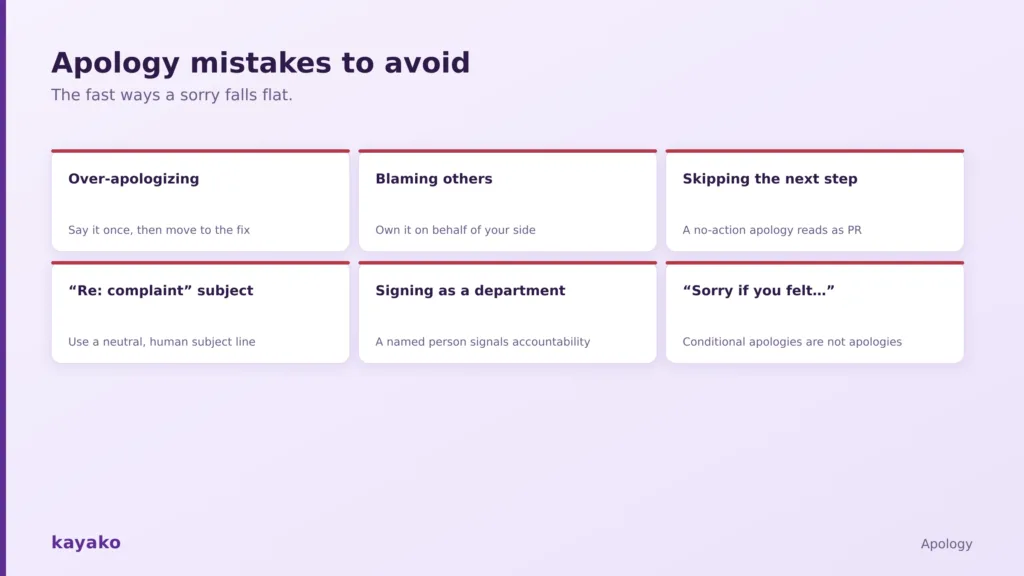
The fast ways a sorry falls flat
- Over-apologizing. Once you’ve named it and said sorry, move to the fix. Looping the apology dilutes it.
- Blaming others. The recipient doesn’t care which department dropped the ball. Own it on behalf of your side.
- Skipping the next step. A no-action apology reads as public relations. The repair is what makes it real.
- Using “Re: complaint.” Use a neutral subject like “Following up on your order” or “Apology for the delay.”
- Signing as a department. A real human name signals real accountability.
- Conditional apologies. “Sorry if you felt…” is not an apology. Drop the “if.”
Apology letter checklist
Before you hit send, run through this:
- Does the subject line make sense without context?
- Have you used the recipient’s name?
- Is the apology in the first one or two sentences?
- Is your reason one sentence, not three?
- Is there a concrete repair, not just a promise?
- Does it say how this won’t happen again?
- Is it signed by a named human, not a department?
- Read it aloud: does it sound like you, or like a template?
How support teams handle apologies at scale
For a support team, an apology is not a one-off; it is a daily task across many customers, and consistency is what protects the relationship. Getting it right pays off: research on complaint handling shows a large share of customers will stay, and even withdraw a complaint, when a situation is handled well, while most will not return after a poorly handled one. Personalization is central, and according to BCG, more than 80% of customers expect and reward communication that feels written for them.
This is where a support platform helps. Kayako keeps every customer’s full history on one record, so an apology references the actual order, ticket, and prior messages rather than a generic “Dear Customer,” and its AI can draft an on-brand apology in seconds that an agent personalizes and sends. If you write apologies often, see our guides to saying no to customers and customer communication management, which cover the surrounding conversations where tone matters most.
| Make every customer apology personal and fast with Kayako |
Frequently asked questions
How do you write an apology letter?
Open with the recipient’s name, acknowledge the mistake in the first one or two lines, give one honest reason, offer a concrete repair, and state what you’re changing so it won’t happen again. Sign off with your name and contact, and read it aloud before sending. If it sounds like a template, rewrite it in your own voice. The repair, not the apology itself, is what rebuilds trust.
What is the format of an apology letter?
An apology letter has seven parts: a clear, neutral subject line; a personal greeting; an acknowledgment of the mistake up front; one honest reason; a concrete repair; a commitment to improve; and a warm, signed close. Keep the apology in the first one or two sentences and the reason to a single line, since a longer explanation starts to read as an excuse.
What are the 5 R’s of an apology?
The 5 R’s are Regret, Responsibility, Rationale, Repair, and Request. Regret names the harm, responsibility owns it, rationale briefly explains what went wrong, repair offers a concrete fix, and request asks to rebuild the relationship. The most common reason an apology fails is skipping one of the five, usually the repair. A shorter 4 R’s variant folds Request into Repair.
How do you start an apology letter?
Start with the recipient’s name, then acknowledge the mistake in the very first line. Avoid warming up with small talk or a long preamble; a reader who is owed an apology wants to see it immediately. A neutral subject line such as “Apology for the delay” sets the right tone, while “Re: complaint” starts the message on the wrong foot.
How do you apologize to a customer professionally?
Use a formal structure: a neutral subject line, the customer’s name, a clear acknowledgment of what went wrong, one honest reason, and a concrete repair such as a refund, replacement, or fix. Commit to a specific change, and sign with a named person, not a department. Reference the specific order or ticket so the apology reads as personal rather than a generic template.
What should you not say in an apology?
Avoid conditional apologies like “sorry if you felt that way,” which pass the blame to the reader. Don’t over-explain or offer three reasons, since that reads as an excuse, and don’t blame another team. Skip “Re: complaint” subject lines and department-only sign-offs. Above all, don’t apologize without a concrete next step, because a no-action apology reads as public relations.