Customer Service Interview Questions and Answers (2026)
| Customer service interview questions test empathy, problem-solving, communication, and composure under pressure. The most common is “Tell me about a time you dealt with a difficult customer.” Answer behavioral questions with the STAR method (Situation, Task, Action, Result) and a real story, and always land on a concrete result. |
Key takeaways
|
A customer service interview is not about proving you are nice. Hiring managers want evidence that you can calm a frustrated customer, solve a problem quickly, work with a team, and stay composed under pressure. This guide covers the questions you will actually face in 2026, organized by type, with sample answers, the STAR framework for behavioral questions, smart questions to ask the interviewer, and how to prepare.
What customer service interviewers are really assessing
Almost every question maps to one of six qualities. Knowing which one a question is testing helps you answer it well.
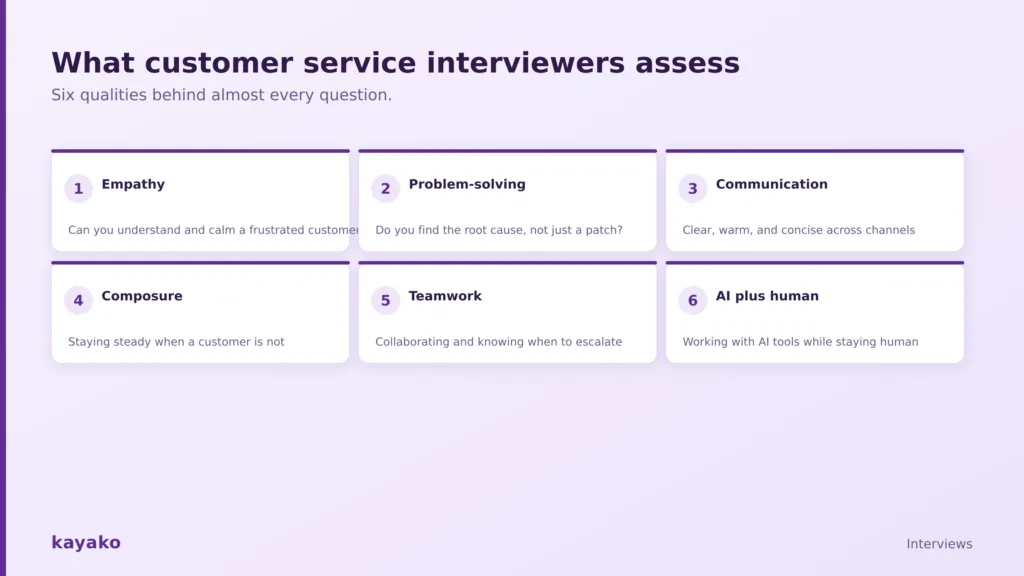
Six qualities behind almost every question.
Empathy, problem-solving, communication, composure, and teamwork are the timeless ones. The newest, in 2026, is comfort working alongside AI: companies now run AI chatbots and assistants beside human agents, so they want people who use those tools well while bringing the empathy and judgment AI cannot.
How to answer behavioral questions with the STAR method
Many of the toughest questions are behavioral, starting with “Tell me about a time.” The STAR method keeps your answer focused and shows exactly how you think and act.
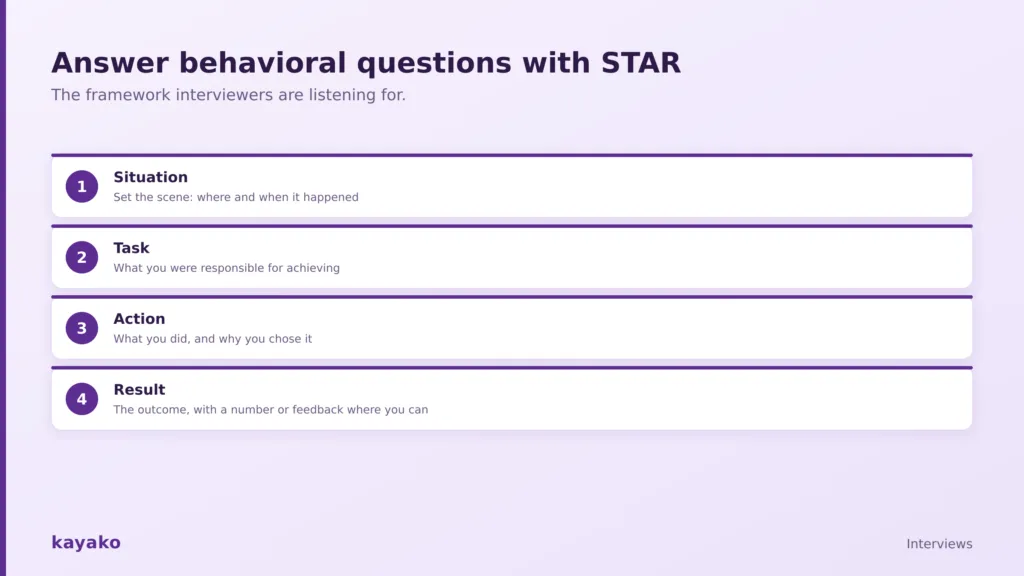
The framework interviewers are listening for.
Before the interview, prepare five to seven real stories from past roles, projects, or volunteering that show empathy, problem-solving, conflict resolution, and teamwork. Each can be reshaped to fit several questions. Keep a STAR answer to about a minute, and always end on a concrete result, ideally with a number or a piece of customer feedback.
Common customer service interview questions and answers
These general and motivation questions open most interviews. Keep answers specific to the company and the role.
Tell me about yourself
Why they ask: It sets the tone and shows how you frame your own story.
Cover your relevant background, your top strengths for this role, and genuine interest in the company. Keep it under a minute and focused on what you bring.
| Sample answer: “I have spent three years in frontline support, most recently handling email and chat for a SaaS product. I am known for calm de-escalation and fast, accurate answers, and I raised my team’s satisfaction scores by keeping replies clear and personal. I am excited about this role because your product serves a customer base I would genuinely enjoy helping.” |
Why do you want to work in customer service?
Why they ask: It reveals whether you are motivated by helping people or just looking for any job.
Connect a genuine motivation to the value the role creates: solving problems, building loyalty, and representing the brand well.
| Sample answer: “I enjoy solving problems and seeing the immediate result of helping someone. Turning a frustrated customer into a loyal one is satisfying, and I like that good support directly strengthens the business. The human connection is what keeps me in this work.” |
What does excellent customer service mean to you?
Why they ask: It tests your values and understanding of the role. This is the second most common question.
Define it as empathy, clear communication, speed, and consistency, then explain why it matters.
| Sample answer: “Excellent service is empathy, clear communication, speed, and consistency working together. It means understanding what the customer needs, being clear about how you will help, responding quickly, and delivering that same quality every time. Customers remember how you made them feel, so consistency is what earns loyalty.” |
How do you handle stress and pressure?
Why they ask: High-volume, high-emotion moments are part of the job; they want to see you stay effective.
Describe a concrete method and where you have used it.
| Sample answer: “I prioritize by urgency, and I take short resets between tough interactions, even 30 seconds to breathe. During holiday peaks, I used this to stay calm and clear-headed, which kept my service quality steady instead of slipping as volume rose.” |
What would you do if you did not know the answer to a customer’s question?
Why they ask: Honesty and resourcefulness matter more than pretending to know everything.
Be honest, find the answer, and follow up. Emphasize accuracy over speed.
| Sample answer: “I would tell the customer honestly that I want to get them the right answer, then check our knowledge base or ask a colleague. I would give a clear timeline and actually follow up. A wrong answer wastes everyone’s time and erodes trust, so I prioritize getting it right.” |
| Hiring support agents? Give them a platform they will love, with Kayako |
Behavioral customer service interview questions
Behavioral questions predict future performance from real past experience. Answer each with a STAR story.
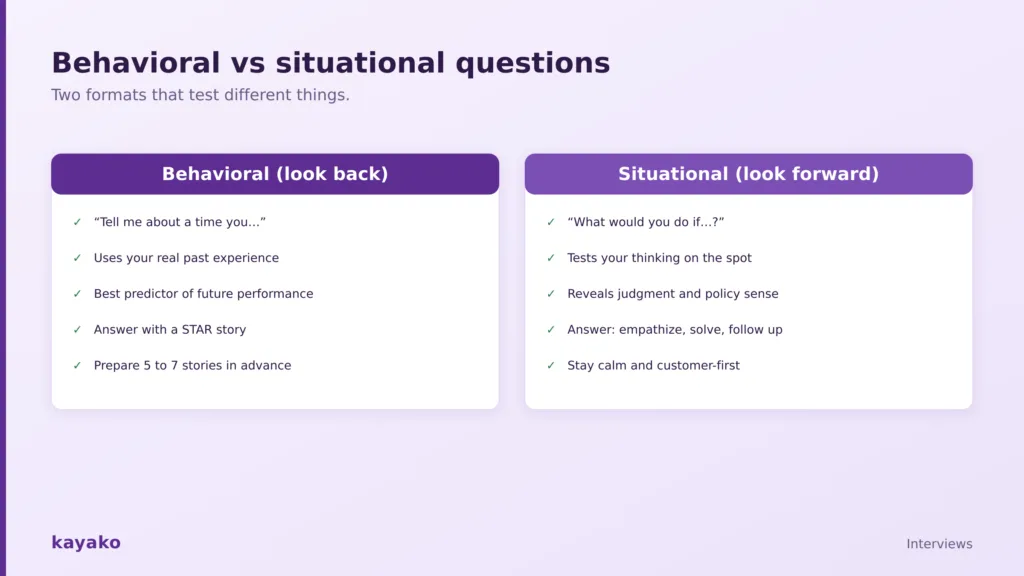
Two formats that test different things.
Tell me about a time you dealt with a difficult or angry customer
Why they ask: This is the single most common customer service interview question, because managing frustration is a daily reality.
| Sample answer: “A customer called upset about a delayed shipment for an event the next day. I let him explain fully so he felt heard, apologized sincerely, and looked into it, finding a system error on our side. I arranged expedited shipping at no cost and a small credit, then followed up the next day to confirm it arrived. He stayed a customer and thanked the team in writing. It taught me that empathy plus fast ownership turns a complaint into loyalty.” |
Tell me about a time you went above and beyond for a customer
Why they ask: It shows initiative and how you define good service.
| Sample answer: “A customer’s gift order arrived damaged two days before a birthday. I expedited a replacement overnight at no charge and added a handwritten note. It arrived in time, and she emailed to say we had saved the day. It mattered because we kept a loyal customer who could easily have switched.” |
Describe a time you turned a negative experience into a positive one
Why they ask: Service recovery is a core skill; they want to see you can rebuild trust.
| Sample answer: “A customer received the wrong product and needed it for an event the next day. I apologized, confirmed the correct item, and arranged same-day delivery, then checked in the following day. She was impressed enough to leave a five-star review and become a repeat buyer. Acting fast and owning the mistake made the difference.” |
Tell me about a time you had to enforce a policy you disagreed with
Why they ask: It tests professionalism, judgment, and how you balance rules with the customer.
| Sample answer: “A customer wanted a refund outside our return window. I empathized first, explained the policy and the reason for it, then offered a discount on a replacement and store credit. She appreciated that I worked to help within the rules. I also flagged the recurring complaint to my manager, since the pattern suggested the policy was worth revisiting.” |
Situational customer service interview questions
Situational questions ask what you would do in a hypothetical. Walk through your process: empathize, solve within guidelines, and follow up.
What would you do if a customer asked for a refund against policy?
Lead with empathy, explain the policy and why it exists, then offer alternatives like store credit or an exchange. If the case is genuinely exceptional, escalate to a manager. The goal is a solution that respects the policy while still helping. Our guide to
How would you handle a customer who is wrong?
Correct them respectfully without making them feel foolish: “I can see why that is confusing; here is how it actually works,” then offer the right solution. Tone and word choice preserve their dignity while getting to the correct outcome.
How do you prioritize when several customers need help at once?
Assess urgency first, then complexity. Handle quick wins immediately, give more complex issues a clear timeline and ongoing updates, and keep everyone informed so no one feels forgotten. Naming the tools you would use to track it, such as a shared inbox or ticketing system, strengthens the answer.
Skills and technical questions
These check whether you can use the tools of modern support and adapt to new ones.
What experience do you have with customer service software?
Why they ask: Fast ramp-up on the team’s tools saves training time.
Name the platforms you have used, such as a help desk or CRM like Zendesk, Salesforce, Freshdesk, or Kayako, and emphasize that you learn new tools quickly. If the company runs live chat, email, and phone, mention that you understand a multichannel workflow. In 2026, add that you are comfortable working alongside [object Object] while keeping answers human.
| Sample answer: “I have used a help desk daily to manage tickets, track interactions, and pull response-time reports, and I was fully proficient within my first week on a new one. I am comfortable with AI-assisted replies too, using them to move faster while making sure the final message still sounds personal.” |
Questions to ask the interviewer
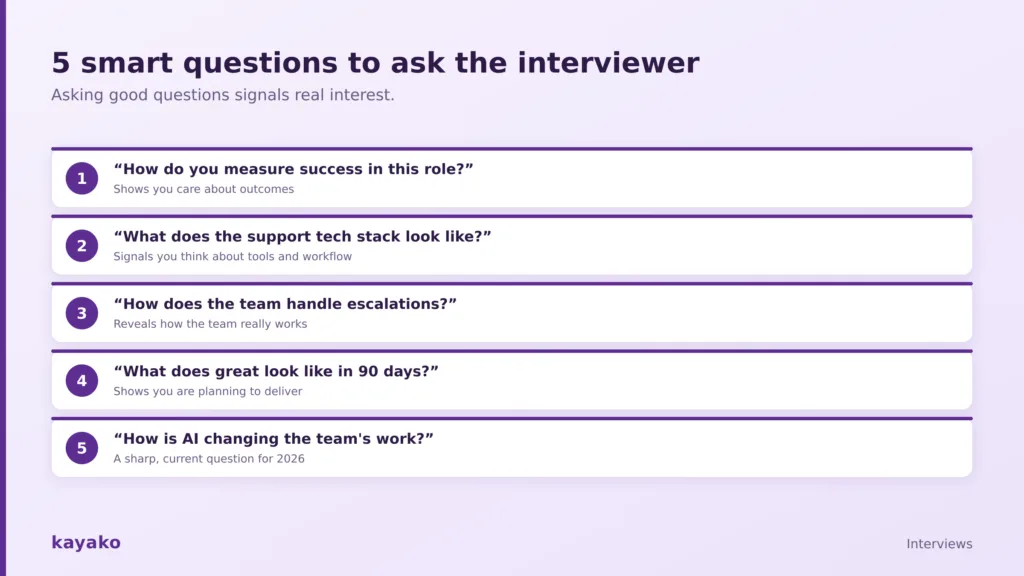
An interview runs both ways. Asking thoughtful questions signals genuine interest and preparation, and it helps you judge the role.
Asking good questions signals real interest.
Good options include how the team measures success, what the support tech stack looks like, how escalations are handled, what great performance looks like in the first 90 days, and how AI is changing the team’s work. Avoid asking only about salary and time off in the first interview.
How to prepare for a customer service interview
Preparation is what separates a confident candidate from a nervous one. A tight checklist:
- Research the company. Learn what they sell, who they serve, and, if you can, test their support channels yourself.
- Match the job description. Note the required skills and prepare stories that map to each.
- Draft 5 to 7 STAR stories. Cover empathy, problem-solving, conflict, and going above and beyond.
- Practice out loud. Rehearsing beats re-reading; record yourself to catch filler and length.
- Prepare your questions. Have three or four ready for the interviewer.
- For remote interviews, test your camera, mic, and connection, and set up a quiet, tidy space with a backup plan.
For hiring managers: what to look for
If you are on the other side of the table, the best answers share a pattern: a specific example, ownership of the outcome, empathy for the customer, and a concrete result. Behavioral questions predict on-the-job performance far better than hypotheticals, so weight the [object Object] story heavily, and probe with follow-ups on the same example to test whether it is real.
It also helps to hire for the environment your agents will work in. Great candidates ramp faster and stay longer when the tools do not fight them, so the platform your team uses is part of the hiring pitch. Kayako gives agents every customer’s full history on one screen and an AI agent that handles routine tickets, so new hires spend their energy on the human conversations you hired them for rather than hunting for context. You can see the approach on Kayako’s AI customer support page.
|
Frequently asked questions
What are the most common customer service interview questions?
The most common include “Tell me about a time you dealt with a difficult customer,” “What does excellent customer service mean to you?”, “Tell me about a time you went above and beyond,” and “Why do you want to work in customer service?” Most interviews include 8 to 15 questions across motivation, behavioral, situational, and skills categories, with the difficult-customer question appearing in nearly every one.
How do I answer behavioral customer service interview questions?
Use the STAR method: describe the Situation, the Task you were responsible for, the Action you took, and the Result you achieved. Pick a real example with a positive or instructive outcome, keep it to about a minute, and end on a concrete result, ideally with a number or customer feedback. Prepare five to seven flexible stories in advance.
How do I prepare for a customer service interview with no experience?
Draw on transferable experience from school, volunteering, part-time work, or projects where you helped people, solved problems, or handled conflict. Frame those with the STAR method just like work stories. Emphasize communication, empathy, and a willingness to learn, and show you have researched the company and understand what the role involves.
How do you answer “Tell me about yourself” in a customer service interview?
Give a focused, under-a-minute summary: your relevant background, the strengths that fit this role, and genuine interest in the company. Keep it professional and tied to the job rather than personal history. Think of it as a short trailer that makes the interviewer want to ask more about your best examples.
What questions should I ask at the end of a customer service interview?
Ask how the team measures success, what the support tools and workflow look like, how escalations are handled, and what strong performance looks like in the first 90 days. A question about how AI is changing the team’s work is especially sharp in 2026. Good questions show genuine interest and help you decide whether the role fits you.
Meta title: Customer Service Interview Questions and Answers (2026)
Meta description: Common customer service interview questions with sample answers, organized by type, plus the STAR method, situational and skills questions, smart questions to ask, and how to prepare.
Suggested slug: /blog/customer-service-interviews-questions (rework in place)