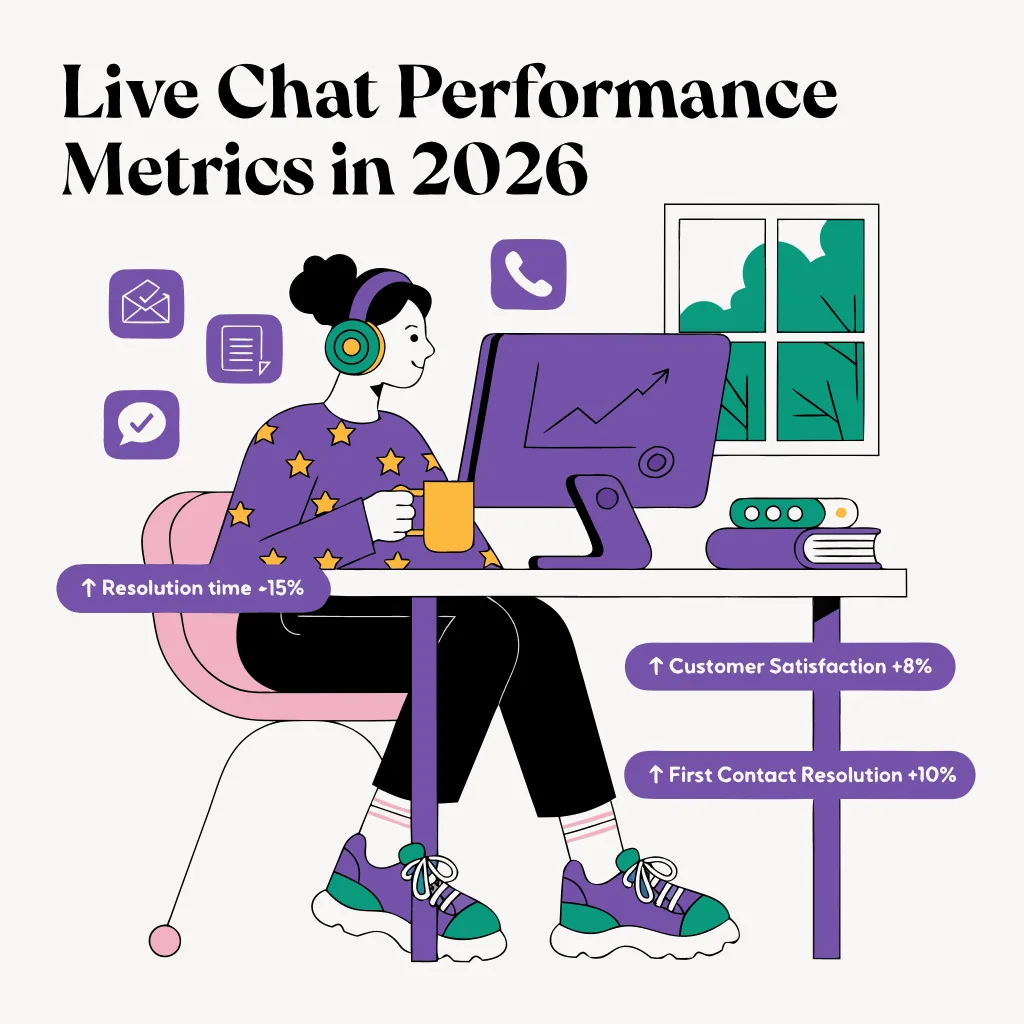
Most support teams track live chat metrics. Far fewer track the right ones, and fewer still use them to make decisions that can help their business succeed. 73% of customers report the highest satisfaction with live chat over any other support channel. But satisfaction scores only stay high when the underlying metrics are actively managed.
Live chat performance metrics are not a reporting exercise. They’re the operational signals that tell you whether your support team is scaling efficiently, burning out, or quietly leaking revenue through abandoned conversations and repeat contacts. Getting them right by measuring correctly, benchmarking against industry data, and acting on what the numbers surface is the difference between a support operation that grows with your business and one that becomes a liability.
This guide covers the metrics that matter, how to measure them precisely, how to use them to evaluate and develop agents, and how AI is reshaping what good performance looks like in 2026.
Why Live Chat Metrics Are Different From Other Support Channel Metrics
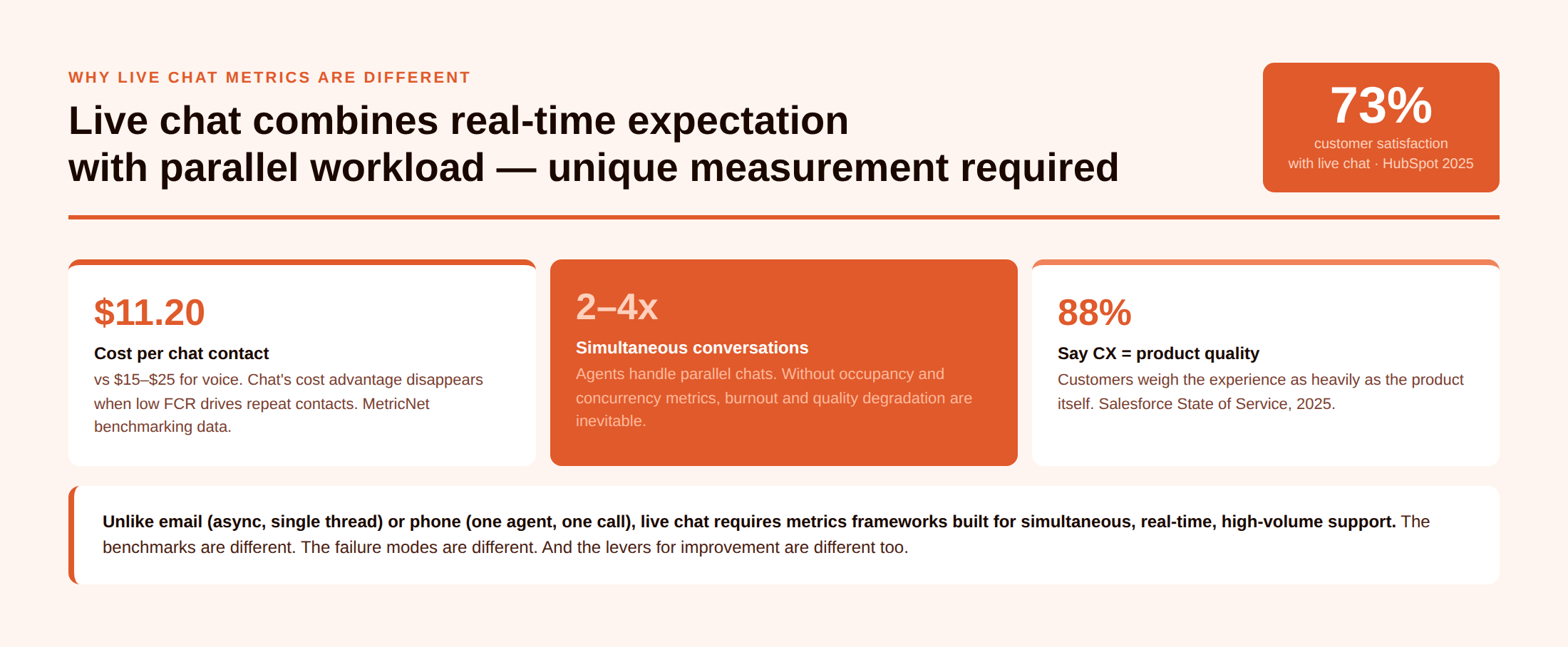
Live chat is the only support channel that combines real-time expectation (customers expect immediate responses) with parallel workload (agents handle 2–4 conversations simultaneously). That combination makes live chat metrics uniquely important and uniquely easy to misread.
79% of businesses say live chat positively impacts revenue, sales, and customer loyalty (Go Squared, 2025). But those gains only materialize when the channel is managed with the right data. Chat contacts cost on average 76% of phone support. The cost advantage of chat disappears the moment low first contact resolution drives customers back for repeat contacts.
Unlike email, where a 12-hour response window is expected, or phone, where one agent handles one call, live chat requires metrics frameworks designed for simultaneous, real-time, high-volume support. The benchmarks are different. The failure modes are different. And the levers for improvement are different, too.
Kayako’s support experts will show you exactly which metrics are leaking revenue in your operation → Book Free Audit
The 6 Core Live Chat Performance Metrics Categories
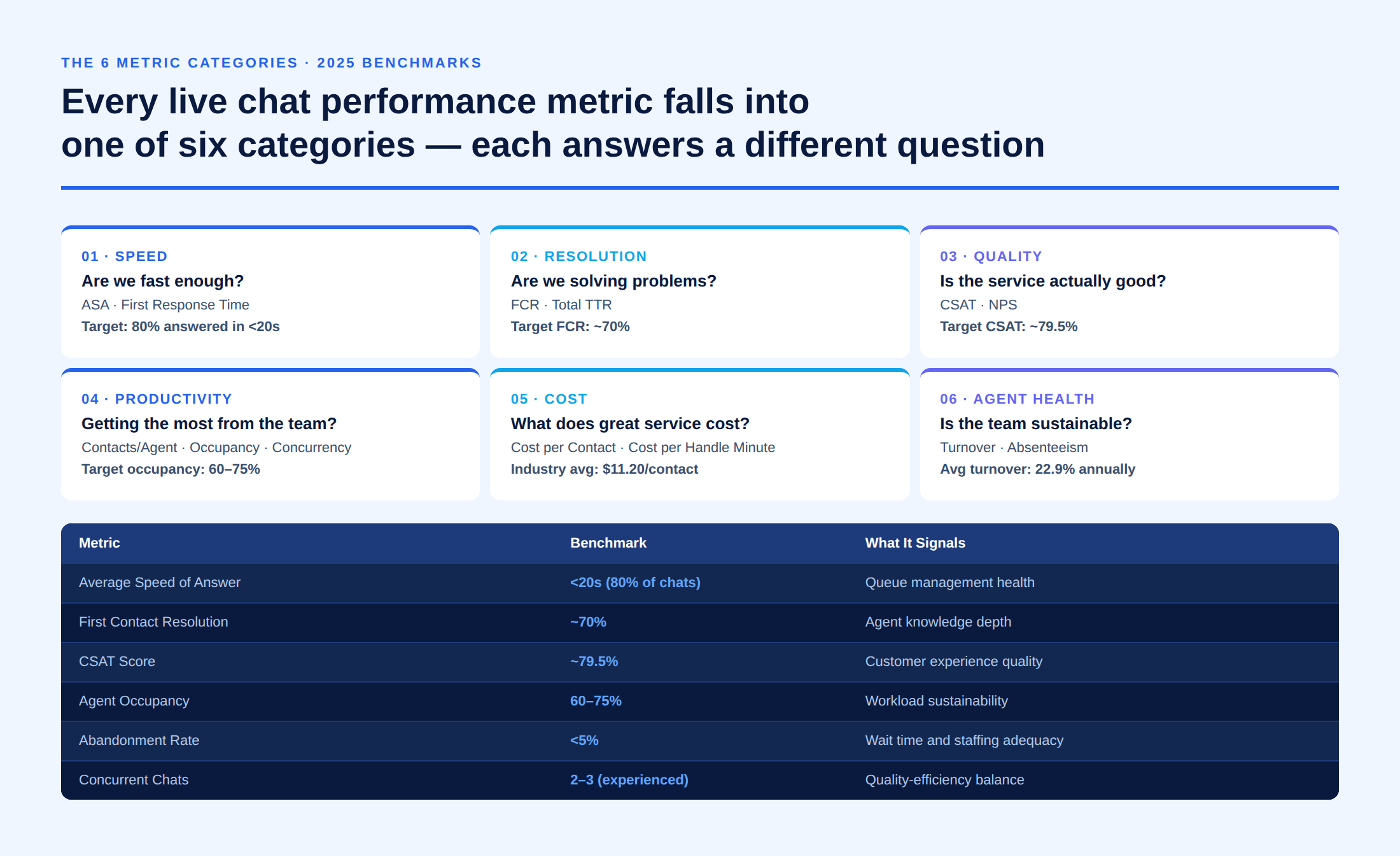
Live chat metrics fall into six categories. Each answers a different operational question. Tracking all six gives you a complete picture. Tracking only one or two creates blind spots.
1. Speed Metrics: Are You Fast Enough with Consistency?
Average Speed of Answer (ASA) is how long customers wait in the queue before an agent picks up. The industry target is 80% of chats answered within 20 seconds. Consistently missing this threshold drives abandonment, and abandoned chats represent lost revenue, not just missed contacts.
First Response Time measures the time to the agent’s first message once the chat is accepted. This shapes first impressions more than any other metric. Customers judge quality within the first exchange, and 90% say the experience a company provides is as important as its products.
Measuring ASA correctly: four rules most teams violate:
- Start the clock at queue entry, not message send. The moment the customer enters the queue, not when they type.
- Exclude off-hours queued chats. Overnight queued chats distort ASA if your team is only staffed 9 am–6 pm.
- Track bot response time and human response time separately. Blending them masks both.
- Use weekly and monthly trends, not daily snapshots. Daily spikes are noise; trends are signal.
2. Resolution Metrics: Are You Actually Solving Problems?
First Contact Resolution (FCR) is the metric that separates support operations that scale from those that spiral. It measures the percentage of issues resolved on the first chat with no follow-up, no reopened ticket, and no second contact. GlowTouch’s industry benchmarks put strong FCR at around 70%. High FCR directly reduces cost per contact, improves CSAT scores, and reduces agent workload.
Total Time to Resolution (TTR) captures the full customer journey, from first contact to complete resolution, including escalations, reopened tickets, and follow-up interactions. It’s the metric that reveals actual customer effort, not just agent speed.
“96% of customers who experience a high-effort interaction become disloyal, compared to only 9% who have a low-effort experience.” — Harvard Business Review
The most common measurement mistake is optimizing AHT (Average Handle Time) without watching FCR. Agents who close chats fast but generate repeat contacts are not efficient; they’re expensive. A 14-minute AHT with 78% FCR will always outperform a 5-minute AHT with 42% FCR. See our full breakdown of why AHT is a misleading metric when used in isolation.
3. Quality Metrics: Is the Service Actually Good?
Customer Satisfaction Score (CSAT) is collected via post-chat survey immediately after the interaction. Strong live chat teams average 79.5% CSAT (GlowTouch). Survey immediately — not 24 hours later — for accurate emotional recall and higher response rates. Keep surveys to one or two questions to avoid fatigue.
Net Promoter Score (NPS) measures long-term loyalty, for instance, the likelihood a customer would recommend your brand after a chat interaction. Unlike CSAT, which measures momentary satisfaction, NPS captures whether the experience built lasting trust. Used alongside CSAT, it provides a complete picture of customer experience quality.
4. Productivity Metrics: Are We Getting the Most From Our Team?
Contacts per Agent per Month is your baseline productivity metric. Industry benchmarks sit at 714 chats per agent monthly.
Agent Utilization/Occupancy is the share of logged-in time an agent spends actively in chats versus idle. GlowTouch research puts the industry sweet spot at 60–75% occupancy: productive enough to justify headcount, sustainable enough to maintain quality. Below 60%: you’re overstaffed. Above 85%: you’re burning people out and degrading satisfaction scores. Neither extreme is safe.
Concurrent Chats is the number of simultaneous conversations one agent handles. New agents: 1. Experienced agents: 2–3. Top performers: up to 4. This should be built into your routing logic, not just your agent guidelines. For a framework on developing concurrent chat skills across your team, see our dedicated guide.
5. Cost Metrics: What Is Great Service Actually Costing?
Cost per Contact is the total support spend divided by total chats handled. This is your most direct signal of financial sustainability. When FCR is low, the cost per contact rises because each unresolved contact becomes two or three contacts. When AI handles routine volume, cost per contact drops without any quality sacrifice.
The ROI calculation is direct: GlowTouch clients report up to 250% ROI by aligning cost and quality metrics intelligently. Gartner research shows AI-enabled customer service can reduce costs by up to 30% while simultaneously improving satisfaction.
6. Agent Health Metrics: Is the Team Sustainable?
Agent metrics are the leading indicators that predict every other metric’s future. Annual agent turnover averages 22.9% across the industry, and daily absenteeism runs around 8% on any given day (GlowTouch benchmarking). Every new agent brings a quality dip during onboarding. High turnover cascades directly into lower FCR, higher AHT, and reduced CSAT because experienced agents resolve issues faster and more completely than newer ones.
If occupancy is spiking and absenteeism is rising simultaneously, you don’t have a lazy team. You have a structural staffing problem.
Live Chat Performance Benchmarks — As per 2025
| Metric | Benchmark | What It Signals |
| Average Speed of Answer (ASA) | < 20 seconds (80% of chats) | Queue management and staffing health |
| First Contact Resolution (FCR) | ~70% | Agent knowledge depth and empowerment |
| CSAT | ~79.5% | Customer experience quality |
| Average Handle Time (AHT) | 10–15 minutes | Efficiency — never in isolation |
| Agent Occupancy | 60–75% | Workload sustainability |
| Abandonment Rate | < 5% | Wait time and staffing adequacy |
| Concurrent Chats | 2–3 (experienced agents) | Quality-efficiency balance |
| Cost per Contact | ~$11.20 | Financial efficiency of the channel |
How to Evaluate Agent Performance With Live Chat Metrics
Metrics-based agent evaluation works when the data is used to coach, not to punish. Here’s the framework.
FCR by Agent: Your Most Powerful Development Tool
Individual FCR rates reveal whether agents understand your product and processes deeply enough to resolve issues on first contact. An agent consistently below 50% FCR likely has one of three problems: knowledge gaps, wrong ticket assignment, or insufficient authority to resolve issues independently. FCR by agent is the most direct input to a targeted customer service coaching program.
CSAT by Agent: The Voice of the Customer, Personalized
Post-chat CSAT by individual agent captures communication quality, empathy, and resolution style in ways that quantitative metrics alone cannot. Use it to identify your highest performers and to model what good looks like across the rest of the team. High-CSAT agents have transferable practices; low-CSAT agents have diagnosable gaps.
Occupancy and Concurrency: The Efficiency Balancing Act
Track both together. High occupancy with high concurrent chat load and declining CSAT means agents are overloaded. High occupancy with strong FCR and stable CSAT means the workload is well-matched to capability. Neither number in isolation tells the full story.
How AI Is Reshaping Live Chat Performance Metrics in 2026
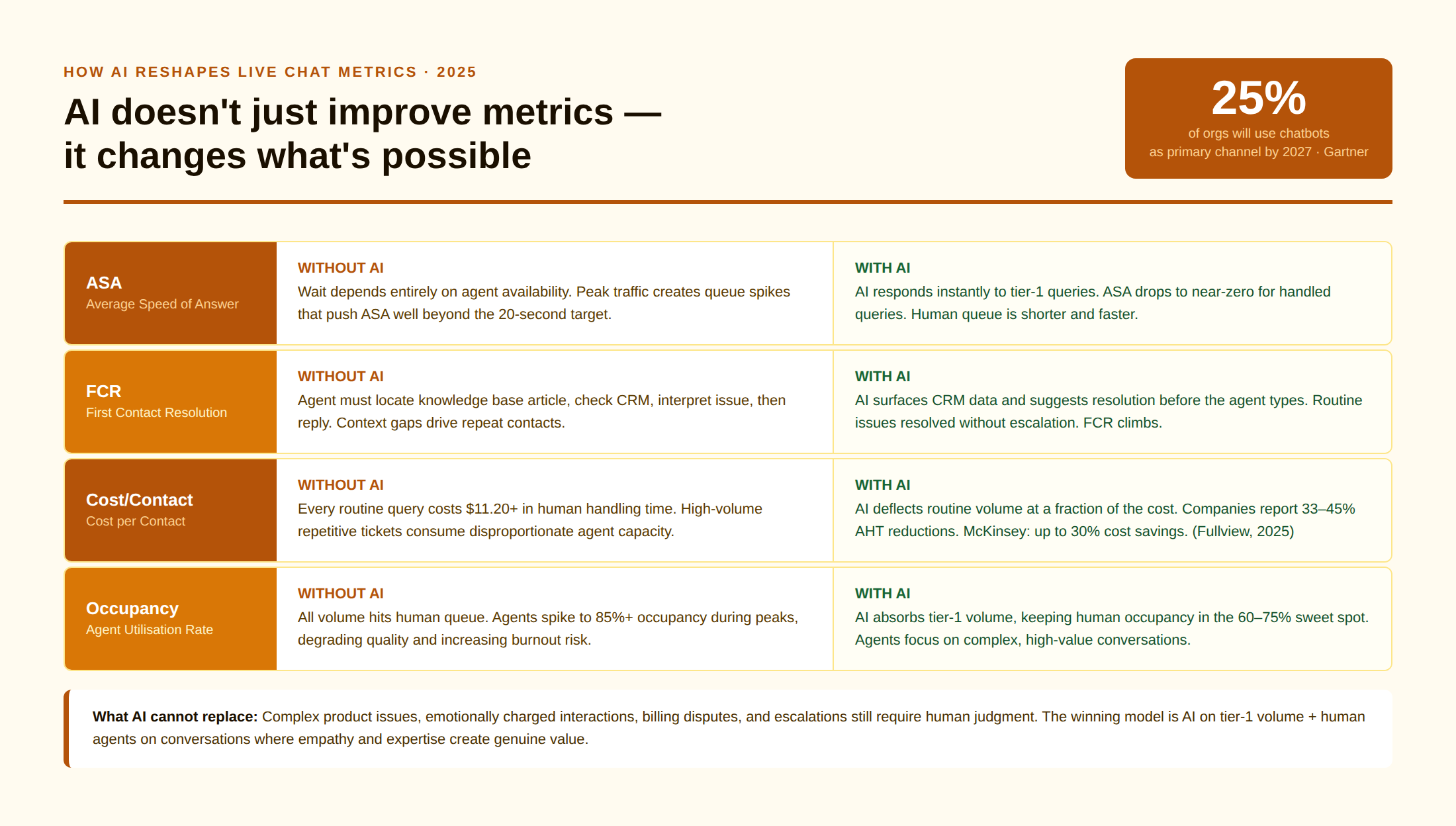
AI doesn’t just improve metrics, it changes what’s possible. Gartner predicts that by 2027, chatbots will be the primary customer service channel for 25% of organizations. The teams building AI-driven support operations now will have a structural advantage that compounds.
AI Reduces ASA Without Adding Headcount
AI agents respond instantly. For routine queries like order status, password resets, policy questions, and account lookups, AI handles first contact at zero wait time. This pulls ASA down across the board and frees human agents for complex, high-value conversations that genuinely require empathy and judgment.
AI Improves FCR Through Context
AI connected to CRM data, order management systems, and knowledge bases resolves common issues on first contact without escalation. This pushes FCR up for the queries AI handles, and also improves human agent FCR because AI can surface the relevant context, suggested next action, and knowledge base article before the agent types their first message. See how AI in customer service creates this compound effect.
AI Lowers Cost per Contact
Every routine query handled by AI is a human chat contact avoided. AI deflection at scale produces material cost reduction. Companies using AI in their live chat operations report 33–45% reductions in average handle time (Fullview, 2025). That’s not just a metrics improvement, it’s a P&L improvement.
What AI Cannot Replace: The High-FCR Agent
AI performs best on routine, well-defined queries. Complex product issues, emotionally charged interactions, billing disputes, and escalations still require human judgment. The winning model is AI handling tier-1 volume while human agents focus on conversations where their expertise and empathy create genuine customer value.
The 7 Best Live Chat Tools for Tracking and Improving Performance Metrics
The platform you use to run live chat determines how easily you can surface, act on, and improve your metrics. Here are seven tools worth evaluating.
1. Kayako
Best for: Support teams that need AI-driven metrics improvement with expert implementation. Kayako’s real-time KPI dashboard surfaces CSAT, ASA, and FCR in one view, alongside AI Agents that actively improve those numbers by handling routine volume. The 90-day pilot model means you start with one queue, prove ROI, and expand. Kayako is the only platform on this list that includes expert implementation as standard.
2. Zendesk
Best for: Enterprise teams with complex ticketing and reporting needs. Strong analytics suite, broad integrations, and a mature AI layer. Pricing compounds quickly at scale: per-seat fees plus AI add-ons can make the cost of ownership substantially higher than it appears.
3. Intercom
Best for: SaaS companies prioritizing proactive engagement and product-led support. Strong conversation routing, bot builder, and product tours. Better suited to customer success workflows than high-volume support operations.
4. Freshdesk
Best for: Mid-market teams looking for a balanced feature set at a lower entry price. Freddy AI provides basic automation. Reporting capabilities are solid but less granular than enterprise alternatives.
5. LiveChat
Best for: Teams that want a dedicated live chat tool with strong analytics. Best-in-class chat widget, agent performance dashboards, and CSAT collection. Integrates with most CRM and helpdesk platforms.
6. HubSpot Service Hub
Best for: Teams already using HubSpot CRM. The native integration creates a unified customer record across sales, marketing, and support, giving agents strong contextual data before each chat begins.
7. Tidio
Best for: Small businesses and e-commerce teams with lighter support volumes. Good chatbot builder and Shopify integration. Live chat metrics reporting is basic compared to enterprise alternatives, but accessible and quick to set up.
6 Proven Ways to Improve Your Live Chat Performance Metrics
Knowing the benchmarks is step one. Closing the gap between your current numbers and those benchmarks is where the real work happens.
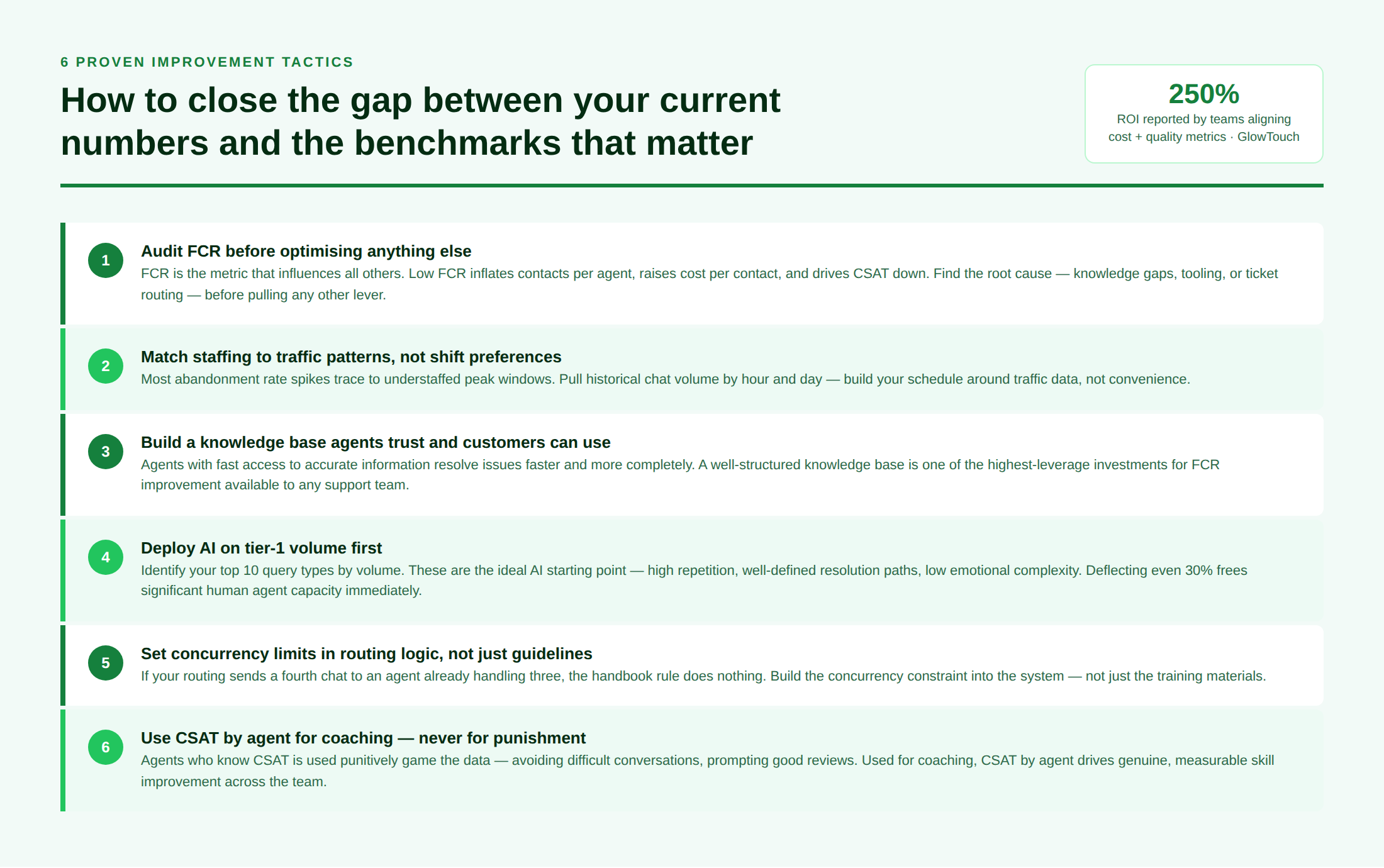
- Audit FCR before optimizing anything else. FCR is the metric that influences all the others. Low FCR inflates contacts per agent, raises cost per contact, and drives CSAT down. Find the root cause, like knowledge gaps, tooling, or ticket routing, before pulling any other lever.
- Match staffing to traffic patterns, not shift preferences. Most abandonment rate spikes trace to understaffed peak windows. Pull your historical chat volume by hour and day, and build your schedule around traffic, not convenience.
- Build a knowledge base that agents can trust and that customers can use. Agents with fast access to accurate information resolve issues faster and more completely. A well-structured knowledge base is one of the highest-leverage investments for FCR improvement.
- Deploy AI on tier-1 volume first. Identify your top 10 most common query types by volume. These are the ideal starting points for AI deflection: high repetition, well-defined resolution paths, and low emotional complexity. Deflecting even 30% of these frees significant human capacity.
- Set concurrency limits in your routing, not just your handbook. If your routing logic sends a fourth chat to an agent who already has three active conversations, the handbook rule doesn’t help. Build the constraint into the system.
- Use CSAT by agent for coaching, not performance management. Agents who know CSAT will be used to track their performance will ask customers to rate them favorably, avoiding difficult conversations. And if used for coaching, CSAT data drives genuine improvement. See how a customer service training program can be built around this data.
Live chat, owing to its instantaneous nature, is often the first channel for customers to engage. Though much like other support channels, live chat too needs to be under constant performance gauge to ensure that it contributes constructively with more happy customers compared to the unhappy ones. We hope that this guide helps you fine-tune your live chat methodology for sparkling results.
FAQs
1. What are the most important live chat performance metrics to track?
A. Start with three: ASA (wait time), FCR (resolution quality), and CSAT (customer satisfaction). These three surface the most critical operational problems fastest. Once stable, layer in occupancy, concurrent chats, and cost per contact for the full picture.
2. What is a good FCR rate for live chat?
A. Industry benchmarks from GlowTouch put a strong FCR at around 70%. Teams below 50% almost always have a knowledge base or ticket routing problem. Teams above 80% are either handling simpler-than-average query types or have exceptional agent training.
3. How many concurrent chats should agents handle?
A. New agents: 1. Experienced agents: 2–3. High performers: up to 4. Overloading agents beyond their sustainable concurrency doesn’t improve efficiency; it just degrades FCR, extends AHT, and increases burnout.
4. How does AI affect live chat performance metrics?
A. AI reduces ASA to near-zero for handled queries, improves FCR by resolving tier-1 issues without escalation, and lowers cost per contact by deflecting routine volume. Human metrics such as CSAT on complex interactions, FCR on escalations typically improve too, because human agents are less overloaded and have better context when AI is doing the first-line work.