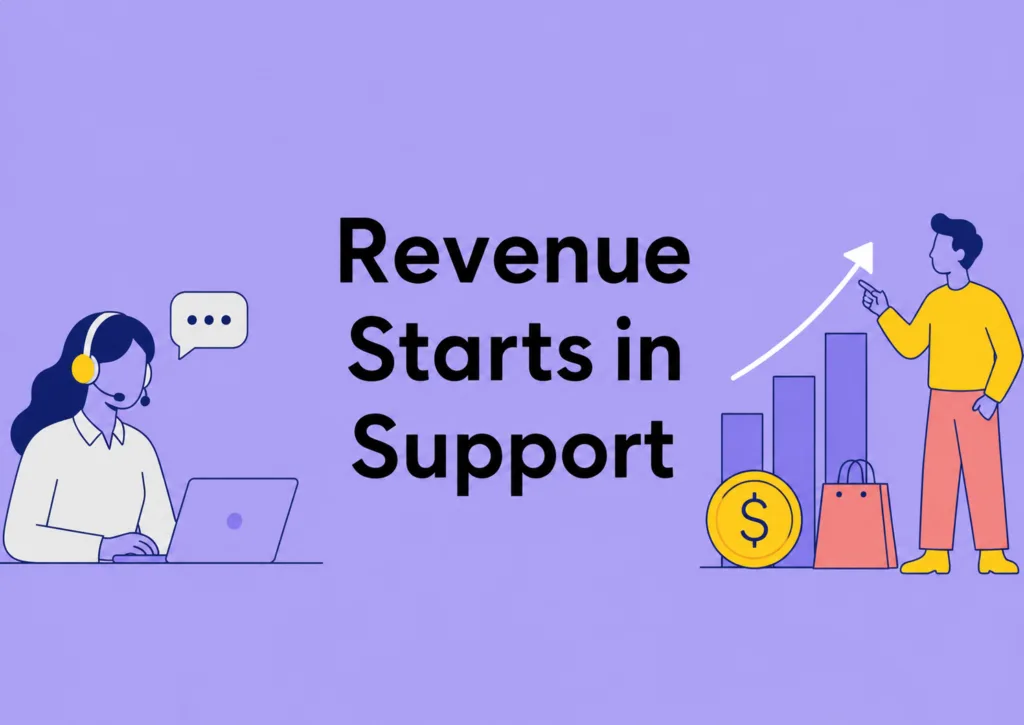
Support used to sit in the cost column. It was there to answer tickets, put out fires, and keep customers from getting too upset. If the queue stayed under control and response times looked good, things were working.
That model no longer holds up.
In subscription businesses, revenue is not won once and locked in. It is earned again and again after the sale. Customers stay when they get value fast. They grow when friction stays low. They leave when problems pile up and no one fixes the root cause.
So, support is much closer to revenue than most teams realize.
Every support conversation carries a signal. It can reveal churn risk, product confusion, upgrade potential, onboarding gaps, or a broken part of the customer journey.
After all, the best CX teams do more than solve issues. They protect renewals. They increase adoption. They surface opportunities the rest of the business would have missed.
In this post, let’s see how support is starting to look less like a cost center and more like a profit center.
Why Revenue Starts in Support
Not because agents are selling. And not because every conversation needs a commercial angle. But because support sits at the point where customer intent, product experience, and business outcomes meet.
Revenue does not stop at the point of sale. It depends on what happens next. Can the customer get value quickly? Can they use the product with confidence? Can they solve problems without hitting friction at every step?
Support shapes those moments. A fast, helpful interaction can prevent churn. A clear answer can improve adoption. A pattern in support tickets can expose a broken part of the customer journey before it turns into lost revenue.
That is the shift. Support doesn’t have to be there only to react. It can actually help protect retention, unlock growth, and improve the customer experience in ways that directly affect the bottom line.
The companies that understand this are changing how they measure CX. They still care about speed and efficiency. But they also ask bigger questions:
- Did this interaction reduce churn risk?
- Did it help the customer get to value faster?
- Did it uncover something that can drive retention or growth?
And so, support is no longer just there to close tickets. It is there to move the business forward.
What Changed: Visibility, Data, and AI Made Support Commercially Measurable
Support did not suddenly become more important. It became easier to measure.
Today, CX teams can see more than ticket volume. They can spot repeat issues, track sentiment, and connect support trends to churn, adoption, and retention.
AI helps too. It can summarize conversations, tag patterns, route issues faster, and surface signals humans might miss. It gives support more visibility across the business.
Instead of just closing tickets, teams can now show where customers get stuck, where they lose momentum, and where revenue is at risk. This shift toward outcome-based visibility mirrors what goal-setting frameworks have already uncovered. According to OKRs Tool, teams that focus on measurable outcomes rather than activities are significantly more effective at driving real business impact, yet many organizations still default to tracking outputs instead of results.
What’s more, as revenue operations have become more connected through platforms like DealHub, support has become easier to measure in commercial terms too. That is a big upgrade because now, support is no longer just operational, but a source of business insight.
Five Ways CX Teams Directly Influence Revenue
Here are five ways a well-oiled CX team can directly boost the bottom line.
1. They reduce churn
Most customers do not leave without warning.
They ask the same question three times. They hit the same blocker. They get stuck during onboarding. Support sees those signs first.
When teams catch that friction early, they can protect renewals before the account is gone.
2. They improve product adoption
Customers stay when they get value.
Support helps them get there faster. A good answer can unblock a workflow, explain a key feature, or turn a frustrating moment into progress.
That drives usage. And usage drives retention.
3. They uncover growth opportunities
Support teams hear what customers are trying to do. It shows when a customer has outgrown their current setup, needs a better workflow, or is ready for more advanced features.
That is not a hard sell. It is context the business can use.
4. They strengthen the customer journey
Every support issue points to something bigger.
Maybe the product is confusing. Maybe onboarding is weak. Maybe expectations were set badly during the sale.
Fixing those gaps improves the full customer journey, not just one ticket.
5. They generate insight other teams miss
Support sits closest to customer friction. They give CX teams a clear view of what is broken, what is unclear, and what keeps slowing people down.
When that insight reaches product, success, and leadership, the whole business gets better.
From Cost Center to Profit Center: What High-Performing Teams Do Differently
Cost-center support teams focus on output. They track tickets closed, queue size, and response times. Those metrics matter, but they only tell part of the story.
Profit-center CX teams look at outcomes too. They ask better questions. Did this interaction reduce churn risk? Did it help the customer adopt the product? Did it reveal a problem worth fixing at the source?
They also work differently: They share insights with product. They flag risk for success. They use automation for repetitive work. And they give agents more time to handle moments that actually shape customer value.
That is the difference: One team manages volume. The other helps drive retention, growth, and better customer outcomes.
The Metrics That Prove Support Drives Growth
If support wants a seat at the revenue table, it needs better proof.
Ticket volume and response time still matter. But they do not show business impact on their own.
The stronger CX metrics are tied to outcomes. Think churn after unresolved issues. Time to value for new customers. Repeat contact rate. Feature adoption after a support interaction. Even revenue at risk tied to open problems.
These numbers tell a better story. They show whether support is just handling demand, or actually helping customers stay, succeed, and grow.
A Practical Playbook For Support Leaders
Start small.
First, identify the support moments that affect revenue most. Onboarding issues, repeat complaints, billing confusion, and upgrade-related questions are good places to start.
Next, tag conversations by business impact, not just issue type. Is this a churn risk? An adoption blocker? A sign the customer needs more from the product?
Then share those patterns across teams. Product should see the friction. Success should see the risk. Leadership should see the trends.
Finally, adjust what the team is measured on. Keep the efficiency metrics. But add ones that reflect customer outcomes too.
That is how support becomes easier to trust as a growth function.
Wrapping Up
Revenue may not be booked in support. But it is often protected there.
Support is where customers go when value feels delayed, confusing, or at risk. That makes CX teams one of the clearest sources of insight in the business.
The best teams do more than close tickets. They reduce friction, protect retention, improve adoption, and help the rest of the company see what customers need next.
That is why support is changing. It is no longer just a service function. Done well, it becomes a growth function too.