What sales acceleration means, where deals actually stall, and how support conversations compress cycles before a rep ever gets involved.
Sales acceleration is usually sold as tooling. Sequencers, dialers, conversation intelligence, deal scoring. All of it aimed at helping reps do more of what they already do, faster.
That framing has a problem. Most of the time a deal spends being decided, no rep is present. Buyers research independently, form a preference, and only then make contact, which means the tools aimed at rep productivity are optimizing the shorter half of the process. The longer half belongs to whatever impressions the buyer picked up along the way, and a large share of those come from support: a trial user who got a fast answer, a colleague at another company who said the vendor was easy to deal with, a help center article that actually resolved the question.
This guide covers what sales acceleration means in practice, where deals genuinely stall, which support signals move them, and how to build the handoff so those signals reach someone who can act.
What Sales Acceleration Actually Means
Sales acceleration is the practice of reducing the time between a buyer’s first interest and closed revenue, without lowering deal quality or win rate.
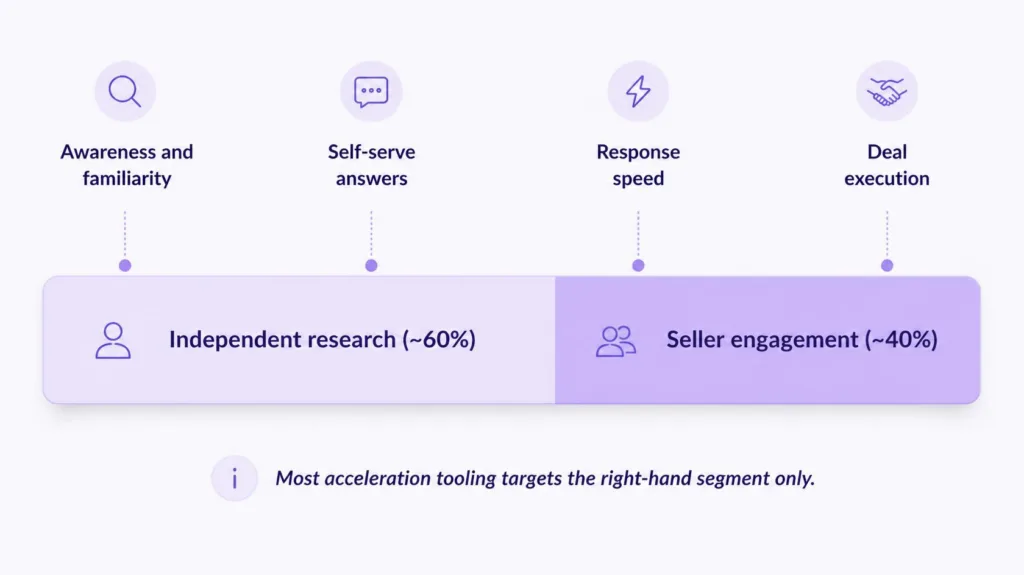
The qualifier matters. Compressing a cycle by disqualifying harder deals is not acceleration; it is scope reduction. Genuine acceleration means the same deals close sooner.
Four levers do the work, and they apply at different points.
Familiarity before contact
Being known and credible inside your market before a buyer starts evaluating. The earliest lever and the one with the longest lead time.
Friction removal during research
Making it easy to get real answers without talking to anyone. Documentation depth, transparent pricing, and accessible technical detail all belong here.
Response speed at first contact
The window between a buyer reaching out and a substantive reply. Short and unforgiving.
Execution during the deal
Security reviews, procurement, integration questions, pilot support. The stage where support involvement becomes explicit.
Notice that three of the four sit outside the sales team’s direct control, and support influences all three.
Where Deals Actually Slow Down
The evidence on this is specific enough to change where you spend money.
6sense’s 2025 Buyer Experience Report, based on responses from more than 4,000 buyers across North America, EMEA, and APAC, found that 94% of buying groups had ranked a preferred vendor before speaking to any seller, and went on to buy from that early favorite 77% of the time. The same research recorded average buying cycles compressing from roughly 11.3 months in 2024 to about 10.1 months in 2025, and the point of first contact moving earlier, from around 69% to 61% of the way through the evaluation.
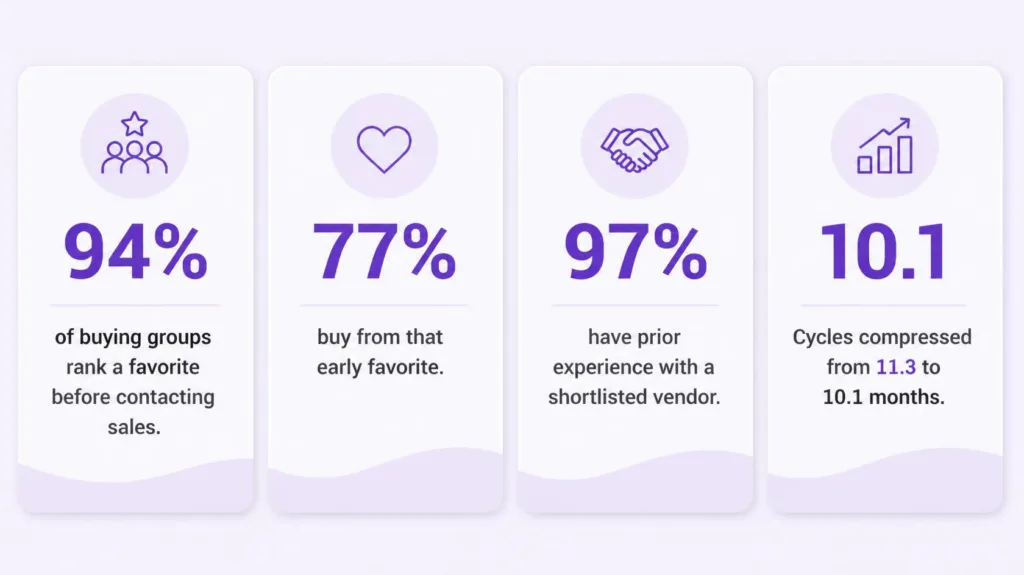
Two conclusions follow. First, the decisive period is before contact, so acceleration work aimed only at post-contact activity is arriving late. Second, buyers are now reaching out earlier than they used to, which means the pre-contact window is shorter and first-contact quality carries more weight.
Then there is the finding that most directly implicates support. 6sense found buyers report prior personal experience with at least one vendor on their shortlist 97% of the time. Prior experience is rarely a marketing asset. It is a trial, a previous employer’s implementation, or a colleague’s account of what the vendor was like to deal with when something broke.
The commercial context reinforces it. ChurnZero’s 2025 Customer Revenue Leadership Study, surveying 793 senior post-sale leaders, found 74% reporting that most revenue comes from existing customers, and Pavilion’s 2025 B2B SaaS benchmarks put the installed base at roughly 40% of new annual recurring revenue. Expansion is where a large share of growth sits, and expansion conversations begin in support far more often than in a sales sequence.
The Support Signals That Move Deals
Your support queue contains buying intent daily. Most organizations answer these messages accurately and route them nowhere.
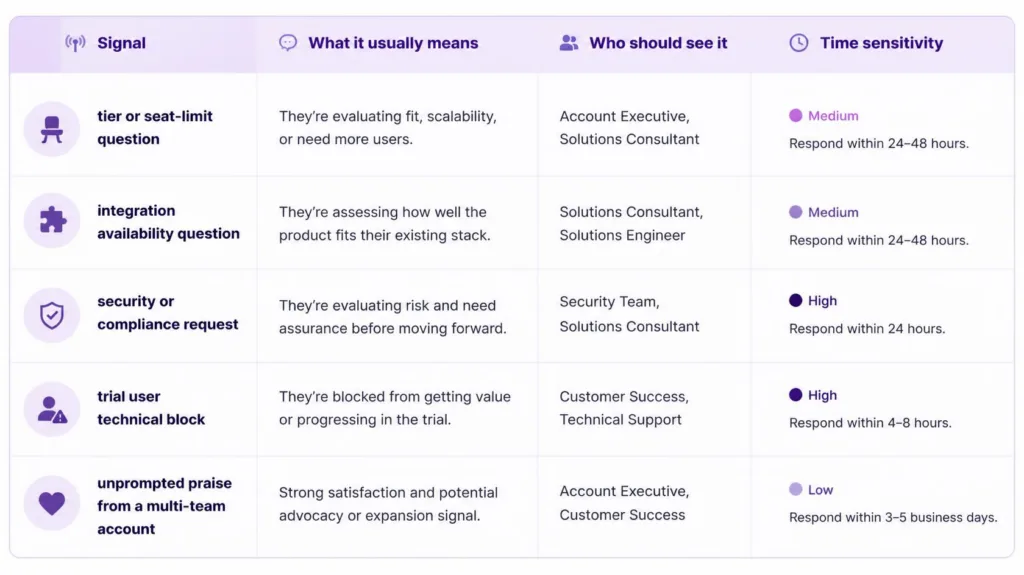
Tier and seat-limit questions
A customer asking whether a feature exists on a higher plan, or what happens past their seat cap, is describing a purchase they are considering. This is the single most under-routed signal in most helpdesks.
Integration availability questions
Someone asking whether you connect to a tool they just bought is telling you their stack changed. Stack changes are procurement events.
Security and compliance requests
Requests for SOC 2 reports, data residency detail, or DPAs almost always come from an evaluation in progress, frequently one your sales team does not know about. Response time here directly determines cycle length, since these reviews sit on the critical path.
Trial users blocked on something technical
A trial that stalls on a configuration problem is a deal dying quietly. These tickets deserve priority routing regardless of account value, because the cost of losing them is a whole deal rather than one interaction.
Unprompted praise from multi-team accounts
An enthusiastic message from someone at a large account is an expansion lead and a referral source. Understanding what a customer advocate does helps you structure that relationship rather than let it pass.
The common thread is that all five arrive in a support channel and require a commercial response. Whether they get one depends entirely on whether your customer support software is connected to the systems where deals live.
Building the Support-to-Revenue Handoff
The goal is a route from support conversation to deal owner that does not depend on an agent remembering to mention something.
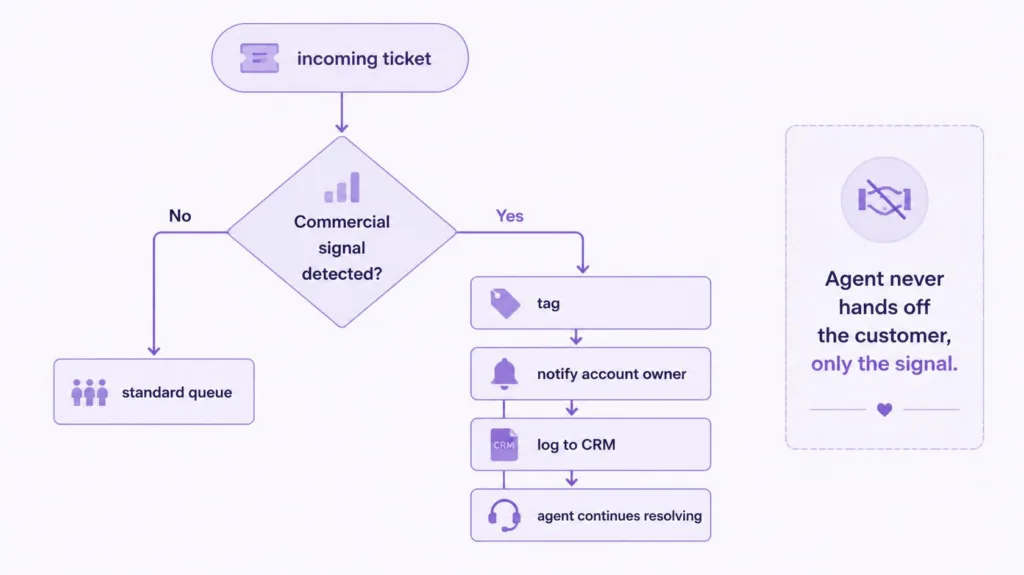
Tag the signal, do not transfer the customer
The mistake here is routing the customer to sales. That converts a helpful interaction into a pitch and damages trust. The agent resolves the issue as normal; the signal goes to the account owner separately.
Define the trigger list explicitly
Write down which questions constitute a commercial signal. Ambiguity means it does not happen. Five to eight well-defined triggers beat a general instruction to watch for opportunities.
Set a response clock on security and compliance requests
Treat these like a P1. A documentation request that takes six days to fulfill adds six days to a deal, and buyers notice which vendors are organized.
Give trial tickets their own queue
Separate SLA, separate ownership, ideally your most technically capable agents. The economics justify it easily.
Make deal context visible to agents
An agent who can see that an account is in an active evaluation answers differently, with more care about precision and follow-through. Continuity of context is what makes this work, and it is why keeping time to resolution low on these tickets matters more than on the general queue.
Instrument it
Count signals detected, signals routed, and signals that became pipeline. Without the last number, nobody will keep doing the first two.
Automation Is What Makes the Capacity Exist
None of the above happens in a queue that is permanently underwater. Agents buried in password resets do not notice that a customer just asked about enterprise pricing.
Salesforce’s seventh State of Service report, surveying 6,500 service professionals between April and June 2025, found AI is expected to resolve half of all customer service cases by 2027, up from roughly 30% today. The same research put the agent-side gain at about 20% less time spent on routine cases, returning an estimated four hours per week for more complex work.
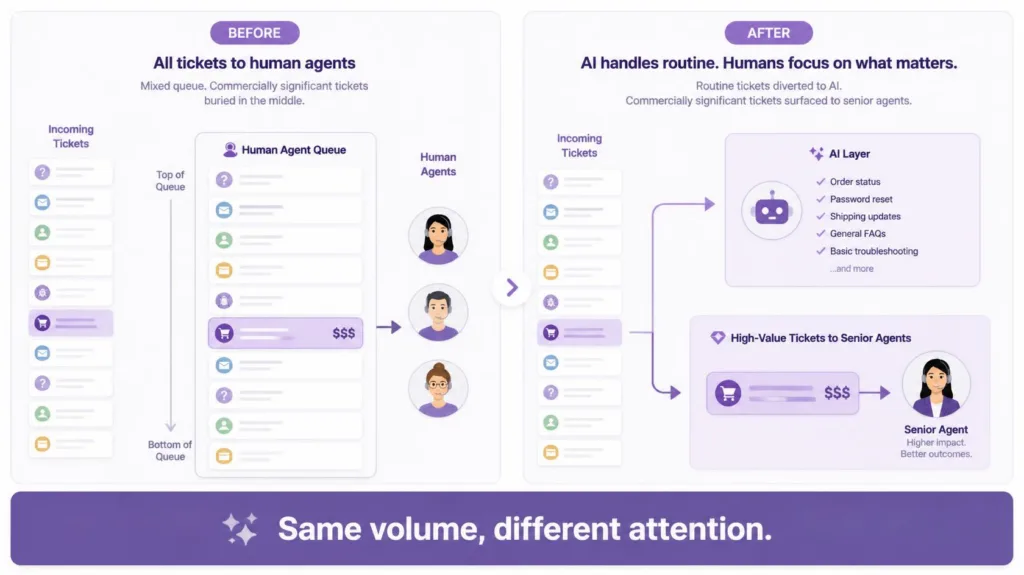
Those four hours are where a security questionnaire gets turned around same-day and a blocked trial user gets unblocked in an hour. Kay, Kayako’s AI support agent, resolves repetitive tickets autonomously, plugs into your existing helpdesk through the API without a migration, and prices against tickets actually resolved rather than seats.
The self-service layer matters for the same reason. A Gartner survey of 265 customer service and support leaders conducted in April and May 2025 found live chat, self-service portals, and knowledge management consolidating as the essential tools for scalable support, and expected to overtake phone and email in value by 2027. For buyers doing most of their evaluation independently, a deep help centre is a sales asset. Prospects read your documentation before they read your pricing page, which makes knowledge base best practices a pipeline concern rather than a support one.
See how Kay frees your team for the conversations that convert
Measuring It, and the Mistakes to Avoid
Four metrics tell you whether any of this is working.
Time to first substantive response on inbound from unknown contacts, measured separately from your general first-response time. Substantive means an actual answer rather than an acknowledgment.
Turnaround on security and compliance requests, tracked as its own SLA.
Trial ticket resolution time, with conversion rate attached so you can see the relationship.
Signals routed to pipeline, counted monthly.
The failure modes are predictable. Turning support agents into a quota-carrying channel, which destroys the trust that made support valuable in the first place. Measuring the support team on a pipeline they cannot control. Over-automating the tier where commercial questions arrive, so a prospective buyer asking about enterprise pricing gets stuck in a bot loop. Letting security documentation sit with whoever has time. And treating cycle compression as the only goal, when a shorter cycle at a lower win rate is worse than what you started with.
Accelerating the Part of the Deal You Are Not Watching
If buyers form a preference before contacting you, and nearly all of them have prior experience with a shortlisted vendor, then the experience your support organization delivers is a sales acceleration function whether or not anyone has labeled it one.
The work is concrete. Define which support questions constitute commercial signals and route them without transferring the customer. Put security and compliance requests on a clock. Give trial tickets their own queue and your best agents. Automate the routine volume so that capacity exists at all. Then measure first substantive response time, compliance turnaround, and signals converted, and report those numbers in the same review where pipeline gets discussed.
That is a cheaper set of changes than most acceleration tooling, and it operates on the part of the buying process where the decision is actually made.
Frequently Asked Questions About Sales Acceleration
What is the difference between sales acceleration and sales enablement?
Enablement equips reps with content, training, and tooling to sell more effectively. Acceleration targets the elapsed time between interest and closed revenue, which includes periods when no rep is involved. Enablement is a subset of acceleration, and the two get conflated because most vendors in the category sell enablement tools.
Which sales acceleration metrics actually matter?
Cycle length by segment, stage conversion rates, and time to first substantive response are the core three. Add turnaround time on security and compliance requests if you sell to mid-market or enterprise buyers, since those reviews frequently sit on the critical path and rarely appear in sales dashboards.
Should support agents be given sales targets?
No. Quota-carrying support agents lose the neutrality that makes their advice credible, and customers detect the change quickly. Route commercial signals to people who own deals, and measure agents on detection and routing rather than on revenue.
How much can support realistically compress a sales cycle?
It varies by deal size and how much of your cycle is consumed by technical evaluation and procurement. Where security reviews, integration questions, and trial support sit on the critical path, the addressable time is substantial. Where deals are small and self-serve, the compression comes from documentation quality rather than from response speed.
Does sales acceleration reduce deal quality?
Only when it is pursued as cycle compression alone. Track win rate and average deal size alongside cycle length. If cycles shorten while either of those declines, the program is disqualifying deals rather than accelerating them, and that distinction is easy to miss on a dashboard showing only velocity.