Build a practical B2B customer service strategy that improves retention, reduces churn, strengthens client relationships, and helps support teams scale efficiently.
Every B2B company already runs on a customer service strategy. Most just never wrote it down, and the informal version that works at 100 accounts breaks at 1,000. This guide gives you an 8-step framework to design a B2B customer service strategy for 2026 that holds up as you scale.
Every B2B company already runs on a customer service strategy. The unspoken rules about who answers a key account, how fast a critical issue gets fixed, and what happens when a renewal wobbles are a strategy, whether anyone planned it or not. The real question is not whether you have one. It is whether the one you have was designed on purpose or simply happened by default.
The trouble starts when you grow. As Front puts it, a customer service strategy is the set of decisions governing how conversations get captured, routed, and resolved, and the informal version only holds up in ideal conditions. What quietly works at 100 accounts breaks at 1,000. The gap is wide. Fin reports just 14 percent of B2B decision-makers believe they deliver a top-tier customer experience, which means the other 86 percent have room to win. This guide gives you an 8-step framework to design a B2B customer service strategy for 2026 that holds up as you scale. And in case you were looking to start with the basics, head over to our guide to B2B customer service.
What Is a B2B Customer Service Strategy
A B2B customer service strategy is the complete system of decisions for how your company supports its business accounts across the entire relationship. It is not a ticket handling policy or a set of canned replies. It is the operating logic that connects your people, channels, data, and metrics to a single goal: keeping and growing the accounts you have already won. In practice, it answers a few hard questions in advance: who owns each account, how quickly different issues get resolved, and how a routine support interaction becomes a reason to renew rather than a reason to look elsewhere.
That makes it different from a B2C strategy in kind, not just degree. Zoom describes B2B service as strategic and personalized, woven into a long relationship rather than triggered by a one-off complaint. You are serving a buying committee, not a single shopper. You are accountable to a contract, not a return window. And the same account can come back to you for years, so every interaction is an investment in the next renewal. A real strategy makes those investments deliberate instead of accidental.
Why a B2B Customer Service Strategy Matters
Without a strategy, support stays reactive, and reactive support leaks money. Tickets get answered, but accounts still churn, expansion stalls, and no one can say why. A strategy turns that same team into a growth engine by making retention, expansion, and referrals the point of the work. Done right, your most satisfied accounts also become your cheapest growth channel, referring peers and expanding their own contracts without a sales push.
The economics are blunt. Clarity finds that winning a new B2B customer costs 5 to 7 times more than keeping an existing one, that lifting retention by just 5 percent can raise profit by 25 to 95 percent, and that around 72 percent of B2B revenue comes from customers you already serve. Strong service is how you protect that base. Techforce argues the differentiator is trust that goes beyond an SLA, built through transparency rather than promises. Tie it together, and the case is simple. A deliberate strategy lifts net revenue retention and slows churn, which together decide whether your customer lifetime value compounds or erodes.
How to Build a B2B Customer Service Strategy in 8 Steps
Here is the framework. Each step is a decision to make, a reason it matters, and a way to execute it. Work through them in order, because each one builds on the last.
Step 1: Set the service vision and tier your accounts
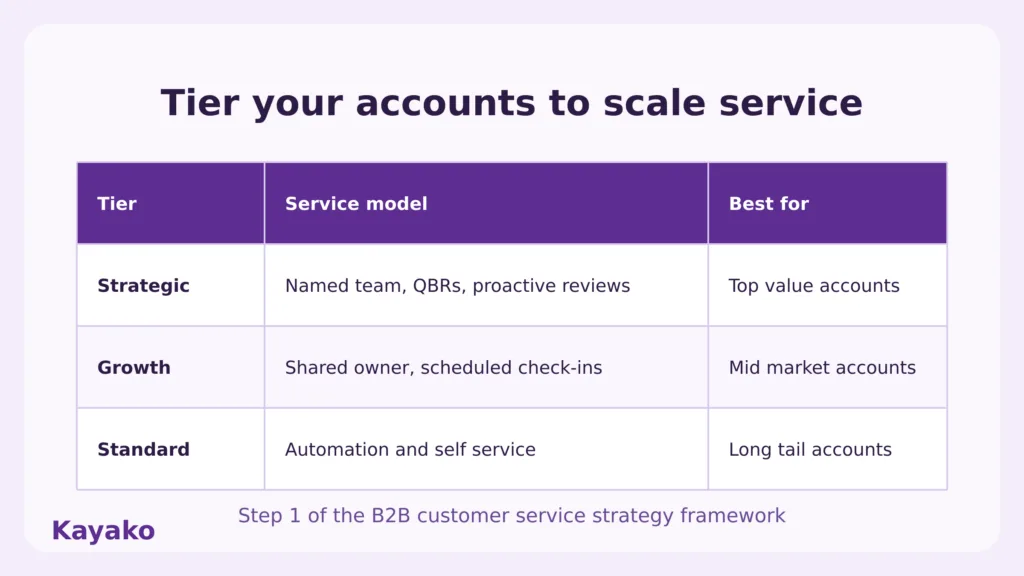
Start by naming the experience you want every customer to have, then accept that you cannot deliver it identically to everyone. Resources are finite, so concentrate the relationship-intensive ones where they protect the most revenue. Segment accounts by value and complexity into a few clear tiers, perhaps strategic, growth, and standard, and define what service each tier receives. A seven-figure account earns a named team and proactive reviews. A long tail account is served efficiently through automation and self-service. The vision sets the ceiling. The tiers decide where you spend to reach it. Write the standard for each tier on a single page, so every team knows exactly what a strategic account receives that a standard one does not, and so the promise survives a change in staff.
Step 2: Map the B2B customer journey and the moments that matter
Your customers do not experience your org chart. They experience a journey. KPMG frames a B2B life cycle that runs from pre-purchase through purchase, onboarding, the ongoing relationship, and renewal, and it identifies the moments that matter at each stage. Map yours and mark two kinds of moments: the trust-building ones, like a flawless onboarding, and the failure points, like a missed go-live or a silent renewal. Those moments carry far more weight than the average ticket. Design your strategy around getting them right, because they are where relationships are won or quietly lost. Rank the moments by how strongly they predict renewal, then put your best people and your clearest playbooks on the few that carry the most weight.
Step 3: Choose your channel mix and ownership model
Decide how customers reach you and, just as important, who owns the relationship. The channel mix usually blends dedicated account managers, phone, email and ticketing, live chat, AI, and self-service, ideally stitched into one omnichannel experience so context never resets. Then pick an ownership model. KPMG describes three: a sole relationship manager, a manager plus a support team, or a full account team, and notes the model you choose has a measurable effect on satisfaction. Match the model to the tier. Strategic accounts get a team, standard accounts get a streamlined path, and nobody falls through the gap between channels. Set routing rules that send each tier to the right owner automatically, so the ownership model holds even on your busiest day rather than depending on whoever happens to grab the ticket.
Step 4: Set SLAs and escalation paths by tier
In B2B, service levels are often contractual, so vague intentions will not do. Define response and resolution targets by priority and by tier, so a production outage for a strategic account and a minor question from a standard one are never treated the same. Just as important, map the escalation paths. When an issue moves between teams, ownership has to move with it, or context gets dropped at the handoff. Fragmented handoffs across teams and channels quietly degrade the experience in multi-team operations. Write the SLAs down, build them into the tool, and make sure every escalation has a named owner at each step. Then review attainment by tier every month, and treat a repeated miss on a strategic account as an early renewal risk rather than a reporting footnote.
Step 5: Build the data foundation
Everything account-aware depends on one thing: a unified customer record. When support, CRM, and customer success each keep their own version of the truth, your strategy runs on fragments. The agent on a billing ticket should see the same history the account manager sees, across every channel. This is the SingleView principle, and it is the precondition for personalization, routing, and automation alike. Salesforce found that a unified data strategy makes a successful AI rollout 1.4 times more likely, and that 88 percent of service leaders now prioritize connecting their tools. Get the record right first. Without it, every later step runs on guesswork. Fragmented data also shows up to the customer, who has to repeat their history on every ticket, which is exactly the friction a good strategy exists to remove.
Step 6: Deploy AI and automation for scale
This is the step that lets a strategy scale without a matching rise in cost. Use AI to resolve tier one volume autonomously: the order statuses, invoice copies, and routine troubleshooting that consume most of a team’s hours. Layer in AI triage to route the rest, and proactive health monitoring to flag risk before a customer complains. This is the Agent Kay principle: automation that runs on the full account record, not a single ticket. Done well, AI keeps your cost to serve roughly flat even as accounts and ticket volume grow, which is exactly what a scaling strategy needs. Start with the highest volume, lowest risk ticket types, prove the resolution quality on those, then widen the scope as confidence grows. For the tooling side, see our guide to helpdesk automation tools.
Step 7: Define metrics and feedback loops
Measure what predicts renewal, not what is easy to count. Track account-level net promoter score, customer effort score, time to resolution on critical tickets, and account health, and watch them at the account level rather than the aggregate. Then close the loop in writing. When a customer’s feedback changes something, tell them. Clarity notes that predictive analytics can flag an at-risk account more than 90 days before its renewal, which is enough time to act. Metrics without a feedback loop are a dashboard. Metrics with one are a strategy that learns. Review the numbers on a fixed cadence with the people who can act on them, so a signal becomes a change the customer can actually feel rather than a chart nobody opens.
Step 8: Align and train sales, support, and success
A strategy fails the moment teams pull in different directions. Give sales, support, and success a shared record and, where you can, shared incentives tied to retention and expansion. Train your team on each major account’s business, not just your product, so they can judge what a problem actually costs the customer. And run Zoom-style quarterly business reviews, where dedicated managers walk strategic accounts through value delivered and what comes next. When support feeds insight back to sales and product, it stops being a help desk and becomes commercial intelligence. Break the silo on purpose, with shared dashboards and joint account reviews, because a strategy only scales when every team is reading from the same page about the same customer.
B2B Customer Service Strategy Frameworks
If you want a named model to anchor the eight steps, two are worth borrowing. The first is the McKinsey three-element customer experience model, summarized for B2B by Thinkstack: translate a clear vision into a roadmap, enable the frontline teams who deliver it, and transform the experience across whole journeys rather than single touchpoints. That maps neatly onto Steps 1, 8, and 2.
The second is the KPMG Six Pillars of experience: Personalization, Integrity, Expectations, Resolution, Time and Effort, and Empathy. Use them as a checklist for the moments you mapped in Step 2. Personalization and Integrity build trust early, Expectations and Resolution govern how you handle SLAs and escalations, and Time and Effort and Empathy decide whether customers feel served or processed. Pick the model that fits how your team thinks. Both turn a list of steps into a coherent philosophy. Whichever you adopt, revisit it once a year, because the moments that matter shift as your product matures and your customers raise their expectations.
How AI Fits Into a Modern B2B Customer Service Strategy
Treat AI as a strategic layer, not a bolt-on. The old approach added a chatbot to deflect a few questions. The modern approach uses agentic AI that reads the account record, resolves requests autonomously, and surfaces expansion signals back to your team. Assist mode, where AI drafts and a human approves, is now the floor. Autonomous resolution is the target.
The trajectory is clear. Salesforce reports AI resolved about 30 percent of cases in 2025 and projects 50 percent by 2027. Salesforce Ben adds that reps working alongside AI spend 20 percent less time on routine cases, drive a 15 percent lift in upsell, and that the underlying AI is reaching roughly 93 percent accuracy. Fin describes the leap plainly: agentic AI that completes multi-step workflows across systems, instead of a keyword bot that hands off the moment things get hard. In a 2026 strategy, AI is what holds service quality steady while your account base grows. The strategic question is no longer whether to adopt AI, but which tier one journeys to hand it first and where the human handoff must stay non-negotiable.
Examples of Strong B2B Customer Service Strategies
The framework is easier to see in companies that live by it. Salesforce ties support to account value, giving its largest customers dedicated technical account managers while routine questions flow to scaled channels, a clean expression of Steps 1 and 3. Slack built part of its reputation on proactive incident communication, telling customers about issues before the queue fills up, which is Step 2 and Step 6 in practice. HubSpot structures support by plan and pairs it with deep self-service, so each tier gets the right level of help, mirroring Steps 1 and 4.
The common thread is consistency. None of these companies improvised. They executed a deliberate strategy with discipline, and their customers feel it as a relationship rather than a series of tickets. Techforce describes a logistics provider that won trust with an open-book dashboard, letting customers see status for themselves and removing the friction of chasing updates. The lesson repeats across all three: the strategy itself stays invisible to the customer and shows up only as an experience that simply works. For more examples mapped to this playbook, see our B2B customer service guide.
B2B Service Strategy Case Studies Across Sectors and Regions
Strategy looks different across industries and markets, and the strongest companies adapt it to local reality rather than copying a template. The three examples below span transport, industrial energy, and logistics across three continents, and each maps back to a specific step in the framework.
Uber, India, transport. Facing local rivals and tax complexity, Uber moved its auto rickshaw service to a software as a service model, as TechCrunch reported. Uber now acts purely as a platform connecting riders with independent drivers, charging a small daily fee rather than a per-trip commission, with fares paid directly in cash or UPI. It is a deliberate choice about ownership and channel, Step 3 of the framework, reshaped for the Indian market. Amazon made a similar localization call years earlier, building cash on delivery and a dense local last-mile network to serve a market where card payments were rare, a Step 1 vision tailored to the country rather than imported from the West. The lesson for any B2B leader is the same: your ownership and channel model should reflect how your market actually pays, communicates, and builds trust.
Schneider Electric, France and global, industrial energy. Operating in more than 100 countries, Schneider built a common customer experience foundation that local teams can customize, as its Genesys story details. The program harmonized tools across markets, increased self-service, added automation, and unified channels into a single omnichannel hub, then surfaced it through a personalized customer and partner portal. That is Steps 1, 3, and 5 executed at industrial scale, one global standard with room for local needs. The payoff is a consistent experience for a multinational customer in any country, without forcing every region onto an identical script.
Maersk, Denmark and global, logistics. In shipping, the biggest source of customer effort is chasing the status of a container. Maersk answered with a visibility layer, a single source of truth for every shipment, so customers can plan around their cargo instead of calling a rep. Every self-service check is one less ticket and one more unit of trust. That is Step 2 and Step 5 in action: map the moment that matters, then build the data foundation that resolves it before it becomes a complaint. For a global logistics business, that single change removes thousands of routine status calls and frees the team for the exceptions that genuinely need a human.
Metrics to Measure Your B2B Customer Service Strategy
A strategy you cannot measure is a guess. Track a focused set of metrics that prove whether the relationship is healthy and whether the strategy is working. Account-level net promoter score shows whether decision-makers would recommend you. Customer effort score shows how hard it was to get help. Customer satisfaction, time to resolution on critical tickets, your autonomous resolution rate, account health, and net revenue retention round out the picture.
Benchmark against rising expectations. Zendesk data shows customers increasingly judge service on speed and resolution, and HubSpot reports 67 percent expect a resolution within three hours. Watch these at the account level, not just the aggregate, because one unhappy strategic account can outweigh a hundred satisfied small ones in revenue. Measure the few numbers that predict renewal, and let the vanity metrics go. A tight scorecard also makes the strategy legible to leadership, which is how service work earns the budget and the headcount to keep improving.
A strategy acts as a guideline to align a company’s ethos, personnel, resources, and the intent of ever-improving customer experience. Without it, the focus and finance lose purpose over time. We hope that we were able to assist you with a thing or two with our customer service strategy focus write-up, because a healthy business outlook is a goal we all want to tick off.
Frequently Asked Questions
What is a B2B customer service strategy?
It is the complete system of decisions for how a company supports its business accounts across the whole relationship, covering vision, account tiers, channels, SLAs, data, AI, metrics, and team alignment. It is the operating logic behind retention and expansion, not a ticket-handling policy. Our B2B customer service guide covers the foundations.
How do you build a B2B customer service strategy?
Work through eight steps: set the vision and tier accounts, map the journey and the moments that matter, choose your channel mix and ownership model, set SLAs by tier, build a unified data foundation, deploy AI for scale, define metrics and feedback loops, and align sales, support, and success around a shared record. Treat the eight steps as a loop rather than a one-time project, and revisit them as your account base grows.
What frameworks work for B2B customer service strategy?
Two are widely used. The McKinsey three-element model moves from vision to roadmap, to frontline enablement, to transformation across journeys. The KPMG Six Pillars- Personalization, Integrity, Expectations, Resolution, Time and Effort, and Empathy- work as a checklist for the moments that matter most.
What metrics measure a B2B customer service strategy?
Account-level NPS, customer effort score, time to resolution on critical tickets, autonomous resolution rate, account health, and net revenue retention. Track them at the account level, since a single strategic account can outweigh many small ones in revenue.
How does AI fit into a B2B customer service strategy?
As a strategic layer, not an add-on. Agentic AI reads the account record, resolves routine tickets autonomously, and surfaces expansion signals. With Salesforce projecting half of all cases handled by AI by 2027, the mature model is hybrid: AI clears tier one volume, and humans take the complex, high-stakes cases.